FAO Home Agriculture Land Water WAICENT FAO Search    Français Español

Home
Introduction
Database
-
Acid soils
Calcareous soils
Histosols
Salt-affected soils
Sandy soils
Steeplands
Vertisols
-
Archive
Links
Literature
-
-
-
Land & Water Home
-
News
Highlights
Events
-
Portals
Information Systems
Special Topic Sites
On-line Documents
Publications
Digital Media Series
Newsletter
-
Sitemap
Links
Search AGL Site
-
People
Contacts


Sandy Soils


Definition

In the context of agricultural problem soils, sandy soils are soils in which a coarse texture dominates the problems related to agricultural land use.  Sandy soils are characterized by less than 18% clay and more than 65% sand in the first 100 cm of the solum.  In the World Reference Base (WRB) soil classification system sandy soils may occur in the following Reference Soil Groups: Arenosols, Regosols, Leptosols and Fluvisols.  In the following the focus is laid on the consideration of Arenosols as the main Reference Group for actual "sandy" soils.

Further description

Sandy soils are weakly developed soils with only weak profile horizon formation because of the slow chemical weathering in these normally dry and hot soils.  Physical weathering predominates in response to extreme variations in temperature.  Wind erosion is dominant.  The A-horizon is only weakly developed and can hardly be seen in a desert sandy soil, but becomes more distinct in the semi-arid sandy soils.  Soil structure is very weak and unstable.  Absence of vegetation cover results in an extremely low production of organic material which leads to the very low organic matter contents of sandy soils.  However, the actual soil moisture content of the sandy soils determines the rate and duration of the chemical reactions, the production of organic matter and biological activity.

General environment

Regions of sandy soils can be divided in two broad categories: residual sands, formed upon weathering of old, usually quartz-rich soil material or rock (normally under tropical conditions) and shifting or only recently deposited sands, e.g. in deserts and beach lands where sand accumulates by the selective action of wind and water.  Arenosols may occur from arid to (per)humid and from extremely cold to extremely hot climates;  related land forms vary from recent dunes, beach ridges and sandy plains under a scattered (mostly grassy) vegetation to very old plateaux under a light forest.

Global extent and location

Arenosols cover some 900 million hectares (see table), mainly in the dry zone, i.e. in the southern Sahara, Southwest Africa and western Australia (see figure).  Several million hectares of highly leached Arenosols are found in the perhumid tropics, notably in South America and in parts of Southeast Asia.  Small areas of (young) Arenosols may occur in all parts of the world.

Land use

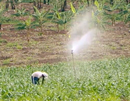
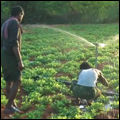
Many sandy soils are non-used wastelands.  Sandy soils in the dry zone may be used for extensive grazing but with irrigation also arable cropping is possible.  In temperate areas mixed arable cropping and grazing is practised but often supplemental (sprinkler) irrigation is needed during dry spells.  In the perhumid tropics sandy soils are chemically exhausted and highly sensitive to erosion and therefore demand cautious management if used for agriculture.

Main production constraints

The course texture of sandy soils causes a low water holding capacity and high infiltration rate which represent the main production constraints.  Nutrients contents and nutrient retention are normally low, thus causing a low inherent fertility status for agricultural production.  Nutrients are easily leached out of the solum.  The poor soil structure makes the soils very susceptible to wind erosion.  However, sandy soils can be very productive when appropriate management is applied and water is available for crop cultivation by means of irrigation or because of a shallow water table.

Summary

The agricultural potential of sandy soils depends on the availability of sufficient water for crop cultivation and the provision of nutrients.  If appropriately managed sandy soils can be highly productive.

[ Top of page - FAO Home - Agriculture - Land - Water - WAICENT - FAO Search ]

© FAO, AGL (2000)    Contact web master    Last update: 21 August 2000
<%Conn.close%>