


We cannot end hunger and poverty without empowering both men and women in agrifood systems.
Today, agriculture and food systems face an unprecedented array of challenges. We must feed a growing global population in a context of emerging and persisting crises - economic, energy, environmental, food and social. These include conflicts, natural disasters, price volatility, market insecurity, mass migrations, health crises, and more, all of which are exacerbated by climate change, depletion of natural resources, rapid urbanization, shifts in dietary patterns and livelihood systems.
Faced with these challenges, it is more important than ever to build inclusive, sustainable and resilient agrifood systems, so that the agricultural sector can perform to its full capacity and become more efficient. FAO recognizes that in order to achieve this, we must address the persisting inequalities that effect the underperformance of the agriculture sector in many countries. We need to work with and empower rural women, men, girls and boys.
The Year will spotlight the essential roles women play across agrifood systems, from production to trade, while often going unrecognized. Women farmers are central to food security, nutrition and economic resilience.

Commit to Grow Equality (CGE) is a global initiative launched by FAO to accelerate gender equality and women’s empowerment in agrifood systems through financing, partnerships and action.
Latest Publications

Publications
Voluntary Guidelines on Gender Equality and Women’s and Girls’ Empowerment in the Context of Food Security and Nutrition (Pocket essentials)
05/06/2026
The guidelines explore and address the systemic barriers and the multiple challenges that women and girls face in food security and nutrition, providing...

Publications
Women’s empowerment farmer business school manual
01/05/2026
This manual provides practical guidance for practitioners, facilitators and policymakers on how to design, implement and scale WE-FBS, including tools,...
Latest Multimedia
Video
Her land, her strength: Women farmers cultivating change in Egypt
15/04/2026
In celebration of the International Year of the Woman Farmer (IYWF) 2026, this short documentary shines a light on the resilience, innovation, and determination...
Video
#shefeedcambodiapodcast: International Day of Women and Girls in Science 2026
31/03/2026
A special #shefeedscambodia podcast episode marking International Women’s Day 2026, highlighting how women across Cambodia are leading change in agriculture,...
E-learnings

E-learning
Voluntary Guidelines on Gender Equality and Women’s and Girls’ Empowerment in the Context of Food Security and Nutrition
01/10/2025
This course explores the “CFS Voluntary Guidelines on Gender Equality and Women’s and Girls’ Empowerment in the Context of Food Security and Nutrition”,...
.tmb-th600x400.jpg?sfvrsn=6165c0b9_1 "dsc_2763-(1)")
E-learning
Integrating gender equality and social inclusion in national drought management planning
01/01/2025
This course targets professionals, technicians and decision makers from relevant ministries, research institutes, and national institutions operating...

E-learning
Empower women to engage in responsible investment in agriculture and food systems
01/11/2024
This course analyses the gender gap in agrifood systems, particularly the reasons why women are disadvantaged compared with men in starting and expanding...

E-learning
Gender-responsive, disability- and socially-inclusive water resource management
17/04/2024
This course provides an understanding of key concepts, terminology, practical tools and processes for incorporating gender equality, disability and...

E-learning
Addressing gender equality in climate change adaptation and mitigation in agriculture
01/12/2023
The course aims at facilitating the exchange of promising approaches, tools and good practices that can be used by parliamentarians and policymakers...

E-learning
Gender-Responsive budgeting for agriculture and climate policies
01/12/2023
This course aims to support parliamentarians in ensuring that adequate financial resources are allocated to achieve food security and gender...

E-learning
Building equitable and inclusive agrifood systems
01/12/2023
This course is intended to strengthen the knowledge and competencies of parliamentarians and policymakers on the relevance of gender issues in agrifood...
E-learning
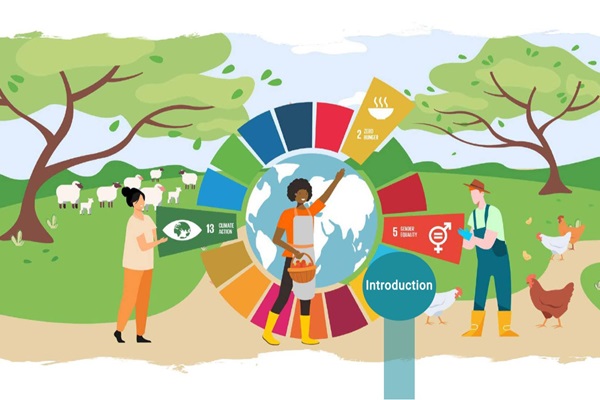
Introduction: Achieving gender equality in climate change and agrifood systems
01/12/2023
This introduction will bring in the most critical issues affecting gender equality and explain why they are important for building inclusive and...

E-learning
Fish loss assessment methods
01/11/2023
This course presents the set of methods available for assessing losses in the fish value chain.

E-learning
Social analysis for inclusive agrifood investments – Introduction
01/11/2023
This is an introduction to a series of three courses designed to provide a diverse audience with the approaches, methods and tools necessary to integrate...

E-learning
Social analysis for inclusive agrifood investments – Practitioners
01/11/2023
In particular, this course provides guidance to practitioners on how to conduct social analysis to enhance the inclusiveness of agrifood investments....

E-learning
Social analysis for inclusive agrifood investments – Field experts
01/11/2023
This course aims to assist social analysts/field practitioners in generating primary data, using qualitative methods that can help to draw a detailed...

E-learning
Social analysis for inclusive agrifood investments - Managers
01/11/2023
This course targets managers of agrifood investment operations (project directors, coordinators, team leaders, task managers) who make decisions about...

E-learning
Minimum dietary diversity for women
01/09/2023
This course has been designed to explain how to use the Minimum Dietary Diversity for Women (MDD-W) indicator, with a view to contributing to improved...

E-learning
Securing women’s land rights in the context of agricultural investment
01/07/2023
This course focuses on gender and land issues in the context of agricultural investment. It provides concrete guidance on strategies, approaches and...

E-learning
Enabling women producers’ successful engagement in agribusiness
01/07/2023
This course looks closely at the gender issues that are central to the substantially lower rate of engagement of women farmers, compared with men, in...
E-learning
Building a gender-responsive policy and legal framework for agricultural investment and supply chains
01/07/2023
This course focuses on gender issues and the policy and legal framework for agricultural investment and supply chains. It provides concrete guidance...

E-learning
Making agricultural investment and supply chains work for women and men
01/07/2023
This introduction clarifies the rationale and scope of the e-learning series, the target audience it was designed for, and the different courses that...

E-learning
Fostering decent wage employment for women and men
01/07/2023
This course analyses gender issues that should be addressed to foster gender-equitable decent wage employment in agriculture. It provides concrete guidance...

E-learning
Developing gender-sensitive value chains
01/05/2020
The development of sustainable food systems is a key component of the 2030 Agenda for Sustainable Development. This course discussed why eliminating...

FAO Policy on Gender Equality 2020-2030
Gender equality is essential to achieve FAO's mandate of a world free hunger, malnutrition and poverty. The Organization recognizes that persisting inequalities between women and men are a major obstacle to agriculture and rural development and that eliminating these disparities is essential to building sustainable and inclusive food systems and resilient and peaceful societies.
Related links
- Commit to Grow Equality
- Gender | Policy Support and Governance Gateway
- Gender mainstreaming | Integrating Agriculture in National Adaptation Plans (NAPs)
- FAO Gender-Lex
- Fisheries and Aquaculture | Gender equality in fisheries and aquaculture
- Rural Transformation and Gender Equality Division (ESP)
- Rural women | Family Farming Knowledge Platform
- Technical Cooperation Programme
- UN Joint Programme on Rural Women’s Economic Empowerment - JP RWEE