FAO Home Agriculture Land Water WAICENT FAO Search    Français Español

Home
Introduction
Database
-
Acid soils
Calcareous soils
Histosols
Salt-affected soils
Sandy soils
Steeplands
Vertisols
-
Archive
Links
Literature
-
-
-
Land & Water Home
-
News
Highlights
Events
-
Portals
Information Systems
Special Topic Sites
On-line Documents
Publications
Digital Media Series
Newsletter
-
Sitemap
Links
Search AGL Site
-
People
Contacts


Vertisols


Definition

Vertisols are dark montmorillonite-rich clays with characteristic shrinking/swelling properties.  This group of soils with a high clay content (>30% to at least 50 cm from the surface) and in dry state with typical cracks which are at least 1 cm wide and reach a depth of 50 cm or more, are often also called heavy cracking clay soils. Vertisols are a Reference Soil Group of the World Reference Base (WRB) soil classification system.

Further description

Vertisols owe their specific properties to the presence of swelling clay minerals, mainly montmorillonite.  As a result of wetting and drying, expansion and contraction of the clay minerals take place.  Contraction leads to the formation of the wide and deep cracks.  The cracks close after rain when the clay minerals swell.  During expansion of the clay minerals high pressures are developed within these soils, causing a characteristic soil structure with wedge-shaped aggregates in the surface soil and planar soil blocks in the subsoil.  The slippage of one soil block over the other leads to the formation of typical polished surfaces, "slickensides" on the blocks.  Expansion and contraction also cause the formation of micro-topographic features known as "gilgai", a distinctive microrelief of knolls and basins that develops by internal mass movements in the soil and heaving of the underlying material to the surface.

General environment

Vertisols occur principally in the soils of hot environments with marked alternating wet and dry seasons.  Vertisols are generally found on sedimentary plains, both on level land and in depressions.  Smaller areas of Vertisols are found on hill slopes and piedmont plains.  The natural climax vegetation is savannah grassland and/or woodland.

Global extent and location

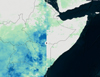
Vertisols cover a total of about 340 million hectares (see table).  Most Vertisols occur in the semi-arid tropics, mainly in Africa (the Gezira and other parts of central Sudan, South Africa, Ethiopia, Tanzania), Asia (the Deccan plateau of India) and Australia (see figure).

Land use

Main parts of the Vertisol regions are used for low intensity grazing.  Where irrigation is possible or in more humid environments arable land use is possible and shows a considerable potential for agricultural production.

Main production constraints

Vertisols are difficult to work:  they are of very hard consistence when dry and very plastic and sticky ("heavy") when wet.  Therefore the workability of the soil is often limited to very short periods of medium (optimal) water status.  However, tillage operations can be performed in the dry season with heavy machinery.  Mechanical tillage in the wet season causes serious soil compaction.  Really wet land is impassable.
Vertisols are imperfectly to poorly drained, leaching of soluble weathering products is limited, the contents of available calcium and magnesium are high and pH is above 7.  This is due to the very low hydraulic conductivity of a Vertisol:  once the soil has reached its field capacity, practically no water movement occurs.  Flooding can be a major problem in areas with higher rainfall.  Surface water may be drained by open drains.  Mole drainage is virtually impossible.
Vertisols are chemically rich and are capable of sustaining continuous cropping.  They do not necessarily require a rest period for recovery; because the pedoturbation continuously brings subsoil to the surface.  However, the overall productivity normally remains low, especially where no irrigation water is available.  Nitrogen is normally deficient as well as phosphorus.  Phosphate fixation (as tricalcium phosphate) may occur but is not a major problem.  Potassium contents are variable.  Secondary elements and micronutrients are often deficient. In semi-arid areas free carbonate and gypsum accumulations are common.  Saline and sodic Vertisols may develop under irrigation, but they are rare under natural conditions.
Vertisols differ in surface characteristics and these strongly influence their reaction to soil tillage operations. There are two broad groups:

  • the self-mulching Vertisols.  These have a fine (granular or crumb) surface soil structure, 2-30 cm thick, during the dry season.  This fine tilth is produced by desiccation and soil shrinkage.  When such soils are ploughed, the clods, after being subjected to repeated wetting and drying, disintegrate.  When this mulch is well developed, seedbed preparation is hardly necessary;
  • the crusty Vertisols.  These have a thin, hard crust in the dry season.  When ploughed, crusty Vertisols produce large, hard clods that may persist for 2 to 3 years before they have crumbled enough to permit the preparation of a good seedbed.  Such soils require mechanical tillage if they are to be cultivated.


The structural stability of Vertisols remains low. They are therefore very susceptible to water erosion.  Slopes above 5 per cent should not be used for arable cropping, and on gentler slopes contour cultivation with a groundcover crop is advisable.  When terracing, sufficient surface drainage must be provided to avoid slumping.

Summary

The adverse physical properties and poor workability of Vertisols are a major obstacle to agricultural land use, especially in low-technology societies. Vertisols have a considerable potential for agricultural production but special management practices (tillage and water management) are required to secure sustained production.


[ Top of page - FAO Home - Agriculture - Land - Water - WAICENT - FAO Search ]

© FAO, AGL (2000)    Contact web master    Last update: 21 August 2000
<%Conn.close%>