India

Source: FAO Disclaimer.
Geography and population
India is located in southern Asia and has a total area of
3 287 590 km2. It is the world's largest peninsula and the
seventh largest country in the world. It is bordered in the northwest by Pakistan, in the
north by China, Nepal and Bhutan, and in the northeast by Myanmar and Bangladesh. In the
south, it has some 5 600 km of coastline on the Arabian Sea, Indian Ocean and
Bay of Bengal. The peninsula can be divided into three main regions: peninsular India,
located south of the Vindhya and Satpura mountain ranges; the plains of the Indus
(northwest) and Ganges (north and northeast) rivers; and the mountainous terrain of the
Himalayas. In addition, the Lakshadweep Islands in the Arabian Sea and the Andaman Islands
and Nicobar Islands in the Bay of Bengal are part of the territory of India. For
administrative purposes, India is divided into 25 states and 7 union territories.
The total cultivable area is estimated at 183.95 million ha, or
about 56 percent of the total area. The total cultivated area was estimated at
142.5 million ha in 1995. In the recent past, the evolution of cultivated area
has presented two distinct phases. From 1950 to 1970, the cultivated area rose by
18 percent/year, while the cropping intensity increased from 111 to
118 percent. From 1970 to 1990, the cultivated area rose by 2 percent/year while
the cropping intensity increased to 130 percent. The major cereals grown in India are
bajra (spiked millet), barley, jowar (great millet), common millet, maize, ragi, rice and
wheat. The average cereal yield increased from 522 kg/ha in 1950 to
1 457 kg/ha in 1992, i.e. an average annual growth rate of 2.5 percent. The
average farm size is estimated at 1.57 ha, and the table below presents the
distribution of landholdings in 1990-91.

India is the second most populous country in the world, with a total
population estimated at 944.58 million inhabitants in 1996 (73 percent
rural). The average density is estimated at 287 inhabitants/km2, but
varies from fewer than 50 inhabitants/ km2 in Jammu and Kashmir (northern
state between Pakistan and China), Arunachal Pradesh (northeastern state near China) and
Mizoram (eastern state between Bangladesh and Myanmar)
to more than 500 inhabitants/km2
in Uttar Pradesh, Bihar and West Bengal (northern states in the Ganges Valley),
and Kerala and Tamil Nadu (states in the extreme south of
the country). The average annual population growth rate is estimated at 2.1 percent.
Agriculture contributed about 29 percent of GDP in 1992-93. It employs more than
65 percent of the labour force and is the primary source of livelihood in rural
areas.
Climate and water resources
Climate
India has a typical monsoon climate. In this region, surface winds
undergo a complete reversal from January to July, and cause two types of monsoon. In
winter, dry and cold air from land in the northern latitudes flows southwest (northeast
monsoon), while in summer, warm and humid air originates over the ocean and flows in the
opposite direction (southwest monsoon), accounting for some 70-95 percent of the
annual rainfall. The average rainfall is estimated at 1 083 mm over the country,
but varies significantly from place to place. In the northwest desert of Rajasthan, the
average annual rainfall is lower than 150 mm/year. In the broad belt extending from
Madhya Maharashtra to Tamil Nadu, through parts of Andhra Pradesh and Karnataka, the
average annual rainfall is generally lower than 500 mm/year. At the other extreme,
more than 10 m of rain fall on the Khasi hills in the northeast of the country in a
short period of four months. On the west coast, in Assam, Meghalaya, Arunachal Pradesh
(states located in the northeast) and in sub-Himalayan West Bengal the average annual
rainfall is about 2 500 mm.
Except in the northwest of India, the interannual variability of
rainfall is relatively low. The main areas affected by severe droughts are Rajasthan,
Gujarat, Saurashtra and Kutch.
The year can be divided into four seasons:
- the winter or northeast monsoon from January to February;
- the hot season from March to May;
- the summer or southwest monsoon from June to September;
- the post-monsoon season from October to December.
Temperature variations are also marked. During the post-monsoon and
winter seasons from November to February, the temperature decreases from south to north
due to the effect of continental winds over most of the country. From March to May, the
temperature increases to some 40°C in the northwest. With the advent of the southwest
monsoon in June, there is a rapid fall in the maximum daily temperature, which then
remains stable until November. The temperature conditions are suitable for year-round crop
production in the whole of India except at higher elevations in the Himalayas.
River basins
The rivers of India can be classified into the following four groups:
- the Himalayan rivers, which are formed by melting snow and glaciers
and therefore have a continuous flow throughout the year. As this region receives very
heavy rainfall during the monsoon period, the rivers swell and cause frequent floods;
- the rivers of the Deccan plateau, which are rainfed and fluctuate in
volume, many of them being non-perennial;
- the coastal rivers, which, especially on the west coast, are short in
length with limited catchment areas, most of them being non-perennial;
- the rivers of the inland drainage basin in western Rajasthan, which
are ephemeral, drain towards the silt lakes such as the Sambhar, or are lost in the sands.
For planning purposes, the country is divided into 20 river units, 14
of which are major river basins, while the remaining 99 river basins have been grouped
into 6 river units, as presented in the table.

Rivers flowing from or to neighbouring countries
Several important river systems originate in upstream countries and
then flow to other countries: the Indus River originates in China and flows to Pakistan;
the Ganges-Brahmaputra river system originates partly in China, Nepal and Bhutan, and
flows to Bangladesh; some minor rivers drain into Myanmar and Bangladesh.
Water resources
The two main sources of water in India are rainfall and the snowmelt of
glaciers in the Himalayas. Although reliable data on snow cover in India are not
available, it is estimated that some 5 000 glaciers cover about 43 000 km2
in the Himalayas with a total volume of locked water estimated at 3 870 km3.
Considering that about 10 000 km² are located in Indian territory, the total
water yield from snowmelt contributing to the river runoff in India may be of the order of
200 km3/year. Although snow and glaciers are poor producers of fresh
water, they are good distributors as they yield at the time of need, in the hot season.
Indeed, about 80 percent of the flow of rivers in India occurs during the four to
five months of the southwest monsoon season.
The total surface flow, including regenerating flow from groundwater
and the flow from neighbouring countries, is estimated at 1 869 km3/year,
of which only 690 km3 are considered as utilizable in view of the
constraints of the present technology for water storage and inter-state issues. A
significant part (647.2 km3/year) of these estimated water resources comes
from neighbouring countries: 210.2 km3/year from Nepal, 347 km3/year
from China (Chinese data) and 90 km3/year from Bhutan. An important part
of the surface water resources leaves the country before it reaches the sea: 20 km3/year
to Myanmar, 181.37 km3/year to Pakistan (Pakistani information) and
1 105.6 km3/year to Bangladesh.
The Central Water Commission estimates the groundwater resources at
418.5 km3/year. Part of this amount, estimated at 380 km3/year,
constitutes the base flow of the rivers. The total renewable water resources of India are
therefore estimated at 1 907.8 km3/year. (Detailed water resources information for India.)
Under the Indus Water Treaty (1960) between India and Pakistan, all the
waters of the eastern rivers, i.e. the Sutlej, Beas and Ravi rivers taken together, shall
be available for the unrestricted use of India. All the waters, while flowing in Pakistan,
of any tributary which in its natural course joins the Sutlej main or the Ravi main after
these rivers have crossed into Pakistan shall be available for the unrestricted use of
Pakistan. This flow reserved by treaty is estimated at 11.1 km3/year.
India controls the flow of the Ganges River through a dam completed in
1974 at Farraka, 18 km from the border with Bangladesh. This dam was a source of
tension between the two countries, with Bangladesh asserting that the dam held back too
much water during the dry season and released too much water during monsoon rains. A
treaty was signed in December 1996, under which Bangladesh is ensured a fair share of the
flow reaching the dam during the dry season.
Dams and hydropower
The total water storage capacity constructed up to 1996 was of the
order of 250 km3, including 72.25 km3 from projects under
construction. Seven dams have a reservoir capacity exceeding 8 km3. They
are the Nagarjuna Sagar dam on the Krishna River (11.56 km3), the Rihand
dam on the Rihand River (10.6 km3), the Bhakra dam on the Sutlej River
(9.62 km3), the Srisailam dam on the Krishna River (8.72 km3),
the Hirakud dam on the Mahanadi River (8.1 km3), the Pong (Beas) dam on
the Beas River (8.57 km3) and the Ukai dam on the Tapti River (8.5 km3).
The gross theoretical hydropower potential has been estimated at
140 000 MW as installed capacity, or 84 044 MW at 60 percent
power load factor, of which 75 percent in the Himalayan rivers. According to
provisional estimates, the installed capacity was 21 645 MW in April 1997,
generating about 25 percent of the total electricity produced in India.
Water withdrawal
In 1990, the total water withdrawal was estimated at 500 km3
(27 percent of the country's actual renewable water resources), of which
91.6 percent for irrigation purposes (Figure 1). Some 19 km3 are
used for energy purposes, and some 33 km3 are reserved for environmental
and other purposes. The surface water withdrawal was 362 km3, while the
amount coming from groundwater was estimated at 190 km3.


Wastewater and desalination
Wastewater production was estimated at 25.408 km3 in
1996. Statistics on wastewater treatment in 1988 are also available for the major cities
of India, where about 0.98 km3 of wastewater was collected, of which
0.60 km3 was treated (primary and secondary treatments).
Desalination of seawater is carried out in India on a limited scale. In
1996, some 550 000 m3 of seawater were desalinated in the Lakshadweep
Islands, mainly through electrodialysis and reverse osmosis. Solar stills are also
installed on the peninsula, as in Gujarat in the northwest.
Irrigation and drainage development
Irrigation history
Traces of irrigation structures dating back 3 700 years have been found
in the state of Maharashtra. During the Mauriyan era (2 600-2 200 years ago), it is
reported that farmers had to pay taxes for irrigation water from neighbouring rivers. The
Grand Anicut (Canal) in Tamil Nadu was begun 1 800 years ago and its basic design is still
used today. In 1800, some 800 000 ha were irrigated in India. Following major
famines at the end of the nineteenth century, major irrigation canals were built, and in
1900 the Indian peninsula (including Bangladesh and Pakistan) had some
13 million ha under irrigation. In 1947, India had about 22 million ha
under irrigation. High priority has been given to irrigation with nearly 10 percent
of all planned outlays since 1950 being invested in irrigated agriculture. This has
resulted in about 0.6 million ha of new irrigated schemes being developed every
year. About US$1 500 million are invested every year in irrigation
programmes in India. Figure 3 shows the evolution of the irrigated area from 1950 to
1993.

Irrigation potential
According to the Indian definition, irrigation potential (called
ultimate irrigation potential) is estimated at 113.5 million ha. This figure
corresponds to the gross area which could theoretically be irrigated in a year on the
basis of the assumed design cropping pattern and a rainfall probability of
75 percent. This figure is generally divided into 58.5 million ha for major
and medium irrigation schemes, and 55 million ha for minor schemes, of which
40 million ha use groundwater and 15 million ha use surface water
(Figure 4). These estimates do not include additional waters which could be used for
irrigation if major interbasin transfer of water were undertaken. This project, known as
the National Perspective Project, would increase the irrigation potential up to
148.5 million ha, 10 million ha being obtained by an increased use of
groundwater, and 25 million ha by surface water. However, interbasin transfers
of water would be expensive and require water-sharing cooperation between states.

Irrigation
The area equipped for irrigation is estimated at
50.1 million ha (1993). The breakdown by state shows that irrigation is mainly
concentrated in the north of the country, along the Indus and Ganges rivers: Uttar Pradesh
(22 percent of the irrigated area), Rajasthan (9 percent) Madhya Pradesh
(9 percent) and Punjab (8 percent) (Figure 5). Another classification by
origin of water is in common use with the Indian authorities. It differentiates irrigation
from canals (34 percent, of which 97 percent are government canals), from tanks
(6.5 percent), from groundwater (53 percent, the majority being tube-wells,
generally privately owned and managed) and other or undefined sources (6.5 percent)
(Figures 6 and 7).


The development of tube-well irrigation, supported by investment in
electrification and credit provision, has been the main driving force behind irrigation
expansion and productivity improvements over the past few decades, particularly in the
northwest. Private groundwater irrigation with shallow wells serving 3-4 ha currently
appears to be the most cost-effective investment, partly because of government subsidies.
Irrigation schemes can be divided into three categories:
- major irrigation projects, with a command area in excess of
10 000 ha;
- medium schemes, with a command area between 2 000 and 10 000 ha;
- minor schemes, with a command area of 2 000 ha or less
(Figure 8).

The irrigated area in the different Federal States or Union Territories of India as established for the Map of Irrigated Areas for South East Asia adds up to 57 286 407 ha for the year 2000. Information regarding the distribution of irrigated areas can be found here.
The emphasis in irrigation development was initially on
run-of-the-river schemes. Subsequently, the need was felt for storage projects for either
single or multiple purposes. Minor irrigation projects generally have both surface water
and groundwater as sources, while major and medium projects exploit surface water
resources. In new major irrigation works, social and environmental costs (resettlement of
displaced people, loss of biodiversity in submerged areas, etc.) are taken into
consideration in a more systematic way than in the past. A case in point is the Sardar
Sarovar dam on the Narmada River, built without external financial assistance due to
resettlement terms considered too stringent by the national authorities.
Irrigation management
The main types of irrigation schemes in India are:
- the warabandi system in semi-arid and arid northwest India where
irrigation water is rationed strictly in proportion to farm area and supplied on a
predetermined rotational schedule. Farmers decide on crops according to the expected water
supply. Infrastructure and operational procedures are relatively simple;
- the shejpali systems of western and parts of central and southern
India where farmers obtain official sanction for proposed cropping patterns and are then
entitled to irrigation supplies according to crop needs. Designed at a time when
irrigation water was plentiful relative to demand, most shejpali systems are now
experiencing difficulties;
- the localization systems in parts of southern India which focus on
locational control of cropping patterns. Low-lying areas are zoned for 'wet'
crops (primarily rice and sugar cane), while higher areas are limited to irrigated
'dry' crops and more restricted water supplies. Such systems break down as
head-end farmers in 'dry' zones take more than their theoretical allocation;
- traditional field-to-field irrigation systems used mainly for rice in
parts of eastern India and some delta schemes in the south. Continuous irrigation flows
are provided, passing from field to field, generally without watercourses or field
channels. Operating rules have often evolved and been agreed through local tradition, and
where water is abundant, yields can be good. However, crop choice and cropping patterns
are limited.
A broad distinction can be made between supply-based, or crop-to-water,
systems that distribute water according to predetermined procedures and require the farmer
to respond accordingly in terms of cropping patterns and areas (such as warabandi), and
demand-based, or water-to-crop, systems that attempt to meet crop water needs (such as
shejpali). In supply-based systems, the role of the irrigation department tends to be
simpler than under demand-based systems that require the department to respond to changing
farmers' needs with more complex and flexible infrastructures and more intensive
management.
The first WUAs were established in the 1980s, and some 4 403 WUAs
had been formed by March 1997 managing an irrigated area of about 397 100 ha
under major and medium irrigation schemes. For minor irrigation schemes (mostly
tube-wells), some 10 400 WUAs had been formed managing an irrigated area of about
50 000 ha.
The aims of the WUAs are: to promote and secure distribution of water
among users; to ensure adequate maintenance of the irrigation systems; to improve
efficiency and economic utilization of water; to optimize agricultural production; to
protect the environment; and to ensure ecological balance by involving the farmers and
inculcating a sense of ownership of the irrigation systems in accordance with the water
budget and operational plan. The WUAs are formed and work on the basis of executive
instructions/guidelines laid down by each state government. There is no central
legislation or legal instrument in this regard. However, the only state which has passed
legislation exclusively for farmer participation in the management of irrigation systems
is Andhra Pradesh.
In many states, especially in the north (Uttar Pradesh, Punjab and
Haryana), the conjunctive use of surface and groundwater has been practised through canal
systems and tube-wells or dug-wells to increase the yield and general efficiency of the
water system. Water from the tube-wells, which are installed along the side of the
existing canals, is added into the canals for utilization in the canal command areas. This
practice helps prevent waterlogging but requires the adoption of good management
techniques by farmers.
The average overall water use efficiency in canal irrigation systems is
estimated at 38-40 percent.
In India, there is considerable diversity in the systems of levying
irrigation charges (water rates). Except in Assam and the northeast states which do not
levy irrigation rates, all states charge directly or indirectly for the use of irrigation
from public sources. In Andhra Pradesh and Tamil Nadu there is no separate water rate for
areas under old irrigation systems (including minor surface irrigation systems). Land
irrigation by these systems is classed as wetlands for land revenue purposes. Being more
productive, wetlands are charged at a much higher rate than drylands are. Within wetlands,
there is a further differentiation by quality of soil and irrigation source. The
difference between dry and wet assessment can be constructed as a water charge determined
on the basis of productivity impact as assessed at the time of the revenue settlement. The
last such settlement was determined more than 50 years ago and there has been no revision
in the base rates of land revenue since. However, for second and third crops raised on
wetlands using public irrigation sources, both states collect a water levy called
irrigation cess. For systems constructed since 1947, they charge separate water rates for
irrigation from public systems.
In all the other states, lands irrigated by public systems are charged
separate water rates. As a rule, these rates are levied on the area actually irrigated;
they are invariably differentiated by season and crop. In many states, the rates are
further differentiated by categories of irrigation projects to allow for differences in
the quality of irrigation as reflected in the quantum, duration and assurance of water
supplies. For example, Bihar distinguishes between perennial and non-perennial canals, and
between sources which are assured and those which are not. Even more elaborate
classifications are used in Orissa and Utter Pradesh. Within this general pattern, there
are some notable variations in particular states. Thus, Orissa charges a basic water rate
on all lands within the cultivable command area of a project for the supply of water,
whether used or not, for the staple cereal crop of the area (generally paddy), and
individual water rates for non-staple crops. Bihar makes a distinction between long lease,
seasonal lease and single watering. Maharashtra and Madhya Pradesh make a distinction
between demand rate and agreement rate.
Water rates are uniform throughout the state in Andhra Pradesh,
Gujarat, Kerala, Madhya Pradesh and West Bengal. However, in Bihar, Haryana, Maharashtra,
Punjab, Rajasthan, Tamil Nadu, Tripura and Uttar Pradesh rates vary within the state from
region to region or project to project.
The water rates are higher for storage systems than for flow diversion
schemes. Similarly, the rates for canal lift irrigation are generally higher (double) than
flow irrigation when water lifting is undertaken by the government bodies. Where lifting
arrangements are made by the individual farmers, then the rate is lower than the flow
rate, as in Punjab, Haryana, Madhya Pradesh and Maharashtra.
Thus, a number of parameters are involved in setting the water rates in
different states, such as:
- recovery of cost of water:
O&M cost only as in Gujarat and Manipur,
O&M cost plus interest charges at the rate of 1 percent for
irrigation purposes;
- capacity of irrigators to pay based on:
gross earning, or net benefit of irrigation;
- water requirements of crops;
- sources of water supply;
- classification of land;
- linkage with land revenue system;
- combination of various elements stated above.
The 10th Finance Commission has adopted a norm of Rs300 (about US$8.5)
per hectare as the O&M charge for major and medium irrigation works. This norm is to
be increased by 30 percent for hill states (hilly terrain). Similarly, for minor
irrigation which includes tube-wells, the commission has adopted a norm of Rs150 (about
US$4.2) per hectare; again increased by 30 percent in hill states.
Irrigation techniques
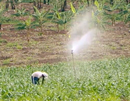
The development of sprinkler and drip irrigation in recent years has
been considerable, mainly due to the pressing demand for water from other sectors, a fact
which has encouraged governments and farmers to find water saving techniques for
agriculture.
Sprinkler irrigation was not widely used in India before the 1980s.
Although no statistics are available on the total area under sprinkler irrigation, more
than 200 000 sprinkler sets were sold between 1985 and 1996 (about 65 000 for 1995-96)
according to the National Committee on the Use of Plastics in Agriculture. The annual
growth rate of the sprinkler irrigated area in India is about 25 percent. This area
can be estimated at about 0.7 million ha in 1996. The cost of installation of
sprinkler irrigation depends upon a number of factors such as type of crop, the distance
of the water shore, spacing, and nature of terrain. The approximate capital cost
(excluding pump cost) ranges from Rs16 000 to Rs20 000 (US$450-560) per hectare.
Drip irrigation is expanding rapidly in India. This can be partly
explained by the subsidies offered by the Government to adopt drip systems. From about
1 000 ha in 1985, the area under drip irrigation increased to
70 860 ha in 1991, mainly in Maharashtra (32 924 ha), Andhra Pradesh
(11 585 ha) and Karnataka (11 412 ha). The drip irrigated crops are
mainly orchards (39 140 ha), whose main crops are grapes (12 000 ha),
bananas (6 500 ha) pomegranates (5 440 ha) and mangoes
(4 750 ha). Drip irrigation is also used for sugar cane (3 900 ha) and
coconut (2 600 ha). The average cost of drip irrigation development ranges from
US$750 to 2 000 (Rs15 000-40 000) per hectare, but a farmer can receive a
subsidy up to Rs15 000 (US$750).
Crops
Irrigation development has enabled crops to be grown all year round.
The expansion of irrigation has not only directly enabled yield increases, it has also
been the essential prerequisite for the expansion of the use of chemical fertilizers and
wheat and rice HYVs. About 56 percent of total agricultural production comes from
irrigated agriculture, which is approximately 35 percent of the net sown area.
Furthermore, the spread of irrigation has also enabled crop diversification.
The total harvested area was estimated at 66.14 million ha in
1993, which means an average cropping intensity of 1.32 on the irrigated area.
Crop yields have increased substantially, and irrigated crops produce
much more than rainfed crops (Figure 9). However, irrigated crop yields are still low
relative to yields under irrigation in other countries. This is mainly due to poor water
management on the majority of the surface command areas. Irrigation is mainly provided on
wheat (84 percent of the total area sown with wheat is irrigated), rice
(47 percent) and sugar cane (88 percent). Cotton (33 percent), pulses
(10 percent) and coarse cereals (10 percent) are also irrigated to a lesser
extent. Trends show that irrigation has been used mainly for wheat (3 million ha
irrigated in 1950; 20 million ha in 1990) and rice (10 million ha in
1950, 20 million ha in 1993), while coarse cereals and maize have not benefited
much from irrigation (Figure 10).


Drainage and salinization
Drainage works have been undertaken on about 5.8 million ha,
which is 12 percent of the irrigated area. The average cost for drainage is estimated
at US$280/ha (Rs10 000/ha). However, in the case of reclamation of soil affected by
alkalinity, the cost is estimated at the rate of US$560/ha (Rs20 000/ha). Investment
in drainage has been widely neglected, and where
such investment has been made, poor maintenance has caused many
drainage systems to become silted up. In the eastern Ganges plain, investment in surface
drainage would probably have a larger productive impact, and at a lower cost, than
investment in surface irrigation.
The total area subject to waterlogging was estimated at
6 million ha in 1976, including both rainfed and irrigated areas. This is
thought to be a substantial underestimate though precise data are lacking. Some
2.46 million ha of irrigated land are estimated to be affected by waterlogging.
Furthermore, it is estimated that out of the total irrigated area about
3.06 million ha are affected by salinity and about 0.24 million ha by
alkalinity. Based on the extrapolation of data on individual schemes, it is estimated that
on average irrigation induces salinization/waterlogging on some 10 percent (i.e.
5.8 million ha for the whole of India) of the command area (net irrigated area).
Parts of northwest India and Uttar Pradesh are affected by a build up of saline
groundwater. Measures to counter waterlogging and salinity are being taken by constructing
field channels and drains, and by encouraging the combined use of surface water and
groundwater.
According to the National Commission on Floods, the area subject to
flooding is estimated at about 40 million ha. About 80 percent of this
area, or 32 million ha, could be provided with reasonable protection. The total
area provided with reasonable protection as at March 1993 was 14.4 million ha.
Water-borne diseases have continued increasing over the years in spite
of government efforts to combat them. States such as Punjab, Haryana, Andhra Pradesh and
Uttar Pradesh have now become endemic for malaria on account of the high water table,
waterlogging and seepage in the canal catchment area. There are also numerous cases of
filariasis.
Institutional environment
Indian irrigation is dominated by the public sector. The scale of most
schemes has necessitated government funding; the O&M of most schemes also requires
public sector involvement. Government management extends to the chak level (plots of about
40 ha), and has entailed a large network of grassroots irrigation officials. The
collection of water charges also involves a substantial government apparatus. India relies
much less than many other countries on non-governmental bodies for scheme management,
although farmers' organizations are encouraged to take over the O&M of small
irrigation schemes.
Under the Indian Constitution, water is the responsibility of the
states. Thus the federal states are primarily responsible for the planning,
implementation, funding and management of water resources development. This responsibility
in each state is borne by the Irrigation and Water Supply Department. The Inter-State
Water Disputes Act of 1956 provides a framework for the resolution of possible conflicts.
At central level (responsible for water policy in the union
territories), there are three main institutions involved in water resources management:
- the Ministry of Water Resources, which is responsible for laying down
policy guidelines and programmes for the development and regulation of the country's
water resources. The ministry's technical arm, the Central Water Commission, provides
general infrastructural, technical and research support for water resources development at
state level. The Central Water Commission is also responsible for the assessment of water
resources;
- the Planning Commission, which is responsible for the allocation of
financial resources required for various programmes and schemes of water resources
development to the states as well as to the Ministry of Water Resources. It is also
actively involved in policy formulation related to water resources development at the
national level;
- the Ministry of Agriculture, which promotes irrigated agriculture
through its Department of Agriculture and Cooperation.
The Central Pollution Control Board is in charge of water quality
monitoring, and the preparation and implementation of action plans to solve pollution
problems.
Following the agreement of 19 September 1960 between India and
Pakistan, there is a joint commission for the Indus basin. Similar arrangements exist
between Nepal and India for the exploitation of the Kosi River (1954, 1966) and the Gandak
River (1959). Although an India-Bangladesh commission was set up for the regulation of the
Ganges River, it has never been operational.
Trends in water resources management
Water resources management planning should be seen in a context of
foodgrain availability. Foodgrain production increased in the 1950s and 1960s due to
increases in the cultivated area, and due to a tremendous expansion in irrigation and the
use of HYVs from the mid-1960s onwards. Irrigation has also helped reduce interannual
fluctuations in agriculture output and India's vulnerability to drought. One of the
goals of Indian policy is now to find ways of maintaining the same level of foodgrain
availability per inhabitant in a context of population increase. The development of
irrigation schemes will reach its limits at the beginning of the next century. Total water
demand will equal water availability by 2025, but industrial and domestic water demand are
expected to rise drastically at the expense of the agriculture sector which will have to
produce more with less water. Therefore, water saving techniques and improved water use
efficiency, which averaged about 40 percent in 1996, are indispensable. Emphasis has
therefore been placed on improving irrigation performance.
India adopted a national water policy in 1987 for the planning and
development of water resources to be governed by national perspectives. It emphasizes the
need for river basin planning. Water allocation priority has been given to drinking water,
followed by irrigation, hydropower, navigation and industrial or other uses. As water
resources development is a state responsibility, all the states are required to develop
their state water policy within the framework of the national water policy and,
accordingly, set up a master plan for water resources development. However, by 1996, not
much progress had been achieved by the states in this regard, and the impact of the
national water policy is still limited by the lack of institutional mechanisms to plan,
coordinate and implement water development across state boundaries and among users.
Water quality is a major issue in India. Although in their upper
reaches most rivers are of good quality, the importance of water use for cities,
agriculture and industries, and the lack of wastewater treatment plants in the middle and
lower reaches of almost all rivers cause a major degradation of surface water quality.
Groundwater is also affected by domestic, industrial and agricultural pollutants. The
overexploitation of groundwater can also lead to seawater intrusion. For example, there is
an inland advance of the saline-freshwater interface in the Chingelput district of Tamil
Nadu, where a well field along the Korttalaiyar River supplies water to the city of
Madras.
In 1992, the Central Pollution Control Board completed water quality
studies in all major river basins. The pollution control action plan of the Ganges River
basin was formulated in 1984 and has been enforced by the Ganges Project Directorate,
under the Central Ganges Authority, to oversee pollution control and the consequent
cleaning of the Ganges River. The water quality in the middle stretch of the Ganges River,
which had deteriorated to class C and D (the worst class is E, the best A), was restored
to class B in 1990 after the implementation of the action plan. A similar programme for
the Yamuna River is in the pipeline, and a national river action plan is being drawn up to
clean the heavily polluted stretches of the major rivers of the country.
India has the second largest irrigated area in the world, but due to
the rapid expansion of irrigation with its emphasis on new construction, irrigation
performance and the sector's increasing management needs have not received adequate
attention. The development impact of irrigation has been well below its potential, and
deficiencies in implementation have accumulated over time. A study by the World Bank
(1991) mentions four points for concern:
- Irrigation productivity is low. The non-optimal distribution of water
results in low yields and cropping intensity and reduced opportunities for diversifying
agriculture as do deficiencies in agricultural extension, limited research on irrigation
technology, insufficient piloting of innovations, poor project design and preparation, and
deteriorating infrastructure.
- The sustainability of irrigation investment is put in doubt by a
decline in the maintenance of infrastructure and in the quality of construction.
Rehabilitation requirements represent an increasing part of construction investment and
environmental problems are mounting.
- A sharp financial deterioration of the sector poses a threat. Lack of
control of expenditure and works in the past decade have resulted in unproductive staff
growth and wastage.
- The domination of the sector by public authorities does not leave
much room for private initiative, nor does it enable responsibilities to be allocated in
the most effective way.
Main sources of information
Central Groundwater Board. 1995.
Groundwater resources of India, p. 91.
Central Water Commission. 1988.
Water resources of India. Publication No. 38/88.
Central Water Commission. 1989.
Major river basins of India, an overview, p. 1,2 and 4.
Central Water Commission. 1990. National
register of large dams, p. 2,14,20,87 and 100.
Central Water Commission. 1991.
Themepaper on water conservation, p. 2. New Delhi.
Central Water Commission. 1993.
Reassessment of water resources potential of India, p. 12. New Delhi.
Central Water Commission. 1996.
Report of the working group on flood management for the formulation
of the ninth five year plan,p. 8.
Central Water Commission. 1996.
Water and related statistics, p. 17 and 48. New Delhi.
Department of Agriculture and Cooperation,Ministry of Agriculture. 1996.
Report of the working group on irrigated agriculture (production)
for the formulation of the ninth five year plan, p. 3.
Department of Agriculture and Cooperation, Ministry of Agriculture.
Land use statistics, part II (1991-92 and 1992-93). New Delhi.
Department of Rural Employment and Poverty Alleviation,
Ministry of Rural Areas and Employment. Annual report (1995-96), p.56. New Delhi.
FAO, Investment Centre. 1997. India: water resources sector review,
inter-sectorial water allocation, planning and management.
Draft report and six working papers.
Indian National Committee on Irrigation and Drainage (INCID). 1994.
Drip irrigation in India, p. 1,75-79, 85 and 130-141. New Delhi.
Ministry of Agriculture. 1996. Agricultural
statistics at a glance, p. 8, 80-83 and 105. New Delhi.
Ministry of Finance (Economic Division).1996.
Economic survey, 1996-97, p. 78.
Ministry of Water Resources. 1991. Report of working group
on problem identification on irrigated areas with suggested remedial
measures, p. 121. New Delhi.
National Institute of Urban Affairs. 1994-95.
Handbook of urban statistics, 1995, p. 91.
Navalawala, B.N. 1995. Water scenario in India. In Bhagirath
(a Government of India publication) - Oct-Dec 1995 issue, p. 9. New Delhi.
Planning Commission. 1992. Eighth five year plan (1992-97),
p. 56-91. New Delhi.
World Bank. 1991. India irrigation sector
review, p. 5. Report 9518-IN (Volume II). Washington, D.C.
|