

OPENING OF THE MEETING
1. The first Technical Consultation on Management of the Fisheries of Lake Mweru was held from 8 to 10 August 1990, at Lusaka, Zambia.
2. The Technical Consultation was attended by delegates from Zaire and Zambia. The list of Participants and Observers is given in Appendix 1.
3. The Consultation was opened by the Honorable Minister of State for Agriculture, Mr. Biggie Nkumbula. He emphasized the importance of the fisheries of Lake Mweru to Zambia and Zaire. As well as the great need for bilateral cooperation in the management on the shared ressources. He expressed a strong wish that this Consultation discuss and produce practical recommendations on the development, management of fisheries and harmonization of regulations. The Opening Ceremony was attended by his Exellency, the Ambassador of Zaire to Zambia, Mr. Bongo Lega Zongakusa, the acting FAO Representative, Mr. M. Smulders and the UNDP Regional Program Officer, Dr. M.A. Ngwenya. Observers from PTA/ITC, ALCOM, the FAO/Netherlands Aquaculture Project for Zambia were also present.
4. The acting FAO Representative thanked the Minister for accepting to open the Consultation. He thanked the Government of the Republic of Zambia for having accepted to host this meeting. He expressed appreciation for the financial support given by UNDP to the Regional Fisheries Project RAF/87/099 which has organised this meeting. He finally wished the scientists and decision-makers great success in their deliberations.
ELECTION OF CHAIRMAN AND VICE-CHAIRMAN
5. Mr. E.D. Muyanga, Director of Fisheries (Zambia) and Mr. M. Kabuyaya, Conseiller chargé des questions juridiques et de la Coopération Internationale (Ministère de l'Environnement, de la Conservation de la Nature et du Tourisme au Zaïre) were elected Chairman and Vice-Chairman respectively.
ADOPTION OF AGENDA AND ARRANGEMENTS FOR THE MEETING
6. The Annotated Agenda and Timetable were adopted as attached in Appendix 2. The documents presented at the Consultation are shown in Appendix 3 (3.1 to 3.4).
GENERAL INTRODUCTION ON LAKE MWERU AND ITS FISHERIES
7. The Secretariat gave a resume on the general features of the fisheries of Lake Mweru bordering on Zaire and Zambia and described the types of fisheries, around the lake. The Zambian sector has only artisanal fisheries whereas Zaire has both artisanal and semi-industrial fisheries.
8. During the presentation of limnological data, it was noted that the most recent information available dates back to the mid-1960's, and this urgently needed to be updated.
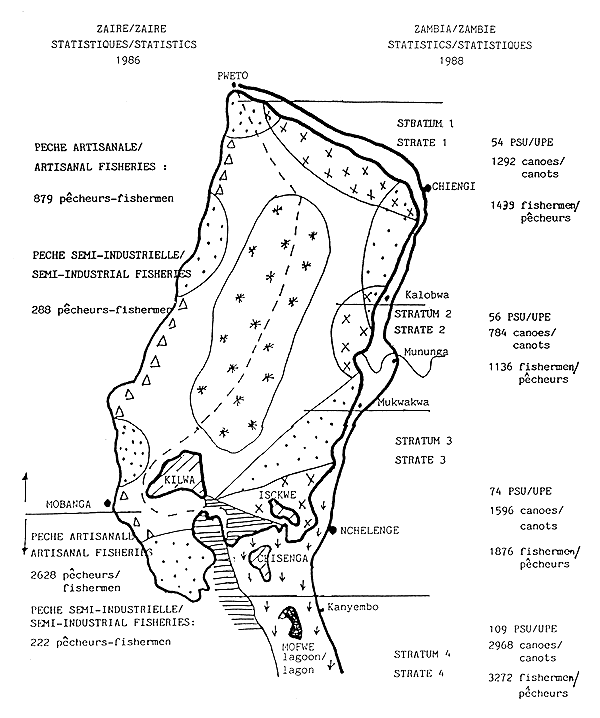
9. Information on resources, location of fishing villages, numbers of fishermen and canoes, prohibited fishing areas, marketing centers and strata for sampling purposes in Zambia was mapped as shown in Figure 1.
10. Subsequent interventions by delegates showed keen interest in the exchange of information on fisheries, fishing methods and socio-economic data. A number of management issues were raised for which specific recommendations appear in paragraphs 24–32.
STATUS OF FISHERIES AND STATISTICS
Types of data collected
11. Under this item, the Technical Consultation first considered the types of data collected by Zaire and Zambia: At present, Zaire has no systematic scheme of collecting data. However some information is obtained during administrative surveys. This information concerns resources, species, fishermen, boats and fishing gears. Marketing surveys provide information on quantities of fresh and processed (iced, salted, smoked and frozen) products passing through Pweto, Kilwa and Kasenga, most of which are destined for Lubumbashi (Shaba).
12. For Zambia, the collection of data dates back to 1951. In 1971–1972, FAO introduced a standardized system of collecting statistical information. Because of financial and man-power constraints, the actual sampling frequency has been reduced from six rounds to three annually. The data collected by Zambia include catch in weight and in number, by species, number of fishermen, boats, gears by fishing settlements. Some additional marketing information is collected but the coverage is still incomplete.
Fishing effort measure
13. The Technical Consultation noted that neither Zaire nor Zambia provided sufficiently detailed fishing effort data to be used for assessing the exploited stocks. For both countries only total numbers of fishermen, boats and fishing gear were made available. These data are given in Appendix 3.
Frame Survey and Catch Assessment Survey
14. For Zaire, no frame survey and catch assessment survey have been conducted. In Zambia, catch assessment surveys have been going on without regular frame surveys.
Status of exploited stocks
15. The most exploited species are: Oreochromis, Serranochromis, Tylochromis and the group Poecilothrissa/Neobola. At present Serranochromis and Tylochromis dominate Oreochromis in the catches in Zambia but on the Zairian side, Oreochromis still dominate the catch.
16. The Technical Consultation noted the controversy about light fishing for Chisense which exists in Zambia but does not occur in Zaire. It was further explained that this fishery may have adverse effects on other fisheries by scaring fish away. In addition, Chisense is thought to be an important food item for other fish species. This factor should be futher investigated and documented by more research.
17. On the Zambian sector, Chisense fishing is presently more profitable than the other artisanal fisheries, whereas for Zaire the Oreochromis fishery has greater economic importance.
18. Since, differences are reported in the size structure of Oreochromis in the Zairian and the Zambian sector of the lake, further scientific investigations are needed.
19. The catch by net by night on the Zambian side has declined from 10 kg in the past (1975) to only 2 kg at present. Similar trends are also reported for the Zairian sector of the lake.
20. For both countries, the Technical Consultation examined historical catch trends and noted a general and gradual increase in catches. These tables showing catches are given in Appendix 3. Some discrepancies were noted and attributed to factors like temporary reduction in fishery activity due to cholera (Zambia, 1981), nationalization (Zaire, 1972–1974). Generally, the data were considered to be inaccurate due to incomplete sampling.
21. As far Zaire as is concerned several fish stocks are at present reported to be overexploited as indicated by the declining average size of the species landed.
FISHERY DEVELOPMENT AND MANAGEMENT ISSUES
Comparison of fisheries legislation
22. The Technical Consultation examined and compared the following existing fishing regulations in Zaire and Zambia:
| ZAMBIA | ZAIRE | ||
| (a) | Minimum mesh-size of gillnets streched 63 mm streched (respected) | (a) | Minimum mesh-size 100 mm of gillnets (generally respected) |
| (b) | Closed fishing season is from 1st December to 28/29 February (enforced) | (b) | Closed fishing season is from 25 December to 25 March (not enforced) |
| (c) | Closed area throughout the year confined to the Mifimbo area (enforced) | (c) | Closed sector throughout the is for the sandy and weedy areas between Pweto and Kilwa (not enforced) |
| (d) | Beach seining is prohibited except for the Chisense fishery (not enforced) | (d) | Beach seining and fishing with the cast/mosquito nets and trawls are prohibited (not enforced) |
| (e) | “Kutumpula” fishing method is prohobited (controlled but not respected) | (e) | “Kutumpula” fishing method is prohibited (respected) |
| (f) | The use of explosives, poison and electric current is prohibited (respected) | (f) | The use of explosives, poison and electric current is prohibited (respected) |
| (g) | Introduction of exotic species is prohibited (respected) | (g) | Introduction of exotic species is prohibited except with a valid permit (respected) |
| (h) | Fishing without licence is proprohibited (controlled through registered canoe numbers but sometimes not controlled) | (h) | Fishing without licence is prohibited (not controlled due to lack of registration) |
| (i) | The transportation of fish products during the closed season has no legal provision except for Chisense (enforced) | (i) | The transportation of fish products during the closed season is prohibited (not (enforced) |
CONCLUSIONS AND RECOMMENDATIONS
General introduction
23. Considering the great need for bilateral collaboration and the harmonization of management measures, the Technical Consultation strongly recommended easy exchange of information and data on all aspects of the Lake Mweru fisheries through periodical consultations between the two countries.
Data collection for management
24. The Technical Consultation stressed the urgent need for the riparian states of Lake Mweru to take the necessary measures for improving the collection and the compilation of catch and effort data; and for harmonizing the methods and formulas of collecting these data through periodical consultations
25. Considering the need for harmonization of fishery statistics and the technical and financial limitations of Zambia and Zaire it was recommended that the UNDP/FAO Regional Fisheries Project (IFIP) assists the Riparian States to formulate a fishery statistics project for the lake and submit it for financing.
26. Recognizing the lack of reliable catch and effort statistics, detailed length frequency data; as well as information on life-history patterns of target species, the Technical Consultation expressed the great necessity for the coordinated and standardized collection and analysis of such data vital for assessing stocks and their state of exploitation.
27. Noting the importance of socio-economic data in fisheries development and management for understanding the local and border trade, marketing and distribution patterns, it was recommended that the two countries initiate and maintain the collection of these data.
Harmonization of fisheries legislations
28. Comparing the fishing regulations given in paragraph 23, the Technical Consultation recommended that both countries work towards harmonizing these regulations and take the necessary measures to enforce them.
29. Considering the difference in the timing of the closed season in Zambia and Zaire, it was unanimously agreed that both countries adopt the closure dates recommended by the Zaire/Zambia Regional Joint Permanent Commission at Kitwe, Zambia, in October 1989: from the first December to the end of February.
Joint management of shared resources
30. Recognizing the need to have a unified management system for the lake, the Technical Consultation stressed the importance of frequent bilateral meetings at technical as well as national and/or provincial policy-making levels in order to prepare for the creation of a joint management body.
Training needs
31. In view of the lack of trained manpower in both countries, it was recommended that emphasis be placed on training professional and technical support staff, in the fields of stock assessment, limnology, fishing technology, fish processing, extension services and socio-economics.
ANY OTHER MATTERS
32. During the Consultation it was noted that not all the data available on Lake Mweru had been provided for use by the first Technical Consultation. Hence, these data must be compiled and submitted at future meetings for lake-wide analysis.
DATE AND PLACE OF NEXT CONSULTATION
33. The next meeting of the Technical Consultation will be held in Zaire, the exact date and place of the meeting will be determined by the Secretariat in consultation with the Zairian authorities.
ADOPTION OF THE REPORT
34. The Technical Consultation adopted the report.
FIGURE 1 : LAC MWERU, RESUME DES INFORMATIONS EXISTANTES LAKE MWERU, SUMMARY OF INFORMATIONS AVAILABLE
| Total | ||||
| Pêche artisanale/Artisanal fisheries: | ||||
| Pêcheurs/fishermen05 | 3005 | 7723 | ||
| canots/canoes | 919 | 6640 | ||
| filets/nets | 12685 | - | ||
| Pêche semi-industrielle/Semi-industrial fisheries: | ||||
| Pêcheurs/Fishermen | 1012 | - | ||
| canots/canoes | 115 | - | ||
| filets/nets | 2997 | - | ||
| moteurs/engines | 9 | - | ||
| LEGENDE/REFERENCE | ||||
 | swamps/marécages |  | closed area/région fermée | |
 | depleted grounds/zone de pèche épuisée |  | Tilapia | |
 | Chisense |  | Clarias, Chrysichthys, Auchenoglanis | |
| PSU | primary sampling unit | UPE | unité de pêche d'échantil- | |
