by
G.W. Ssentongo
Fisheries Biologist, IFIP Project
1. INTRODUCTION
Lake Mweru/Moero, bordering on Zaire and Zambia, is located at 8°27'–9°31'S; and 28°25'–29°10'E at an altitude of 904 m in the Shaba Region (Zaire). Its total area is about 4580 km2 of which 42% belongs to Zaire. This relatively small lake has two main affluent rivers namely, the Luapula from the south and Kalungwishi from the east. The Luvua rivers flows out of the lake and joins the Lualaba to the north. Lake Mweru has an extensive swampy floodplain of about 1500 km. This swamp is 160 km long and 5–18 km wide. These are large permanent lakes located in the swamp, viz Mofwe, Kamibombo, Chitondwe, Pembe and Kaombe in Zambia; as well as Kifikula, Kusha and Kitshomposhi in Zaire.
The exact location of Lake Mweru and the border line between the Zambian and Zaire sectors are shown in Figure 1. Considering the geographical position of this lake, it should have similar species assemblages with Lakes Bangwelu and Mweru-wa-Ntipa both of which are situated in Zambia. Current information on species composition indicates that the various fisheries now exploit fewer target species.
2. GEOGRAPHICAL AND MORPHOMETRIC DATA
The magnitudes of fish catches by Zambia and Zaire fishing units and the general productivity of Lake Mweru/Luapula complex systems are influenced by the following geographical and morphological factors (see Figure 1):
Location : Zaire/Zambia 8°27'–9°31'S; 28°25'–29°10 E
Altitude : 927 m (= 3040 ft) (1)
Area (surface) - Zaire 1924 km2 (42%) (1) or 2000 km2 (2)
- Zambia 2656 km2 (58%) (1) or 3000 km2 (2)
- Total 4580 km2 (100%) (1) or 5000 km2 (2)
Depth - maximum for lake 37 m
- mean average (north) 10 m
- mean averagae (south) 3 m
Volume : 36.6 × 10⁹ m3
Maximum length : 124 km (= 77.5 mi)
Maximum width : 51 km (= 32 mi)
Shoreline length: 340 km (= 212 mi)
Fluctuation in Lake level - average 1.5 m (= 5.2 ft)
- maximum 5.0 m (= 16.4 ft)
Inflowing Rivers: Luapula (from South) and Kalungwishi (from east)
Outflowing Rivers: Luvua into the Lualaba (to the north)
(1) in Welcome R. L., 1972
(2) in Burgis M.J. and Symoens J.J., 1987
3. PHYSICAL AND CHEMICAL CHARACTERISTICS OF WATER
Chemical and physical characteristics of aquatic systems influence the productivity of lakes. The productivity of a water body determines the carrying capacity of a given equatic system. The fluctuations in productivity will be reflected in fish populations fluctuations. The main physical and chemical factors influencing fish population in Lake Mweru are the following:
Conductivity: K20 170–125 μ mhos
Surface temperature: 19–30°C
Dissolved solids: 76 mg/l
PH: 6.4–9.3
Sodium (Na): 4.6 mg/l
Calcium (Ca): 7.5 mg/l
Magnesium (Mg): 5.1 mg/l
Bicarbonate + Carbonate (HCO3) + CO3: 0.8 mg/l
Chloride (CI): 5.0 mg/l
Sulphate (SO4): 3.7 mg/l
Silcon (SiO2): 10.5 mg/l
Potassium (K): 1.25 mg/l
It should, however, be noted that the physical and chemical factors fluctuate depending on temporal environmental factors of rainfall, temperature and evaporation.
4. COMMERCIALLY IMPORTANT EXPLOITED SPECIES
During the initial phase of fishery of Lake Mweru there were more than 14 species with somewhat equitable distribution. The main commercial species exploited in the lake by then were:
| Family name | Generic name | Local name |
| - Cichlidae | O. macrochir | (mpale) |
| - Cichlidae | Tylochromis | (tembwa) |
| - Cichlidae | Serranochromis | (makobo) |
| - Mormyridae | Gnathonemus | (lusa/mbubu) |
| - Schilbeldae | Schilbe | (lukonge) |
| - Mormyridae | Marcusenius | (lusa/mbubu) |
| - Characidae | Hydrocynus | (manda) |
| - Cyprinidae | Barbus | (mpifu) |
| - Bagridae | Auchenoglanis | (imbwa/lupembe) |
| - Clariidae | Clarias | (kabambale/muta) |
| - Characidae | Alestes | (musebele) |
| - Mochokidae | Synodontis | (bongwe) |
| - Cyprinidae | Labeo | (mpumbu) |
| - Mormyridae | Mormyrus | (ndomo) |
| - Clupeidae | Poecilothrissa | (chisense) |
| - Cyprinidae | Neobola | (chisense/ndakala) |
| - Distichodontidae | Distochodus | (mukessa/mkakabala) |
At present the target species ranked by order of catch magnitudes are: O. macrochir (tilapiine cichlid), Tylochromis (cichlid), Serranochromis (cichlid), Clarias (clariid), Alestes (characin) and Poecilothrissa (clupeid). There are a number of fish species which have declined to very low levels and which rarely appear in the catch, namely : Schilbe, Labeo, Barbus and Hydrocynus.
5. CATCH AND EFFORT DATA
Available catch figures on both Zaire and Zambian sectors of the lake show that production has been variable over the years. The fluctuation in catch could be due to a combination of environmental factors and variation in fishing effort. Table 1 shows trends in catch and effort (boats, number of fishermen) for the Zambian sector of the lake. Estimated available statistics of fish production for the Zaïre sector of the lake are given in Table 2.
For both Zaire and Zambia, there are still no adequate mechanisms for collecting and compiling fishing effort and catch per unit effort for the various fisheries. The necessary measures are, however, being taken to improve the situation. Indices of fishing effort for the Zambian and Zaire sectors of the lake are given in Tables 1 and 3 respectively. It is apparent from the two tables that fishing effort is variable and this is also reflected in catch fluctuations.
5.1 Fishery Data Systems
5.1.1 Zambia
In Zambia Fishery statistical data are mainly on landings (total amount of fish landed). Information on exact catches is not easily available. The statistics collected on Lake Mweru are based on random sampling and previous frames surveys. The Central Statistic Unit at Chilanga adjusts the estimates to bring them up to 100 percent. However, the allocation of total catches/landings is not yet adequate.
In 1986 the World Bank Fisheries Development Project provided financial support to the DOF for conducting frame surveys of various Zambian lakes, including Lake Mweru-Luapula. According to the results of the survey, three hundred and five (305) primary sampling units (PSU) were covered, accounting for 6640 canoes (boats) and 7723 fishermen on the Zambian sector of the lake.
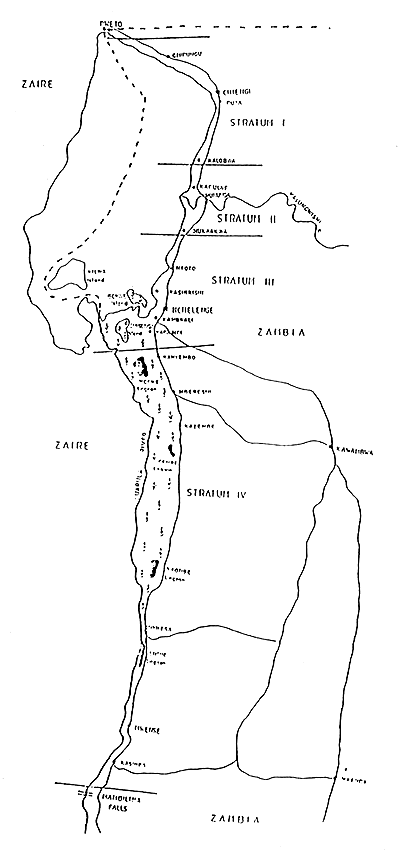
It is noted that the Zambian sector of Lake Mweru has been divided in four strata for statistical sampling purposes. Stratum 1 (in the northern end of the lake) which extends from Pweto to Kalobwa, included 54 PSU with 1292 canoes and 1439 fishermen. Stratum 2 (extending from Kalilabulanda to Kashikishi) included 56 PSU with 784 canoes and 1136 fishermen. This lake sector includes active landing sites as Kafulwe, Mukwakwa, Ntoto and Kashikishi. Stratum 3, extending from Nchelenge in the north to shimulundi in the south, has covered 74 PSU with 1596 canoes and 1876 fishermen. This sector includes Kilwa, Isokwe, Kanakashi and Chisenga islands and Chitondwe and Muku lagoons. The fourth and largest stratum includes the River Luapula swamps containing the four lagoons (Mofwe, Pembe, Chitolwe and Kaombe). Stratum 4 has 109 PSU with 2968 canoes and 3272 fishermen. This is the most difficult sector for conducting reliable catch assessment surveys since many landing and fishing settlements are not easily accessible.
5.1.2 Zaire
There is no adequate mechanism for collecting catch and effort data along the Zaire sector of Lake Moero/Mweru. Some historical catch data have been made available at the “Département du Plan, Institut National de Statistiques (I.N.S.)”, Direction Régionale du Shaba at Lubumbashi. These catch figures appear in Table 2.
Concerning the Frame Surveys (FS), the Fisheries Division (at Kinshasa) and the Regional Fisheries Office for Shaba (at Lubumbashi) in collaboration with UNDP/FAO Fisheries Project ZAI/88/002 should carry out a Frame Survey (FS) on the lake to establish the number of fishing units (canoes), fishermen and the different fishing gear used. The results of this FS should form the basis for future Catch Assesment Surveys (CAS). When establishing a viable Catch Assessment Survey System, consideration should be given to the following factors:
6. SOME MEASURES TO IMPROVE FISHERIES MANAGEMENT
Information on the fisheries of Lake Mweru and the state of exploited stocks was obtained through field visits, discussions with fishery administrators and scientists as well as interviews with fishermen. Additionally, reference was made to published reports on the lake. On the basis of this information, it is concluded that conservation of exploited stocks and rational unified fisheries management would be realized if the following measures could be effected :
rational management of fish stocks of Lake Mweru shared by Zaire and Zambia will require cooperation among fisherie authorities of the Riparian States;
the fisheries authorities in the two countries should intervene in the lake's local fishery management systems in case of destructive fishing practices;
the strengthening of local fishery management groups around the lake would require enlightening the fishermen on the long-term benefits of conserving exploited stocks;
wherever and whenever practicable, fishing village chiefs and chairmen should be requested to assist in compliance with fishing control measures;
if non-fisheries agencies such as the army and police are entrusted with fishery management functions, Governments of the Riparian States should ensure that the Fisheries Division / Department remain responsible for fisheries enforcement;
bilateral agreements between Zaire and Zambia should possibly include some codes of conduct to be adhered to by the fishermen jointly exploiting the resources so as to reduce illegal fishing and conflicts between competing artisanal canoe fleets; and
increasing the earnings of fishermen while at the same time maintaining reasonable stable consumer prices will require a fundamental change in market infrastructures around the lake; however, this might take quite some time considering the problem of effective communication between extension workers and fishermen.
7. EXISTING FISHERY REGULATIONS REQUIRING HARMONIZATION AND ENFORCEMENT
After reviewing existing fishery regulations for the Zaire and Zambian sectors of the lake, a number of discrepancies have been noted. In view of these, consideration should be given to the harmonization of the following existing fishery regulations concerning:
the introduction of exotic fish species in the waters of Lake Mweru/Luapula;
the introduction of poisonous substances and other substances physically destructive to fish in the waters of Lake Mweru;
the use of trawl and purse seines and beach seines on Lake Mweru;
the use of gillnets or other nets of mesh size less than 5 cm on Lake Mweru;
digging or dredging and widening new channels around Lake Mweru and also to widening existing channels in the Mweru/Luapula complex; and
the use of drifting and set gillnets longer than 100 m long and with a depth of more than 2 m depth. This regulation is probably respected.
8. BIBLIOGRAPHY
Burgis M.J. and Symoens J.J., 1987 African wetlands and shallow water bodies/zones. Ed. ORSTOM, Collection Travaux et Documents, No 211, 650p.
Welcomme R.L., 1972 The inland waters of Africa, CIFA Tech. Pap., (1): 117p.
TABLE 1 : FISHERIES STATISTICAL SURVEYS OF ZAMBIA
MWERU LUAPULA STATISTICS ON NUMBER OF FISHERMEN AND BOATS, FISH PRODUCTION ESTIMATES AND MARKETING STATISTICS
| COLUMN FOR NUMBER OF BOATS, FISHERMEN AND FISH | M A R K E T I N G S T A T I S T I C S | ||||||||
| FISH PRODUCTION ESTIMATES IN METRIC TONNES | F R E S H F I S H R E C O R D S D R Y F I S H R E C O R D S | ||||||||
| YEARS | No. OF FISHERMEN | No. OF BOATS | FISH PRODUCTION ESTIMATES IN MTS | WEIGHT IN KGS | VALUE IN KWACHA | AV. VAL PER KG. | WEIGHT IN KGS | VALUE IN KWACHA | AV. VAL PER KG. |
| 1979 | 2,602 | 2,599 | 11,648 | - | - | - | - | - | - |
| 1980 | 3,500 | 1,750 | 7,663 | 626,675 | 173,181.00 | 0.28 | 223,170.50 | 114,680.50 | 0.51 |
| 1981 | 1,759 | 1,702 | 2,744 | 524,530 | 230,793.00 | 0.44 | 238,247.00 | 270,435.00 | 1.14 |
| 1982 | 2,630 | 1,762 | 7,907 | 514,335 | 265,747.00 | 0.52 | 225,847.94 | 335,148.65 | 1.48 |
| 1983 | - | - | 6,574 | 1,440,986 | 1,108,717.00 | 0.78 | 361,752.50 | 374,208.66 | 0.92 |
| 1984 | - | - | 9,297 | 1,303,423 | 728,891.00 | 0.56 | 407,238.00 | 776,328.45 | 1.91 |
| 1985 | 5,890 | 4,876 | 10,758 | 866,246 | 566,629.70 | 0.65 | 444,394.50 | 923,724.50 | 2.07 |
| 1986 | 7,390 | 6,453 | 11,267 | 666,272.50 | 761,450.00 | 1.14 | 341.211.50 | 1,009,539.00 | 2.96 |
| 1987 | - | - | 7,707* | 305,535 | 507,550.00 | 1.66 | 85,676.00 | 210,922.50 | 2.46 |
| 1988 | - | - | 6,996* | 759,800.50 | 1,269,695.00 | 1.67 | 37,671.00 | 338,415.00 | 8.98 |
Footnote
- DENOTES NONE AVAILABILITY OF DATA
* DENOTES FIGURES BASED ON RATIO ESTIMATION
Table 2. Statistics of fish production in tons for the Zaïre sector of Lake Mweru for the period 1966 – 1989
| YEAR | SECTOR | TOTAL | ||
| Pweto | Kasenga | Kasania | ||
| 1966 | 1,600 | 9,956 | 795 | 12,351 |
| 1967/68 | - | - | - | - |
| 1969 | 1,061 | 4,475 | - | 5,536 |
| 1970 | 676 | 4,751 | - | 5,427 |
| 1971 | - | 376 | - | 376 |
| 1972 | 779 | 5,332 | - | 6,111 |
| 1973 | 963 | 4,378 | - | 5,341 |
| 1974 | 1,499 | 3,500 | - | 4,999 |
| 1975 | 1,906 | 3,280 | - | 5,186 |
| 1976/77 | - | - | - | - |
| 1978 | 1,443 | 2,450 | 1,021 | 4,913 |
| 1979 | 776 | 2,249 | - | 3,025 |
| 1980 | 1,102 | 1,960 | 83 | 3,145 |
| 1981 | 1,188 | 2,155 | 45 | 3,388 |
| 1982 | 962 | 1,980 | 27 | 2,969 |
| 1983 | - | 1,599 | 31 | 1,630 |
| 1984 | 1,079 | 3,340 | 40 | 4,459 |
| 1985 | 143 | 2,207 | 34 | 2,384 |
| 1986 | 835 | 5,758 | 43 | 6,636 |
| 1987 | 2,553 | 8,479 | 47 | 11,079 |
| 1988 | 161 | 699 | 90 | 959 |
| 1989 | 3,031 | 7 | 3 | 3,041 |
Table 3. Estimation of Fishermen and Fishing Nets for the Zaïre Sector of Lake Mweru
| YEAR | SECTOR | TOTAL | ||||||
| Pweto Fishermen Net | Kasenga Fishermen Net | Kasania Fishermen Net | Fishermen Net | |||||
| 1966 | 1197 | 1476 | 889 | 1400 | 20 | 20 | 2106 | 2899 |
| 1967/1968 | - | - | - | - | - | - | - | - |
| 1969 | 750 | 2518 | 1476 | 2243 | - | - | 2226 | 4761 |
| 1970 | 770 | 2804 | 1614 | 2306 | - | - | 2384 | 5110 |
| 1971 | - | - | - | - | - | - | - | - |
| 1972 | 882 | 2379 | 1670 | 2357 | - | - | 2552 | 4736 |
| 1973 | 889 | 2424 | 1353 | 1657 | - | - | 2242 | 4801 |
| 1974 | 1002 | 3265 | 1940 | 2385 | - | - | 2942 | 5650 |
| 1975 | 1100 | 3375 | 1581 | 2609 | - | - | 2681 | 5984 |
| 1976/1977 | - | - | - | - | - | - | - | - |
| 1978 | 1872 | 3989 | 2139 | 3949 | 53 | 105 | 4064 | 8043 |
| 1979 | 925 | 1965 | 1595 | 2395 | - | - | 2520 | 4360 |
| 1980 | 925 | 1965 | 959 | 1200 | 320 | 327 | 2204 | 3492 |
| 1981 | 931 | 1280 | 1028 | 2486 | 402 | 475 | 2361 | 4511 |
| 1982 | 1273 | 1378 | - | - | 90 | 274 | 1361 | 1652 |
| 1983 | - | - | - | - | 346 | 376 | 345 | 376 |
| 1984 | 1428 | 1519 | 2066 | 2145 | 352 | 382 | 3846 | 3703 |
| 1985 | 426 | 1764 | 3004 | 6635 | 315 | 315 | 3745 | 8714 |
| 1986 | 1723 | 6610 | 957 | 1015 | 252 | 382 | 2932 | 8007 |
| 1987 | 728 | 3729 | 1884 | 6442 | 346 | 376 | 2958 | 10547 |
| 1988 | - | - | 3377 | 9820 | - | - | 3377 | 9820 |
| 1989 | - | - | - | - | - | - | - | - |
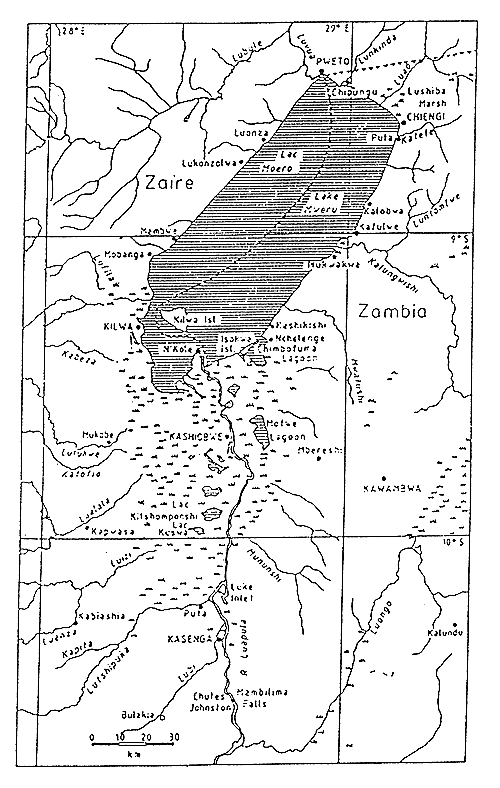
Figure 1 - Carte du lac Moero et des zones humides du bas Luapula
Map of Lake Mweru and the wetlands of the Lower Luapula River
by
Sabuni Kasereka
“Le Directeur National des Projets Pêches”, Kinshasa
and
A. Konaré
Conseiller Technique Principal
ZAI/88/002, Kinshasa
1. INTRODUCTION
Zaire possesses important freshwater fishery resources, more than 70,000 square km of lakes, swamps and floodplains represent an estimated fishery potential of 300,000–750,000 t. The national production does not exceed 150,000 tons per year, Lake Mweru contributes a total of 10,000 tons. It appears that Zaïre continenal waters are still generally under-exploited.
Lake Moero (Mweru) is situated between 8°29' and 9°31'S and 28°09'. It's mainly fed by the Luapula whose river source runs towards the Johnston falls (10°3'S, 28°39'E), through Kifakula marshy plains. The lake river is the Luvua which starts at Pweto (8°28'S, 28°54'E).
2. FISHERY EXPLOITATION OF LAKE MWERU AND THE LUAPULA
2.1 The fishermen
The census figures carried out by Konaré and Kadima (1984) at the level of Pweto and Kasenga zones have enabled to determine 44 fishing camps for Pweto locality, 56 fishing camps for Mweru and 35 fishing camps for Kasenga settlement.
The total ethnic composition of Lake Moero is as follows : the Bemba, Baluba, Lunda, Bashila and the Basela.
The extension of the lake and the Luapula system and the relative reliability of official statistics make it difficult to have a precise estimation of fishermen and average fish production. We were satisfied with the estimates made by the “Departement des Affaires Foncières, Environnement et Conservation de la Nature”. The total number of fishermen estimated during 1986 was as follows :
Pweto 879 fishermen for artisanal fishery and 510 fishermen for semi-industrial fishery.
Kasenga 2628 fishermen for artisanal fishery and 222 fishermen for semi-industrial fishery.
2.2 The Resources
The main exploited genera are as follows :
The species appearing in the catch are :
2.3 Fish migration
Fish migrations are as follows : (a) lateral migrations of which the most important are connected with reproduction and the search for food.
It's observed that there's a large migration from the month of August to December, more especially so for Oreochromis towards more fresh water areas longitudinal migration is practised by the Labeo artivelis (Pumbu) which has practically disappeared from Lake Moero and the Luapula.
From August to December, the Labeo aggregate themselves in Lake Mweru in the proximity of Nikole to make massive migration which leading them to reproduction areas. The return migration occurs from March to April after spawning.
2.4 Fishing equipment and techniques
There are three types of fishing boats used on Lake Mweru and Luapula:
dugout canoes (traditional) which are 5 – 6 m long, and are used for artisanal fishing along the Luapula, in marshes and along the lake shores.
planked canoes (short wooden canoes)
the industrial boats which are exclusively used for semi-industrial fishing.
The main fishing equipments are : gillnets with a finely knitted mesh (Makila) of 100 to 200 metres long and 2 m depth, used by artisanal and semi-industrial fishermen. The legal dimension of the gillnet is 5 cm (knot to knot). The small gillnet of 1.5 cm to 3 cm are prohibited in the lake, but they became numerous in the lake and are not effectively controlled by the Department of Environment. The passive method consists of setting the gillnet in a chosen place, leave it for sometime and then pull it up for getting out the catches. The active fishing method involves beating the water “Kutumpula” with a sort of a clab made out of a “mukussu” (a cone-shaped piece of wood fascened to a bamboo of 1 to 2 m long).
Other fishing equipments are :
long fishing rods generally used for fishing Clarias (Muta);
basket traps wooven in liana and bamboos which are utilised during the drop-in water level between artificial dams dug on water exists towards a larger basin.
Artisanal fishermen generally do not have outboard engines, they fish with traditional canoes and non-powered boats. As for semi-industrial fishing, the fishermen use diesel engine-powered boats.
Semi-industrial fishing was in the past practised by Greek ship-owners and private ‘Zaïrois’. This no longer exists.
2.5 Statistics of fish production on Lake Mweru
The fish production has increased on a progressive rate from 1932 to 1958.
| LAKE MWERU (ZAIRE SECTOR) | |||||
| YEAR | PRODUCTION (tons) | YEAR | Tons | ||
| 1932 | 706 | t | 1966 | 400 | t |
| 1947 | 400 | t | 1983 | 14760 | t |
| 1958 | 13600 | t | 1985 | 11600 | t |
From 1958 to 1982, fishing effort was very variable and suffered a lot of fluctuations.
In 1961, Under traditional chiefs pressure who claimed their fishing rights, the Zaire Government prohibited fishing to foreigners (Greeks), who were responsible for semi-industrial fishing. Fish production declined to a low level of 400 t in 1966. The estimated production level in 1983 was calculated on the basis of sales figures for the Pweto location (5960 t) for Kasenga (8800 t). The total production was estimated using a conversion factor of 3 for the dry-salted fish and 4 for the smoked fish.
2.6 Fish preservation and processing
In the Zaire sector of Lake Mweru, three methods of preservation are used: salt-drying, smoking and freezing.
Salt-drying is the most widely-used method around Lake Moero. The type of fish generally used is Oreochromis macrochir (Mpale).
Smoking equally takes a lot of time for fishermen and their families and requires physical presence and permanent supervision. All the fish species of Lake Mweru could be smoked properly. Unfortunately, the fishermen are not selective to the type of firewood they use, especially in areas where wood is scarce.
Preservation by freezing is used by the Katebé Katoto “Company” which distributes and sells fresh fish throughout the Shaba Region. The transportation of ice blocks from commercial centres to fishing zones is carried out on trucks installed with isothermal containers.
The Three most important fishing centres on Lake Mweru (Zaire sector) are:
3. INSTITUTIONAL ASPECTS
3.1 Fisheries Administrative Structures
On the Central Government level in Kinshasa, the fisheries sector is controlled the “Service National de Promotion et de Développement de la Pêche” (SENADEP) - e.i The Department of Promotion and Fisheries Development - whose set-up is actually supported by the FAO/UNDP Fishery Project ZAI/88/002.
At the regional level in Lubumbashi, the SENADEP is represented by the regional coordination of Environment and Conservation of Nature, which has the following essential roles in the field of fisheries : fishermen training, fishermen assistance, fisheries development, market resources improvement, statistics improvement and and assistance to private initiative.
However, the SENADEP in its operational phase, hopes to post its agents to the main fishing centres of the country, especially on Lake Mweru, in order to take charge of duties associated with fisheries management and development. This management option will not be effected until there is a budget allocation for it and competent manpower.
3.2 Legislation of fishing on Lake Mweru/Luapula and on the whole of Shaba: General rules
The introduction of fish species or foreign fish eggs to the waters of Shaba region is prohibited, except with special permission from the regional Government and with the accord from the Regional Coordinator on Environment, concerning inland waters meant to receive those fish species. (Decree No 68/AGRI of July 13, 1945).
In Shaba region, it's prohibited to throw into rivers, lakes, ponds and marshes, substances in a form of permanent or temporary nature meant to destroy or disturb fish. (Decree no 52/2 Fisheries of January 6, 1953).
It's equally prohibited to fish or to fish for someone using castnets, trawls, seines or draw nets. (Decree No 52/249 of October 29, 1948).
For specific Regulations, it is prohibited:
to fish or to fish for someone using nets of mesh size less than 5 cm;
to fish or to fish for someone using traps, baskets and other gears whose mesh size is less than 5 cm;
to fish or fish for someone in Lake Mweru or in the channels of Rivers Luapula/Luvua during the period 25 December to 25 March (Decree of 7 December, 1983);
to dig or to dig for someone a new water channel and to make deeper existing channels; and
to fish or to fish for someone using drifting and set gillnets of not more than 100 m long and 2 m depth.
The development of the semi-industrial fishery and even of the artisanal fishery of Lake Mweru was based on harmonization of legislation and unified exploitation by the two countries sharing the lake that is Zambia and Zaire. Before independance and until 1954, one agreement (gentlemen agreement) had been concluded between the two countries. It authorized semi-industrial fishing on Lake Mweru under certain conditions particularly indemnifying the communal catch through a levy of taxes. That agreement was brought foward by customary chiefs in the absence of receipt of licence fees.
4. FISHERIES DEVELOPMENT CONSTRAINTS FOR THE ZAIRE SECTOR OF LAKE MWERU
The main constraints to fisheries development for the Zaire Sector of Lake Mweru are as follows:
lack of assistance to artisanal fisheries - the supply of fishing equipment is insufficient;
low income for artisanal fishermen;
lack of training facilities in fishing villages;
lack of transportation means for agents in-charge of fisheries, environment and protection;
lack of reliable statistics to enable a precise estimation of stocks;
lack of diversified traditional fishing techniques;
lack of outboard engines for artisanal fisheries which limit the movement to other zones with abundant fish; and
bad and difficult connecting roads between towns and fishing settlements (i.e. Pweto - Kilwa - Kasenga - Lubumbashi).
5. RECOMMENDATIONS
to reinforce fisheries training system at lake level by providing agents with the necessary means of action.
to apply current fisheries legislations.
to reach as soon as possible an agreement with Zambia aimed at harmonising legislations.
to improve artisanal fishing techniques.
to improve the preservation of smoked and salt-dried fish.
to help artisanal fishermen to better equip themselves through loan allocation to organize themselves into committees in the Mweru/Luapula area or sector.
to ensure training of staff in fishing techniques; in outboard engine technology and fish processing ; in research in fish biology and hydrobiology, in fishery management ; in fisheries economics and statistics (Institut Supérieur des Statistiques de Lubumbashi).
It should be noted that the purpose of harmonizing fishery legislation between the two countries, it would be desirable to introduce certain measures, particularly :
publication and exchange of information on the lake fisheries by the two countries
the standardization of the system for collecting and processing statistical data.
The administration of “SENADEP” defines clearly the administrative arrangements decreed to safeguard its functions and statistical system. In the field (around the lake), the SENADEP will be directly represented in the main fishing zones by a Department directly depending on the Head office of SENADEP.
by
V. M. Kanondo
Fisheries Department Chilanga, (ZAMBIA)
1. INTRODUCTION
Lake Mweru-Luapula fishery is shared almost equally between Zaire and Zambia. It comprises of two areas that are different and yet are interdependant. First is the lower Luapula river from Johnson falls up to where it drains into the Lake. Second, is the lake Mweru-Luapula itself whose general features of the topography and hydrobiology can be summerised as follows :
Altitude 927 m, length 160 km, width 5–18 km, depth 16 km, maximum depth 37 m, average depth at north 10 m, average at south 3 m. The Zambian side of the lake has 2,656 km2 of water surface area. Air temperature ranges from 27,5° to 35°c while water temperatures vary from 21°c to 29°c at the surface. Rainfall ranges from 101.6 cm to 121.92 cm for November and April respectively.
The lake is quite rich in fish species. Over 100 species of fish have been recorded from the lake. In the past important fish stocks like Labeo altivelis were wiped up due to over fishing. species of Commercial importance are about 27 of which the most prominant ones are : Tylochromis mylodon, Serranochromis spp and Neobola moeruensis. Oreochromis macrochir once the pride fish species of the fishery has declined during the past two decades.
2. DEVELOPMENT OF STATISTICAL SYSTEM
Collection of Fisheries Statistics or data in Zambia dates back to the year 1952 when the Fisheries Division of the Department of Game and Fisheries was under the Northern Rhodesia Government. It should be pointed out that at that time there was no one general system of collecting fisheries statistics applicable to all capture fisheries in this country. The system of collecting fisheries data evolved more or less on a try and error basis. In practise what used to happen was that the fish ranger in charge of each fishery designed his own system of data collection which he thought was applicable to his particular fishery. Using the designed questionnaire or format, the officer supervised the collection of fisheries statistics using staff under his control. In this way fishery data were collected on a regular basis.
Eventually the two systems or approachers of collecting fisheries data became widely used. One was termed “the periodic survey of fishermen and their gear”. Under this system it was deemed necessary to define specific areas where census teams could go to collect data on fishing camps or settlements on monthly basis. The data collected under this system included the following:
Where it was not possible to collect data using the above mentioned approach, at less frequent intervals, aerial survey of boats were undertaken. In general, the above mentioned approach of collecting fisheries data was also termed the census system. The other approach of collecting fisheries statistics which was complimentery to the census system was called “the sample recording stations”. Under this system the fishery was divided into a number of areas which were more or less homogeneous biologically, sociologically and physically. The division of the areas was done by the fisheries officer in charge or the fish ranger in charge of the respective fishery. In each selected area, one or more recording stations were established at fishing camps. It was from these landing points along the lake shore that fish guards collected data on daily basis as fishermen landed their catch. The information collected included the following:
If the selected landing point had also a market for selling fish to fish traders more marketing data such as quantities of fish sold fresh, quantities of fish sold dry, selling price of fish t producer level, number of traders, destination of marketed fish, method of transporting the fish which could be use of public transport, bus, private vehicle, bicycle, or foot, etc were collected. Under this system data on fish consumed by the fisherman and his family was also recorded.
It is not exactly known when the above systems were first introduced but it is safe to say that by the early sixties the two systems were already in use in lakes like Kariba, Mweru, Mweru-Wantipa, Bangweulu and the Kafue river system.
Fishery biological data on sex, sex activity and stomach contents, length and weight relationship of fish were collected by fisheries research units. The research teams fished at selected fixed positions in the fishery under investigation. Data was collected through fishing on a regular basis using gear which sampled both the exploited stocks and as far as possible the commercially important stocks out side the range of gear used by fishermen.
Fisheries trade statistics which consist of information on quantities of exported fish, value and destination as well as quantities of imported fish by specie, value and country of origin was collected as far back as the decade of the fifties. However, this type of data was not collected by Fisheries Department but has always been collected by Ministry of Commerce and Trade especially under the Department of Customs and Exercise.
This information is of little value in as far as managing a fishery is
concerned. However, the same information is of great importance in
determining the demand for fish at national level if production for fish
does not satisfy the local demand.
Economists use this information to formulate tariff policies as well as in
assessing fish consumption in the country.
3. COLLECTION OF FISHERIES DATA LAKE MWERU-LUAPULA
Like elsewhere in the then Northern Rhodesia (now Zambia) collection of fisheries statistics from Lake Luapula started in 1952. In that year, about 5,200 short tons of fish were produced. The most productive fishery in that year was Bangweulu which registered a total of 7,282 short tons. The total production for that year for the whole country was about 12,520 short tons. Mweru-Luapula fishery came second with a total contribution of 41%. As stated already the methods used then of collecting data were crude, since the system was entirely determined by the fish ranger responsible for the fishery in question. This means that the more enthusiastic and knowledgiable the officer was in data collection the better the quality of data collected. For the Mweru-Luapula fishery, it seems the officer who was running it had a lot of interest in fisheries statistics. Fish production data for the period from 1952 up to the time of Independence in 1964 is well tabulated as shown in figure Table 1. During this period fish production increased from 5,200 short tons to 6,400 short tons in 1964.
4. FURTHER DEVELOPMENT OF STATISTICAL SYSTEM
In 1963 a real attempt was made to develop a uniform system of collecting and presentation of fisheries statistics which up to this time was left up to the initiative of individual fisheries officers. The system covered all the capture fisheries of the country namely Mweru-Luapula, Mweru-Wantipa, Bangweulu, Tanganyika, Kafue flood plain and the newly manmade lake Kariba. This system attempted to cover two aspects of fisheries production:
Fish production estimates were made by adding catch effort data to the results of a census of fishermen and their fishing gear conducted periodically. It eventually became impossible for the two surveys to operate uniformly in all fisheries. As a result fisheries like Bangweulu Mweru-Luapula and Tanganyika had poor records of fish production. For each of these fisheries another method was devised which was to measure the amount of processed fish exported through established check posts under the supervision of field recorders. Yearly catch estimates were calculated by adding to the marketing quantity of fish a lump figure to compensate for local consumption.
With regards to excess production since all the fish exported to the Co perbelt from Luapula and Northern province i.e, from Lakes Mweru-Luapula, Mweru-Wantipa, Bangweulu and Tanganyika had to pass through the pedicle road in Zaire, for customs purpose the weights of fish so recorded were incorporated in the production estimates.
The synchronization of a large number of field data to the system, lack of flexibility in the system to follow up the dynamic evaluation of the fishing industry and lack of integration of the various data collection approaches adversely affected the system in the long run. Planners and administrators who were responsible for the development of the fishing industry and management of the fishery resources realised the inaccuracies and incompleteness of the system then decided to take action in order to improve the collection of fishing statistics.
5. FRAME SURVEY OF MWERU-LUAPULA
The first frame survey of Mweru-Luapula fisheries was conducted under the auspices of the General Fisheries Research Institute from the end of October to middle of December, 1971. At that time the territorial lake fishery was divided into 6 strata. The purpose of the frame survey was to obtain accurate basic data concerning fishing activities. The data collected were as follows:
The survey revealed that the Zambian sector had 524 fishing sites of which 509 were permanent fishing villages while 15 were temporary camps. This sector had a total of 5,963 fishermen out of which 4,155 were boat owners, 1365 were gear owners and 443 were merely assistants. With regards to type of boats in use, the dug out canoe was the commonly used numbering 3,296. Plank boats came second; 582 were without engines while 123 had engines. GRP boats were used too. The frame survey indicated that 26 GRP boats were without engines while 128 had engines. Thus the total mechanised boats were 251. The gears commonly used were gillnets, baskets, hooks on line and beach seines. Fish was either sold fresh, sun dried or smoked.
Fish marketing data was also collected and most of the fish traders originated from Copperbelt, Kawambwa, Zaïre or near-by villages and other towns; a trading pattern which has not changed much up to the present date.
6. CURRENT FISHERY STATISTICAL SYSTEM
The current system of collecting fisheries statistics in the Mweru-Luapula fishery and other fisheries of Zambia was first carried out between 1971–1975. It was designed by G. Bazigos of FAO based on probability sample surveys for providing estimates of fish catch and other characteristics like average catch/fisherman, average, catch/boat and average catch/gear, etc.
This system was conducted along side the check post system. The reasons for using the probability sample survey system were :
Frame Survey
This is an inventory type of survey which provides data on the size and structure of the fishing industry. It requires enumerating all fishermen and their boats in their respective fishing villages. This survey is important because it identifies the location and size of each fishing site (size expressed in total number of fishing boats) together with information on fishing gear owned and disposition of catch and any other fishing activity. The data are also used for efficient stratification of fisheries and in the selection of samples for catch assessment surveys.
Catch Assessment Survey (PS2-Survey Form A 2)
This is a current survey form which provides estimates of input to output of the fishing industry. For this survey system the method of sampling in space and time is used. Each fishery is divided into strata. In the case of Mweru-Luapula currently it has four strata. The collection of information by field recorders on the input and output characteristics of the fishing industry is made by using objective measurement. In other words sampling is done at two level: first at the fishing village and second at the landing side of the selected villages. It should be noted that not all fishermen's catch are recorded but only random samples of active fishing boats.
In 1975 when catch assessment survey system was introduced on lake Mweru-Luapula, the data were collected 6 times in a year, i.e every two months a survey round was conducted. However, as the budget constraints became severe, it was reduced to 3 surveys rounds in a year.
7. TYPES OF FISHERIES
Basically there are two types of fisheries in Lake Mweru-Luapula. The oldest is the demersal fish stocks which comprises 100 fish species out of which 27 are of commercial significance (list of fish species is in the appendix). There are different ways of catching these demersal fish stocks. The most commonly used is the gillnet. By far the majority of fishermen owning dugout canoes or plank boats use gillnets. Consequently most of the catches come from the gillnet fishery. Currently production is around 7,000 metric tons.
Traps, baskets and hooks on lines are still being used but are not of commercial significance. Draw nets or beach seines are used even though officially they are banned under the Fisheries Act. Kutumpula method of fishing is equally banned but fishermen practice it illegally.
The second is the pellagic fishery of Neobola moeruensis locally known as chisense. Being a pellagic fishery, fishing is by light attraction at night. This is a relatively new fishery which started around 1985. During the same year, it was estimated that 500 metric tons of chisense were produced by 40 fishermen. Since then the number of chisense fishermen has increased and so are the catches.
But unfortunately their catches have not been properly monitored. By far this is a very lucrative fishery in comparison to say the gillnet fishery. For instance in 1987 it was documented by means of a socio economic study that while a demersal fisherman made between kwacha K100–300 per month, a pelagic fisherman on average made K4,000 per month.
8. FISH MARKETING STATISTICS
Fish marketing statistics are collected virtually in all commercial fisheries of Zambia including Mweru-Luapula. Perhaps they are the easiest data to collect because records are taken at permanent markets on the lake shore built by the Department during sixties and early seventies. The forms used are called sales records, catering for both dry and fresh fish sales. The information collected includes; fish species, type of marketed fish i.e fresh or dry quantity by weight, destination of fish, methods of transport, producer price, number of fish traders, etc. It should be pointed out that collection of marketing data is by census approach that is the recorders record all landed fish, since there is no sampling of any kind. Data are collected on a daily basis then aggregated monthly.
Reliability of estimated fish catch
Estimated fish production figures are not reliable for very obvious reasons:
the random sampling approach at the landing site is so tedious that very few recorders rarely follow the stipulated instructions. In fact instructions are followed only when the supervising officer is present;
lack of commitment on the part of recorders also contributes to poor quality data being collected. Usually at the landing point, recorders just record the first 6 fishermen who land their catch;
at times, recorders fill in fictitious data;
unrecorded data due to inadequate coverage of fishing units as well as selected villages caused by insufficient fuel allocations;
high mobility of fishermen from one fishing camp to another such that at times the whole selected landing site is deserted.
9. CONSTRAINTS AFFECTING THE CURRENT FISHERY STATISTICAL SYSTEM
Obviously the major constraint is that of shortage of funds to buy sufficient fuels, weighing scales and camping equipment. The recorders work under harsh conditions especially so during the rainy season as they make do without tents. Worse still is the fact that tents are not even available in the country even if one would secure a bit of funds.
Shortage of outboard engines as well as land transport is another chronic bottleneck to the smooth conduction of catch assessment surveys. Once engines break down spare parts cannot be purchased as they are out of stock due to worsening economic climate currently prevailing.
The recorders need to be given on the job training of some kind. Some simply do not appreciate the value of collecting good quality data. Misuse of fuel both on the part of officers as well as recorders is another point to reckon with.
10. SUGGESTIONS FOR IMPROVING THE EXISTING FISHERY DATA COLLECTING SYSTEM
Without doubt, there is need to increase the budget allocation for data collection so that the recorders can be paid all the daily subsistence allowance due to them rather than the current fixed 15 days per round. The same should apply to fuel allocation.
Camping equipment ought to be provided for if the morale of recorders is to be enhanced. By so doing they will be encouraged to collect more reliable data. Basic equipment like weighing scales, pails, pencils, rubber and paper should be provided to recorders at all times.
Penalties should be meted out against officers or recorders who misuse fuels for their personal benefits if discipline in this area is to be maintained.
Last but not least, there is dire need to retrain the recorders in basic techniques of data collection including the officers analysing the data at the statistics unit at headquarters. At least three officers need to be trained on how to run the micro computer presumably at degree level in computer science. There is also need to have a post of a qualified statistician within the statistics unit.
11. SUMMARY
The Department of Fisheries has endeavoured to developing a scientifically sound system of collecting fisheries statistics not only in lake Mweru-Luapula but in all commercial fisheries of Zambia. It is noted that fisheries data was collected as far back as 1952 when 5,204 short tons were recorded to have been produced from lake Mweru-Luapula using rudimental methods devised by the fishery officer in charge. Since then step by step improvements of data collecting system have been made from time to time.
First was the census system, followed by the sample recording stations approach all of which have been explained in detail. Improvements to the above systems of data collection came in 1963 when it was decided to have a standard system of data collection applicable to all fisheries. The break through in developing a system of collecting fisheries statistics came in 1971 when Dr. D. Bazigos of FAO working under the Central Fisheries Research Institute devised the present system based on probability sample surveys.
In the same year a frame survey for Mweru-Luapula fishery was conducted which provided the basic frame data covering the whole fishery. Catch assessment surveys covering the whole fishery of Mweru-Luapula which was divided into 4 strata was first conducted in 1975. Since then catch assessment surveys have been conducted from year to year even though there have been changes in the frequency of surveys rounds. At first it used to be six survey rounds per year, but when the financial situation worsened the survey rounds were reduced to three per year.
Today Mweru-Luapula fisheries provides employment to 7,675 fishermen producing almost 7,000 metric tons of fish. Most of the fishermen use gillnets to catch fish; the dugout canoe is still the most commonly used craft. Fishing intensity has increased by exploiting a new profitable pelagic fishery, the chisense which was initiated in the mid-eighties.
It is also noted that while the present system of data collection is technically sound, the quality of data collected has a lot of room for improvement. Essentially this can be done by increasing the budget allocation.
REFERENCE
1. Game and Fisheries Department (1965), the fish and Fisheries of Zambia.
2. SADCC - Workshop on Fisheries Statistics in the SADCC region, cyclos tyled report Lusaka Zambia, April 1988.
3. Kanondo V. (1987) Economic Survey of Mweru - Sardine Credit Scheme.
4. Department of Fisheries (1971) Preliminary report of frame survey on Lake Mweru-Luapula river.
T A B L E 1
MWERU-LUAPULA ESTIMATED FISH PRODUCTION IN SHORT TONS
| YEAR | PRODUCTION |
| 1952 | 5204 |
| 1953 | 6401 |
| 1954 | 6555 |
| 1955 | 7124 |
| 1956 | 7757 |
| 1957 | 7556 |
| 1958 | 7429 |
| 1959 | 7389 |
| 1960 | 7306 |
| 1961 | 6501 |
| 1962 | 5598 |
| 1963 | 6196 |
| 1964 | 6411 |
TABLE 2 MWERU - LUAPULA FISHERIES STATISTICS
| Year | Fish Prod. in metric tons | Canoes | Pank boats | GRP boats | Metal boats | Total boats | Out board Engines | No. of Fishing V/G | No. of F/men |
| 1965 | - | ||||||||
| 1966 | 9479 | ||||||||
| 1967 | 7543 | ||||||||
| 1968 | 7617 | ||||||||
| 1969 | 7717 | ||||||||
| 1970 | 7326 | ||||||||
| 1971 | 8342 | 3296 | 705 | 154 | - | 251 | 524 | 5963 | |
| 1972 | 9068 | ||||||||
| 1973 | 8031 | ||||||||
| 1974 | 8135 | ||||||||
| 1975 | 8483 | ||||||||
| 1976 | 10680 | ||||||||
| 1977 | 9534 | ||||||||
| 1978 | 7629 | ||||||||
| 1979 | 9438 | ||||||||
| 1980 | 7663 | ||||||||
| 1981 | 2744 | ||||||||
| 1982 | 7907 | ||||||||
| 1983 | 7902 | ||||||||
| 1984 | 11050 | ||||||||
| 1985 | 10758 | ||||||||
| 1986 | 6284 | 3914 | 2639 | 82 | - | 6635 | 212 | 469 | 7675 |
| 1987 | 7707 | ||||||||
| 1988 | 6996 |
FIGURE 1: STATISTICAL SAMPLING ZONES FOR THE ZAMBIAN SECTOR OF LAKE MWERU.
by E.S. Ngula
1. INTRODUCTION
Lake Mweru is one of the small East-Central African fishing lakes found in the North-Western part of Northern Zambia; that is within parallel 9° and 18°5 and longitude 22° to 34° East. The Fishery includes the Luapula river sector with its lagoons, swamps and flood plains from Mambilima rapids (falls) South of Mwense Boma and the open Lake itself. Both the river sector and Lake Mweru are shared almost equally by Zambia and Zaire (about 52% and 48% respectively); making Mweru-Luapula fishery one of the most complicated fishing areas to manage especially with the rising population on both sides of the lake vis-a-vis fish demand.
The Zambian Sector which is about 2700 km2 produces nearly 7,000 metric tons of fish per annum making it one of the most important fishing areas in the country. There are 4000 to 4500 boats in the fishery though not all of them are active throughout the year as the Nation would have wished them to be due to a number of problems. Non-availability or shortage of nets; the prohibitive prices offered whenever a few of these appear on the market, and the rampant thieving of nets are but some of the reasons for this slowed down fishing effort. Despite the above setbacks however, the fishery employs about 14,000 fishermen/workers and some 4000 to 5000 fish traders both of whom solely depend on good fishing. These are not the only groups of people who depend on good fish catches on our sector of the fishery. Nearly 500 people are employed as boat-builders/sawyers mostly in family unit undertakings. Retail shops spread/lined throughout the three (3) districts that borders the Zambian side of the fishery are dependent on successful fishing. Apart from Government grants all the three District Councils (Nchelenge, Kawammbwa and Mwense) derive much of their revenues from fish and fishing levels both of which depend on good catches.
Catches and catch rates are changing in spite of certain fishing controls such as the closed season and areas. This might be due to lack of unified control by the Riparian States sharing the lake. It is necessary to have similar control measures since the fish and sometimes the fishermen do not respect borders.
Oreochromis macrochir which was dominant and the most prefered fish, is slowly giving in to Serranochromis macrocephala; Tylochromis mylodon and now the famous chisense (Poecilothrissa moarunsis). Other species whose occurance also seem to have been affected are Auchenoglanis occidentalis, Chrysichthyse mabus, Gnathonemus macrolepidotus, Mormyrus and Clarias species. In any case, the fact that fish catches, have been going down over the last few years for various reasons. Differences nor pinpoint who of the two nations is more at fault; but only to discuss what used to happen and what is being done regarding fisheries management on the Zambian side. An attempt to look into the future is also made to incite a discussion which may bring about better exploitation trends; which may ensure survival of not only our fishermen but the whole fishing community around. But even then it is important to note that no amount of regulations, etc. pushed by one country will bear fruit without equal support, vigor and commitment by the other; Zaire is mentioned only in passing, since due to lack of consultations I am rendered ignorant and therefore incompetent to discuss in detail what is not happening that side.
2. MANAGEMENT MEASURES IN THE PAST
The present inhabitants of the Luapula valley (Mweru-Luapula Fishery), having drifted from the Luba-lunda forests in the Congo were not traditional fishermen but hunters. Their settlement in this area therefore posed no fisheries management problems. Fortunately again our people found the valley and its outlying forests very rich with wild animals, so fishing with its attendant problems was not taken up early or easily. Having come from where there were only small streams and wells, Lake Mweru and the larger Luapula river with its large lagoons and swamps envoked great fear and in its new residents. So it took such a long time for the people to develop the canoe, spears and then fibre nets to start fishing especially with the presence of crocodiles and hippos which seemed to claim ownership of whatever was in water. Even when fishing finally started there was no attractive market for the product, until the copper mines were established in bothe Zaire and Zambia at the turn of the century. Still more, transportation to those markets due to non-availability of haulage trucks and proper roads was very difficult, which continued to slow down intensive commercial fishing as came to be experienced in the late 1950's.
Prior to the 1950s good fishing nets and better and bigger boats/canoes began to be used, and roads opened bringing good fishing and the market nearer. However, like the number of fishing boats and nets, the number of people living around the fishery was very low and unsophisticated at the time that traditional rulers used traditional beliefs and powers to control fishing pressures. Hunting was still profitable too, giving people alternatives when chiefs declared certain fishing areas closed. Naturally there was no need for the control on the number of fishermen, number of boats or net mesh-sizes, as there was enough bigger fish which were also more prefered by the consumers. However the 1950s saw the unpreceded swelling of population around the fishery brought about by the good markets in the mining towns and the then poor hunting both in the swamps and the highlands. The Greeks using their Mediterranian sea fishing expertise came on the fishery on the Zairean side. These factors brought in the need for some kind of controls like on fishermen, fishing nets etc.
2.1 Control on Fishermen
Control on the number of fishermen operating in the Zambian sector of Lake Mweru was a prerogative of chiefs and their headmen. Ther was no written laws but nobody was allowed to settle in a locality and fish without the approval of the chief who had powers to refuse such settlement even with good recommendation of the headman where the applicant intended to settle. Likewise the headman too had powers to turn down a settler without consulting or refering the matter to the chief. The number of villages along the fishery was more seriously controlled as not even indigenous residents were allowed to start new villages even if one differed with his village headman.
In this way chiefs did not only ensure that the right numbers of fishermen reside in their villages but also that only the well disciplined people who acknowledged the chiefs powers to rule and command are allowed to settle in their areas. The colonial settlement or traditional rulers regulations supported these controls which also helped in the control of crime. Nobody was allowed to settle in any area or village without a transfer certificate from his former headman and chief.
2.2 Control on Mesh-size
For a very long time there was no need to put a formal regulation on the sizes of nets used, because there was still large-sized species, the sizes of which were also prefered by the consumers. 4" (104 mm); 4.5" (114 mm); 5" (127 mm); 5.5" (140 mm); 6" (165 mm) and upward were the commonly used nets. 3.5" (89 mm) nets were unheard of since even consumers would not buy small fish from such nets. Also headman with the vigilance of all other fishermen in the villages consficated such small mesh nets as unacceptable in the fishing village. If one headman became lax over such rules neighbouring headmen would report him to the chief and could lose his headmanship because of such reports. The Government therefore was assisted by the people themselves to reglate the size of fish that was caught. No beach seining was done around the lake shore and river mouths then, and the illegal Kutumpula fishing method was still undeveloped, laborious and time consuming like beach seining. Actually, the beach seining is strictly prohibited.
2.3 Control on Fishing Boats
Registration of fishing boats and issue of fishing licences for each boat was started around the 1940s to the control of fishing boat numbers. The good catches of that period up to the early 1970s made remote the idea of controlling the number of boats or of nets in each boat. But the fact that chiefs controlled the number of would be settlers and new fishing villages mean that numbers of boats were actually controlled. Certain areas like the river mouths of the Luapula, Kalungwishi, Mwatishi considered breeding grounds were restricted areas during breeding periods.
Chiefs seem to have been the main actors in the fishing control game, but the two Governments did not abandon or let them play alone. In fact they had more support than what is being done today. This is evidenced by the fact that, apart from the Departments of Fisheries both Governments created fisheries advisory committees which met twice a year in an expanded Anglo-Belgium Fisheries Advisory committee for the Mweru-Luapula Fishery.
3. CURRENT MANAGEMENT MEASURES
The free for all mentality that engulfed both nations soon after their independence coupled with very high catches brought about by improved fishing methods and gear attracted a lot of people into the fishery. Both the chiefs controls and registration (licencing) of boats were then considered colonial appendages which had to be discarded forth with. The Anglo-Belgium Fisheries Advisory committee and its sub-committees on each side of the fishery collapsed. The Department of Fisheries was charged with the responsibility of of teaching fishermen more efficient capture methods, improved processing methods etc without instituting any meaningful management controls. Everybody seem to have believed the fishery could continue increasing its output, without depleting or endangering the breeding stocks. The river mouths which were only disturbed during the non-breeding months were opened to all types of fishing throughout the year. Even the Mifimbo (restricted) area that was spared no longer got its desired patrols to stop or refrain fishermen from fishing there.
Naturally all this confusion pleased everybody since the total annual catch was increasing with the additions of more nets. But slowly the fisherman was beginning to suffer as his returns per fishing day decreased; and to make ends meet he changed his net mesh size from 114 mm down to 89 mm which temporarily gave him good catches. Unfortunately this false improvement in catches attracted more men into fishing, that within a short time net mesh sizes again changed further down to 63 mm and now to 37 mm. The bigger sized breams were no longer caught in economic numbers with the use of stationary gill nets, so fishermen started experimenting with Kutumpula and beach seines in shallow areas which happen to be breeding zones.
The situation has worsened by the existence of a lucrative fish market in Zaire where a salted bream ‘tilapia’ is like gold. This factor has forced some law-abiding fishermen to break regulations in search of Oreochromis macrochir. The high rate of unemployment coupled with economic difficulties prevailing in the riparian states means that more and more new fishermen are joining the declining fisheries daily. Hence, management measures had to be instituted.
3.1 Current Control on Fishermen
Registration of fishermen and licencing of fishing boats was re-introduced in 1986 after a break of over twenty years. However despite boats being given numbers, the number of boats or fishermen allowed to work or fish in Lake Mweru like in all our fisheries is not controlled. That is the registration of fishermen and the licencing of fishing boats regulation does not include limiting or controlling the number of boats or fishermen in accordance with the size of the fishery. Likewise, anybody may carry and set any number of nets as he wishes. There is not even a regulation that compels a would be fisherman to register even to the headman before starting his fishing enterprise.
3.2 Current Control on Mesh Size
The control on mesh size of gillnets is indiscriminate, that is, there is no specific mesh size limit for a particular species. There is only one limit, the (63 mm) mesh size being the smallest allowed.
However due to variations in species occurance per particular season, fishermen have developed some voluntary mesh controls i.e. depending on which species are abundant at that time. The 53, 63, 76 and even 89 mm mesh sized nets are used during the cold flood peiods (from March to end of July) when the larger growing species like the bream are not active or are just dispersed (hiding) in the submerged swamps; and therefore not vulnerable to capture.
These small mesh nets disappear from fishing boats soon in August when the temperature begins to rise and water levels rescinds forcing fish to come back into the open waters. They are then replaced by 4", 4.5" and 5" nets (114 mm and 127 mm) mainly to hunt the Oreochromis macrochir, and other larger species like tiger fish (Hydrocynus vittatus). At this time fish for the small mesh nets like serranochromis etc are not much available for fishing in desirable quantities; so very few fishermen would continue wasting their time hunting them with small mesh sized nets. Otherwise there is no regulation that compels fishermen to use some specific net sizes for particular seasons of the year.
3.3 Closed Fishing Seasons
In 1986 the department introduced the seasonal closures - 1st December to 28th February for the months considered the peak breeding period for larger species. Both countries sharing the lake one a part to this conservation measure which fishermen too acknowledge as being necessary, though many would not observe it voluntarily. The harsh economic conditions both countries are passing through forces fishermen to flout and even hate the closures because surviving without fishing under todays living conditions is very difficult.
This setback coupled with inadequate monitoring, policing requisites such as fuels, marine engines, allowances etc. makes it difficult to manage these closures effecitively. Our counterparts on the Zairean side are not very keen in implementing this regulation, making the whole exercise a complete failure and a disadvantage to the Zambian fisherman who does not find much chance to flout it. Selling of fish in both our countries town markets become so profitable that many fishermen and fish traders risk arrests to make an extra kwacha.
3.4 Closed Fishing Areas
The Luapula river estuary, commonly known as Mifimbo is a permanently closed breeding area where fishermen are not allowed throughout the year. The area demarcated during the colonial period and both governments strictly prohibited their fishermen from going in there. Presently however, only the Zambian side of the estuary is still considered a protected breeding zone. Due to inadequate operational requisites both the Zambian and Zairean sectors are free to fishing by the Zairean fishermen all year round even during annual closed fishing seasons.
Kalungwishi and Mwatishi river estuaries are no longer restricted areas though these are equally important breeding zones. These two estuaries and many other lagoons on both sides of the river sector were seasonal closed areas, managed by the traditional rulers supported by the colonial governments through the Anglo-Belgium Fisheries Advisory committee. Chiefs no longer have such controlling powers which has opened these important nurseries to intensive fishing throughout the year. Even such destructive fishing methods like kutumpula and beach seining are practiced in these areas including the Luapula river mouth itself. Species like Oreochromis macrochir which breed or use these areas as transit points are extremely sensitive to these uncontrolled intrusions and bad fishing methods; which has prompted many Zambians to ask, “Where has the Pale (bream) gone”?
3.5 Light Fishing for Chisense (Neobola moeruensis)
Fishing for chisense (dagaa) came at the decline of larger species catches especially the bream during the poor fishing periods when relish became a big problem to get. It was started by women and children washing plates/pots in the early 1970s, who began catching this tiny fish using their pots and even dresses as it came to feed on the food waste cleaned out of pots etc. Chisense fishing using mosquito nets and even women's wrap-over cloths (chikwembe) started on the village beaches by women and then by men who later ventured out away from village beaches. Chisense became a commercial species way before lights were introduced for catching it. Fishing was done in shallow beaches even without using boats for casting, using all sorts of fishing materials from pieces of modern webbings to mill sacks. Light fishing was introduced into Mweru-Luapula in 1975/6 by a man known only as Sikasote from Lake Tanganyika who came with all his fishing gear (webbings and telelamps) he used for kapenta (Limnothrissa and Stolothrissa species) fishing. Even at this time chisense fishermen confined themselves near the shoreline, and at times even hauled their catches in the beaches i.e, drawing their lights slowly into the shore before casting their net behind the lights. At that stage chisense fishing did not pose nor raise any complaints from the gill net community.
However chisense fishing at the moment is facing a lot of opposition mainly from the stationary gillnet users to the extent of even calling for its complete ban. There are two beliefs producing this quarrel; one being biological and the other physical, although non of these is yet investigated by the Department. Fishermen believe that the present trend where chisense lights go much off-shore where they set their gilnets affects their catches because larger species become inactive fearing the lights. Many of our larger species feed at night and become inactive during the day, and therefore intensive lighting by the fishing lights could seem a prolonged day-light in which fish remain inactive.
The other assertion is that chisense is food for many larger species, and therefore its intensive exploitation may have some telling effects on the food chain. The chisense quarrel is in fact such a big issue now that light fishing for it is already banned by some chiefs in their nearby lagoons. Although some of the arguments advanced by fishermen in this quarrel sound unscientific, it is prudent that the Department carries out some simple basic investigations. After all, chisense fishing is completely banned in the Zairean waters and our fishermen would like the same done here, but we need knowing the scientific facts first.
3.6 Kutumpula Fishing Method
Kutumpula is a fishing method by which fish is driven into set gillnets by hitting the water with knobbed sticks. It is mainly intended for the capture of O. macrochir and therefore practiced in shallow inshore waters. The other species caught by this method could be regarded as by-catch.
This fishing method is banned in Zambia for its destructive effects; the adults abandon the young and fry. However, the Department of Fisheries is not in a position to enforce this restriction.
4. ENVISAGED FUTURE MANAGEMENT MEASURES
The increasing population in the riparian states sharing Lake Mweru will increase the demand for fish (the cheapest source of animal protein). The high demand for fish around the lake will lead to increased fishing effort. This stock abundance is limited, catch rates will decline more and more.
Already many fishermen realize that their economic performance is less than what it was a decade ago. Hence, fisheries managers urgently need to focus great attention to the following measures:
4.1 Control on Number of Boats and Fishermen
Mweru-Luapula fishery produces about 7,000 Metric ton per Annum, and its maximum sustainable yield may not go beyond 9,000 t. If this was the same on the Zairean side which is even smaller, we would not expect the total fishery's MSY to be beyond 18,000 Metric tons. There are about 4,000 boats on the Zambian sector making it probably 8,000 for the whole fishery. This is only 2.25 t per boat per year or 190 kg per month and six kg per day. This is not enough for a fisherman to look after his family and be able to replace his fishing gear at the prevailing prices etc. Any further increases in numbers of boats or fishermen brought about by economic factors and lack of control will make the fishermen situation even worse. Hence, there is need to establish an effective way on controlling an increase of boats and fishermen. To achieve this, fishery administrators, village chiefs and headmen as well as fishermen must collaborate.
4.2 Control on Mesh Size of Fishing Gear
An agreement must be reached that will set the minimum mesh size which should not be below 63 mm throughout the Lake. Both anti-beach seine and Kutumpula regulations must be strengthened and strictly applied by both countries. The Chiefs and the villagers will once again be involved in both controls through the village and area committees.
4.3 Control on Spawning Areas and Seasons
All the known breeding areas like Mifimbo (Luapula river estuary), Kulungwishi and Mwatishi river estuaries must be prohibited areas to fishermen throughout the year. In addition other breeding areas must be identified and fishing in them restricted. Additionally, the scientific reasons on which the closed season is based must be highlighted to win acceptance of closed season and areas by the fishermen.
4.4 Unified Management of the Fishery
Mweru-Luapula Fishery is shared by the two countries whose fishermen do not seem to know or recognise the border. There is no way one country can benefit from any management regulations no matter how strictly they are applied if the other country is not doing the same. The fishery therefore demands to be managed as one, that is same regulations enforced with equal vigour by both sides.
LIST OF IFIP REPORTS - LISTE DES RAPPORTS PPEC
I. TECHNICAL DOCUMENTS / DOCUMENTS TECHNIQUES
Gréboval D., A. Bonzon, 1989 M. Giudicelli and E. Chondoma, Baseline Survey Report (1987) on inland fisheries planning, development and management in Eastern/Central/Southern Africa. UNDP/FAO Regional Project for Inland Fisheries Planning (IFIP). RAF/87/099-TD/01/89 (En): 104p.
Gréboval D., A. 1989 Bonzon, M. Giudicelli and E. Chondoma, Rapport sur l'étude de base (1987) sur la planification, le développement et l'aménagement des pêches continentales en Afrique Orientale/Centrale/Australe. Projet Régional PNUD/FAO pour la Planification des Pêches Continentales (PPEC). RAF/87/099-TD/01/89 (Fr): 110 p.
Gréboval D., and B. Horemans (eds), 1989 Selected Papers presented at the SADCC/FAO Training Workshop on Fisheries Planning, Victoria Falls, Zimbabwe, 15–24 Novembre 1988. UNDP/FAO Regional Project for Inland Fisheries Planning (IFIP). RAF/87/099-TD/02/89 (En): 138 p.
Horemans B., et Maes M. (éds), 1989 Rapport de la consultation technique sur les lacs Cohoha et Rweru partagés entre le Burundi et le Rwanda (Bujumbura, 13 et 14 Décembre 1989). Projet Régional PNUD/FAO pour la Planification des Pêches Continentales (PPEC). RAF/87/099-TD/03/89 (Fr): 94 p.
Gréboval D., 1989 Management of the New Fisheries of Lake Victoria: Major socio-economic issues. UNDP/FAO Regional Project for Inland Fisheries Planning (IFIP), RAF/87/099-TD/04/89 (En): 25 p.
Gréboval D. (ed), 1990 Principles of fisheries management and legislation of relevance to the Great Lakes of East Africa: Introduction and case studies. UNDP/FAO Regional Project for Inland Fisheries Planning (IFIP), RAF/87/099-TD/05/90 (En):41p.
Gréboval D. (éd), 1990 Principes d'aménagement et de législation des pêcheries des grands lacs de l'Afrique de l'Est: Introduction et études de cas. Projet Régional PNUD/FAO pour la Planification des Pêches Continentales (PPEC). RAF/87/099-TD/05/90 (Fr): en préparation.
Bean C.E., 1990 Introductory guide to the economics of fisheries management. UNDP/FAO Regional Project for Inland Fisheries Planning (IFIP), RAF/87/099-TD/06/90 (En): in preparation.
Report 1990 of the IFIP/SWIOP Workshop on Economics Aspects of Fisheries Development and Management. UNDP/FAO Regional Project for Inland Fisheries Planning (IFIP), RAF/87/099-TD/07/90 (En): 22p.
Corsi F., 1990 Evaluation des pêcheries zaïroises des lacs Idi Amin/Edouard et Mobutu Sese Seko. Projet Régional PNUD/FAO pour la Planification des Pêches Continentales (PPEC). RAF/87/099-TD/08/90 (Fr): 64p.
Rapport de la première réunion du Comité consultatif du projet régional pour la planification des pêches continentales. 1990 Projet Régional PNUD/FAO pour la Planification des Pêches Continentales (PPEC). RAF/87/099-TD/09/90 (Fr): 24p.
Report 1990 of the First Meeting of the Advisory Committee of the Regional Project for Inland Fisheries Planning. UNDP/FAO Regional Project for Inland Fisheries Planning (IFIP), RAF/87/099-TD/09/90 (En): 22p.
Report of the Symposium on Socio-economic aspects of Lake Victoria Fisheries. 1990 A Symposium organized by the IFIP Project under the framework of the CIFA Sub-comittee for Lake Victoria, 24–27 April, Kisumu, Kenya, UNDP/FAO Regional Project for Inland Fisheries Planning (IFIP), RAF/87/099-TD/10/90 (En): 24p.
Report on the Technical Consultation on Lake Mweru shared by Zaire and Zambia, 08–10 August, Lusaka, Zambia, UNDP/FAO Regional Project for Inland Fisheries Planning (IFIP), 1990 RAF/87/099-TD/11/90 (En): 46p.
Rapport de la 1990 Consultation Technique sur le lac Mweru partagé par le Zaïre et la Zambie, 08–10 Août, Lusaka, Zambie, Projet Régional PNUD/FAO pour la Planification des Pêches Continentales (PPEC). RAF/87/099-TD/11/90 (Fr): 46p.
Papers presented at the IFIP/SWIOP Workshop on Economic Aspects of Fisheries Development and Management. 1990 UNDP/FAO Regional Project for Inland Fisheries Planning (IFIP), RAF/87/099-TD/12/90 (En): 122p.
Case studies presented at the IFIP/SWIOP Workshop on Economic Aspects of Fisheries Development and Management. 1990 UNDP/FAO Regional Project for Inland Fisheries Planning (IFIP), RAF/87/099-TD/13/90 (En): 115p.
II. WORKING PAPERS / DOCUMENTS DE TRAVAIL
Bean C.E., 1989 Selected abstracts of basic references and current literature in fisheries economics. UNDP/FAO Regional Project for Inland Fisheries Planning (IFIP), RAF/87/099-WP/01/89 (En): 51p.
Ssentongo G. W., 1989 Fish and fisheries of shared lakes of Eastern/Central/Southern Africa. UNDP/FAO Regional Project for Inland Fisheries Planning (IFIP), RAF/87/099-WP/02/89 (En): 19p.
Nfamara J.D., 1990 Recent observations on the fisheries of lake Tanganyika. UNDP/FAO Regional Project for Inland Fisheries Planning (IFIP), RAF/87/099-WP/03/90 (En): 16p.
Horemans B., 1990 Socio-economic surveys of the artisanal fisheries on Lake Malawi: a case study (Part I: preparatory work). UNDP/FAO Regional Project for Inland Fisheries Planning (IFIP), RAF/87/099-WP/04/90 (En): in preparation.