
EPR/81/36
August 1981


| FOOD AND AGRICULTURE ORGANIZATION OF THE UNITED NATIONS | ESN:FAO/WHO/UNU/ EPR/81/36 August 1981 |
| WORLD HEALTH ORGANIZATION | |
| THE UNITED NATIONS UNIVERSITY |
Provisional Agenda Item 3.3.3 and 2.4.3
Joint FAO/WHO/UNU Expert Consultation on Energy and Protein Requirements
Rome, 5 to 17 October 1981
Protein and Energy Requirement of Women
by
Prof. D.H. Calloway
University of California
Berkeley
California, U.S.A.
This paper reviews research reported since the 1971 Meeting of a Joint FAO/WHO Ad Hoc Expert Committee, or not considered by the committee, and excludes current data from UNU studies reported separately.
Obligatory nitrogen output
Bodwell and coworkers (1) reported the following data on urinary and fecal N of young women and young and middle-aged men fed protein-free diets on an out-patient basis:
| Women | Men | ||
| Age, yrs. | 22.0±0.6* | 22.8±0.6 | 41.1±2.0 |
| Weight, kg | 60.0±2.3 | 66.5±2.0 | 81.8±2.6 |
| m | 11 | 5 | 8 |
| Energy intake, kcal/kg | 41±1 | 40±1 | 40±2 |
| Urine creatinine, g/kg BW | 17.3±0.8 | 19.7±2.7 | 18.4±0.8 |
| Urine N | |||
| mg/kg BW | 30.7±1.8 | 36.9±2.3 | 27.1±1.3 |
| g/g ur. creatinine | 1.78±0.09 | 1.72±.16 | 1.48±.07 |
| Fecal N | |||
| mg/kg BW | 7.7±0.6 | 8.6±0.2 | 9.0±0.5 |
| g/g ur. creat.** | 0.45 | 0.44 | 0.49 |
In the absence of information on body composition and basal metabolic rate, urinary creatinine excretion may serve as an imperfect index of lean body mass. On this basis, there is no significant difference between obligatory urinary N excretion of young men and women, a conclusion reached by the 1971 committee. Fecal N values are about 15% below previously reported figures but do not differ between the sexes.
Scrimshaw et al. (2) reported obligatory urinary N excretion of 11 elderly women to be 24 mg/kg and fecal N, 10 mg/kg. These figures are not different from those of young and old men studied in the same laboratory when related to basal metabolic rate (UN + FN = 0.5 mg/basal kJ).
Miscellaneous N losses
Sweat N loss of six young women fed on low protein diets ranged from 87 to 179 mg/day under temperate conditions and light activity (Calloway & Kurzer(3)). At approximately the 1973 FAO/WHO Safe Level of Intake, sweat loss was 154±30 mg N/day (mean ± SD). Appel (4) reported similar values: 111±35 mg N/day for 10 non-pregnant women and 129±58 mg N/day for pregnant women; the small difference between the two studies is probably due to lower physical activity requirement in Appel's study.
Menstrual N loss is quite variable between women but remarkably uniform within an individual (3). Loss during a menstrual period ranged from 0.43 to 2.50 gN (six subjects, 2 or 3 cycles each, no contraceptives), or an average loss of 43±24 mg N/day of an average 28-day cycle (range from 15 to 90 mg/day). Hess (5) reported menstrual loss of 20 mg N/day by women using hormonal contraceptives. Intrauterine contraceptive devices increase menstrual flow but N loss has not been quantified.
Swedish investigators (5) reported menstrual blood loss to be 43.4±2.3 ml. (mean ± S.E.) in 476 nonanemic women; the mean value was significantly lower in teenagers (mean age 15 yrs., n = 95, 33.8±2.4 ml) and significantly higher in women nearing menopause (mean age 50 yrs., n = 37, 62.4±13.2 ml). If blood is assumed to contain 30 mg N/ml and menstrual cycles to be 28 days in length, the population N loss is 46 mg/d, the teenagers' is 36 mg/d and the older women's loss is 67 mg/d.
Hair, nail and skin growth leades to variable, but small, daily N loss. In young men consuming low-protein diets the total of these is about 30 mg/d (6) and the value for old men is about half that figure (7); in both groups, CV is large; 58–59%. Hair N loss in a small group of female laboratory workers was about the same as for men (unpublished) but the value was far lower in a group of pregnant, Black teenagers, 5±4 mg/d (8).
Other miscellaneous unmeasured N losses include breath ammonia (50±6 mg N/day (6)), urinary and fecal nitrate (net loss 75–120 mg/d (9), toothbrushing (14±2 mg N/event (6)) and expectoration (1 mg N/g (6)) and nasal discharge (no data), and fecal and urinary rests on toilet tissue, (28±11 mg/d for women (8), 4.4±2.5 mg for men (6) consuming low-fiber diets). In balance studies, there is unavoidable plate waste (less than 10 mg/d with formula diet and meticulous technique) and residual on urine collection funnels (6±2 mg/d (8)), and blood samples (32±2 mg N/g (6)).
The average total miscellaneous N loss can be taken to be 400 to 500 mg/day, or about 8 mg/kg body weight for women in a temperate environment and with light activity. Conventional balances (intake - urine - feces) must be positive to this extent to assure true balances.
Nitrogen requirement
Single proteins.
A balance study was carried out at the University of California to determine egg protein requirement of young women using the slope ratio method, and to evaluate the impact of the menstrual cycle on N utilization (3). Women, aged 19 to 33 years, were fed a defined formula diet with progressively decreasing levels of egg white protein: 4 mg N/basal kcal for 42 days; 3 mg N/kcal for 28 days; and 2.5 mg N/kcal for 22 days. A statistically significant biphasic cycle in urinary total N and urea was found in all 5 subjects that completed the study (Fig. 1). Linear regression analysis of data for entire cycles predicted egg white N requirement of 4 women to be 73±20 mg N/kg body weight or 3.6±0.9 mg N/basal kcal (Table 1). Similar calculations using data only for the three lowest or highest successive urinary N values yielded requirement estimates of 42±15 and 109±36 mg N/kg, respectively. Random sampling of highs and lows increased the CV from 27% to 77%. The egg white nitrogen requirement of women in this study, 73 mg/kg, is almost identical to the figure, 74 mg/kg, we have reported for young men under the same test conditions (10). The CV is large as is to be expected with such a small n, but the highest requirers (5501 and 5504) were within the 1971 Safe Level of reference protein established for men (90 mg N/kg) and only slightly above the level adopted for women (83 mg/kg).
Uauy et al (10A) determined egg protein requirements of 7 old women (71–78 years) by feeding three levels of N for 10 days each, separated by 4-day breaks. N balance was negative for all subjects at 83 mg N/kg, for 5 of 7 at 104 mg/kg and at 128 g/kg. Energy intake was low and the two subjects in whom positive balance occurred were among the three who received 30 kcal/kg or more. Inconsistent data were obtained for men in the same study.
In a study at Berkeley (10B) carried out for another purpose, six women, aged 65–74 years, were maintained in N balance with a diet that provided 128 mg N/kg, mainly from egg white.
Alford and Olney (11) determined cottonseed N requirement of 14 young Texas women (19–25 years) using the same test design as early Illinois workers, i.e. a given N level was fed for at least 5 days and if the subjects were in N “equilibrium” for 3 days diet N was decreased, until balance was clearly negative. N requirement of the group, calculated by regression analysis, was 106 mg/kg body weight allowing 5 mg/kg for miscellaneous N losses. In a second study from the same laboratory (12) average cottonseed N requirement was again determined to be 106 mg/kg body weight (n = 7, N Balance = 0.024 N Intake - 2.513). (Individual regressions were not calculated but published data would allow this computation.)
Mixed proteins
A mixed vegetable protein diet (mainly rice and grain legumes) was fed to 6 Indian college women (age 19–22 yrs, weight 40–63 kg) at five levels of N intake for 9 days each (13). Crude N balance was consistently negative with intakes of about 73, 103 and 115 mg/kg, and on the average positive with intake 137 mg/kg. By regression analysis, N requirement for crude balance (I-F-U) was 141 mg/kg (NBal = 0.257 NI - 36.3). This figure is much higher than that reported by Pasricha et al. (14), of 82 mg/kg body weight for well-nourished Indian women (n = 7, age 26–35 yr., weight 44–45 kg). The main difference between diets used was inclusion of 11–21 g dry milk/d in the Pasricha study. Fecal N was 400 mg/d higher in the study by Bai and Devadas than in that of Pasricha et al., suggesting that part of the difference in requirement estimate is due to digestibility.
Intengan and coworkers (15) studied protein requirement of 8 female government employees (professional and technical), using customary diets with an animal to vegetable protein ratio of 1:3. Different protein levels were fed for 30 to 50 days, with not less than 10 days per treatment. Regression equation was calculated from the group data, allowing 5 mg N/kg for unmeasured losses: N Bal = 0.226 NI - 0.024. This predicts requirement for balance to be 108 mg N/kg. Using the same techniques and diets, requirement of 14 young men was 95 mg N/kg.
In studies designed to explore magnesium utilization, Hunt and Schofield (16) fed a low-protein diet to women (age 21–41 years) for 30 consecutive days. Diets providing 62 mg N/kg (1/3 animal) and 77 mg/kg (1/2 animal) failed to maintain N balance in separate groups of 5 women each. Average balance was positive in 4 women given 94 mg N/kg (1/2 animal), but not sufficiently so to cover unmeasured losses. At 119 mg N/kg (2/3 animal) balance was established (0.68±0.32 g/d. crude balance) in four cases.
Only one woman (age 24, weight 59.7 kg) was included in a study of diets based on rice, milk and wheat (2:1:1) protein (17). She was in positive N balance at an intake of 89 mg/kg, the lowest level fed. The five young men were in positive balance at intakes of 74, 81, 96, 100 and 113 mg/kg, respectively, but not at lower intakes (except the first to whom no lower level was given).
Energy Requirement
The best estimates of women's energy requirements available are derived from studies in which diet is controlled and body weight is recorded. Most investigators attempt to maintain weight constant when energy is not an intended variable but accept some change in weight as equivalent to constant weight, so even these data are not perfect. However, the data assembled in Table 2 provide a weighted average energy requirement figure of 36.5 kcal/kg for 78 women, aged 19 through 41 years, engaged in light activity. The unweighted average of the studies is 36.4±2.9 kcal/kg. In the Berkeley studies, where exercise was controlled at light level, young women appear to require 1.7–1.8 times BMR, as do male subjects.
There is marked difference between the energy levels fed in the two studies of elderly women. The Berkeley women may have been more active than some older women as they went for a 1/2-hour walk on the campus daily or took other exercise, but the requirement of 32.8 kcal/kg is about 10% below that of younger women.
Conclusion
Protein requirement per kg. of body weight appears to be the same for young women as for young men. Based on the short-term N balance method, average requirement to maintain crude balance (I-F-U) is about 75 mg egg N or about 100 mg of mixed dietary proteins. Balance must be positive to the extent of about 8 mg/kg body weight to allow for miscellaneous losses under temperate conditions with light activity. If efficiency of utilization of dietary protein is about 0.25 as regression equations indicate, intake needs to be raised by about 30 mg to take account of these losses. This predicts the average dietary protein requirement to be 0.8 g/kg. If the average energy requirement for light activity is accepted to be 36.5 kcal/kg, a diet providing 9% of energy as protein that met energy needs would meet the average protein requirement.
There are not sufficient data to provide a reliable estimate of protein needs of elderly women.
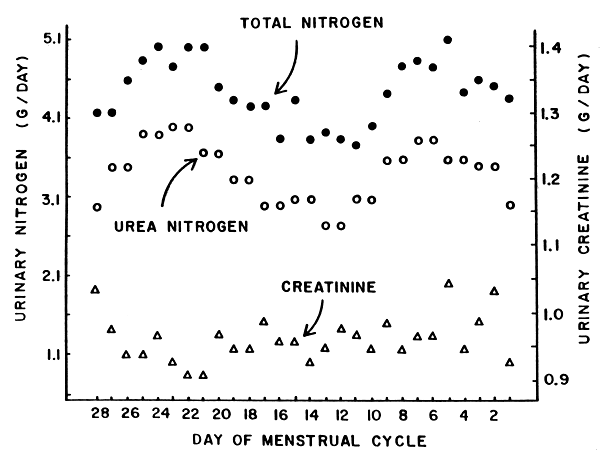
FIG. 1 From Calloway and Kurzer, ref. 3
| Subject | Entire menstrual cycle | Lowest days2 | Highest days2 | ||||||||
| Intercept | Slope | Requirement3 | Intercept | Slope | Requirement3 | Intercept | Slope | Requirement3 | |||
| g/day | mg/kg | mg/basal kcal | mg/kg | mg/kg | |||||||
| 5501 | -.606 | 0.11 | 5.41 | 88 | 4.8 | -.291 | 0.12 | 40 | --4 | --4 | --4 |
| 5504 | -.5415 | 0.115 | 4.795 | 905 | 3.75 | -.395 | 0.15 | 49 | -1.248 | 0.16 | 146 |
| 5505 | -.709 | 0.20 | 3.62 | 65 | 3.1 | -1.19 | 0.38 | 56 | -1.48 | 0.25 | 106 |
| 5506 | -.658 | 0.23 | 2.82 | 49 | 2.7 | -.256 | 0.21 | 21 | -1.21 | 0.28 | 74 |
| X ± SD | 4.16 ± 1.16 | 73 ± 20 | 3.6 ± 0.9 | 42 ± 15 | 109 ± 36 | ||||||
1 Nitrogen balance = Intake - (Fecal + menstrual + sweat + urinary) N.
2 Urinary N excretion for three successive days at the lowest and highest points in the cycle.
3 Requirement for zero balance; i.e., no allowance for hair, nails, etc.
5 Calculated from periods 2 and 4 only.
From Calloway and Kurzer, ref. 3
| Ref | m | Free-living | Confined | Conditions | Weight, kg | Energy, kcal/kg/d |
| Aged 19–41 years | ||||||
| 1 | 11 | x | Lab. workers, no protein | 60.0±2.3 | 41±1 | |
| 3 | 6 | x | 1 hr walk/d, var. prot. | 58.8±5.0 | 38.1±2.4 | |
| 4 | 10 | x | ½hr. walk/d, 0.8g prot/kg. | 60.9±8.9 | 35.7±1.0 | |
| 11 | 14 | x | Students, 7–15% prot. kcal. | 58.7±8.6 | 33±3 | |
| 14 | 7 | x | Lab. workers, Var. prot. | 51.0±5.2 | 38.6 | |
| 16 | 15 | x | Univ. staff/stud. var. prot. | 45–79 | 34.2 | |
| 17 | 1 | x | Var. prot., student? | 59.7 | 37.4 | |
| 18 | 7 | x | ½hr.walk., oral contracep. | 59.5±9.1 | 36.7±1.4 | |
| 19 | 7 | x | ½hr.walk., oc's, low Zn | 56.4±8.0 | 38.9±1.4 | |
| Aged 65 and older | ||||||
| 10A | 7 | x | Var. protein | 68.9±5.7 | 27.6±6.1 | |
| 10B | 6 | x | ½hr.exercise, var. fiber | 61.8±4.5 | 32.8±2.6 | |
REFERENCES
10B. Calloway, D. H. and S. Meyer. Unpublished. Univ. Calif., Berkeley.
