Total external aid costs of PPP projects average $63 per year per group member and less than $11 per beneficiary (i.e. the group member's dependants).
While average cost per participant and beneficiary is high at the start of the project, it declines rapidly as project staff are trained and groups become more self-reliant.
Thanks to economies of scale, the incremental cost per beneficiary of including a participatory component in a large-scale project would be even lower. Incorporating participatory elements involves the following extra costs:
▪ Financing a small number of locally recruited field workers to act as group promoters
▪ Inception and training workshops on participatory approaches and procedures
▪ Training for participants and project staff in participation
▪ Participatory research and monitoring and evaluation, which cover group formation, action, performance and constraints.
The cost of adding these elements would be balanced by the improved design of the project and, in the long run, by its increased social and economic benefits.
Two perspectives
PPP's benefits can be measured from two perspectives, that of individual participants and that of society in general. Benefits to participants include:
▪ Increased food production. In Ghana, groups' maize output is 20 percent higher than that of non-participating farmers. Similar results have been recorded in Kenya, Sierra Leone and Sri Lanka.
▪ Higher net family incomes. Proxy indicators such as high loan repayment rates, rising levels of group savings and visible improvements in participants' housing conditions point towards increased net family incomes.
▪ Increased employment. Production technologies employed by PPP groups tend to be low-cost and labour intensive. The most common indicator of greater rural employment opportunities is the participants' increased output per hectare, which generates demand for more farm labour.
▪ Higher rates of saving. Per capita savings registered in PPP projects — e.g. $21 in Kenya, $39 in Swaziland and $40 in Zimbabwe — represent a major achievement.
▪ Acquisition of new skills. A clear benefit emerging from PPP evaluations is the acquisition by participants of technical, organizational and leadership skills.
Benefits for society include:
▪ Creation of “zero-cost” receiving systems. For delivery systems, the provision of financial, extension and other services to organized small farmers is more cost-efficient than traditional methods.
▪ Building of rural community infrastructure at low-cost. Groups in all PPP projects have initiated community improvement activities, using their own labour and materials. This infrastructure is built and maintained at minimum cost to government.
▪ Strengthening of rural institutions. Many rural institutions, such as cooperatives, do not function efficiently because members have little scope for participation in decision making. As PPP groups link up with these institutions, they stimulate improvements in organizational performance, reducing the need for government support.
| Declining costs of PPP projects |
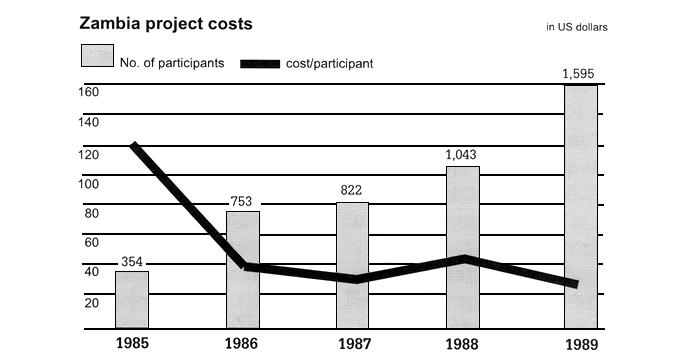 |
| The chart above shows how annual costs per participant declined during implementation of the Zambia PPP project. In 1985, when 354 people had joined groups, average cost per participant was about $120. |
| By 1989, with 1 595 people participating, costs per head had fallen to only $28. |