

Groupe de travail ad hoc sur les aspects économiques de l'exploitation des sardinelles et autres espèces de petits pélagiques de l'Afrique du Nord-Ouest CRODT, Dakar, 1–3 décembre 1993
Mercredi ler décembre
INTRODUCTION
SITUATION ACTUELLE DES PECHERIES AUX PETITS PELAGIQUES OUESTAFRICAINES - PRESENTATION GENERALE
VALEURS DES CAPTURES COURANTES (par pays, espèce et méthode de pêche)
TENDANCES DES PRIX DES ESPECES DE PETITS PELAGIQUES - DONNEES HISTORIQUES ET PREVISIONS POUR LE FUTUR (marché local et marché d'exportation)
INFRASTRUCTURES DE TRAITEMENT APRES CAPTURES ET ASPECTS DE VALEUR AJOUTEE
MARCHES (marchés local et mondial) ET RESEAUX DE DISTRIBUTION
Jeudi 2 décembre
COUTS DE LA PECHE ET ANALYSE FINANCIERE DES OPERATIONS DE PECHE (secteurs artisanal et industriel, opérateurs étrangers et nationaux)
ANALYSE ECONOMIQUE DES OPERATIONS DE PECHE
ASPECTS DE POLITIQUE NATIONALE ET MACRO-ECONOMIQUES CONCERNANT LE DEVELOPPEMENT DE LA PECHE (gestion, SCS, changement de pavillon)
Vendredi 3 décembre
SCENARIOS DE DEVELOPPEMENT FUTURS POSSIBLES DU SECTEUR DES ESPECES DE PETITS PELAGIQUES DANS LA SOUS-REGION
POTENTIEL DE DEVELOPPEMENT INDUSTRIEL BASE SUR LA PECHE AUX PETITS PELAGIQUES
ROLE FUTUR DES OPERATIONS DE PECHE ETRANGERES ET NIVEAU POSSIBLE DE LA PARTICIPATION LOCALE (NATIONALE) DANS CE SECTEUR
CONCLUSIONS
RECOMMANDATIONS DE SUIVI
| Hmida ATMANI | Economiste |
| ISPM | |
| 2, rue Tiznit, B.P. 21 | |
| Casablanca, MAROC | |
| Moustapha DEME | Economiste |
| CRODT | |
| B.P. 2241 | |
| Dakar, SENEGAL | |
| Mark HOEKSTRA | Economiste, |
| Ministerio das Pescas, Agricultura Animação Rural | |
| Caixa Postal 115 | |
| Praia, CAP-VERT | |
| A.B.C.JONES | Economiste de pêche |
| Department of Marine Resources | |
| Ministry of Agriculture, Natural Resources and Forestry | |
| Youyi Building - Brookfields | |
| Freetown, SIERRA LEONE | |
| Z.W.KASPRZYK | Economiste/planificateur (consultant) |
| B.P. 3528 | |
| Antanarivo 101, MADAGASCAR | |
| Moustapha KEBE | Economiste |
| CRODT | |
| B.P. 2241 | |
| Dakar, SENEGAL | |
| Ismaila THIAM | Economiste |
| CNROP | |
| B.P.22 | |
| Nouadhibou, MAURITANIE | |
| G.V. EVERETT | Fonctionnaire principal |
| Division des politiques halieutiques et de la planification | |
| FAO | |
| Viale delle Terme di Caracalla | |
| 00100 Rome, ITALIE | |
| Lena WESTLUND | Analyste en planification des pêches |
| Division des politiques halieutiques et de la planification | |
| FAO | |
| Viale delle Terme di Caracalla | |
| 00100 Rome, ITALIE |
| Année | Sardinella maderensis | Decapterus rhonchus |
|---|---|---|
| Prix moyen (en Escv/kg) | Prix moyen (en Escv/kg) | |
| 1986 | 40 | 95 |
| 1987 | 48 | 94 |
| 1988 | 68 | 101 |
| 1989 | 183 | 203 |
Source:
Exposé M. Hoekstra.
| Année | Sardina pilchardus | Scomber japonicus | Engraulis encrasicolus |
|---|---|---|---|
| Prix moyen (en DH/kg) | Prix moyen (en DH/kg) | Prix moyen (en DH/kg) | |
| 1975 | 0.34 | 0.24 | 1.10 |
| 1976 | 0.31 | 0.46 | 1.01 |
| 1977 | 0.58 | 0.37 | 0.98 |
| 1978 | 0.57 | 0.34 | 1.21 |
| 1979 | 0.52 | 0.53 | 1.29 |
| 1980 | 0.47 | 0.55 | 1.60 |
| 1981 | 0.54 | 0.74 | 1.11 |
| 1982 | 0.76 | 0.44 | 1.20 |
| 1983 | 0.64 | 0.52 | 1.34 |
| 1984 | 0.85 | 0.44 | 1.73 |
| 1985 | 1.01 | 0.51 | 5.11 |
| 1986 | 0.87 | 0.42 | 7.38 |
| 1987 | 0.90 | 0.74 | 0.70 |
| 1988 | 1.16 | 1.56 | 0.19 |
| 1989 | 1.12 | 1.03 | 0.18 |
| 1990 | 0.90 | 1.35 | 6.82 |
| 1991 | 1.08 | 1.90 | 4.59 |
| 1992 | 1.24 | 1.87 | 6.65 |
Source:
Exposé H. Atmani.
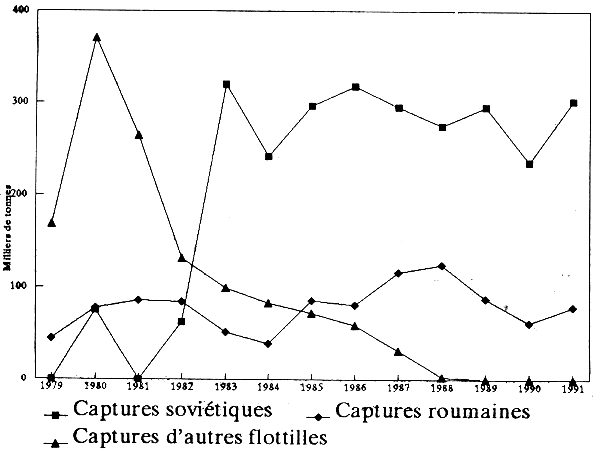
Source:
Exposé I. Thiam.
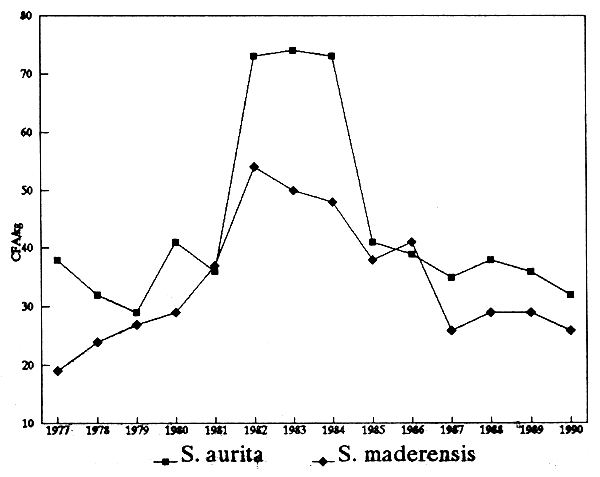
Source:
M. Debe / CRODT.
Exposé de discussion préparé par
Mlle Lena Westlund
Analyste en planification des pêches
Division des politiques halieutiques et de la planification
Service de planification du développement
FAO
pour le
Groupe de travail ad hoc sur les aspects economiques de l'exploitation des sardinelles et autres especes de petits pelagiques de l'Afrique du Nord-Est
L'exposé est préparé dans le but de servir comme base de discussions. Par conséquent, il ne doit être considéré ni définitif, mais plutôt àtitre d'indication et comme un outil pour la réunion, une aide pour les discussions sur les coûts de pêche et sur comment évaluer ces coûts dans les analyses de coûts/bénéfices. Quelques exemples des calculs de “cash flow” et de rentabilité interne sont présentés. En outre, quelques aspects concernant la différence entre l'analyse financière et l'analyse économique sont traités. La discussion se base sur la pêche en Afrique de l'Ouest et couvre les différents types d'embarcations allant des pirogues artisanales aux chalutiers congélateurs.
Les coûts de pêche peuvent être divisés en coûts fixes et en coûts variables. Les coûts fixes incluent les dépenses financières, frais d'assurance et de licence, et la partie fixe des salaires. Les coûts variables sont, entre autres, les salaires à prime ou àrendement, le petit entretien et les réparations, le carburant et le lubrifiant, et, le cas échéant, des frais de transformation (e.g., congélation, réfrigération).
Au tableau de l'exposé, quelques analyses financières des unités de pêche différentes sont résumées. Les données, qui viennent de rapports et sources différents, ne sont cependant pas entièrement comparables. De plus, quelques valeurs sont plutôt arbitraires et, par conséquent, pour permettre d'en tirer des conclusions plus précises, des vérifications devraient être faites. Néanmoins, on pourra constater que surtout les grandes unités, i.e., chalutiers “Super Atlantic” de pêche, sont difficilement rentables.
Quant aux analyses économiques, il faut prendre en considération les prix de référence. Ceux-ci représentent des coûts qui ne sont pas traités de la même manière dans le calcul financier pour la société privée et dans le calcul économique national, par exemple des subventions et des impôts. Un autre aspect dans l'analyse économique est le coût d'opportunité du travail.
Discussion paper prepared by
Ms Lena Westlund
Fishery Planning Analyst
FAO Fishery Policy and Planning Division/
Development Planning Service
for
Ad hoc Technical Meeting on Economic Aspects of the Exploitation of Sardinellas and Other Small Pelagic Species Off the Northwest Africa Dakar, 1–3 December 1993
1. INTRODUCTION
This short paper is prepared to serve as a basis for discussions. Therefore, it should be considered as neither exhaustive nor definitive, but merely as a tool for and guidance to the meeting in support of its discussions regarding different aspects of costs of fishing and how to evaluate them in a cost and earnings analysis. Some examples of cash flow and internal rate of return analyses are also given. Furthermore, some aspects of the difference between financial analysis and economic analysis are discussed.
2. COSTS OF FISHING
2.1 Introduction
The costs of fishing operations can be divided into fixed and variable costs. Fixed costs are mainly capital expenditures. Other costs such as insurance fees and non bonus components of crew salaries are also fixed, at least within certain capacity ranges. Typical variable costs include labour and fuel costs. These costs are either variable with the amount of catch or time spent at sea.
The following discussion covers aspects of fishing costs in West Africa for different types of vessels ranging from artisanal canoes to large freezer trawlers.
2.2 Fixed Costs
2.2.1 Capital costs
The assessment of the capital investment component in the financial analysis, can be made in different ways, depending on the information available and the framework of the analysis. Often the replacement value of the vessel is used. This is probably the best measurement as long as the calculation is not made for one specific vessel or fleet for which each actual value, age and state is known. If this information is available the market value, i.e., the price the vessel would fetch if sold, could be used. Another possibility is to use the vessel's insured value.
The life span of a vessel varies according to the vessel type. For canoes, it has been seen that the life span varies considerably depending on the landing site. Very rough landing sites in some places, and the more protective sites in others, influence the life span markedly3. The annual cost of depreciation is most commonly calculated assuming linear depreciation over the life span.
Regarding financial costs, the manner and the cost of financing a vessel will vary with the type of vessel. An artisanal canoe could be financed by the owner or his family and will in that case not incur any direct expenses for interest. The money could also be borrowed from for example a fish trader with payment of interest in kind or by selling future catches at a preferential price. The actual cost of interest is then difficult to evaluate4. Vessels such as freezer trawlers are usually financed on international financial markets or through equity and the expenses for interest represent a relatively well-defined and significant part of fixed costs.
An opportunity cost is usually unavoidable in all investment analyses. This would be true for the industrial fisheries sector. However, in the artisanal sector it is more questionable whether the opportunity cost is relevant since other investment options might only be available in theory.
Gear expenditures can be either treated as an investment cost or as a variable cost depending on the type of gear and its life span.
2.2.2 Insurance fees
The world fleet average for insurance cost has been calculated as 2% of the replacement value, varying between 1.6% and 6% depending on the GRT class5. However, usual practice for artisanal vessels is not to take out vessel insurance.
2.2.3 Licence fees
The large freezer trawlers operating off West Africa, are almost exclusively foreign owned, and will pay licence fees to the countries in whose EEZs they fish. These fees may be a major component of the total operating costs. The fees could be levied on a per GRT basis, alternatively, or in addition, a fee may be assessed based on the amount of fish caught. In some countries, a part of the catch may be taken in lieu of money, e.g., former Soviet Union vessels fishing in Sierra Leone6.
2.2.4 Fixed labour costs
In the industrial fisheries sector, crew costs usually consist of two components; a fixed salary and an incentive bonus. In the artisanal sector, only bonus salary, i.e., revenue sharing, is used as crew remuneration (see below).
Expenditures for food, taxes and social security charges etc are crew related costs in addition to salary cost and must be included.
2.3 Variable Costs
2.3.1 Labour costs
In the artisanal sector, remuneration of crew in most cases depends on the net revenue of the fishing operation. Different systems for calculating the crew's part are used in different fisheries and in different locations. Usually the net revenues are divided between the owner, the vessel and the crew. An example from Senegal, gives the following division of the revenues of a team operation of two purse seine canoes7:
| Total sales revenue: | X |
| - Fuel costs | Y |
| Net revenue | Z |
Out of the net revenue Z, one third goes to the owner representing the share for the net. The remaining two thirds is divided between the crew, the canoes and the engines:
1 share to each canoe;
1 share to each of the two engines;
1 share to each fisherman;
2 shares to the captain.
In the industrial sector, a combination of a fixed salary component and a bonus salary, dependant on the catch rate, is used. For example, crew payments budgeted by the Nigerian
National Fish Company for their factory vessel, contained a 58%-bonus component of total salary8.
2.3.2 Maintenance and repair costs
The world wide average cost for routine maintenance and repair of a vessel has been estimated to be between 6 and 11.25% of the vessel's replacement value depending on the GRT9. These figures will vary depending on how, for example, gear replacements are treated in the analysis. Regarding small-scale canoes operations where nets are constantly replaced and repaired, it can be difficult to separate investment and repair costs.
2.3.3 Fuel costs
Fuel and lubricants are usually the largest component of fishing operating costs. The cost depends, in most cases, on the time spent at sea (and not necessarily with the catch rate) since more time can be spent travelling to the fishing grounds that fishing. The cost of fuel will naturally vary according to how fare the vessel must go to catch the fish. This can vary considerably with season and is of particular importance to the costs and earnings analysis of the small-scale canoe fisheries10.
2.3.4 Processing costs
If the catch is refrigerated either ice or refrigerated sea water is usually used. The costs for refrigeration could be considered processing costs. Processing costs on freezer trawlers can be considerable and requires more thorough calculations.
2.3.5 Miscellaneous costs
Other costs that should be considered, according to their relevance in each case, are vessel's management costs, administrative costs, taxes, port fees, expenditures for bait etc.
3. FINANCIAL ANALYSIS
In the following table, some examples of costs and earnings, cash flow and internal rate of return analysis are given. The information has been summarized from various reports and the analyses of the different vessel types are therefore not fully comparable. Furthermore, some values are quite arbitrary and would have needed further verification if precise conclusions are to be drawn.
| COST AND EARNINGS PER ANNUM (in USD) | ||||||||||||
|---|---|---|---|---|---|---|---|---|---|---|---|---|
| Canoe purse seiner | Inshore purse seiner | Offshore purse seiner | Freezer trawler/ Super Atlantic | Poli canoe/ purse seiner 1) | Purse seiner 2) | |||||||
| Operating area Type of catch | Ghana Sardinella | Senegal/lvory Coast Sardinella | Namibia Sardines | Angola Horse mackerel | Ghana Sardinella | Morocco Sardines | ||||||
| Investment | 25,000 | 120,000 | 1,000,000 | 15,000,000 | 26,038 | 196,319 | ||||||
| Expected life span | 3 | 10 | 15 | 15 | 5 | 10 | ||||||
| Interest rate | ||||||||||||
| REVENUES | ||||||||||||
| Catch per annum(MT) | 180 | 438 | 5,000 | 15,000 | 1,259 | |||||||
| Price/MT | 100 | 100 | 100 | 100 | 113 | |||||||
| TOTAL REVENUES | 18,000 | 43,750 | 500,000 | 1,500,000 | 29,547 | 142,267 | ||||||
| COSTS | ||||||||||||
| Insurance | 0 | 0 | 30,000 | 450,000 | 0 | 8,525 | ||||||
| Labour | 4,320 | 28,800 | 36,000 | 180,000 | 11,836 | 69,152 | ||||||
| Repair and Maintenance | 1,250 | 9,600 | 80,000 | 900,000 | 2,519 | 11,367 | ||||||
| Fuel | 8,100 | 5,775 | 66,000 | 1,320,000 | 5,875 | 11,444 | ||||||
| Miscellanous | 0 | 4,375 | 50,000 | 75,000 | 0 | 7,492 | ||||||
| TOTAL COSTS | 13,670 | 48,550 | 262,000 | 2,925,000 | 20,230 | 107,980 | ||||||
| >PROFIT/DEFICIT BEFORE DEPRECIATION AND FINANCIAL COSTS CASH FLOW) | 4,330 | (4,800) | 238,000 | (1,425,000) | 9,317 | 34,287 | ||||||
| Depreciation cost | 8,333 | 12,000 | 66,667 | 1,000,000 | 5,300 | 19,632 | ||||||
| Financial cost | 0 | - | - | - | 0 | 9,816 | ||||||
| PROFIT/DEFICIT | (4,003) | (16,800) | 171,333 | (2,425,000) | 4,017 | 4,839 | ||||||
| CASH FLOW AND INTERNAL RATE OF RETURN ANALYSIS (in USD) | ||||||||||||
|---|---|---|---|---|---|---|---|---|---|---|---|---|
| Canoe purse seiner | Inshore purse seiner | Offshore purse seiner | Freezer trawler/ Super Atlantic | Poli canoe/ purse seiner 1) | Purse seiner 2) | |||||||
| Term (years) | 3 | 10 | 15 | 15 | 5 | 10 | ||||||
| Discount rate | 10% | 10% | 10% | 10% | 10% | 10% | ||||||
| Annual revenues | 18,000 | 43,750 | 500,000 | 1,500,000 | 29,547 | 142,267 | ||||||
| Annual costs | 13,670 | 48,550 | 262,000 | 2,925,000 | 20,230 | 107,980 | ||||||
| Yearly cashflow | 4,330 | (4,800) | 238,000 | (1,425,000) | 9,317 | 34,287 | ||||||
| NPV revenues | 44,763 | 268,825 | 3,803,040 | 11,409,119 | 110,480 | 874,169 | ||||||
| NPV costs | 33,995 | 298,319 | 1,992,793 | 22,247,783 | 75,643 | 663,493 | ||||||
| investment | 25,000 | 120,000 | 1,000,000 | 15,000,000 | 26,038 | 196,319 | ||||||
| NPV CASH FLOW | (14,232) | (149,494) | 810,247 | (25,838,663) | 8,799 | 14,357 | ||||||
| INTERNAL RATE OF RETURN | N.A. | N.A. | 22.69% | N.A. | 23.15% | 11.68% | ||||||
1) Exchange rate
2) Exchange rate1990:1 USD=265 cedis 1989: 1 USD = 8.15 DH
3.1 Canoe Purse Seiner,Inshore Purse Seiner, Offshore Purse Seiner and Freezer Trawler/Super Atlantic11
The estimates of capital and operating costs are based on examination of different conditions in the region.
The fuel cost is estimated to US$ 250 per 1000 litres.Insurance has been assessed only for the middle and high cost vessels and is estimated to 3% of the investment value. The calculation of crew costs was found difficult in view of the different wage rates along the coast and within the fishery sector itself. For the three bigger vessels, the wage rate has been set at US$ 300/month. The canoe wage cost is considerably lower; US$ 30/month. Maintenance and repair costs represent 6–8% of the investment value of the vessels, whereas other costs, including licence fees, port taxes etc - shown as“miscellaneous” - are calculated as a percentage of revenue. Processing costs, discussed above, have not been taken into account. Neither have any assessment of the financial cost been done.
3.2 Poli Canoe/Purse Seiner12
The analysis is based on a thorough study by means of interviews with the fishermen concerned. Investment and operating costs have been calculated as averages of the gathered information. Financial cost has not been included since few of the interviewed fishermen financed their investment through the formal banking system, but rather by themselves or through an informal credit system. The actual cost of this kind of financing was considered too difficult to evaluate in a satisfactory way to be included in the analysis.
3.3 Purse Seiner13
The investment and financial costs are based on estimates from shipyards and banks. Maintenance and repair and miscellaneous costs are set to a percentage of revenues. Labour costs are based on a share system.
4. ECONOMIC ANALYSIS
4.1 Shadow Prices
From the perspective of private company operations, duties and taxes that must be paid are not different to any other costs of fishing operations. However, from a national economic perspective, duties on, for example, imported fishing gear or taxes on fuel etc, would represent revenues from the fishery. Also taxes on company profits and income tax on crew's wages and bonuses will be revenues in a national economic analysis. Conversely, subsidies which are beneficial to the company, e.g., for fuel and gear, as well as provision of shore infrastructure etc, represent national costs of the fishing operations.
11 “Promoting industrial fisheries in West Africa”, G.V. Everett, 1993, FAO, (UNPUBLISHED).
When a cost or input factor is taxed or subsidized, the cost or revenue to the fishing company will not reflect the actual cost to the society. Such adjusted prices - “shadow prices” - represent the full unsubsidized or untaxed price of a product or a service.
4.2 Foreign Exchange Considerations
Net foreign exchange earnings from a fishery may be of major concern in national economic planning. A fishery can generate foreign exchange by exporting its products or it can contribute to net foreign exchange earnings through savings, i.e., domestic catches substituting for a product that otherwise would have been imported. These aspects could be of significant importance in an economic analysis of a fishery operation.
Imported trawlers and expenditures for outboard motors, are examples of foreign exchange costs. If the foreign exchange needs of the country exceed that available, and if the country applies a two-tier currency exchange system through which funds are made available to a fishery at the lower exchange rate, it may be appropriate to use shadow prices for foreign exchange. Some other sector might have been prepared to pay the higher price for the foreign currency to obtain imported items. In such a case, the difference between the two exchange rates is often referred to as shadow price for foreign exchange.
4.3 Opportunity Cost of Labour
In an economic analysis, wage rates should be set equal to the opportunity cost of labour. Where there is a high level of unemployment or underemployment, for example in many rural areas, opportunity costs of unskilled or semi-skilled labour is close to zero. On the contrary, in a fishery which requires for example highly skilled engineers, the opportunity costs of labour may be important.
1 $EU équivaut:
| CAP-VERT | 85 Escudos |
| GAMBIE | 9 Dalasis |
| GUINEE | 970 Sylis |
| GUINEE-BISSAU | 11 500 Pesos |
| MAROC | 9,5 Dirhams |
| MAURITANIE | 125 Ouguiyas |
| SENEGAL | 290 FCFA |
| SIERRA LEONE | 570 Leones |
Bellemans, M.S., 1983. Les revenus et la rentabilité de différents engins de pêche artisanale à Mbour. Document scientifique N. 86, CRODT.
Bjorndal, T., 1992. Towards a management plan for the Moroccan sardine fishery, FAO/UNDP project MOR/86/019.
Callerholm Cassel, E., 1991.Cost and earnings and credit studies on Ghanaian canoe fisheries, FAO/DANIDA/NORWAY project IDAF.
Chaboud, C. et Deme, M., 1991. 38. Ressources instables et pêche semi-industrielle: les exemples sénégalais et ivoiriens, Pêcheries ouest-africaines - variabilité, instabilité et changement, ORSTOM Editions.
Deme, M., 1988. Etude économique et financière de la pêche sardinière sénégalaise, Document scientifique N. 107, CRODT.
Durand, M.-H., 1984. La pêche artisanale au Sénégal; l'approche d'une enquête, Université de Paris I Panthéon-Sorbonne.
Everett, G.V. Promoting industrial fisheries in West Africa, document FIPP/C857 (En), FAO, (in press).
Frielink, A.B., 1987. Costs and earnings of the industrial sardinella fisheries in three West African countries in 1983, CECAF/TECH/87/80, FAO.
Leslie, J., 1991. The analysis of artisanal fisheries data; Catch and financial returns in Tombo, Sierra Leone 1987-1990, GTZ, Sierra Leone.
Sandy, J., 1992. Bulletin of fisheries statistics, West/Northwest artisanal fisheries and community development programme, EEC project No. 6100.36.46.007, Sierra Leone.
Shotton, R., 1982. Preliminary assessment of the Northwest African small pelagics fishery, CECAF/TECH/84/56, Dakar.

