Access to agricultural resources and services
Land. Although only male heads of household have land rights, rural women traditionally have access to land. Problems of lack of access may arise particularly in the case of widows who are not on good terms with their in-laws. The concept of land title is not yet widespread in rural areas, except among an elite.
Livestock. In all regions of Cameroon, the family farms raise small livestock (goats, sheep, pigs, and/or chickens), which are tended to by women and children.
Forestry. More than 50% of the country is forested. Government plans in the forestry sector include people's participation in managing community forests in the framework of new legislation regarding forests
Water. According to the Ministry of Mining, Water and Energy, 40% of the rural population has access to safe drinking water. However, as a result of the financial crisis, over 40% of the supply systems are not operational. Moreover, in certain areas of the Extreme Northern Province, women have to travel 10 km or more to obtain water.
Credit. Lack of access to credit is a problem for both rural men and women, due to high interest rates and collateral requirements. The Agricultural Credit Bank of Cameroon is not yet carrying out activities in the area of rural credit, but measures have been taken to institute credit funds that are accessible to the rural population. The Investment Fund for Agricultural and Community Micro-Enterprises (FIMAC) finances projects presented by both men's and women's groups.
Extension services and agricultural training. In the past, extension services were directed almost exclusively to cash crops. In line with the new focus on food production, the National Project for Extension and Agricultural Training (PNVFA) was established in 1988, and became operational in 1990/91 in 6 out of 10 provinces. However, partly due to the economic crisis, the project has yet to give adequate attention to the food production sector. Until the United Nations Conference on Environment and Development in 1992, little attention was paid to extension in the forestry sector. Subsequently, a Ministry of Environment and Forests was set up and initial efforts begun. The Government has also drawn up a plan for livestock extension.
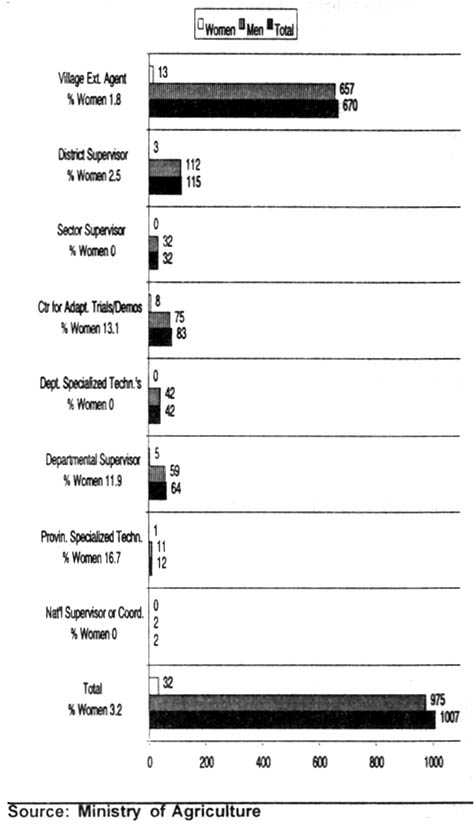
While women comprise 25% of extension agents in forestry, they comprise only 3.2% of extensionists in agriculture. Very few women have benefitted from extension or agricultural research, and most are carrying out their tasks without the benefit of labour-saving technologies.
Agricultural Extension Staff by Position and Gender, 1992/93