


To contribute to the achievement of the goals and objectives of the National Population Plan through an integrated approach to improve the living conditions of small-scale fisherfolks, with particular emphasis on women.
(a) By the end of project life, at least 50% of project participants would have increased their income; improved their skills in managing their micro-enterprises.
(b) By the end of project life, at least 50% of project participants would have manifested positive changes in attitudes, knowledge and practice in FP/POP-ED and MCH related matters.
(c) By the end of project life, a community-based/managed integrated system would have been developed and tested.
An estimated 3,200 women in 13 coastal communities in Pangasinan and 7 coastal communities in Capiz will directly participate in the project.
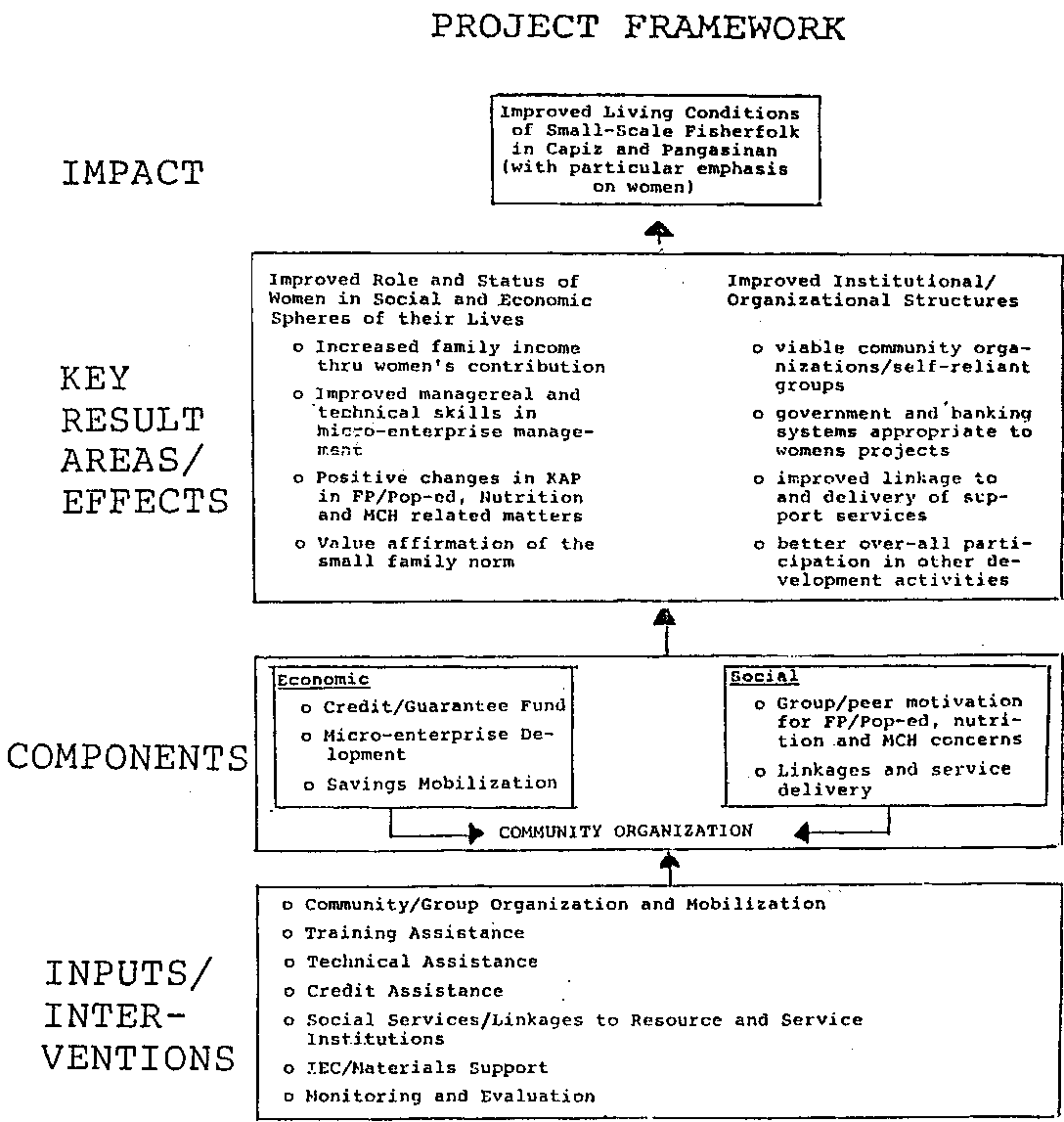
The two major components, namely the economic and social development components will be managed as one inter-active whole. Both components will be supported by (a) participative problem needs identification survey; (b) a training system; and (c) ongoing technical assistance.
The community organization principle is applied in introducing in an interactive manner, the economic and social development inputs, into the selected women participants.
Economic inputs will be provided in the form of revolving fund, to support income-generating activities of the women. Social development focus will be in areas related to population education, family planning, MCH and nutrition. Based on the same community organization principle, these groups will organize and manage their own concerns in both economic and social development concepts. The groups will manage their own motivation strategies and facilitate required services.
Technical guidance in various aspects of both the economic and social development aspects as well as in community organization will be provided by the project staff, supported by FAO. The key person at the barangay level is the Field Worker or Area Coordinator.
Figure 1 presents the project's conceptual framework.
* 30 Women Groups (WGs) with 864 members were organized in 7 coastal municipalities of Capiz
* 48 Women Groups with 1185 members were organized in 13 coastal municipalities of Pangasinan
Annex 2 presents the total membership of WGs organized organized from 1990-1994.
* WGs were trained in the areas of team building, organizational skills, micro-enterprise development and family welfare. Refresher training activities were also conducted.
* A total of 332 training were conducted for 7,738 women participants.
Annex 4 presents the summary of training conducted by the project for women participants from 1990-1994.
* Through project consultants and specialists, technical assistance provided to WGs in the preparation of project proposals for funding and specific fishery-related technologies
* 1612 members received loans totalling P7,242,245.16 to finance income-generating projects in 1993. An additional loan of P1,863,668 was released as of August 1994.
* Repayment rate is 81/. for 1993 and 78% for 1994
* Percent utilization of Guarantee Fund for both provinces is 190% in 1994
Annex 4 shows the summary of credit assistance extended by the Project.
FIGURE 1
* Family welfare classes conducted
* Family planning referral system in place
* Linkages with DOH, POPCOM, FPOP, USAID, UNICEF and other line agencies established at local levels
* Social action projects in various stages of implementation
* Contraceptive prevalence rate for women participants increased from 20% in 1990 to 65% in 1994
Annex 4 presents the contraceptive prevalence rate from 1990-1994.
* Produced 3-year calendar and comics for WGs
* Produced Field Worker's Manual and Diary for Project Staff
* Produced a Consolidated Manual of Training Activities for PHI/89/P16 WGs
* Installation of client-based and gender-focused monitoring tools and evaluation
* Annual Tripartite Reviews
