


Module 1 - Rural women in non-formal population education
Purpose:
* This Module provides basic background on the population situation and the problems common to rural women in South East Asia.
* The importance of integrating non-formal population education (NFPE) in rural development programmes and projects is discussed.
* More than 50% of the population in South East Asia depends on agriculture for a living.
* Except for Malaysia and Singapore, the rest of the countries in the region have economies based on agriculture.
* South East Asia is composed of the following countries:
- Brunei Darussalam |
- Myanmar (formerly Burma) |
- Indonesia |
- Philippines |
- Cambodia |
- Singapore |
- Lao People's Democratic Republic (Laos) |
- Thailand |
- Malaysia |
- Viet Nam |
South East Asia
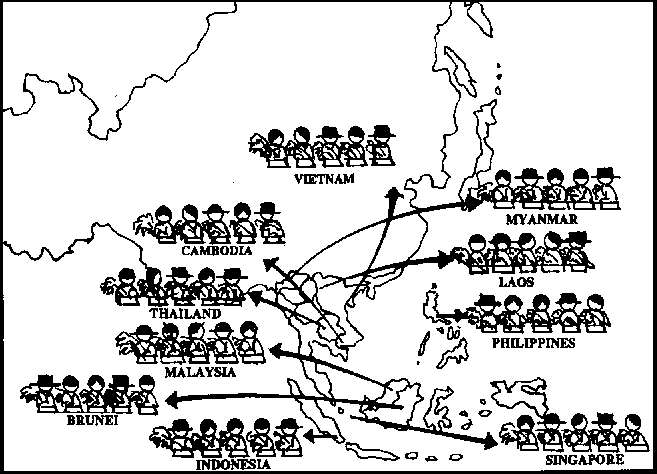
DEMOGRAPGHIC ESTIMATES FOR SOUTH-EAST ASIA, 1994
Region/Country |
Mid- 1994 Population (in thousands) |
Annual Grown Rate (in %) |
Total Fertility Rate(*) (per woman) |
Projected Population to 2010 (in thousands) |
Brunei Darussalam |
282 |
2.6 |
3.4 |
406 |
Cambodia |
9,222 |
2.4 |
4.4 |
12,959 |
Indonesia |
194,937 |
1.6 |
2.8 |
240,935 |
Lao PDR |
4,742 |
2.9 |
6.4 |
7,119 |
Malaysia |
19,683 |
2.3 |
3.5 |
26,138 |
Myanmar |
45,573 |
2.1 |
4.1 |
61,631 |
Philippines |
67,898 |
2.0 |
3.8 |
89,337 |
Singapore |
2,933 |
2.0 |
1.8 |
3,158 |
Thailand |
59,396 |
1.3 |
2.1 |
71,118 |
Viet Nam |
72,342 |
2.0 |
3.8 |
97,097 |
South-East Asia |
477,008 |
1.8 |
3.2 |
609,898 |
Source: UN. Economic and Social Commision for Asia ant the Pacific. Demographic Estimates for Asian and Pacific Countries and Areas, 1994.
* Total fertility rate represents the average number of children that would be born alive to a woman if she were to live to the end of her child-bearing years (i.e., age 15 to 49) conforming to the age-specific fertility rates (i. c., The number of live bir the per 1,000 women at different child-bearing ages) of a given year.
* More than two-thirds of South-East Asian population is rural and the majority will remain rural for decades to come (UN Population Division, 1993.)
* A large portion of the rural population in this region are women who are engaged in various types of agricultural work such as planting crops, food processing, animal husbandry, inland fisheries and marketing of agricultural products. Women farmers comprise a significant proportion of the total agricultural labour force in most countries, ranging from approximately 35% in the Philippines to over 60% in Thailand (FAO/UNFPA, 1991.)
Figure
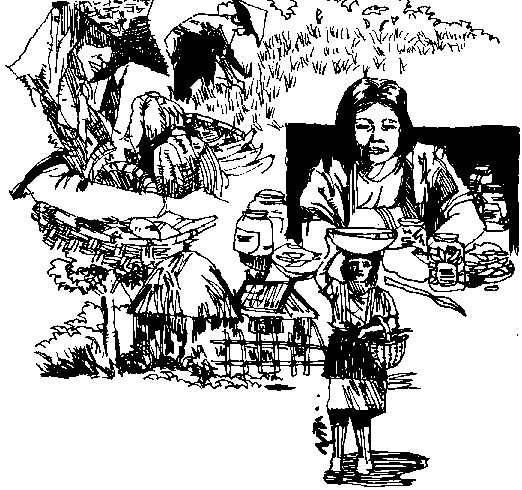
* Though their role in agriculture is vital for the well-being of families and the society as a whole, women nevertheless carry a triple burden in their everyday lives: as wives and mothers, as agricultural producers and as community workers.
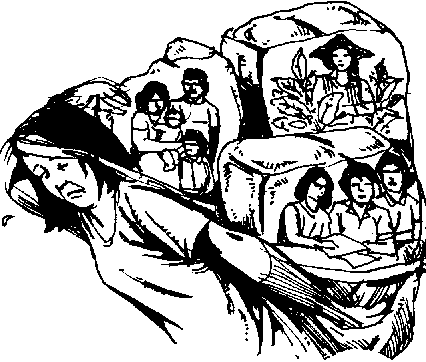
* As daughters, women often have primary responsibility far the care of the aged.
* As wives and mothers, women are expected to be responsible for childbearing. child-rearing and taking care of their husbands.
Figure
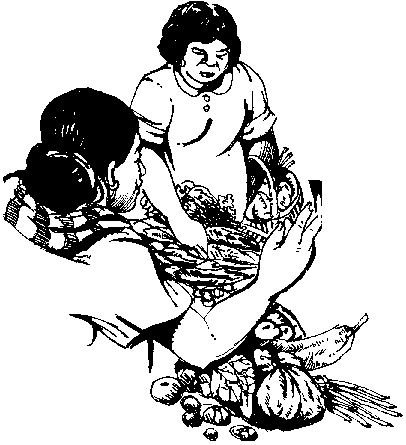
* As agricultural producers/ marketers, women are expected to sow, plant, weed, harvest, process and sell the crops.
Figure
* As community workers, women serve as volunteers for health, livelihood and other social development programmes.
Figure
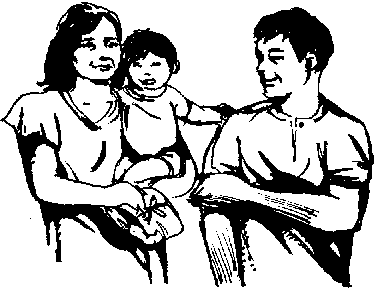
It is unfortunate women have not been given equal recognition in society, compared to men. This is shown by the fact that women have lower levels of literacy and education, lower income and social status, and less participation in political affairs and in decision-making. Women also work for longer hours and often are not paid for most of the work that they do.
What are the problems that have kept women from getting into their rightful place in rural development?
Sex discrimination
* Women are still regarded as the inferior sex. Note these comments from some people in the region:
Figure
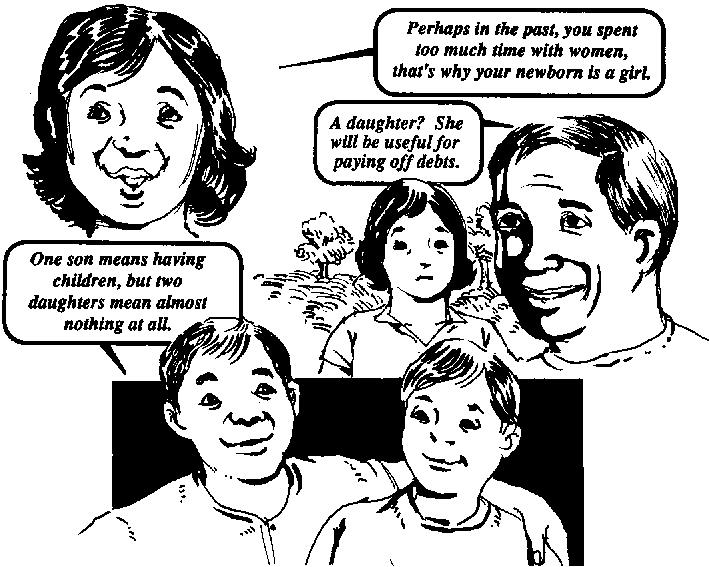
* In the above examples, the low regard for women has the effect of increasing population. How? The wives are expected to have more children until they meet the desired number of sons.
* Other forms of discrimination against women:
- Most women cannot get financial credit on their own because they do not own land, cattle or other types of collateral. Often, their husband's approval is needed to obtain credit or a loan.
Figure
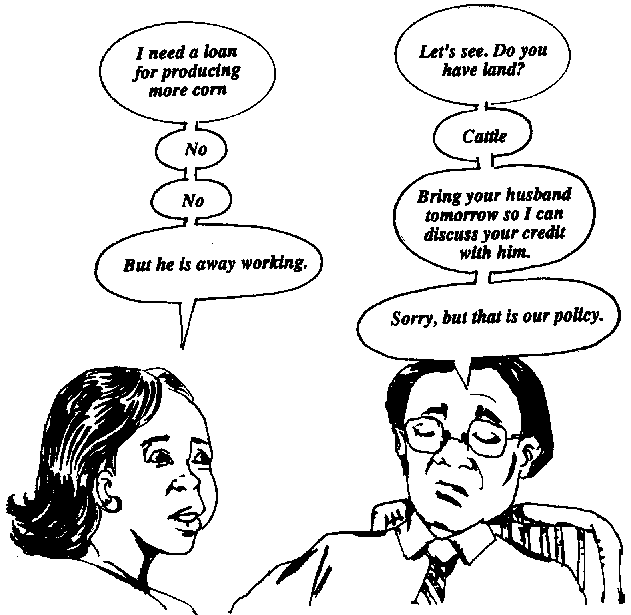
- The narrow economic opportunities for rural women lower their self-confidence. This strengthens their notion that, for them to be useful, they must give their husbands the number of children the latter desire.
- Unequal pay for equal work. In some countries in the region, women are paid lower than men for the same amount and quality of work.
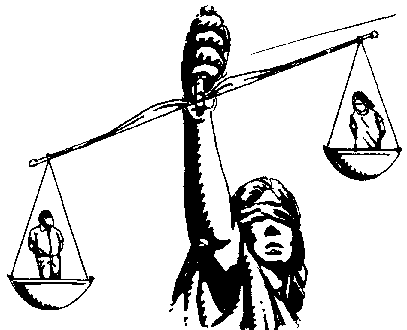
All of the above are true, even if the Constitutions of most countries in South East Asia affirm the equality between men and women.
* For example, the Constitution of Malaysia states that: "All persons are equal before the law and are entitled to equal protection of the law."
* The Thai and Indonesian Constitutions have the same provision as that of Malaysia.
* The Philippine Constitution is more explicit in its regard for women:
The state recognizes the role of women in nation building, and shall ensure the fundamental equality before the laws of men and women. (Sec. 14, Art. 11, 1986 Constitution of the Philippines).
* However, a basic problem is that laws governing the rights of women are usually not enforced.
Figure
Non-involvement in family decision
* Most women cannot take part in making decisions important to their lives. These include matters like childbearing and how the household income will be spent.
Figure
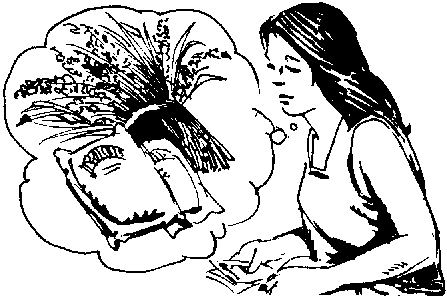
* It has been recorded worldwide, however, that if women are able to take a more active part in making decisions, the quality of family life will improve. There will be fewer and well-spaced children. A bigger part of the family income will be spent on such basic needs as food, health and education. Studies have shown that women tend to put priority on these needs rather than on items like clothing and household appliances.
Figure
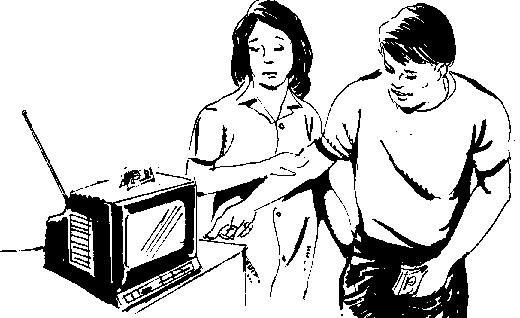
* Women do not get the same recognition (financial, social, legal, etc.) as men for their contributions to agricultural development.
* Worse, women do not have much choice in childbearing, which is one of the most important aspects of their lives.
* Few realize that this lack of choice (whether or not to have children) is a factor in the increase of population.
* The United Nations Population Fund (UNFPA) 1990 Report says: "If women who wanted no more children had the choice there would be a 38% reduction in the births and a 29% drop in maternal deaths worldwide."
* Rapid growth of the rural population has resulted in worsening living conditions for family households and entire communities. For women, this has made the job of obtaining resources, such as water and fuel, and ensuring stability of family nutrition, more difficult.
* An increase in family size means that less land will be available for cultivation for each member of the family if the inheritance is divided equally.
* All the above, in turn, hamper the effective planning and delivery of rural development programmes and projects.
* Non-formal population education (NFPE), also known as out-of-school population education, can be considered as life-long, continuous means of upgrading one's knowledge, attitudes and skills on population - related concerns affecting individual, family and community well-being.
* NFPE is versatile. It can be integrated into ongoing rural development programmes and the regular activities of outreach workers.
* Where there is also a formal process of population education, it can be complemented and strengthened by NFPE.
Population education can be integrated into the various activities of ongoing programmes and projects.
Below are examples of such activities:
Adult education/functional literacy trainings
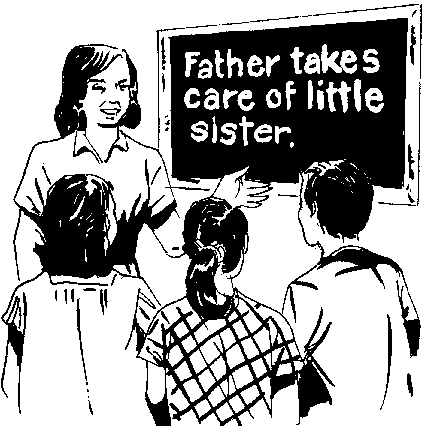
* Sentence construction in reading/writing classes can impart simple gender sensitive population messages.
* For example:
- Father helps mother in cleaning the house.
- Father takes care of little sister.
Figure
Agricultural extension training/orientation
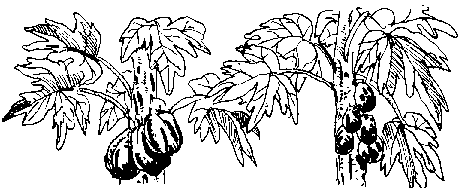
* The role of agricultural extension training in non-formal population education is crucial. Training in food production, for instance, can easily integrate health and population concerns even by way of illustration.
* A favorite example is the analogy given by Philippine Secretary of Health Dr. Juan Flavier. He cited that papaya fruits grow bigger and sweeter when there are only few of them on the tree.
Figure
Cooperatives
* In forming a cooperative, there is usually a value-formation portion in the training.
* Population messages as they relate to cooperative development, can be discussed during the training, and also during meetings.
* In forming a cooperative there is usually a value-formation portion in the training that can highlight the fact that the bigger the family size, the smaller is the share per family member.
Figure

Health Education
* Health education classes conducted by both government and non-government organizations always provide opportunities for incorporating population education.
* Malnutrition, poor hygiene and unsound sanitation contribute to infant and child mortality in developing countries. This may result in high fertility levels as couples try to compensate for high infant and child mortality.
Women's Organizations
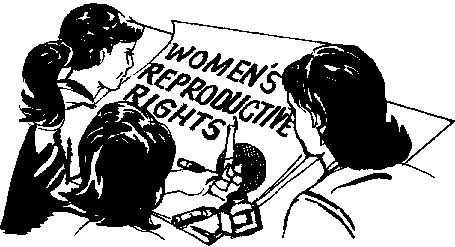
* The process of organizing women entails orientation/reorientation sessions, where gender concerns and population issues can be introduced.
* It is therefore natural that in above sessions, such as the role of women in agricultural development, women's reproductive rights, and other such topics be discussed.
Figure
Farmers' Organizations
* Farmers' organizations have a wide range of opportunities for integrating population and development messages.
* For instance, during training on new technologies concepts on human reproduction can be introduced. Seasonal production, where the conditions are suited to the optimum growth of certain types of crops can be compared to the idea of spacing the children, so they come at the proper season. That is, if the time is right for having a child, the family will be financially and emotionally prepared. In addition to that, the mother is physically ready for the demands of a (new) child.
Figure
Home Economics Education
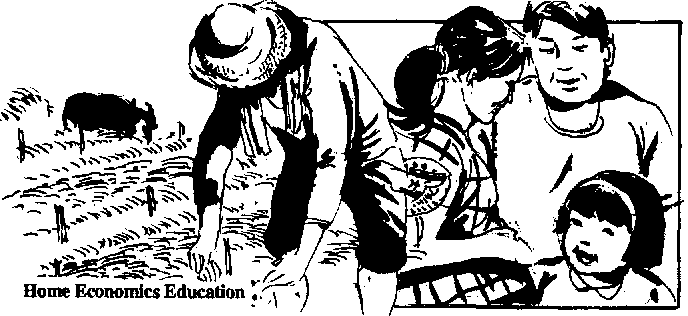
* In most South East Asian countries, home economics education usually prepare young girls to be good and productive housewives.
* In others, it is extension work that provides more skills to rural housewives/women on food preservation, dressmaking, handicrafts, etc.
* Sessions in home economics provide excellent opportunities for introducing population education messages. For instance, time allocation for household chores usually done by women can be shared by the male members of the family.
* The indirect effect on the decision of women not to have more children can be brought about by the skills introduced in home economics classes. Now that they have acquired new skills to earn additional income, women would be mare involved in the decision of whether or not to have more children.
Follow-up Support for Formal Education
* Follow-up support to formal education at the elementary level has been found to be effective.
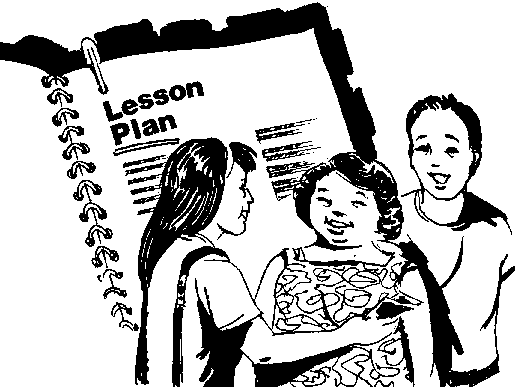
* In the Philippines, for example, a method for following up lessons learned in the elementary school classrooms has been developed through the Teacher-Child-Parent Program. Nutrition and population messages are incorporated into lessons in Home Economics and Livelihood Education, Science, Mathematics, etc.
* The messages are transmitted to the parents through children's notebook/workbooks which the parents are made to sign.
* The teacher conducts home visits to provide assistance in understanding and appreciating the mesages being popularized.
Figure
Media
* Radio Plugs/Dramas
- Radio plugs are the most common, and perhaps the easiest method of popularizing population messages.
- A 30-second radio plug repeated several times a day has been found to be effective in guiding the actions of the listener.
- Serialized dramas can also incorporate population messages as part of the content.
- The advantage of using radio is that the audience could follow the programmes without interrupting their day-to-day activities.
- Workers planting rice, for instance, have radio as their constant companion, either through the music it generates, or through the group's favorite soap opera (drama series).
* School in the air
- This is a popular format among rural extension workers.
- Radio programs are usually scheduled early in the morning, presumably while the housewives are cooking breakfast.
- Extension workers provide support to the program by giving the school-on-the-air enrolees the needed workbooks/materials required by the program.
- The workers likewise monitor the responses to the questions posed in the radio program, to ensure that the learning by the enrolees is progressing as expected.
Figure

* TV Plugs/Drama/Quiz Shows
- Although messages from TV have more impact than those coming from the radio, they reach a smaller segment of the rural population. This is because in most communities in the region, only those from the higher income bracket have TV sets.
- Just like in the radio, soap operas, TV plugs and quiz shows can all be used as a means for disseminating population messages.
* Comics
- The highly visual and easy-to-read format of the comic magazines make them the preferred materials in rural communities.
- Comics have a distinct advantage because they can be passed on from one person to another, or they can be read over again for review
Figure

Persons/groups/organizations to link with
* Depending on the area, there are plenty of sources for support in conducting NFPE.
* Retired school teachers, for instance, have been found to be one of the most effective trainors/facilitators in NFPE.
* Community groups or organizations can be tapped to provide technical and material support for NFPE. The Primary Health Workers or their equivalent can provide information and manpower support for house-to-house campaigns.
* It is extremely important to be in close coordination with local health units, since most of the services needed by the population are delivered by this sector.
Figure
* Outside the communities, there are plenty of development organizations that can help boost our NFPE efforts. Appendix D provides a list of sub-national, national and even international organizations with whom to link.
In linking with other organizations for NFPE, it would be helpful to go through the following steps:
* Study the aims and objectives of the group/organization; find out their target groups and their area of coverage.
Figure

* Talk to the key persons in that group/organization. Tell them about the situation in your area, the objectives of the NFPE and the aspects of the work where you need most help. Where possible, it would be better if the members of the community/target groups for NFPE are included in this meeting. Later on, the community members can be the ones to continue the linkages with these organizations.
Figure
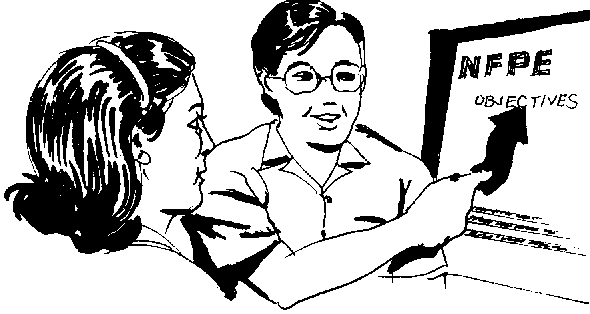
* Get the commitment of the organization to support the NFPE. A simple, written agreement will go a long way towards clarifying expectations from both sides -- yours and that of the supporting group/organization.
Figure

* Invite representatives from the support group to observe/take part in the NFPE sessions. In this way, the commitment of this group/organization to assist the NFPE efforts shall be strengthened.
* Keep the support group/organization updated with the progress of your NFPE. If the group/organization is giving financial/material resources, the supporting group/organization would welcome an accounting of the donation or grant that they have given.
Organizing networks/institutional umbrellas to sustain NFPE
Eventually, it would be helpful to put together a network of organizations/ institutions to sustain the NFPE. This could be done by bringing together these support groups to regular meetings where they can discuss and plan out how they can coordinate and integrate their support to the NFPE.
