


SOWING THE SEEDS OF KNOWLEDGE
As farming gets more complex and greaser crop yields are required to feed more people on less land for each, farmers' know-how needs to be constantly upgraded. Agricultural research profits no one if its results are not communicated fruit filly to the farmer. Some regions are well served by extension or on-farm training, more formal agricultural education and communication services such as farm reports on radio. Other regions have a great need for this critical input: knowledge.
Farm Agents Bring Extension to the Field
TODAY, most countries have some type of extension system, by which agents take the latest advice and research findings right to the farmer's field. An estimated US$6 billion a year is spent and some 600 000 extension workers are engaged worldwide in serving the educational needs of farmers, herders, foresters, fisherfolk and others.
Even with this effort, only a small fraction of those in need of extension is being served, and the quality and relevance of service are uneven. By 2000, an estimated 1.25 million trained extension workers will be needed.
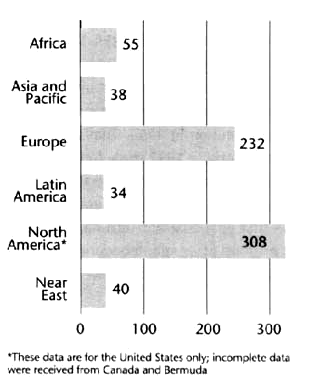
Considerable contribution to increased production has been obtained through technology development. However, with transfer successful mainly for medium and large scale farming, much less has been achieved in transferring technology to subsistence farmers in a participatory manner. Worldwide data indicated that in 1989 only about 6 percent of extension personnel time was devoted to women farmers and 7 percent to young farmers and rural youth. There is also considerable regional disparity in extension coverage (see chart).
Financial support for extension varies worldwide from as little as 0.2 to 0.5 percent of agriculture domestic product (AGDP) in some countries to as much as 6 percent in others. The average is about 0.5 percent. It is recommended that developing countries should invest between 1 to 2 percent of AGDP in extension.
Agents for 100000farmers, 1988
Agricultural Education at the Crossroads
QUALITY FORMAL and non-formal education in agriculture is a prerequisite for development. Yet FAO figures show that investment in agricultural training, extension and research has declined from 9 percent of total donor agricultural assistance in 1984 to 2 percent in 1989. Notwithstanding a lack of funding, some progress has been made. For example, the enrolment of women in intermediate and higher level agricultural education in Africa has increased from an average of 15 percent to nearly 25 percent. In order to provide more useful service to agriculture, institutions need to:
- revise curricula to include the role of women in farming and environmental protection.
- play a developmental role through outreach activities and linkages with farm communities.
- improve training in technical agriculture and in methods to communicate production technologies to small-scale farmers
- promote indigenous knowledge and farmer-to-farmer sharing of information whenever and wherever appropriate.
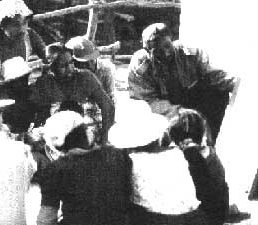
Extension worker talks with farmers in Madagascar
Defining the Target Audience
A large majority of the agricultural labour force of 1.3 billion (1995) people worldwide needs ongoing training, especially:
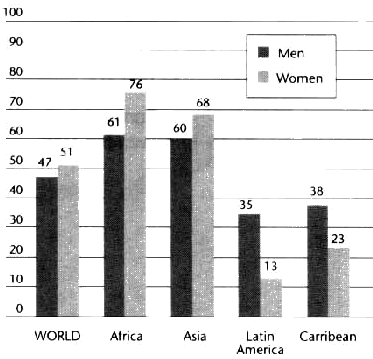
- women, who make up 51 percent of the agricultural labour force worldwide, need appropriate training and information, usually different than men;
- illiterate, small-scale, resource-poor farmers;
- farmers using unsustainable methods and those achieving only Low productivity;
- Young people, the next generation of farmers;
- agricultural extension agents, communication specialists, technicians, government and private service providers.
Agricultural labour force by gender in 1985 (% of active population)
Communication at the Service of the Disadvantaged
COMMUNICATION methodologies and tools can help overcome the barriers of illiteracy, language, intercultural difference and physical isolation. A good communication strategy can establish a dialogue with rural people, involve them in the planning of their own development and convey knowledge and skills necessary for improved farming.
Key methodologies and approaches include:
- the development of rural radio;
- the use of traditional and popular media to change lifestyles;
- multimedia campaigns for transfer of technology;
- the use of video for training illiterate farmers;
- participatory research methods.
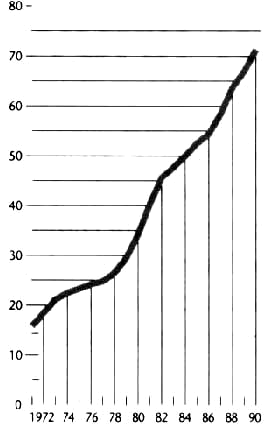
Estimates of radio sets in Sub-Saharan Africa
Training and Communication: Excellent Return on Investment
- A strategic extension campaign on rat control in Malaysia costing US$140 000 saved 1 885 tonnes of rice worth US$859 320 from 477 one-hectare farms in only one season.
- In the United States, from 1922 to 1972, public investment in research and extension accounted for 60 to 70 percent of the progress towards higher efficiency.
- In Thailand, its government extension budget increased from US$54 million in 1987 to US$191 million in 1994. Thailand is one of the few hod surplus developing country.
- In Nigeria, a 1992 study found that an increase in the average education of a small-scale farmer by one year increased the value added to agricultural production by 24 percent.
- In a study of 22 sub-Saharan African countries, crop yields increased by 40 percent in the first year that agricultural extension was offered.
- A group of developing world farmers who had completed four years of elementary education had 8.7 percent higher productivity than a control group.
Multimedia impact
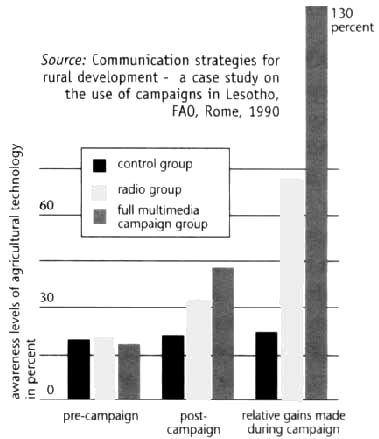
Pinpointing Problems....
In order to make progress in the struggle to upgrade farmers' knowledge and skills, the following problems must be addressed:
- lack of funds and unstable policy on extension, training and communication;
- shortage of trained staff and equipment;
- inadequate coverage of the growing farming population, especially women, small farmers and rural youth;
- inadequate communications, transport and roads linking extension agents with their clients;
- keeping up to date on an increasingly complex message to farmers, including environmental issues such as soil and water management, and economic issues such as farm management, credit and marketing;
- the perception that extension, training and development communication is an unnecessary expense, rather than an investment in food security and sustainable agriculture and rural development that yields good economic and social returns (see box above).
... and Possible Solutions
Four trends are emerging in countries that have made a serious effort to provide extension and education for all farmers. They are:
- Countries such as Thailand, China and Zimbabwe have increased budgets for extension and education.
- China, following the lead of the USA and Japan, is sharing the cost between the central and local governments.
- Ministries of agriculture are forming partnerships with agricultural colleges, NGOs and private firms to provide a "pluralistic" extension, training and communication service.
- Wealthier farmers pay for services so that governments can concentrate on providing extension and training for poor farmers.
- Wider application of participatory extension approaches as well as approaches with high multiplier effects such as use of mass media, distance learning, training of trainers and farmers' field schools.
For further information, please contact:
Information Division, Food and Agriculture Organization of the United Nations
Vialle delle Terme di Caracalla, 00100 Rome, Italy. Tel:
(39-6) 52 2 5-3276/52 25-4243; Internet: http://www.fao.org or gopher:fao.org
Research, Extension and Training Division, (39-6) 5225-3363
