


All the coastal states in the northern subregion of CECAF have claimed extensions of jurisdiction over the fishery resources off their shores. Although not all the claims are out to 200 nautical miles, they are all of sufficient breadth to cover the narrow continental shelf and enclose the most valuable stocks of fish.
However, the precise delimitation of the boundaries between adjacent and opposite coastal states has not yet been achieved, except in the case of Senegal and the Gambia. As in many areas of the world, it may be several years before all the disputes are settled and the maritime bounderies become fixed.
Since the determination of the boundaries is a matter of wealth distribution, it can only be resolved by the concerned states. Although the median line principle1 is generally accepted as one of the most important bases for demarcating a border, it is not the only one. Discussions of the relative importance of the different principles are still under way at the 3rd United Nations Conference on the Law of the Sea.
1 Under the median line principle, a line is drawn such that every point on the line is equal in distance to the nearest points on the baselines of the opposite or adjacent coastal states.Although the maritime boundaries have not yet been decided, it is still clear that many of the most important stocks of fish in the subregion are shared by two or more of the coastal states. This is particularly critical in the case of the high valued stocks of cephalopods. The major fishing grounds for the cephalopods are illustrated in Figure 5. It has been estimated that about 75 percent of recent catch has occured in the region from Cape Garnett to Cape Barabas (from about 26°N to 22°30'N) (FAO, 1978a). Since the potential economic rents in this zone are very high and there is a high degree of apparent overexploitation, there is considerable urgency for the coastal countries concerned in the exploitation of the resources to reach agreement on the distribution of the benefits and on the management of the stocks.
Fig. 5 - Main fishing grounds for cephalopods
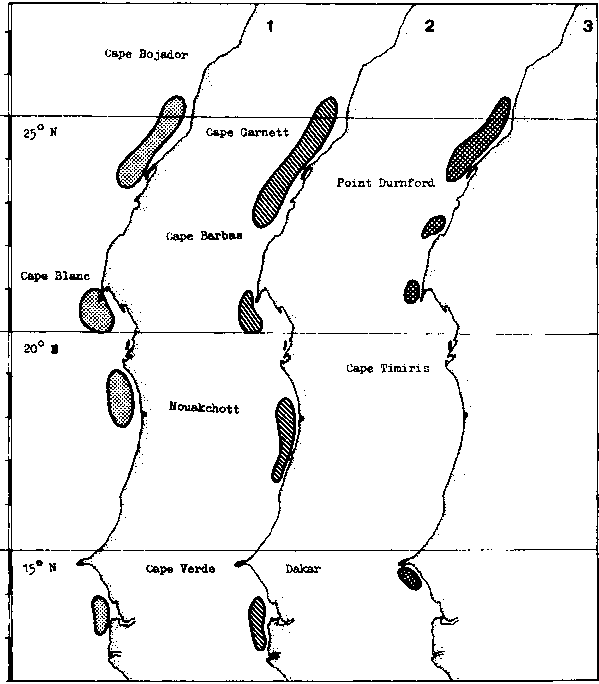
Source: FAO, 1978a, Figs. 1,2,3.The cephalopod fishing grounds south of Cape Verde are shared by Guinea - Bissau and the Republic of Guinea. Although it has been estimated that only about 2 percent of recent catch occurs in this zone, this is a new development and one that is likely to increase in the future (FAO, 1978a)1. Thus, it is important that Guinea-Bissau and the Republic of Guinea also reach an early agreement" on the management and distribution of the stocks.
1 A more recent estimate indicates that the cephalopod (mostly cuttlefish) catch in this area was about 8 percent of the total in the period February 1978 - February 1979 (Yamamoto and Ansa-Emmim, 1979a).The distribution of the sardine fishing grounds is shown in Fig. 6. The relative importance of the different fishing grounds has gone through major changes in the past few years. Between 1976 and 1978, the catch in Zone B went from 15 percent of the total to 42 percent, whereas the catch in Zone C declined from 60 percent to 16 percent (FAO, 1979b). This change is due almost entirely to the termination of fishing by Soviet and Polish vessels in Zone C. As shown in the map, this Zone is shared by Morocco and Mauritania. As in the case of the cephalopods, there is a pressing need for agreement between the two states on the management of the stock and sharing of the benefits.
Most of the other stocks of importance are more widely distributed in the northern subregion of CECAF. Among the horse mackerels, Trachurus trachurus occurs northward of about 13°N (Boely and Freon, 1979) and is thus shared by Senegal, Mauritania and Morocco. T. trecae occurs in its greatest abundance from The Gambia to Nouadhibou and Caranx rhonchus from Guinea to northern Mauritania (Boely and Freon, 1979). For the round and flat sardinellas, the distribution is about the same as that for Caranx rhonchus (Boely and Freon, 1979).
With regard to the hakes there are three separate species with overlapping distributions. Although Merluccius merluccius is found as far south as Dakar, the main fishing grounds are in Morocco (FAO, 1978c). Merluccius senegalensis occurs mostly between 13°N (just south of the Gambia) and about 20°N in Mauritania, and M. cadenati from about 8°N (off Republic of Guinea) to 22°N in Mauritania (FAO, 1978c). Other demersals are found throughout the subregion, although there are differences in their distribution associated with the differences in the kinds of sea bottom (FAO, 1979c). Many of these may be made up of separate stocks and fall within the jurisdiction of individual coastal states.
Aside from some of the latter group of demersals, most of the species mentioned above occur in stocks that are common to the jurisdiction of two or more coastal states and therefore, require joint decisions on management and allocation. For several of the species, particularly the pelagic ones, these decisions are complicated by seasonal migrations and differences in vulnerability in different areas. The complications, however, do not remove the necessity for joint decisions.
