1. STRUCTURE
As shown in the flow chart (Figure 1), the operational analyses are built up from individual component microcomputer spreadsheet modules, each representing a discrete part of the real-life system. Links are provided between modules so that data and results can be automatically sent to where they are needed for further calculation. For example, a section dealing with investment in the fishing fleet typically passes results to two destinations: fish landing forecasts are moved to the next stage of the operational analysis, i.e., shore-based activities, whilst revenues and costs go to the financial/ economic summary. This structure enables the user to concentrate on a particular area, trying out different ideas locally, without being forced to examine global consequences of every single change. Only the results of the final change need be used elsewhere in the analysis.
2. CONTENT
The mechanisms used within modules dwell only on such detail as is strictly relevant to the investment profile in question. For example, seasonal variation of supply can sometimes be treated as a simple constraint on days at sea, but on shore might require a monthly analysis for each year of the forecast. The same considerations apply to short-term random variation of supply, whose impact on shore processing and inland transport must be examined in detail. In this study, a similar approach to short-term aspects of fishing operations would be superfluous. There follows a brief description of the main models used.
3. VESSELS
The main effect of introducing CSW stowage on board a fishing vessel, apart from fish quality improvement, is to modify the constraints under which the boat must operate. The basic computer model used here defines the constraints governing vessel operations, and performs straightforward calculations to determine the results. Although not complex, the vessel modules are exhaustive, as can be seen from the appropriate analysis tables in Chapter 5 to 8.
Vessel performance is restricted in the analyses by the following main constraints:
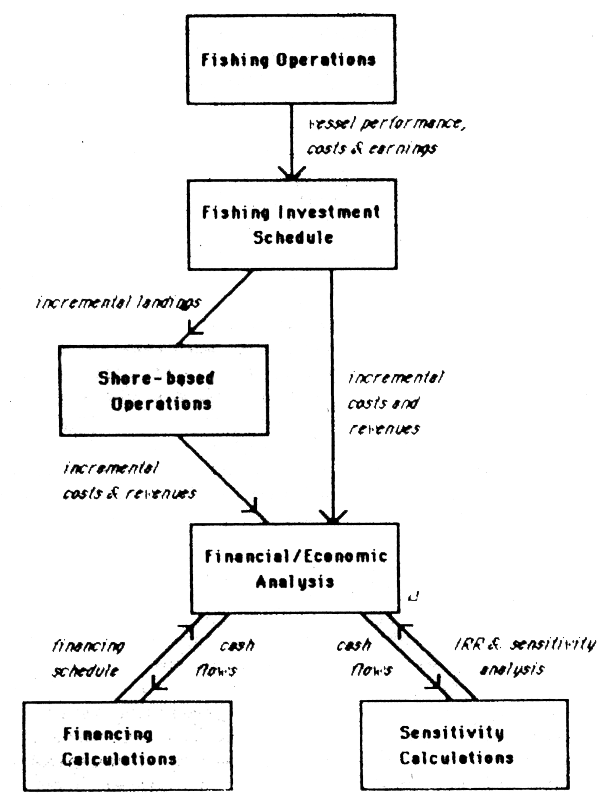
Figure 1 Overall structure of operational analyses
- hold capacity
- fuel capacity
- time available for fishing per trip
- days at sea per year
Other important variables include:
- horsepower
- age of vessel
- distance to fishing grounds
- catch rate
- operating and investment costs
- prices and revenues
All logical and temporal interactions between variables and constraints are included, e.g., age affects both days at sea and operating costs. The outcome in each case is a 10 year forecast of individual vessel operations, costs and earnings. If the investment comprises a CSW hold modification, the whole analysis is performed with and without the modification, so that incremental landings, revenues and operating costs can be estimated.
The final section is a schedule of the proposed investment, which calculates incremental landings, revenues and costs over a 10 year period for a group of vessels. These results are passed as input to appropriate destinations.
4. SHORE-BASED OPERATIONS
Central to the analyses of shore-based operations is the extent to which both the improved quality landings and the capacity to deal with them (processing and transport) can be utilized. In many small pelagic fisheries, the nature of their short-term variation pattern means that daily landings are below the seasonal average more often than above. On the rarer occasions when landings are above the seasonal average, the effects can be lessened by using buffer storage, such as CSW tanks. However, small pelagic landings tend to be so prolific when above the seasonal norm, that they swamp both regular processing/transport capacity and buffer storage. Even with good knowledge of the next days's landings, it is impossible to make full utilization of capacity, as the use of CSW is limited to 3 days from catching to final destination. The only way to obtain near 100% capacity utilization is to have relatively large average raw material supply, which also guarantees great wastage of fish. Conversely, the only route toward 100% utilization of landings is to tolerate heavily under-utilized processing capacity, or vehicles often idle. It is important to obtain the best compromise between these extremes, especially as fish quality has already been enhanced by investment earlier in the chain. Only in this way can the optimal plan for shore-based investment be found.
In this study, it was essential to be able to predict the proportion of landings utilized over a wide range of average supply relative to shore-based capacity. Relative variation arises either through seasonally changing landings against fixed shore capacity, or through studying the effect of changing capacity (e.g., number of trucks) when average landings are steady. The relevant calculations are performed using “utilization functions” derived mathematically from the pattern of random variation expected for each case. These manipulations are too complex to be described in this report, especially when evaluating the benefits of buffer storage. Suffice it to mention that all the shore-based analyses use appropriate utilization functions. Figure 2 shows a typical example. In all cases time spent in buffer storage is limited to one day.
The flow chart in Figure 3 shows the general method for analysing shore-based transport operations. Note the iterative procedure to calculate the optimal number of trucks. Figure 4 shows the method used for the Bali Strait, a fishery which already has some canning and freezing capacity, plus a special requirement for reconciling conflicting data obtained during the consultants' mission.
5. FINANCIAL AND ECONOMIC ANALYSES
The analysis tables for each country show all calculations which finally lead, through the relevant operational assessments, to financial investment appraisal. Results of economic analyses are shown only as brief summaries (economic rate of return and sensitivity analysis) together with the financial summaries. Internal rate of return is calculated by the standard discounted cash flow method. None of the examples of financing an investment are more than indicative, although the interest rates used reflect those prevailing in the countries concerned. Switching values are calculated using a iterative search procedure, to avoid laborious manual trial and error.
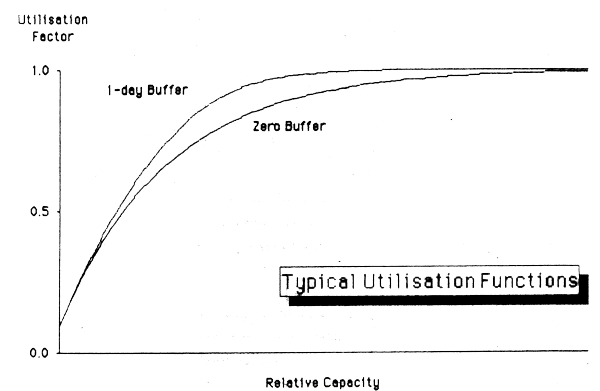
Figure 2 Typical utilization functions
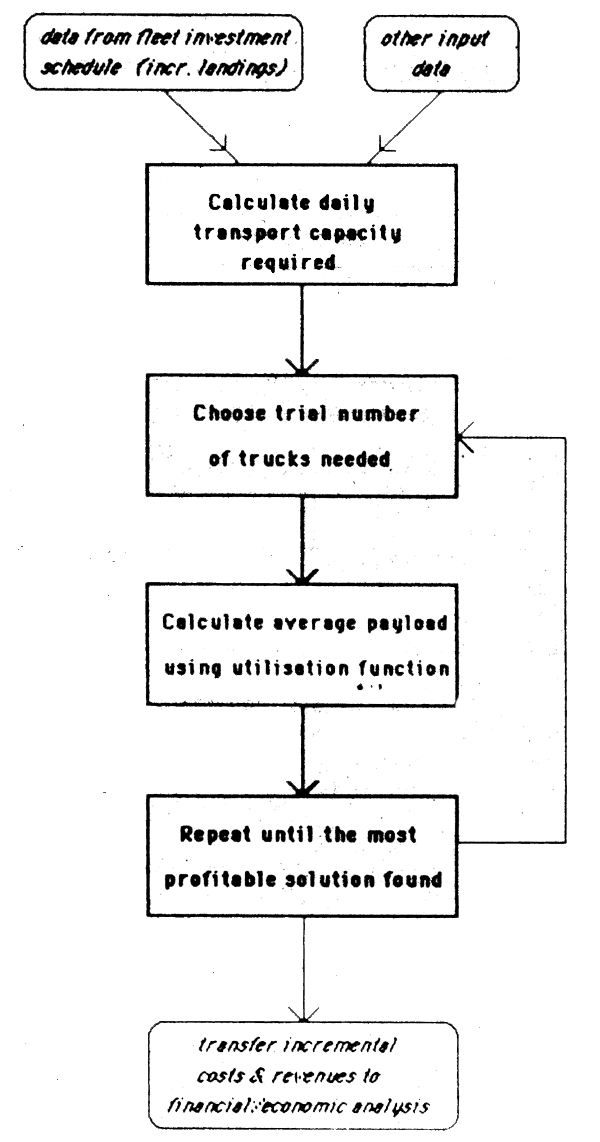
Figure 3 Structure of shore-based analyses
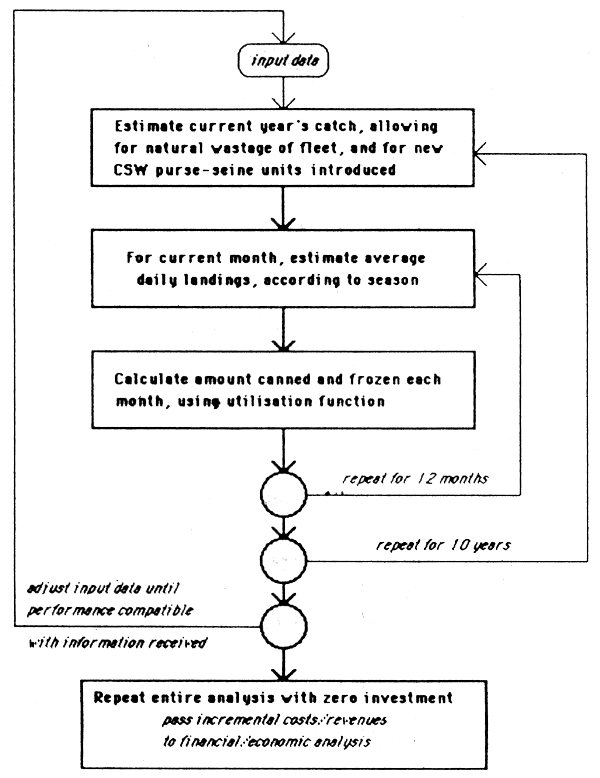
Figure 4 Structure of analysis for Bali Strait
1. GENERAL
Baum, W.C., 1981. The project cycle: seventh annual review of project performance audit results. Washington, D.C., World Bank
Campleman, G.,1976. Manual on the identification and preparation of fishery investment projects. FAO Fish. Tech. Pap., (149): 86 p. Issued also in French
Engstrom, J.E.,1974. Preparation of fishery investment projects. Proc.IPFC, 16(3):311–31
FAO, Report of the FAO World Conference on fisheries management and development. Rome, 27 June - 6 July 1984. Rome, FAO, pag. var. Issued also in French, Spanish, Arabic and Chinese.
Haywood, K.H., 1982. A methodology for investment planning in developing fisheries PhD. Thesis. University of Hull, England
Jarrold, R.M. and G.V. Everett, 1981. Some observations on formulation of alternative strategies for development of marine fisheries. Dakar, FAO/UNDP Project, CECAF/TECH/81/38:53 p. Issued also in French
Lanier, B.V., 1981. The world supply and demand picture for canned small pelagic fish. FAO Fish.Tech.Pap., (220):111 p.
Matton, E., 1982. Markets for frozen small pelagic fish. FAO Fish.Tech.Pap., (221):131 p. Issued also in French
Teutscher, F., 1979. A review of potential catches and utilization of small pelagic fish. Rome, FAO, TF/INT/298 (DEN), 59 p.
2. INDONESIA
FAO/World Bank Investment Centre,1985. Indonesia fisheries development project. 25/85 CP-INS-54. February 1985
Hotta, M.,1982. Fishery credit in Indonesia. A report prepared for the Fisheries Extension Services for Small-Scale Fisheries Project. FAO Field document 1. Rome, FAO FI:DP/INS/78/014:30 p.
Indian Ocean Programme, 1977. Report of the Joint Mission to plan development of the Sardinella fisheries in the Bali Strait. Rome, FAO, Indian Ocean Programme, IOP/TECH/77/15:51 p.
Putro, Sumpeno, Improved method of oil sardine handling using chilled seawater. Paper presented at the ACAIR Project Coordination Meeting, Denpasar, Bali, July 1982 (mimeo)
Suyuti, Nasran, Perbaikan Teknik penanganan lemuru di perahu motor purse-seine dengan sistim air laut yang didinginkan. Jakarta, RIFT, March 1985
3. INDIA
Haywood, H. and C.T.W. Curr, 1984. Economic evaluation of the purse-seining industry. FAO Fish.Circ., (751) Rev. 1:42 p.
Nordheim, A. and F. Teutscher, Financial aspects in using chilled sea water in handling of small pelagic fish on the west coast of India. Paper presented at the FAO/DANDIA Workshop on the handling of small fish in the Arabian Sea. Mangalore, India, 3–15 November, 1980. Rome, FAO, FAO-FII-GCP/INT/ 294(DEN):20 p. (mimeo)
4. THAILAND
FMO, The Fish Marketing Organization Bangkok
Thailand, Department of Fisheries, 1984. Fisheries Economics and Planning Sub-Division, Fisheries record of Thailand, 1982. Fish.Rec.Thailand, (57)
Vadhanakul, S.,M. Eiamsa-ard and N. Kuantanom,1975. Report on the survey of species composition of scrap fish in the Gulf of Thailand by M.V. PRAMONG II, 1974. Demersal Fish.Rep.Mar. Fish.Div.Fish.Dep.Bangkok, (1/1975):pag.var.
5. MOROCCO
FIDECO, 1974. Technical reports on the development of the fisheries in the Kingdom of Morocco. Norway, Fideco
Everett, G.V. et al., 1982. Recent trends in CECAF fisheries. Dakar, FAO/UNDP Project, CECAF/TECH/82/42:95 p. Issued also in French
Shotton, R., 1984. Preliminary of the northwest African small pelagics fishery. Dakar, FAO/UNDP Project, CECAF/TECH/84/56:118 p.