0516-C1
James Mayers and Sonja Vermeulen 1
Partnerships are increasingly seen as a route to sustainable forest management. But experience in how best to make partnerships work for partners, forests and the public good tends to stay at local levels, giving little opportunity for broader learning. To share experience more widely, this paper draws out key lessons from attempts around the world at partnerships for wood fibre production between forestry companies and rural communities. For this purpose, 57 examples in 22 countries were gathered and reviewed - from informal deals to contract-based outgrower schemes and joint ventures. Many, if not most arrangements between forestry companies and local communities are partial deals rather than well-developed partnerships. Though many are inequitable, or exist primarily to improve company image, deals between companies and communities are able to provide significant returns to local livelihoods as well as to company goals. The outstanding challenges to partnerships include overcoming the high transaction costs faced by both sides, and expanding the benefits to poorer members of communities. Experience to date offers several innovative means of tackling these and other challenges. Ways forward for company-community forestry partnerships centre on developing brokering roles, forming equitable, efficient and accountable governance frameworks, and raising the bargaining power of communities.
Globalisation of markets, capital flows and technology holds great potential gains for communities who have access to forest resources. To realise this potential, communities need to be able to exploit their comparative advantages and seize new economic opportunities while simultaneously withstanding the pressures of increased competition and inadequate social and environmental investment that global markets foster (Scherr et al. 2002). Similar forces apply to the forestry industry, with greater privatisation of forest resources and services, rapid increases in demand for wood fibre, a shift from natural forest to plantations as the main source of raw materials, ever more corporate mergers, and growing pressure for environmental and social responsibility (FAO 2001, Poschen 2001). As a backdrop to these global trends, governments and NGOs concerned with sustainable development are promoting partnerships as the key route for making progress towards sustainable development - for example at the Earth Summit in Johannesburg in 2002.
Within these contexts, a range of factors may determine whether companies and communities strike up deals or actively avoid them. For companies, external policy or market duress to practice fair trade or sustainable forest management may be important, as may economic considerations, such as the potential to cut costs, share risks or gain access to resources through engagement with local groups. Companies can provide skills, technologies, resources and access to markets that communities would otherwise be unable to obtain. Communities may aim for partnerships when they can make more money from growing, harvesting or processing wood fibre than alternatives would provide, but lack the means to exploit these advantages without services that the company can provide. Factors working against company-community deals include ineffective policy frameworks, poorly functioning markets, histories of conflict, and weak institutional mechanisms within the company, community or government (Mayers 2000).
Over the years, a spectrum of partnership arrangements between communities and forestry companies has been struck up - this paper aims to capture a cross-section of that wealth of experience (Figure 1). Detailed examinations of company-community forestry partnerships were conducted in six countries (Table 1) and supplemented with a set of shorter examples from around the world, giving a total of 57 examples from 22 countries.3
Table 1. Characteristics of company-community partnerships in six countries
Country |
Land tenure context |
Types of schemes reviewed |
Notable features |
South Africa |
Some community land, some large private plantations, many smallholdings - current land redistribution is taking trend from large towards smaller-scale |
Outgrower schemes - non-timber forest products and pulp Corporate social responsibility projects Joint ventures - pulp |
Big companies run schemes providing significant local livelihood benefits; scheme-management partly contracted out to NGOs; co-operatives and unions also established as alternatives to big company partners; communities forming trusts for joint ventures |
India |
Many smallholdings and some commons; by law companies do not have any access to large tracts of land for plantations so they must source raw materials from small-scale growers |
Farm forestry support - commodity wood and pulp Farm forestry crop-shares - pulp |
Rapid evolution of partnership schemes from free seed supplies, through bank loan contracts to loose buyer arrangements with companies that develop high quality tree clones for sale |
Indonesia |
About 75 % of land is classified as state forest and under government control though much is contested; otherwise smallholdings |
Outgrower schemes - commodity wood Co-management for non-timber forest products and service contracting |
Schemes dependent on high levels of government support, which is not always forthcoming; some progress now towards revenue-sharing in the long-established tenant farmer (taungya) schemes |
Papua New Guinea |
97 % of land is held under customary ownership - companies must negotiate with communities to operate logging concessions or plantations |
Concessions leased from communities Potential joint ventures Contracts from communities - commodity wood and outgrower schemes |
Communities are able to register as companies, though problems with accountability; novel legal mechanisms foster forestry development on customary land |
Ghana |
Most land is under customary tenure - companies must reach government-sanctioned arrangements with local owners |
Corporate social responsibility policy |
Workable system for participatory planning of company (and community) social responsibility built into tender process for logging permits |
Canada |
80 % of First Nation reserves are forested with varying splits of rights between customary groups and government - companies must negotiate with both |
Joint ventures, cooperative business arrangements and forest services contracting |
Communities able to register as companies; wide-ranging deals have allowed business diversification for both partners |
Before any partnership can develop, certain prerequisites must be in place. The most important of these are perhaps secure land tenure and enabling government policy. No single model of property rights is the correct one for forestry partnerships - they can work just as well for example on communally or individually held land - and the interplay between company-community deals and land tenure has many variations. Changes in land policy have been the impetus for partnerships in China and South Africa, while in Canada and Indonesia partnerships provide an arena for ongoing struggles for land rights. Enabling government policy can be targeted. For instance, in Ghana there is a requirement for social responsibility agreements, and in Canada kick-start funding is reserved especially for schemes that partner First Nations companies with existing businesses, though artificial financial environments, in which deals would fall away without funding, should be avoided.
Some of the main positive impacts of company-community forestry deals are:
To be convinced that company-community forestry deals are a worthwhile option, potential participants need to make careful comparisons with the alternatives. There is hard evidence from several countries that for many small-scale farmers growing trees under partnership is more profitable in the short-term than alternative crops. In Uttar Pradesh, India, net returns from poplar are slightly higher than from sugarcane, and substantially higher than from wheat or paddy rice (Saigal and Kashyap 2002). Outgrowing eucalyptus and bamboo is a more profitable option in Thailand than competing cash crops, in spite of the fact that partner companies pay below the market price (Makarabhirom and Mochida 1999). In South Africa too, changing conditions in the sugar industry mean that timber outgrowing is now a more viable land use for smallholders than the longer-established sugarcane outgrower schemes (Zingel 2000). On the other hand, the general long-term stability of prices of wood fibre compared to agricultural crops is less certain.
From the perspective of companies too, deals with local growers and forest managers can prove superior to alternatives. Where local landholdings are the only source for accessing new supplies or securing existing supplies of forest products, companies can either try to work round or work with local growers and owners. Avoiding or exploiting communities is certainly still prevalent in some cases (e.g. in some Papua New Guinea logging deals), though some exploitative deals are inching towards greater equity (e.g. PT Perhutani in Indonesia). In other cases, partnerships may be sensible long-term options for forestry companies (e.g. Babine in Canada). Pulp companies are particularly eager to secure proportions of their supplies through partnerships, e.g. Stora Enso in Indonesia secures 10 % of supplies this way (Nawir and Calderon 2002) and Zimboard in Zimbabwe 60 % (Desmond and Race 2000).
Some expectations of company-community partnerships are rarely fulfilled. Some areas where partnerships so far have produced unproven or neutral impacts include:
Company-community deals may also be accompanied by negative effects on both partners, especially in the early stages of development when most mistakes and learning occur, such as:
One encouraging trend is the achievement, in some company-community deals, of real improvements in their designs and outcomes over time. A particularly positive trend is that the position of the community within the partnership tends to strengthen over time, as they gain greater experience in business management, law, marketing and negotiation.
Sometimes company-community deals come to an end. Often this is due to changes in prevailing market conditions, whereby competing sources of raw materials or alternative livelihood opportunities become more attractive to either partner. Perhaps the most well-known example is the Picop outgrower scheme in the Philippines, which collapsed after 30 years as other sources of wood fibre became much cheaper than that from the scheme. Some partnerships end in a shambles of heavy losses and recrimination, even violence, for example the Boise Cascade joint venture in Mexico (Rainforest Action Network, 2001). However, longevity is not really an indicator of success in partnerships, and some deals have cut-off points built in from the start, for good reason. Deals between companies and communities can be a stepping stone to improved business and livelihood opportunities for both sides, as has happened in farm forestry in India or in the proliferation of First Nation businesses in Canada.
Company-community partnerships in forestry commonly face a number of enduring challenges, which may sink a deal, or be solved by deft innovations (Table 2). Whilst each case is unique, and whilst differences between partnerships involving natural forest and those involving planted trees are particularly strong, these challenges seem to cut across all contexts. Managing transaction costs and risk are at the forefront for both communities and companies. External policies and institutions also present abiding obstacles. Regulations and bureaucracy can be opaque, over-complicated and uncoordinated. Devolution to communities is sometimes merely dumping of responsibility without building capacity or increasing rights, while in some contexts corporate interests are able to sway policy in their own favour and avoid compliance with existing legislation. But calls to greater accountability may serve only the biggest corporations, pushing out small and medium scale companies unable to make the grade, or worse still, pushing production into sectors that are not subject to scrutiny. Types of partners other than limited liability companies, e.g. cooperatives, should receive more attention and support - a shift of focus from `corporate' responsibility to `enterprise' responsibility.
Table 2. Five major challenges to company-community partnerships - and ways forward
Partnership stumbles |
Partnership innovates |
Some general ways forward |
1. Complexity and transaction costs - how to work with disparate and diverse groups? | ||
Partnerships fail in Canada due to needs for high company and community time Difficulties of organisation among clans in Papua New Guinea hold back deals |
In South Africa, local grower and contractor groups achieve economies of scale while broader federations work for smallholders' interests Joint ventures in China involve government forest bureaus as brokers |
Company field staff with budget control, but working within core principles Community members form coalitions linked into local and national networks Small alliances to deal with immediate transaction costs Communities piggy-back on existing systems of collective organisation Use of local brokering agents |
2. Uncertainty and risks - how to cope with long timeframes and environmental uncertainties in tree-growing, and with economic and social risks? | ||
Outgrowers in India, Thailand, Indonesia and South Africa exit from deals when yields and prices do not meet expectations Asia Pulp and Paper forced to freeze huge outgrower scheme in China due to sudden change in government policy |
Land leasing for forestry in Georgia, USA, incorporates risk prediction and management measures Contracts between Smurfit and smallholders in Colombia protect each party's investment |
Schemes are introduced in phases with a learning cycle philosophy Both sides avoid dependency on a single commodity or land use Early revenues from trimming trees, partial harvesting or intercropping Government provides stable incentives and buffers e.g. soft loans, tax breaks Insurance companies expand their services to small-scale fibre producers |
3. Single versus mixed production systems - how to integrate tree production into diverse farmer and company strategies? | ||
Some South African outgrower schemes insist on monocultures Campesino groups in Honduras are able to sell only well-known timber species |
Flexible fibre buying policy in India allows small-scale planting along contours and field boundaries Greater tree spacing in plantations in Indonesia gives more space for non-fibre crops |
Both sides consider forestry activities other than tree growing Farmers devote only part of their land, time and capital to partnership activities Companies maintain a diversity of sources of raw materials |
4. Conflicts, mistakes and recourse - how to deal with the rough as well as the smooth? | ||
Hundreds of court cases against Wimco in India by dissatisfied outgrowers Squatting and violence in taungya schemes in Indonesia |
Regional dispute resolution committees support corporate responsibility in Ghana Special government office acts as firewall between investors and communities in South Africa |
Contracts include conditions for arbitration, and a named arbitrator Companies don't overstate predicted positive outcomes at outset Investment in developing good personal relationships Partners develop a culture of shared learning Small claims courts are used to settle disputes more efficiently |
5. Limits to corporate responsibility - how to prevent corporations winning at the expense of smaller enterprise, and how to address the deeper problems of corporate power? | ||
Logging companies in Papua New Guinea ignore retention of community benefits by elites Boise Cascade in Mexico ignores protests from environmentalists |
USA buyers from campesino groups in Honduras sponsor certification to gain market edge Prima Woods in Ghana set up agreement with local community long before legislated requirements |
Effective legislation on investment rules, fiscal incentives and disclosure requirements to complement voluntary codes Support for practical rules for alternative business structures Alliances to foster equitable and effective small and medium scale enterprises Promoting partnerships on their own merits rather than because companies need to demonstrate social responsibility |
| Source: Mayers and Vermeulen (2002) |
Third parties also need more support and capacity building to be effective brokers of company-community deals or independent community development institutions. One agenda for these groups is to help shape governance around partnerships to empower community partners such that decision-making and benefit sharing are extended to the poorest members of local society. There are also tremendous - and as yet largely untapped - opportunities for communities to claim a share of rights and benefits from downstream processing and non-fibre forestry activities. Representative community groups with power at the bargaining table are sorely needed to realise these objectives.
More equitable deals, in which terms are negotiated rather than set unilaterally, do seem to work better. Working with a more equal partner makes sense as a means of mitigating risk - defection, recrimination and litigation are far less likely if terms are fair and open to debate. Some of the best potential for sound business partnerships comes where communities are able to register as companies themselves, securing for both partners the mutual rights and controls that come with corporate law. Even where this is not possible, it is in the interests of both company and community to invest in getting conditions of engagement right from the start. Deals are seldom ideal, especially in their early days, but an equitable and workable governance structure should allow for future development and response to unexpected trends and events. If there is one basic message, it is that company-community forestry partnerships are worthy of support, but that prospective partners should enter the deal-making arena with their eyes open.
Desmond, H. and Race, D. 2000. Global survey and analytical framework for forestry out-grower arrangements: Final report. Forest Resources Division, FAO. Rome, Italy.
FAO. 2001. State of the world's forests. FAO, Rome, Italy.
Makarabhirom, P. and Mochida, H. 1999. A study on contract tree farming in Thailand. Bulletin of Tsukuba University Forests 15: 1-153.
Mayers, J. 2000.Company-community forestry partnerships: a growing phenomenon. Unasylva 200. 51: 33-41.
Mayers, J. and Vermeulen, S. 2002.Company-community forestry partnerships: from raw deals to mutual gains? Instruments for sustainable private sector forestry series. IIED, London, UK.
Nawir, A. A. and Calderon, M. 2002.Towards mutually beneficial partnerships in outgrower schemes: learning from experiences in Indonesia and the Philippines. CIFOR, Bogor, Indonesia.
Poschen, P. 2001.Social and labor dimensions of the forest and wood industries on the move. ILO Sectoral Activities Programmed Report TMFW1/2001. International Labor Organisation, Geneva, Switzerland.
Rainforest Action Network. 2001.The unchanged face of Guerrero. Rainforest Action Network, San Francisco, USA.
Saigal, S. and Kashyap, D. 2002. Review of company-farmer partnerships for the supply of raw material to the wood-based industry. Ecotech Services, Delhi, India, and IIED, London, UK.
Scherr, S., White, A. and Kaimowitz, D. 2002. Strategies to improve rural livelihoods through markets for forest products and services. Forest Trends, Washington DC, United States of America.
Zingel, J. 2000. "Between the Woods and the Water". Tree outgrower schemes in KwaZulu-Natal: the policy and legislative environment for outgrowing at the regional level. CSIR, Pretoria, South Africa, and IIED, London, UK.
This paper draws on the work of many people involved in a collaborative research project coordinated by the International Institute for Environment and Development (IIED), running between 1999 and 2001, entitled Instruments for sustainable private sector forestry. A wide range of people made contributions of material for case studies of company-community forestry partnerships, provided insight or reviewed drafts of this document. Financial support for the project was provided by the European Commission (EC) and the UK Department for International Development (DFID). The authors would like to express their sincere thanks to all of the above.
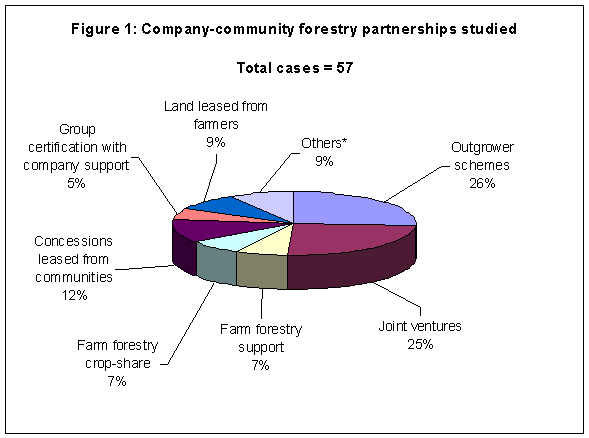
Notes on Figure 1: The main products from outgrower schemes, joint ventures and farm forestry are timber, commodity wood or pulp
*Others include: corporate social responsibility projects, forest environmental service agreements and co-management for non-timber forest products
1 Forestry and Land Use Programme, International Institute for Environment and Development (IIED), 4 Hanover Street, Edinburgh EH2 2EN, UK. [email protected]; Website: www.iied.org
2 The following working definitions are used in this report:
3 Case studies were drawn from the following countries: South Africa, India, Indonesia, Papua New Guinea, Ghana, Canada, Brazil, China, Guatemala, Nicaragua, Honduras, Mexico, Colombia, Zimbabwe, Philippines, Thailand, Solomon Islands, Vanuatu, Australia, New Zealand, Portugal, Ireland and USA. See Mayers and Vermeulen 2002 for full references.