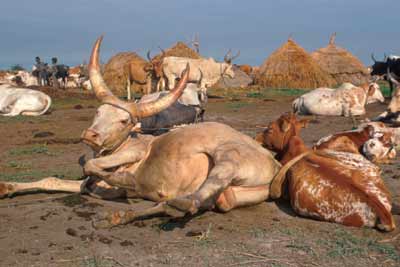
There is growing confidence that rinderpest has been eradicated from the Sudan in the last year. That confidence is building as time passes without any detection of rinderpest, following an active surveillance programme that exceeds anything else in place in eastern Africa. Rinderpest was last confirmed in 1998 in the south of Eastern Equatoria. The infection appeared to have come from a northeasterly direction. Data gathered subsequently in 2001 using participatory epidemiology techniques suggested strongly that the virus had been present since 1998 in animals held by the Murle and Jie tribes (in Eastern Equatoria and Jonglei). An outbreak of serious stomatitis-enteritis disease in the vicinity of Pibor in late 2000/early 2001 was identified by the pastoralists as rinderpest. Veterinary opinion was mixed and investigations attributed the disease to schistosomosis. Nevertheless, the FAO Operation Lifeline Sudan (OLS) Livestock Programme, with the concurrence of the Government of the Sudan, seized the opportunity to mount an intensive vaccination campaign intended to immunosterilize the Murle and Jie herds, which amount to nearly a million head of cattle. The strategy was agreed with IBAR-PACE and ratified by all stakeholders at an OLS North-South Coordination meeting held in Khartoum in May 2001. Despite difficulty in obtaining funding support and frank opposition from some quarters, the vaccination programme was completed successfully in these populations, which had never been effectively vaccinated previously. All rinderpest vaccination ceased at the end of June 2002 (throughout the whole of the Sudan). This withdrawal of vaccination will set the scene for serological studies to confirm the absence of rinderpest in due course. Similarly, should there be any virus persisting unnoticed, it should be visualized much easier in the susceptible population created. The use of rinderpest vaccine will be reserved for combating outbreaks should they occur.
|
|
Surveillance in Eastern Equatoria and Jonglei has led to confidence that the virus has been unable to maintain itself in these populations during 2002. Events suspicious of rinderpest (i.e. stomatitis-enteritis outbreaks or any occurrence of mortality) are routinely investigated by the southern sector of OLS in partnership with the European Union (EU)-funded PACE Southern Sudan project, aptly entitled "The fight against lineage 1 rinderpest virus". Executed by OAU-IBAR through Vétérinaires sans frontières (VSF), Belgium, this project is now playing a dynamic role in southern Sudan. A system of payment for active stomatitis-enteritis clinical surveillance to be undertaken by animal health assistants and stockpersons has been developed and was launched during May and June. Each supervisor is asked to carry out two cattle camp or village visits per month, during which they examine animals for clinical signs of disease and interview a livestock keeper on the livestock situation. One investigation, still in progress in the southern sector at the end of June 2002, has caused particular concern because it occurred west of the Nile, believed to have been freed from rinderpest some years ago, in a most insecure area not far from where rinderpest was confirmed in 1998. On 12 June 2002, a report was received suggestive of rinderpest in Lainya in Juba County. A team comprised of representatives of Vetwork Sudan Trust (a Sudanese non-governmental organization [NGO]) and OLS-South left on 18 June to investigate. On 24 June, news was received that no evidence of rinderpest had been found but East Coast fever was suspected - a highly credible diagnosis in that area. Samples were collected for confirmation. Although in the northern sector there is less evidence of active investigation (an activity that needs to be strengthened), major outbreaks are investigated. For example, rinderpest was suspected west of the Nuba Mountains earlier this year but, on investigation, it was confirmed by histopathology at Onderstepoort Veterinary Institute in South Africa to be malignant catarrhal fever.
It must be stressed that the final eradication thrust has only been possible by building on the progress made over the preceding decade through the Livestock Programme of OLS under the stewardship of the United Nations Children's Fund (UNICEF) with technical support from Tufts University, the United States of America. A major step forward has been the clearance of rinderpest from southern Eastern Equatoria by intensive vaccination coverage between 1994 and 1996. FAO assumed responsibility for the OLS Livestock Programme in late 2000.
Two areas have caused particular concern because of their inaccessibility for surveillance. The first of these - the Nuba Mountains - earlier this year became the subject of a ceasefire agreement that allowed access. The opportunity to survey for rinderpest was grasped quickly. There has been no evidence of rinderpest there for many years. The second area, of continuing concern, is the Sobat Basin, home to the Jikany and visited by groups of the Nuer and Fellata people. Evidence from neighbouring areas tends to suggest that the herds of the Sobat Basin are not harbouring rinderpest. OLS has requested a period of tranquillity to perform an active disease search, which is likely to confirm the absence of rinderpest from this population. Such periods of tranquillity, in which both sides in the conflict agree to cease fighting for a period of time, are negotiated occasionally to allow human vaccination days under the Expanded Programme on Immunization of the World Health Organization.
It will be some time before it can be certain that rinderpest has indeed been eradicated from the southern Sudanese reservoir. However, all the indications are that, after many years of effort, African lineage 1 rinderpest virus could now be extinct.
Fresh impetus to the eradication of mild rinderpest from the Somali ecosystem
|
|
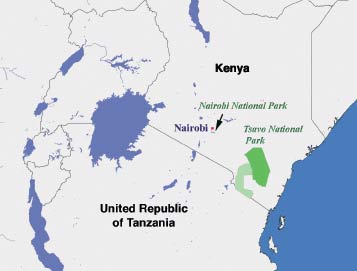
In 1994-95, rinderpest was detected and diagnosed in Tsavo East National Park and subsequently, in 1996, in the Nairobi National Park. Cattle from areas to the northeast of Tsavo National Park are believed to have entered the park towards the end of 1993 and transmitted the infection to wild buffaloes. This gave rise to the series of high mortalities in buffaloes, eland, lesser kudus and some other species in Tsavo from early 1994 until May 1995. Molecular biology showed that the Tsavo virus and the isolates from Nairobi National Park were genetically similar, being African lineage type 2. Isolates of this lineage had not been seen in East Africa since 1962, while it was recovered last from West Africa in 1983. This outbreak of rinderpest in wildlife revealed that there could be an area of endemic maintenance in East Africa that has remained undetected for the past 30 years and thus throughout the Joint Project 15 (JP15) campaign and the eight years of the Pan-African Rinderpest Campaign (PARC) project. The area of endemic maintenance is roughly defined as northeastern Kenya and southern Somalia.
Piecing together all the information available it is possible in retrospect to see a pattern of related events. In the pastoral ecosystem of northeastern Kenya-southern Somalia, rinderpest has reappeared periodically, showing a cycle of about five years:
1980-83 |
A moderately severe epidemic of rinderpest entered Mandera and spread to extensive areas of southern Somalia. |
1985-88 |
A second wave of rinderpest affected the Middle and Lower Juba regions of Somalia. |
1991-93 |
Coinciding with the onset of drought in 1991, two waves of rinderpest spread out from Wajir District, Kenya. The first, in April, travelled through Simper Fatima in central Mandera District to cause moderate mortality in Eastern Mandera District. The second wave passed Liboi, Kenya, to enter Lower Juba, causing moderate to severe mortality (30 to 70 percent) at Tabta, Bilis Qooqaani, Afmadow and Badhade in Somalia. |
1994-96 |
Rinderpest in Mandera District persisted in a mild form. From there the disease spread to no man's land between El Wak, Kenya, and El Wak, Somalia, where it was sighted by Somali veterinary personnel in mid-1994. Subsequently, low to moderately severe outbreaks occurred in border regions on both sides of the border until the onset of the rains in early 1996. Antibodies to rinderpest were detected in Meru National Park. |
Oct. 1996 |
A rinderpest outbreak affected eland and buffalo in Nairobi National Park. Few signs were noted in local cattle. |
Late 1995-96 |
An outbreak of rinderpest was suspected in buffaloes in Amboseli National Park Kenya (not confirmed). |
Dec. 1996 |
After observing mild clinical disease in Maasai cattle in Kajiado, rinderpest was confirmed by the "agar gel immunodiffusion" test in cattle in South Kajiado, Kenya. |
Jan.-May 1997 |
Outbreak of rinderpest in cattle in northern areas of the United Republic of Tanzania. It was first confirmed by the "penside" test in Ngorongoro (March 1997) and Loliondo (April 1997). |
1998-99 |
Clinically mild cases of rinderpest were detected in several locations in Afmadow District. None was clinically confirmed. |
Oct.-Nov. 2001 |
Lineage 2 type rinderpest was detected and confirmed in buffaloes from the Meru National Park. |
In Somalia, the area of endemic maintenance of African lineage 2 rinderpest virus has been considered to be confined to the area south of the Juba River. Serosurvey work done over the past years shows the presence of antibodies in unvaccinated stock as far as central Somalia.
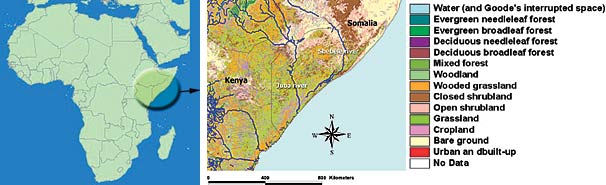
Land cover classification in the Horn of Africa (Maryland - 1 km resolution)
In order to consider how to address the issue of eradicating mild rinderpest from Eastern Africa, a workshop on mild rinderpest was organized by OAU-IBAR under the auspices of PACE and held in Nairobi from 17 to 19 June 2002. This meeting, in which FAO participated, brought together all concerned stakeholders.
There is growing confidence that the Somali pastoral ecosystem harbours the last reservoir of rinderpest viral activity |
While much remains to be done to prove that other areas are free, there is growing confidence that the Somali pastoral ecosystem harbours the last reservoir of rinderpest viral activity in Africa. Although the political will and existing technical tools are sufficient, initially doubts were raised about interest in its eradication. However, the countries involved in the endemic maintenance reaffirmed their commitment to the eradication of the rinderpest virus as it was perceived that mild rinderpest could revert to a more virulent form. It was agreed that the basic strategy is one of "seek, contain, eliminate and verify" - in other words, surveillance should identify the areas of endemic maintenance and, within these areas, the foci of active disease transmission. The surveillance tools include participatory epidemiology and wildlife surveillance. Focused vaccination campaigns would be used to immunosterilize these foci, if needed. If other tools become available, offering advantages over those in use, they will be applied to the work.
RECOMMENDATIONS OF THE WORKSHOP Overall strategy
It is recommended that:
Wildlife and rinderpest
It is recommended that:
Laboratory diagnosis, molecular epidemiology and serological testing It is recommended that:
Vaccines and their role in the eradication control of rinderpest It is recommended that:
|