


|
In Stage 5 the desirable economic, social and environmental characteristics of the market need to be reviewed and a site chosen that comes closest to fulfilling those requirements. The site for the market and the availability of the chosen site should be confirmed, and the need for an environmental assessment reviewed. The following points should be considered:
|
STAGE 5
CHOOSING THE RIGHT SITE
Introduction
This stage is primarily applicable to new markets, but is also relevant when existing market conditions are cramped and expansion is needed. Choosing the site for a market is a key stage in the design process and one that is often undertaken badly. Before starting this stage it is essential that the previous design stages have been successfully completed.
Transport of produce to markets. Usually, the key factor in locating rural markets is their relationship to transport links and to other commercial and public facilities, particularly their proximity to bus stands and lorry parking areas. Passengers and goods normally travel together, usually on buses, modified lorries, pickups, motorbikes, or on non-motorized transport such as bicycles or animal carts.
Transport improvements can have a significant impact on marketing. For example, investment in local assembly markets may be pointless if the simultaneous improvement of access and feeder roads encourages the farmer to either market more produce at the farm gate or deliver produce directly to urban markets. Investment in a new or improved retail market may similarly be wasted if there are plans to move a bus station to the other side of the village or town. Under such circumstances, farmers and retailers are likely to follow the bus station, even if it means conducting business on a vacant plot of land and leaving a purpose-built retail market empty. For such reasons, it is essential that existing and planned traffic flows be fully reviewed.
Mapping. Before choosing a site it is essential to see if maps are available of:
the planning context, indicating the potential market site in relation to its catchment area, transport links and other economic and social facilities; and
the potential market site (or sites), showing its physical layout and facilities, including infrastructure services.
Sources of such information are survey departments and local authority engineers. Other relevant data may also exist, such as aerial photographs and planning reports. The mapping process is discussed in further detail in Annex A.
Step 5.1
Review suitability of site
locations
The first step in choosing a market site is to ensure that its location is satisfactory. The essential locational characteristics that a site should have are:
There must be easy access for deliveries to the market. If the market is not well located, producers may bypass an assembly market and try to supply an urban market directly.
Primary markets that are mainly retail in nature should be close to where consumers live so that it is convenient for them to use the market.
Both primary and assembly markets should be close to public transport facilities and, preferably, also close to other commercial and social facilities.
These locational characteristics are important, whether an existing market is to be upgraded or a new site is to be selected. At this stage there may be a number of alternative sites for the market and it may also be necessary to choose between upgrading an existing market or relocating it to a new site. Some examples of typical locational factors in selecting a site are shown in Figure 4.
Figure 4. Market location characteristics
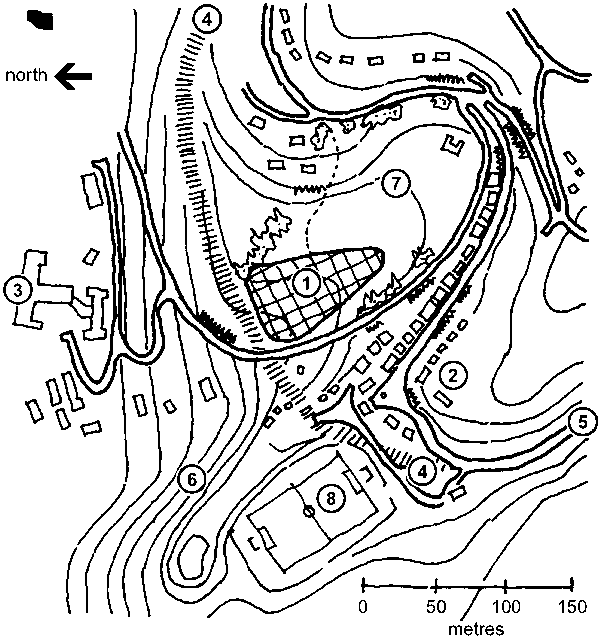
In this example the market site was identified in a local action plan and located adjacent to a proposed bypass road. The site was within a short walking distance of the centre of a small district town and near to the district hospital, a potential customer for produce.
The site for this market is relatively flat, compared to adjacent areas, but as it was located in a minor valley there were potential drainage problems, This issue was addressed in the layout plan of the market and the design of the infrastructure (see Figures 6 and 7).
KEY
1 Possible market site
2 District centre and mini-bus stand
3 Local district hospital
4 Proposed bypass road
5 Existing main road to the capital
6 Steep slopes
7 Valley with drainage problems
8 Sports field
Step 5.2
Reviewing site features
After a list of the potential sites has been drawn up, it is then necessary to look in detail at the individual sites. The factors that should be considered are as follows.
Will the site meet the needs of the users, as identified in Stage 3? Is the site, or a nearby location, already being used for marketing, thus suggesting that the location is suitable?
Is there sufficient space on the site to accommodate the required facilities that were identified during Stage 4?
Is the site available for market use (see also Step 5.5)? Does the use of the site as a market fit in with local planning or zoning requirements?
Can the site development be coordinated with other projects or linked to road and other transport infrastructure upgrading?
Is there good access for pedestrians and uncongested road access for vehicular traffic?
Will the site be easy to develop? Generally, building costs are lower for flatter sites.
Are there any breaks in slope that will need retaining structures?
Are there soil problems, such as contamination, low bearing capacity or swelling clays?
Are there any potential hazards, such as flooding, erosion or landslide problems?
Could there be any negative environmental impact (see Step 5.3)?
Are any public services, such as water or electricity supply, available on the site?
The result of the site analysis will be a list of the site characteristics, which can be noted on a map of each potential site. An example of a simple site analysis map is shown in Figure 5. Such a map will also form an essential basis for the site planning process to be undertaken in Stage 6.
Figure 5. Market site analysis
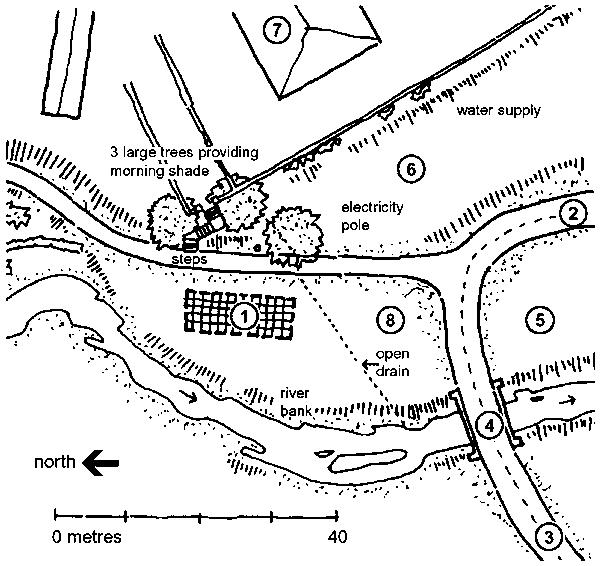
Site analysis looks at development options and problems. In this case, the original market site was rejected as it caused congestion on the main road and obstructed the view from a guest house. The only viable alternative in this steeply sloping settlement was an area adjacent to a fast flowing river with a potential flooding risk, requiring river training to protect the site. In compensation, the site could accommodate some future expansion and easily be provided with parking, drinking water and electricity supplies.
KEY
1 Proposed market site
2 Road to district centre
3 Main road to capital
4 Bridge over river
5 Landfill parking area
6 Original market site
7 Guest house
8 Expansion/parking area
Step 5.3
Determine if an environmental assessment is
needed
Environmental issues need to be taken into account at an early stage to ensure that any positive impact is maximized and any negative impact is either prevented or reduced to a minimum. A well-formulated market development should not have a negative effect on the environment or on the local population. Any negative impact can be reduced, but at a cost. It is better, therefore, that the potential impact is recognized from the beginning.
Environmental Impact Assessment (EIA). This is a process for preparing a balanced appraisal of a project by predicting and evaluating the likely effects that a development activity could have on the natural and human environment. The EIA is undertaken before the activity starts. Small rural markets do not usually need an EIA, although it may be required where a donor funds the market.
Screening. This establishes whether a detailed assessment is needed. Guidance on the criteria for screening needs to be obtained from a relevant government department or agency. Screening criteria usually relate to the type of land use and scale of development. Most industrial activities and large-scale developments require an EIA.
Step 5.4
Prepare an impact statement
When an EIA is required, the market owner or rural planner usually prepares it. Most rural technicians can carry out an initial assessment (IEIA), but a full-scale EIA is likely to need the assistance of a specialized agency or of private consultants.
When the EIA has been completed a government or specialized agency usually reviews it and comments on the proposals. A formal environmental consent is often needed (see Stage 9), and this may also specify whether an environmental management plan needs to be drawn up.
Table 7
Site analysis - example of ranking
alternatives
|
Site characteristics |
Existing site |
New site 1 |
New site 2 |
New site 3 |
|
Site area (hectares) |
1.3 |
1.5 |
2.0 |
1.8 |
|
1. Fits needs assessment |
1 |
2 |
2 |
3 |
|
2. Adequate size |
3 (9) |
2 (6) |
1 (3) |
2 (6) |
|
3. Land availability |
1 |
2 |
3 |
1 |
|
4. Access |
1 |
1 |
2 |
3 |
|
5. Topography |
2 |
1 |
2 |
3 |
|
6. Services availability |
1 |
2 |
3 |
3 |
|
7. Environmental impact |
2 |
3 |
2 |
1 |
|
8. Hazards |
2 |
3 |
2 |
1 |
|
9. Planning context |
2 |
1 |
1 |
3 |
|
Maximum score 27 (or 33) |
15 (21) |
17 (21) |
18 (20) |
20 (24) |
Note: Lowest number = best option
Step 5.5
Review site options and
availability
The last step of this stage is to review the site options, choose the best option and confirm the availability of the preferred site. The information obtained during the previous steps needs to be gathered and compiled into a ranked tabulation of the alternatives (see Table 7).
Ranking. If there is only one possible site, the purpose of this analysis is to ensure that it fulfils all the criteria listed in Step 5.3. If there are a number of alternatives the simplest approach is to prepare a table (as in Table 7) in which they can be compared. This can be done by ranking the factors for each site on a scale of 1 to 3 (with 1 being best and 3 worst) and then totalling all the factors. If the market users find some of the factors more important than others these could be “weighted”.
Thus, in the example shown in Table 7, the “existing site” offers the best alternative. However, because this site is the smallest, it may not be found viable at the time of detailed design. This problem could be reflected by weighting factor 2 (site size) using a ranking of the options on a scale of 3 to 9 (the alternative scores are given in brackets in Table 7). In that case the overall ranking of the options would change and “new site 2” would become the preferred option.
Site availability. Site availability is often one of the main constraints to choosing a site. Ownership or title to the land must be clarified and the relevant planning, building and environmental consents obtained. If compulsory acquisition is not possible, an agreement to purchase or rent the land will need to be made with the landowner. This may be a private owner, a local authority or a community. These issues need to be clarified at the site selection stage and before any detailed site planning is started (Stage 6).
