


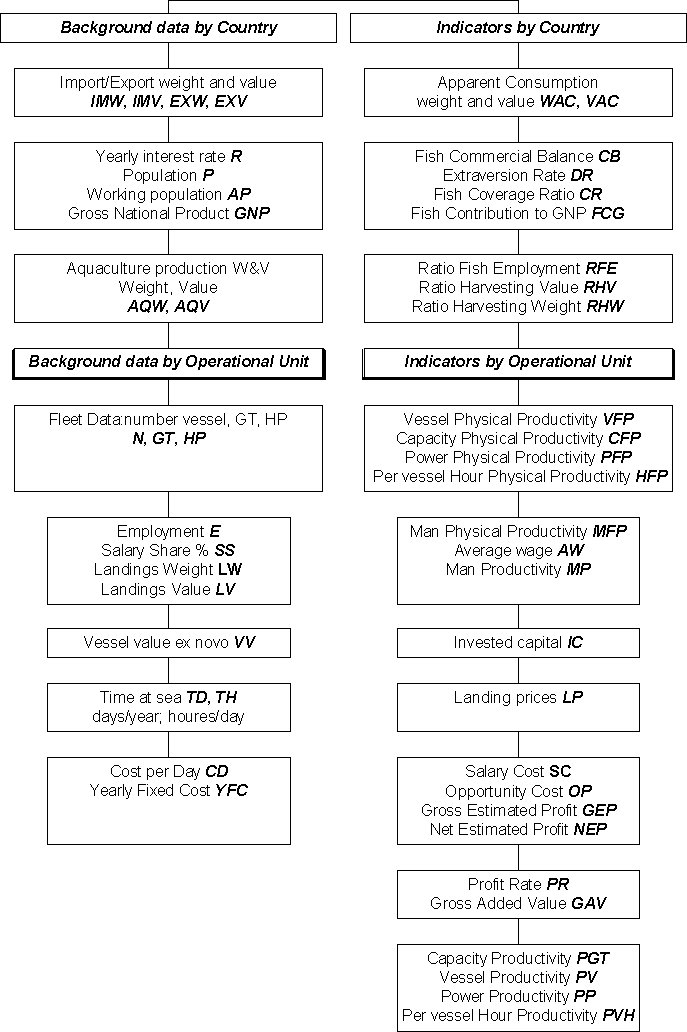
Description of National Indicators
Apparent Consumption, shows the gross consumption of fishing products per inhabitant of each country. It can be expressed either as weight of consumed fish per inhabitant (WAC) or as expense per inhabitant (VAC).
Fish Commercial Balance (CB), shows whether exports or imports of fishing products are higher in a given country.
Ratio Fish Employment (RFE), indicates the ratio of employment created directly by the fishing industry in a country.
Fish Coverage Rate (CR), shows the rate of apparent consumption covered by the national production.
Extraversion Rate (DR), shows to what extent the fishing sector of a country depends upon foreign trade, both for imports and exports.
Fish Contribution to the GNP (FCG), shows the importance of fishing production in the Gross National Product.
Ratio Harvesting Value (RHV), shows the importance of fishing in comparison to aquaculture in terms of income.
Ratio Harvesting Weight (RHW), shows the importance of fishing in comparison to aquaculture in terms of production weight.
Description of Segment Indicators
Vessel Physical Productivity (VFP), shows the average production of each vessel in terms of weight of landings.
Capacity Physical Productivity (CFP), indicates average production in terms of weight of landings for each capacity unit (GT) of the vessels.
Power Physical Productivity (PFP), shows the average production in terms of weight of landings for each power unit (HP) of the vessels.
Per vessel Hour Physical Productivity (HFP), indicates the average production in terms of weight of landings for each full fishing hour. The total fishing time (T) results from multiplying the number of fishing hours by working days and then by the number of working days in one year (TD).
Capacity Productivity (PGT), shows average production in terms of market value in the first sale for each capacity unit installed (GT) in the vessels.
Vessel Productivity (PV), shows average production in terms of market value in the first sale for each vessel.
Power Productivity (PP), shows the average production in terms of market value in the first sale for each power unit (HP) of the vessels.
Per Vessel Hour Productivity (PVH), shows the average production in terms of market value in the first sale for each fishing hour.
Man Physical Productivity (MFP), shows the average production in terms of weight of landings for each man employed.
Man Productivity (MP) shows average production in terms of value in the first sale for each man used.
Average Wage (AW) indicates the average salary obtained by each man employed.
Landing Prices (LP) represents the average market price of landings.
Invested Capital (IC) shows the current value of the whole of the vessels. Invested capital is very difficult to measure in the Mediterranean Sea. A recommended method will be explained below.
Salary Cost (SC) indicates the fishermen's income. To measure the salary cost, we must bear in mind the parts in which landings of each kind of fleet are divided. This indicator tends to underestimate the actual figures, since fishermen usually keep a small part of landings as salary in kind. Often, in artisanal fisheries, each fisherman's earnings depend on his condition, i.e., whether he is a sailor (salary) or the owner (salary plus profits). For the purposes of making an economic analysis, we should make a distinction between the natures of each distinctive part of the income.
Opportunity Cost (OP) shows the yields that the owner could obtain should he invest his money in National Debt instead of investing in his business. This means that the owner is relinquishing that potential income. There is a profit in its economic sense when the yields of the invested capital surpass the opportunity cost.
Gross Estimated Profit (GEP), which indicates the total profits obtained by the whole of the vessel owners, once the operating costs have been deducted. Such costs include: Salary Cost (SC), Opportunity Cost (OP), Costs related to Fishing (CDxTD) and Yearly Fixed Costs (YFC). How to calculate CD and YFC is explained below.
Net Estimated Profit (NEP), which shows the total earnings obtained by the whole of the owners, once the depreciation cost has been deducted from the GEP. This cost is calculated following the criterion that the shelf life of a vessel is 10 years. In fact, the shelf life of vessels is normally longer, but in that subsequent period repair costs equal the value of a new vessel.
Profit Rate (PR), which indicates the percent ratio of yearly net profits plus the opportunity cost in relation with the investment. It should be borne in mind that this figure does not include the additional earnings obtained by the owner as an employee in artisanal fisheries.
Gross Added Value (GAV), which expresses the Added Value that the segment in question contributes to the National Economy. This includes: salaries, profits, opportunity cost and depreciations.
