FAO/WHO Global Forum of Food Safety Regulators
Marrakech, Morocco, 28 - 30 January 2002
RISK MANAGEMENT
INTEGRATED APPROACHES TO THE MANAGEMENT OF FOOD SAFETY
THROUGHOUT THE FOOD CHAIN IN SLOVAK REPUBLIC
by Peter Šimko - Milan Ková
Food Research Institute, Slovak Republic
Country Paper proposed by Slovak Republic
1. Introduction
Slovak Republic is a country where substantial social-political and economic changes have taken place during last 12 years. Since 1989, a new political, economic and social system has been built and a transition of centrally planned economy to the market one has been realised. Of course, these changes have needed to adopt a new legislation, compatible also with international laws.
At present time, Slovak republic is a member of associated countries group, trying to enter in European Union as quickly as possible. Because the one of the main entering conditions is full inclusion of European union legislation (directives and regulations) into national legislation, Slovak republic is harmonizing also national food legislation in line of "European White Paper on Food Safety" principles to comply fully not only with existing but also proposals (e. g. food law) to be being prepared in European Union, covering all aspects of food products "from farm to table".
2. Base of integrated approaches to the management of food safety in Slovak republic
In our country, food policy is realised on three basic principles - safety, transparency and trustworthiness. The safety of foodstuffs have has really the highest priority of Governments of Slovak republic even in the past, when food quality and safety have been controlled and assessed very intensively.
The Codex Alimentarius has adopted the following definition for risk management: it is the process of weighing up the various possible policies, taking account of the evaluation of risks and other factors involved in the health protection of consumers and the promotion of fair trade practices, and taking decisions accordingly, i.e. choosing and implementing the appropriate prevention and monitoring measures.
The management of food-related risk is therefore a political prerogative which involves balancing the recommendations formulated by the experts commissioned to scientifically evaluate the risks, and the resources of all types that social and commercial groups and manufacturers can set aside for dealing with these risks1. Of course, risk management has to be an integral part of risk analysis, which consists apart from risk management (regulation and control) also of risk assessment (scientific advice and information analysis), risk communication, even risk perception. If necessary, a precautionary principle should also be a part of risk management.
It is well known that legislation and control are the two essential parts of risk management. Current Slovakian food legislation consists of Food Act (No. 152/1995), which has been adopted in 1995 by Slovakian parliament and has come into the force also in 1995. On the base of Food Act, individual chapters (directives) of Slovakian Food Codex have been being adopted which deal with setting of general procedures and requirements (horizontal principle) and concrete parameters (vertical principle) for individual products to be made by food industry. Individual chapters of Slovakian Food Codex have come into force after their approval by Ministry of Agriculture and Ministry of Public Health. Both ministries in conjunction are empowered by Act No. 152/1995 for preparation, actualisation and eventual correction of texts to be published in Slovakian Food Codex.
Apart from this, Food Act No. 152/1995 enacts also control of food products by control institutions - State Veterinary Administration and State Agricultural and Food Inspection, as is shown in Fig. 1. Both institutions are responsible for control and assessment of safety and quality of all food products.
On the base of Protection of Public Health Act No. 272/1994 to be novelised by Act No. 514/2001, the responsibility for control of hygiene conditions during food production, catering, and selling belongs to Ministry of Public Health institutes, as is also shown in Fig. 1.
Just two days ago, Slovakian parliament has adopted actualised version of Food Act. This actualisation will come in force 1st January 2002 and follows latest trends in European Union food legislation. On its base will be formed Slovakian Veterinary and Food Administration as the only food control institution by combination of current institutions - State Veterinary Administration and State Agricultural and Food Inspection. In close cooperation, but as an independent body, will be Food Research Institute, which should cover tasks, related to Rapid Alert System and risk analysis. Both institutions will be adequate and complementary partners to European Food Authority in all scientific and professional activities.
By Slovak Government decision, National Environment Monitoring Program has been launched in 1992, and part of this Program is Partial Information System about Food Contaminants (PIS FC) to obtain data about contamination level in water, soil, and feed. Simultaneously, Monitoring of Contaminants in Food Chain (MCFC) has been launched to obtain data about presence of contaminants as heavy metals, mycotoxins, nitrites, nitrates, pesticides, veterinary drug residues, polycyclic aromatic hydrocarbons, organo-chlorinated biphenyls, including legal food additives in foods. Of course, pathogenic micro flora is also being monitored. MCFC consists of three subjects - Monitoring of Food Basket, Monitoring of Wild Animals and Fish, and Coordinated Aimed Monitoring. Analysis are carried out on the base of one year working plans. Obtained data are submitted to PIS CL and this provides treated data either for central and regional authorities or international data systems, as is e.g. Global Environment Monitoring System (GEMS). Scheme of PIS CL is shown in Fig. 2.
To guarantee reliable analytical results, by the same Slovak Government decision the establishment of Analytical Quality Assurance (AQA) centre has been approved for periodical assessment of quality of laboratory work. The AQA centre organizes ring national and international tests, workshops, and seminars for laboratory staff to keep them at latest trends in good laboratory practice trends. Slovak National Accreditation System has accredited all control laboratories by EN 45 001 and ISO/IEC 17 025 standards.
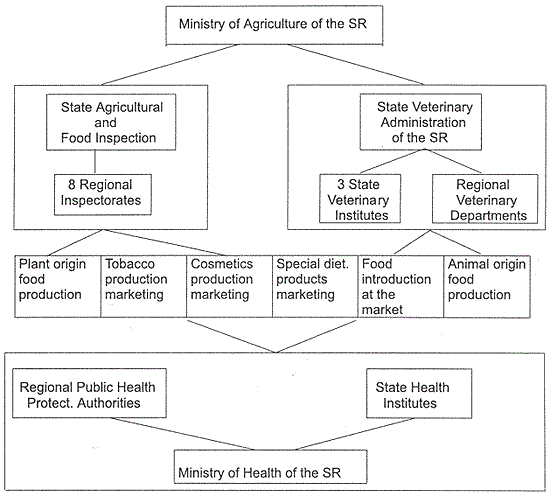
Fig.1. Current structure of food safety supervision in Slovak republic to be valid till 31st December 2001.
PIS CL, MCFC and AQA are localized at Food Research Institute (FRI), which is responsible for their management and performance. FRI is also responsible for preparation of annual reports about level of contamination of food chain in Slovak republic and these reports are published in Green Reports as well as in public medias. Apart from this, the reports are evaluated also by Commission on Food Chain Contamination to be established for periodical evaluation of contaminants in food chain. The commission consists of selected experts working in various scientific areas relating to food safety and deals with various topics related to contaminants in food chain. In addition, the Commission deals also with "hot" problems to be arisen in area of food safety and proposes solutions to remove jeopardy of public health damnification.
Very effective outline of risk management is rapid alert system, which makes possible to warn authorities and public about jeopardy from spoiled, non-correct processed or contaminated foods. Although this system operates within European Union countries, some countries use the same principle also outside European Union.
Example: During last summer, on the base of agreement between control institutions of Czech republic and Slovak republic, we obtained alert information about over limited concentrations of carcinogenic benzo(a)pyrene in some olive oils to be imported to Czech republic from Spain. Followingly, our control laboratories found the same situation in olive oils available in Slovakian market. On the base of Slovakian food legislation, identified olive oils were baned to sell, returned back to the country of origin, and importers were punished by the law.
3. Future of the risk management of food safety in Slovak republic
As already mentioned, risk management is the integral part of risk analysis. Adopting European food legislation and its full transposition into Slovakian food legislation will be built appropriate base for professional approach to risk management in food safety and followingly to risk analysis. It is expected that total harmonisation of food legislation in Slovak republic with be reached in the end of the year 2002.
Apart from this, the structure of Slovak Veterinary and Food Administration and Food Research Institute will be re-arranged at the beginning of next year (2002) to correspond to generally accepted Danish model, which combines control, research and scientific activities "under one roof".
By realisation of items mentioned above, Slovak republic will be fully able to carry out up-to-date risk management of food safety, which will be essential for real risk assessment. Moreover, the application of precautionary principles, if necessary, will be smart and flexible. Joining functional risk management and risk assessment, there will be good platform to be built for risk communication with consumer, because just public opinion (also with regard to lack of adequate information) is too weak to resist "correct and true" information, to be disseminated from time to time in public.
Example: Public in Slovak republic is misleaded by" true" information about over limited presence of contaminant in foods, genetically modified products harmful to human health, E - code labelled food additives toxic and carcinogenic effects, etc.
It shows, that involving the public into the risk analysis will be an essential task of close future when there is really "white place" in aimed approach to individual groups of the public.
4. Conclusion
Recent and current advance in food legislation, establishment of a food control institution, its professional activities in cooperation with Food Research Institute guarantees real possibilities to realise comprehensive protection of consumer in frame of European White Paper of Food Safety philosophy and application of risk analysis in "every day life" of public in Slovak republic.
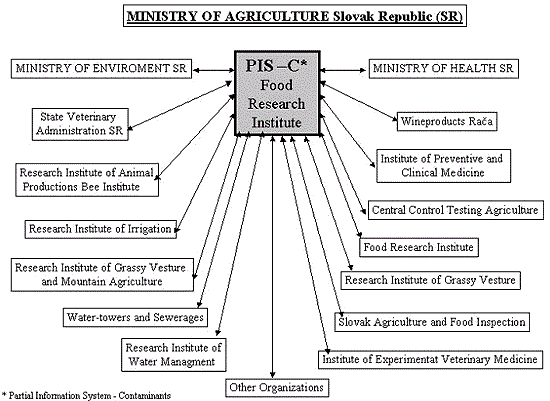
Fig. 2. Scheme of partial information system for contaminants in food chain.
5. Summary
Slovak republic is a country, which is being prepared intensively for membership in European Union. During this process, all EU legislation is being included into Slovakian legislation. Decisive part of food legislation have been already harmonised with EU legislation in line of European philosophy of total consumer protection. Both sides of risk management - legislation and control - are just now finishing to adjust to current European level, what will guarantee exhaustive and reliable approach not only to primary protection of consumer, but also to creation of substantial base for risk analysis individual procedures. Two institutions together - Slovak Veterinary and Food Administration and Food Research Institute - will be fully competent to take over the responsibility for food safety and consumer protection in the country and cooperate with European Food Authority.
|