


(41) The World Bank appraisal mission (1983) was entrusted with the task to design a Fisheries Research Institute, using as much as possible existing facilities of the Directorate of Fisheries. This lead to:
(42) This set-up met quite some criticism from various sides, mainly for the following reasons:
During the first year of operation, FRI indeed faced all the difficulties listed above. Due to lack of adequate manpower, and due to communication and transportation problems, the development of management and research procedures was even slower than expected.
(43) The following research stations were originally envisaged:
FARS (see (25)) and RFRS (see (27)) are existing facilities that are transferred to FRI already. MFRS is also an existing facility, but is still under the umbrella of DOF. BARS and FTRS do not exist at present.
(44) The research identification mission under the present project (October-December, 1984) experienced difficulties in alloting research programmes to RFRS and FTRS for the following reasons:
Still the mission drafted research programmes for RFRS and FTRS in an attempt to make them full-fledged stations, assuming that either more funds might become available, or the whole concept might be revised. Funds did not become available, however, for FTRS, and the available funds for RFRS are not sufficient to upgrade the station. For these reasons and for the general reasons mentioned in (41) it is now proposed to revise the arrangement of facilities, in order to give FRI a fair chance of development.
(45) The proposal for revision (within the budgetary frame-work of the existing Project Proforma) is as follows (see Fig. 2):
By doing so, FRI will comprise the following facilities:
(46) The Freshwater Research Station, Mymensingh, will physically be completed before July, 1987 (DANIDA project). There are ample facilities to also house the freshwater programmes that presently are allocated to Chandpur. The funds available for renovation, and equipment in Chandpur can be used to construct some extra rooms to house the Headquarters. Libraries will be combined and structural policies for co-operation between FRI and the Bangladesh Agricultural University will be developed.
The research at this Freshwater Research Station will contain the following programmes (see also Annexes A and C):
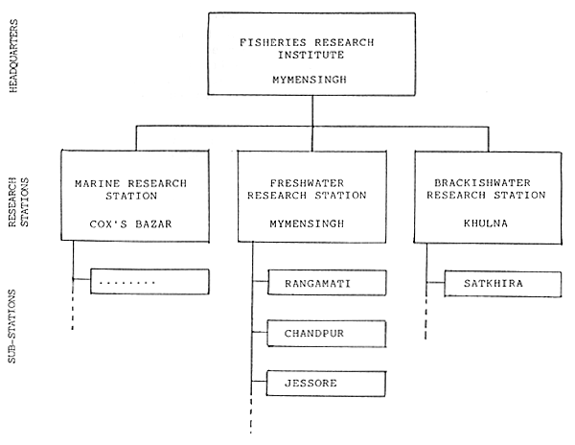
Fig. 2. Proposed set-up for FRI.
(47) With respect to the last programme (Riverine production ecology) it has been suggested to maintain a sub-station of FRI in Chandpur to house this work. The reasons for this were that Chandpur is on the river, and that riverine studies were traditionally carried out here. These are sophisms. Riverine studies require extensive travelling, that can be carried out from any place in Bangladesh; it is even expected that travelling from Mymensingh safes time because of better connections. The advantages of bringing also this programme to Mymensingh are obvious: the researchers will have much better access to library and computer facilities and to scientific communication and guidance. Thereabove, their interests are better served by FRI management when they are close-by.
As an alternative, the Riverine production ecology programme could also be housed adequately in the future Brackishwater Research Station, that will be close to the rivers.
(48) The concept of sub-stations as such should not be left. Chandpur might be closed down since the riverine work does not ask for a specific place, but in other projects this could be the case. Work on Lake Kaptai, for example, cannot be carried out from any one of the stations, and the same is valid for research aspects of (e.g.) the Oxbow Lake project or the (future) Floodplain Fisheries Development projects. In those cases, sub-stations could be established. To make them manageable, however, they should meet the following conditions:
(49) The Brackishwater Research Station, Khulna, will be developed under the present Agricultural Research II Project. Site selection will be completed before July, 1986, and detailed planning of projects and facilities is underway. A preliminary list of research programmes is presented in Annex C. It is the intention to start actual construction of the station in the winter of 1986–87, and to initiate on-station research one year later.
Part of the high-priority research programmes will start before the station is built. Surveys of Macrobrachium and development of systems for its reproduction and culture can be carried out from Mymensingh (presently planned for Chandpur). Surveys and other work on penaeid shrimps might be carried out from the BOBP Shrimp Demonstation Farm in Satkhira; its suitability for research is studied presently, and an advice regarding its transfer to FRI is expected before May 1986.
(50) The Marine Research Station, Cox's Bazar, will be taken over by FRI upon completion of the present UNDP project in 1987. In the winter of 1986–87 a detailed research programme will be drafted, based on perspectives of the work carried out presently, on national priorities in marine fisheries and mariculture, and on development projects in the marine sector. A preliminary list of research programmes is presented in Annex C.
(51) Originally, the facilities transferred to FRI (in Mymensingh and, to a lesser extent, Chandpur) had an important production objective. When production facilities are used for research, production can never be optimal (research includes risks), but it is not expected that all of them will be occupied by the research work. Especially hatching and nursing facilities are so spacious, that the stations can continue to produce fry and fingerlings for farmers. This production is a rather short seasonal activity for which experienced staff is needed. As it does not seem appropriate to employ special staff for this activity, it is envisaged to include it as much as possible in the work programme of the regular staff and to mingle the production as much as possible with research activities. For this reason hatchery production objectives are listed analogous to research projects in the stations' programmes (Annex A).
(52) A schedule of reconstruction and building activities cannot be given before the Board of Governors has taken decisions concerning the number of stations and the place of the Headquarters, and before short-term consultants have finalized their plans for the brackishwater station. The schedule will be presented in the Physical Action Plan, to be expected around August, 1986.
(53) As prescribed in the FRI Ordinance, the Institute is supervised by a Board of Governors. The composition of the Board is also laid down in the Ordinance. The tasks of the Board include supervision of activities and progress of FRI as well as confirmation of management rules and research programmes.
(54) For reasons of cost-effectiveness the Headquarters of FRI will remain relatively small. Scientific work proper will be done at the research stations. The tasks or the Headquarters of FRI are:
(55) An organogramme for the Headquarters is presented in Fig. 3. This organogramme is based on the assumption that the Headquarters will be placed in Mymensingh and that the number of stations will be limited to 3.
The Director will have the overall responsibility for FRI and he will maintain high level outside contacts with GOB, BARC, funding agencies including international and bilateral donors and lending organizations, and with the Board of Governors of FRI. For this purpose he will have the asistance of the Directors secretariat.
The Director will also be responsible for the Research Wing, that covers planning, co-ordination and implementation of the research programmes in the stations. For this purpose the Director will have to maintain regular contacts with the station chiefs (CSO's); at Headquarters he will have the support of the Programme Division and the Co-ordination Division.
Fig. 3. Organogramme of FRI
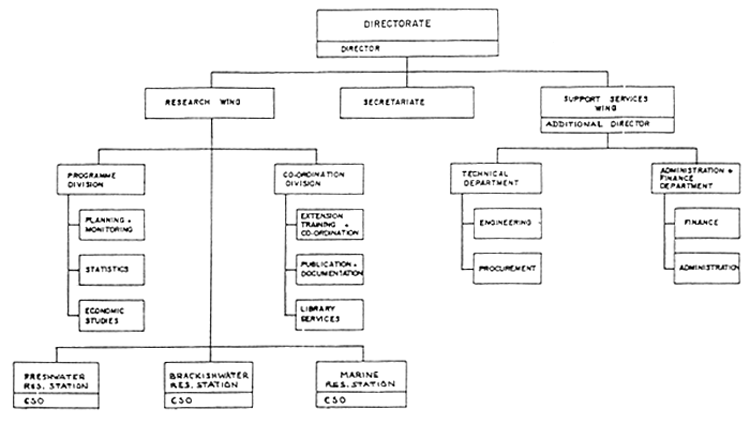
The Programme Division will be responsible for planning and monitoring of research, collection and processing of statistics, and preparation of cost-efficiency studies for research programmes. This last aspect will be carried out in close co-operation with (or even completely by) the Socio-economic Programme of the Freshwater Research Station, also in Mymensingh.
The Co-ordination Division will be responsible for training and extension, for publication and documentation of research findings, and for library services.
The Support Services Wing of Headquarters will be headed by the Additional Director. He will be responsible for the operation and maintenance of the facilities of Headquarters and the 3 research stations, for which purpose he will be supported by the Technical Division. He will also be responsible for administration and finance, including budgeting and financial reporting. For this purpose he will be supported by the Administration and Finance Division.
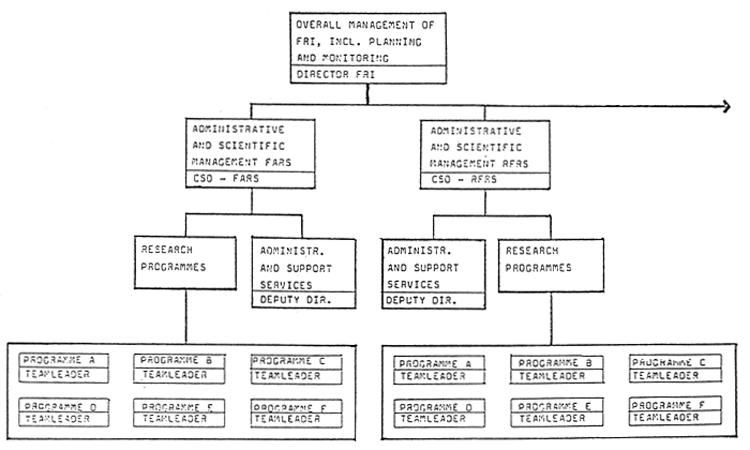
(56) In Fig. 4 the relationship between the Headquarters and the research stations is shown. Fig. 4 is based on the present facilities, but the relation will not change in the revised set-up.
(57) In Fig. 4 also the typical organogramme of the research stations if presented. The structure of this organogramme is strictly homologous to that of the Headquarters: the station chief (CSO) has the overall responsibility for the station and he supervises the research programmes directly. For the administration and support services he has a Deputy Director at his disposal. Through this set-up there is a relatively short management line from the Director FRI towards the actual research programmes, whereas on the other hand interference of research with administrative affairs is blocked as much as possible.
It is expected that this construction can bring new research priorities quickly included in the workplans of the scientists. At the same time scientists are not bothered by all kinds of administrative and financial procedures that are not directly related to their individual projects.
(58) The research programmes themselves are all headed by a teamleader (underligned in Annex A). The teamleadership is a research-oriented function; it has nothing to do with the actual position of the individual officers. A teamleader can be a PSO, an SSO, or even an SO, dependent of the weight, area, and further staffing of the research programme concerned.
The tasks of the teamleader, next to implementation of his individual research project, will include co-ordination of the work in research projects in his programme, as well as programme reporting (see (74) and (80)).
Fig. 4. Organogramme of FRI (present situation).
(59) At the time that the Project Proforma (PP) for FRI was prepared there was not yet a clear picture of the research programmes to be carried out, nor of the facilities needed. At present, there is somewhat more clearness: for the freshwater fisheries research the projects have been identified and a plan concerning the facilities has been presented in this Masterplan (Chapter 4.1). Both have consequences for the original staffing lists presented in the PP: sometimes more manpower is needed for a certain activity or facility, and sometimes less. For the brackishwater fisheries research the needed manpower will be known as soon as the research programme is drafted (presently underway); it is assumed that the manpower requirements will be covered more or less by the provisions in the PP. For the marine fisheries research the programme will only be composed in 1987; for the time being it seems that there are more than enough posts foreseen in the PP.
(60) In Annexes D, E, F, and G staffing lists are worked out for (respectively) Headquarters, Freshwater Research Station, Brackishwater Research Station, and Marine Research Station. These lists show the following data:
(61) In Table 4 a summary is presented of staff provisions and requirements. The Table shows a positive balance: although the research programmes as well as other services have been staffed more adequately than in the original PP, still 31 positions can be eliminated. This will lower the regular budgetary requirements of FRI strongly, more so since there is simultaneously a percentual shift from higher-paid towards lower-paid individuals; see Table 5. When, however, the Board of Governors will decide to continue with 5 (or even 4) stations, the situation will be much less favourable: adequate staffing of management and research will then show a negative balance.
Table 4 - Staff provisions and requirements (nrs. of posts)
| facilities | PP-provision | posts needed | balance |
| Headquarters | 39 | 40 | - 1 |
| Freshwater Research Station | 170 | 170 | 0 |
| Brackishwater Research Stn. ' ) | 80 | 87 | - 7 |
| Marine Research Station ' ) | 147 | 108 | + 39 |
| Total for FRI | 436 | 405 | + 31 |
| ' ) provisional |
(62) Job descriptions of all the individual FRI personnel are being drafted in a preliminary form. They will be used during the first year of operation of the (existing) FRI facilities, and adjusted towards a definite version thereafter. The job descriptions will include a detailed listing of individual duties and responsibilities, as far as these are not yet specified in the general terms and conditions for personnel in FRI.
Table 5 - Level of positions in FRI
| PP-provision | posts needed | ||||
| nr | % | nr | % | ||
| High pay-scales | (over Tk 2000) ' ) | 58 | 13 | 44 | 11 |
| Medium pay-scales | (Tk 750–2000) | 122 | 28 | 98 | 24 |
| Low pay-scales | (under Tk 750) | 256 | 59 | 263 | 65 |
| Total for FRI | 436 | 100 | 405 | 100 | |
| ' ) pay-scales from PP; 1984 maximum levels. | |||||
(63) The funding of land acquisition and civil works for FRI Headquarters and Stations will be covered by the GOB and IDA budgets as specified in the PP. Actual detailed budgets will be presented in the Physical Action Plan (see (52)).
For the repair and purchase of equipment, machineries and vehicles also funds from GOB and IDA are specified in the PP, that can be supplemented with funds from other sources (DANIDA, IDRC, USAID). Detailed specification of equipment is underway; lists and financial consequences will also be included in the Physical Action Plan.
(64) In the present report funding of the research itself (operational expenses) is covered, albeit in very general terms: detailed budgets for the research projects are still being prepared; see (38). It is the intention to limit the total amount of operational expenses (all projects) to the amount of money available in reality. When more funds are required for a certain project, that project will be phased out over a longer time-span, or specific additional sources of funds will be looked for.
For the operational expenses of FRI (administration plus research) the following funds are presently available:
(65) Although no detailed budgets are available for the research programmes as yet, a general allocation of available funding sources is presented in Table 6.
(66) As has been specified in (51) the FRI facilities will partly be used for production of fry and fingerlings. Moreover, many of the research projects will have fish, shrimp, ducks, or other crops as subsidiary results. All these products will be sold. Since FRI is an autonomous body, the sales income does not have to flow into the Treasury, but can be used for strengthening FRI's own position. It is logic to use that income as far as possible to ensure the continuation of that income; it should be spend for maintenance of production and research facilities and for operational expenses for hatchery- and production-oriented research projects.
Marketing of the products from the research stations should not be left to the research staff; all activities that are not directly related to their research task will decrease progress and limit the efficiency of FRI. Marketing can be handled by the Support Services section of the station concerned, but in fact these sections are not staffed for such peak activities in the present staffing schedules. Therefore it might be considered to involve a third (private) party in the marketing of all salable products of FRI. Provided that the Board of Governors approves such involvement soon, its implementation can be worked out definitely before the 1987 production season.
Table 6 - Research programmes of FRI and their source of fund
| programme | source of fund |
| Freshwater Research Station | |
| - Integrated aquaculture | Contract research |
| - Fish reproduction and hatchery production | GOB/FRI |
| - Production systems development | Contract research |
| - Fish feed and nutrition | Contract research |
| - Fish pathology | PL-480 |
| - Socio-economic studies | GOB/IDA |
| - Production in large waterbodies | GOB |
| - Riverine production ecology | IDRC |
| Brackishwater Research Station ' ) | |
| - Culture | Contract research |
| - Resources | Contract research |
| - Reproduction | GOB/FRI |
| - Health care | PL-480 |
| - Processing | GOB/IDA |
| Marine Research Station ' ) | |
| - Mariculture | Contract research |
| - Marine fisheries | GOB |
| ' ) provisional; other sources might become available in time. | |
(67) Setting up a new institute is not a simple task, especially during the first few years. Practically all aspects of organization, management, backstopping, and evaluation have to be dealt with, whereas simultaneously construction and purchasing activities have to proceed. Moreover, most of the (young) scientists that are expected to carry out fisheries research are unexperienced and, to a certain extent, not well aware of what has been achieved elsewhere in their (new) fields of specialization. To overcome a very slow start of FRI and to guide the scientists through their first years, an extensive Technical Assistance (TA) programme is available.
(68) Fig. 5 shows, that TA is provided to all levels of FRI. This Figure is based on the present facilities, but the picture will not change in the revised set-upof the Institute.
Fig. 5. Organogramme of FRI (present situation), including Technical Assistance.
The Headquarters of FRI will be assisted by specialists in:
The Research Stations will be assisted on the management level, as well as on the technical level in the research programmes themselves. For this purpose a team of short- and long-term, national and expatriate specialists have been planned under various financial schemes, but in good mutual consultation. An overview of all planned specialists is presented in Table 7, with the duration of each assignment, the funding source, and the main counterpart section(s) in FRI. Terms of Reference of the UNDP/FAO specialists that are already employed (indicated with * in Table 7) are shown in Annex H. Terms of Reference for the other UNDP/FAO specialists will be drafted close to their arrival times. Terms of Reference for DANIDA and IDRC specialists can be found in the relevant project documents.
(69) In Table 7 two positions have been included for which no funding is available: a long-term research guider for the Brackishwater Research Station, and a comparable post for the Marine Research Station. It is felt that they will be needed for the first 2 – 3 years of operation of these stations. The need is increased by the fact that the programmes concerned include new areas of research for Bangladesh, for which no national expertise is available as yet. Donors should be invited to provide funds for this TA, as well as for a part of the operational expenses of these two stations during their first years.
Table 7 - Technical Assistance for FRI
| specialist | duration (months) | start (mo-yr) | expat/ national | funding source | counterpart section(s) | |
| 01 Research planning advisor* | 47' ) | 10–85 | exp. | UNDP/FAO | HQ | - Diractorate |
| 02 Farming systems specialist | 2'') | ----- | exp. | UNDP/FAO | HQ | - Directorate |
| 03 Aquaculture biologist | 24 | 07–85 | exp. | DANIDA | FRS | - Management/Research programmes |
| 04 Hilsa specialist | 36 | 01–86 | exp. | IDRC | FRS | - Research programme |
| 05 Shrimp specialist* | 5''') | 03–86 | exp. | UNDP/FAO | HQ/BRS | - Research Wing/Res. programmes |
| 06 Financial specialist* | 4 | 03–86 | nat. | UNDP/FAO | HQ/FRS | - Supp. Serv. Wing/Res. programmes |
| 07 Training specialist * | 3 | 03–86 | nat. | UNDP/FAO | HQ | - Research Wing |
| 08 Soil specialist * | 4 | 03–86 | nat. | UNDP/FAO | HQ | - Support Services Wing |
| 09 Aquaculture engineer * | 1 | 04–86 | exp. | UNDP/FAO | HQ | - Support Services Wing |
| 10 Pond fish culturist * | 36 | 04–86 | exp. | UNDP/FAO | FRS | - Research programmes |
| 11 Fish nutritionist * | 6 ' )''') | 04–86 | exp. | UNDP/FAO | FRS/BRS | - Research programmes |
| 12 Extension specialist | 15 | 04–86 | exp. | DANIDA | FRS | - Research programmes |
| 13 Riverine species specialist* | 24 | 05–86 | exp. | UNDP/FAO | FRS | - Research programmes |
| 14 Fish pathologist | 4''') | -86 | exp. | UNDP/FAO | FRS/BRS | - Research programmes |
| 15 Fishery economist | 9''') | -86 | nat. | UNDP/FAO | FRS | - Research programmes |
| 16 Pen & cage culture specialist | 24 | -86 | exp. | UNDP/FAO | FRS | - Research programmes |
| 17 Riverine researcher'''') | 9''') | -86 | nat. | UNDP/FAO | FRS | - Research programmes |
| 18 Limnologist | 1 | -86 | exp. | IDRC | FRS | - Research programmes |
| 19 Biologist'''') | 1 | -87 | exp. | IDRC | FRS | - Research programmes |
| 20 Marine researcher'''') | 2 | -87 | exp. | UNDP/FAO | MRS | - Research programmes |
| 21 Quality control specialist | 2 | -87 | exp. | UNDP/FAO | BRS | - Research programmes |
| 22 Brackishwater aquaculturist | 36 | -87 | exp. | ? | BRS | - Research programmes |
| 23 Marine research specialist | 24 | -87 | exp. | ? | MRS | - Research programmes |
| * Terms of Reference presented in Annex H. ' ) one month in 1984. '') two months in 1984. ''') intermittent assignements. '''') to be specified later. | ||||||
