


The official title of this project is "Conservation and management of natural resources with community participation in the western slopes of the Maribios hill range." The project is executed by the Ministry of Environment and Natural Resources (MARENA; known as "IRENA" before 1994) with technical assistance form FAO and financial assistance from the Dutch Government. The project started in March 1989, for a period of five years. A second phase of five years has been approved recently. The project is being executed in the northwestern part of Nicaragua.
During the first phase, the project area was limited to the southern slopes of the Maribios hill range, with a territorial coverage of some 37 500 ha. From the second phase onwards, activities have been extended to the eastern slopes on the other side of the hill range, representing 34 000 additional hectares. Approximately 6 700 families are living and working in these areas. The central part of the project area is crossed by a volcanic chain of recent formation that is still active. Altitudes in this region vary between 100 and 1000 m above sea level. The climate is hot with an annual average temperature of 27.4oC (dry tropical forest zone) and the annual rainfall is between 1 100 and 1 560 mm, falling mainly during the rainy season (May-November). During the last three years, this figure has suffered a reduction of 300 mm per year. Around 80% of the soils are of volcanic origin, with corresponding characteristics. The remaining 20% are soils with a high concentration of loam, making them less suitable for the production of annual crops. The land use pattern in the project area is as follows: 35% degraded forests; 31% annual crops (out of which a high percentage is on degraded land); 7% perennial crops; 3% semi-perennial crops; 11 % pastures; and 11 % houses, roads and non-arable land.
Local communities have no historical roots as such in the area, since haciendas (plantations) were the predominant systems of production before the 1979 revolution. With the adoption of land reform, former contract workers were mobilized and brought together in cooperatives, most of which collapsed after some time. Therefore, the small farmer is a relatively new phenomenon in this region. Another factor in this connection was the expansion of cotton production in the lowlands between 1954 and 1981, which caused the large-scale out-migration of the local people.
The project is working with some 30 villages (comarcas) with a total population of about 1 600 households (12 000 inhabitants). Most of the comarcas consist of small hamlets with 5-7 families (caseríos). Land tenure is a very complicated and delicate issue. The political developments of the past 15 years have created a situation of uncertainty concerning ownership and usufruct rights. It is estimated, however, that almost 25% of the families do not own land. Of those that do own land, 30% have less than 5 manzanas (1.4 manzanas = 1 ha), 25% between 5 and 10 manzanas, 5% between 10 and 20 manzanas and 30% more than 20 manzanas. Agricultural production systems have contributed to a continuous degradation of natural resources and ecosystems during the past four decades. In particular, the intensification of cotton production (pesticides and chemicals) and the irrational exploitation of marginal lands for permanent agricultural production have caused a significant reduction of the groundwater level, degradation of soils, and overexploitation of natural forests and forest-related resources.
The general objective of the project is to improve the living conditions of the farmers through sustainable and rational management of natural resources and the environment. The immediate objectives for the second phase are to achieve: (1) a replicable system of agroforestry extension based on both farmer participation and institutional participation, which also strengthens the rural extension functions of the concerned governmental and non-governmental institutions; and (2) the active participation of around 3 000 farmers, of whom at least one-quarter are women, who will develop an adequate capacity in planning, management and rational use of the natural resources. Although the immediate objectives of the first phase were not similarly formulated, in practice the project has been working towards these two objectives from the start. During the second phase, the methodological, technical and operational experiences are being put into practice and verified through expansion of its coverage to the other side of the Maribios range, and through establishment of further linkages with other institutions and organizations working in the region and elsewhere in Nicaragua.
The rapid rural appraisal (RRA) constitutes an important component of the methodological approach of the project. A field manual has been produced for the rapid appraisal of rural zones and the diagnosis of farming systems. Field documents illustrate how this manual is used in practice. They show that RRA is being used as a tool for the extension worker to systematically collect some basic information about the rural communities.
Typically, the first part of the exercise is to formulate a general description of the comarca. This information is collected by the extension workers and technicians mainly through structured observation and semi-structured interviews with key informants during a pre-project phase. It allows them to make a first assessment of the "strong and weak" points of the following aspects of the communities: urbanization (physical appearance of the community); infrastructure (roads, health, education, recreation); organization (political committees, development committees, service or production cooperatives); authorities (political, administrative, "traditional"); and past and present projects (successful or unsuccessful, with or without participation). Each of these variables is given a certain weight. By adding them, a total "score" is obtained for the community; this is used as a criterion for the selection of the communities to be targeted by the project.
The next step is to get to know the people and their problems. In the manual, a number of suggestions are given for establishing a viable dialogue with the different groups in the community, referring to basic communication skills and to attitudes such as the ability to be receptive and flexible. A framework of issues to orient the meetings is provided, such as the authority structure, more specific community information or a problem census. The information is obtained by using forms. After the data have been collected at individual level, they are clustered by group (landless, small, medium and large farmers, cooperatives) in order to identify common problems of the different groups and group-specific problem areas. This exercise results in a selective list of the most important problems of the community. At present, however, no explicit reference is made to the importance of a gender-specific problem census.
The following step is to identify those problems that fall within the scope of the objectives and strategy of the project. Meetings with the community are focused on issues related to natural resource management in order to determine the extent of community awareness of problems that might be solved with project support. For that purpose, another list is made of measures for resource conservation that have been or are being taken by the community. The manual suggests doing this exercise at the level of groups, examining the reasons why specific measures have been taken, how, by whom and with what results. On the basis of these group meetings, an initial appraisal is made of possible project support.
Before concrete plans are worked out with individual farmers, an analysis is made of the opportunities and constraints of their farms (fincas). This is done by the extension worker and the farmer, based on direct observation (transect walking) and interviews. A number of forms have been designed for these exercises, covering the following areas: general information about the finca, the farmer, the owner, etc.; a map of the actual use of the different spatial units (agriculture, pasture and forestry); and a detailed description of the use of the units. For each of the three categories (agriculture, pasture and forestry), special forms are used, recording information about the crops, inputs, credit and investment, efforts for improvement and the monthly labour requirements of each activity.
Next, family off-farm economic activities are recorded, and then a description of the main problems and their causes as experienced by the farmer, including recommendations for actions to be taken in the future. At this point, a map is prepared by the extension worker and the farmer of the recommended land use in view of the land use capacity. Then a farm management plan is worked out, specifying the changes to be introduced. This is followed by the elaboration of a workplan, specifying when activities have to be executed and the required inputs. The management plan and workplan are put into an written agreement between the farmer and the project.
These steps constitute the process of participatory extension. As developed by the project, participatory extension is a continuous, progressive and iterative learning process for the extension worker and the farmer. The rural appraisal is considered the starting point of this process and is aimed at the identification of problems and possible solutions (from the farmer's perspective). The extension activities to orient and support this process are the execution of a participatory appraisal and the promotion of alternatives. In this way, the different phases of participatory extension are defined both from the institutional and farmer's perspective, as illustrated in Figure 5.3.
| farmer | extension worker | extension objective |
| assessment and solutions | participatory appraisal and promotion of alternatives through field visits plenary meetings/workshops | widening horizon of analysis and awareness of possible solutions |
| decision-making | follow up results previous phase; planning workshops | action plan |
| execution | training: demonstration, technical assistance, training workshops; | local capacity building |
| evaluation | evaluation: fields visits and evaluation workshops | validation |
Figure 5.3: Participatory exbonsiow approach
The response of farmers has been very positive. In some comarcas the project is working with all the families without exception. This situation has contributed to the phenomenon of interest group formation, through which a number of people elaborate their proposals for improved land use management and present them for approval. This is useful because many of the envisaged protection and conservation activities serve common interests. Women, often on their own initiative, have started to prepare management plans for their home vegetable gardens, introducing such activities as the production of fruit and forestry trees, flowers or medicinal plants. They also apply soil conservation and protection measures.
Landless peasants such as the fuelwood collectors of the Cerro Negro (the Black Mountain) constitute another particular group. These groups were very difficult to approach when the project started as they had been always involved in illegal tree cutting and fuelwood collection. The project was seen by these groups as part of MARENA, their "natural enemy." As described by an extension worker:
MARENA had a very bad image since it was the institution that persecuted them, and they never benefitted from its work. That was the point, to try to convince these people to listen, to become familiar with the objectives of the project and to realize that they will benefit when they organize themselves...
Now, the majority of the families are participating, not only men but also women. Now that we have started working with the women, the participation of the community has become richer. But it has not been easy because of the bad reputation of MARENA which caused them to see us as inspectors or policemen coming to control those who were robbing wood... they couldn't stand officials of MARENA, and therefore initially we told them we were working with FAO, not with MARENA. Only gradually did we tell them about MARENA, but now that the work is going fine they have become very close to us...
The positive responses indicate that the project's technical menu responds to the local opportunities and constraints and that the approach helps the farmers take control. This is not surprising: the project responds to the basic problem that most of theses families do not have access to land, to appropriate technologies for land use management or to financial resources to invest in improvements. Irrational cutting of the forest resources is the consequence of the poverty of most of these families, who depend almost entirely on the revenues obtained from cutting and selling fuelwood. This project is strengthening the claiming and negotiating capacity of the individual farmers or groups of farmers. It is providing them with the means to do so effectively, facilitating access to land for agricultural production and tree planting, to technology and to credit.
The credit system has been important for the promotion of sustainable management of natural resources. It started on a very modest basis, and after some years of experimentation and critical review, new options became visible. The system works as follows. The project, through its extension work, has promoted the creation of Municipal Committees for Forestry Credit in the four municipalities of the project area. This committee is composed of the project director, a credit administrator, a representative of the Municipal Council and five to seven representatives elected among the leaders of farmers' groups. At least two of these farmers' representatives are women. The committee appraises farmers' project proposals for improved land use loans, and then selects projects and grants the loans depending on the financial resources available. The committee is also responsible for the loan administration. As can be expected, this system has various kinds of difficulties to cope with. In spite of this, however, the municipalities are showing a marked capacity to improve their performance and the farmers consider these credit facilities their own.
One example where the credit system has proven to be very instrumental and effective is the Association of Fuelwood Collectors of the Cerro Negro. During the first months of 1990, an RRA was conducted in this region and the results indicated that many families depended for their livelihood on cutting and selling fuelwood from natural forests 15-20 km away, using oxcarts for transport. The sandy tracks meant that this journey could take up to eight hours. These families are landless and, in many cases, do not have access to land for agricultural production. There are no off-farm employment opportunities in the region.
A public meeting, organized by the project in collaboration with the leaders of the groups living at the foot of the Cerro Negro, took place at the end of April 1990. The objective of this meeting was to present and discuss the results of the RRA, to identify priorities and to analyse what to do next. At the end of the meeting, the participants agreed to create an association, and four representatives were selected from the four sectors that had attended: Monte Redondo, Los Urroces, Los Caleros and El Pastal. Together with the project, these four representatives were given the task of preparing the draft internal regulations of the association and a workplan. After a number of revisions, the final Internal Regulations of the Association of Fuelwood Collectors of the Cerro Negro have been approved by the members, stipulating that:
The fuelwood collectors of the sectors of Urroces, Pastal, Caleros and of the camarca Monte Redondo have formed an Association, as has been recorded in the minutes of our meeting, dated April 24, 1990. This Association of Fuelwood Collectors of the Cerro Negro has been recognized by the mayorship of Leon and the Institute of Natural Resources and Environment (IRENA). The objective of the Association is: the improvement of the living conditions of the members through the rational use of the natural resources which are under their responsibility. To achieve this objective, the Association defines an annual workplan which includes a calendar of activities. The workplan, discussed and approved by the members, will complement the regulations of the Association. The Internal Regulations define the rules and norms of the functioning of the Association and is composed of the following points: duration of the Association, its members, representatives, rights and duties of the members and sanctions...
The organization of the Association is based on small groups of 10-15 members. Each group has its own representative or leader who acts as contact person for the extension worker of the project. The group leader is responsible for the internal organization of the work as defined and agreed upon in the annual land use plan of the group. The other level of the organization is composed of the territorial leaders. They are members of the Board of the Association and responsible for implementation and follow-up of the annual workplan. The group leaders are their contact persons in the field and with them ad hoc problems are solved or suggestions for adjustments are discussed.
In effect, the planning is flexible, based on principles established when the Association got the usufruct rights of an area called Alto de la Cruz. When this land was granted, an initial plan was prepared by representatives of the Association, the project and Agrofocsa (the state company) whereby Alto de la Cruz was identified as a reforestation area for the landless and poor farmers. The next step was to assign to each of the interested persons a piece of land of three manzanas for agroforestry and possibly two manzanas after some time for crop production, grouping together people
from the same sector. This has enhanced mutual support among the group members, execution of activities of collective interest such as fire protection and clearing, and sharing of experiences, ideas and materials and equipment. In general, people are convinced that they will benefit from their efforts, but some still have doubts regarding the role of the Forestry Department, as one of the extension workers describes:
Look, these doubts will not disappear completely until the farmers start cutting and will realize that all the product is theirs. Because many of them are convinced that it is theirs, but there is a small percentage still not convinced, in particular the new members who are becoming part of the Association. Because they call you and they tell you "look, explain it to me well: 1 want you to tell me how this thing is. I am new and just starting and I want to know the arrangement." With these words they talk to me, obvious, as they are new they don't realize how it is that this whole thing functions.
Although the project integrated its women's programme as a component to be looked after in all the activities being promoted in the field, women have shown particular interest in improving their home garden systems, establishing their own groups and electing their own group leaders. Meetings to discuss tree-related issues are mainly attended by men. However, both men and women are present in meetings where credit issues are on the agenda. As mentioned before, two women are members of the Credit Committee and recently a women was elected as a member of the Board of the Association. A female extension worker explains what happened:
Because of the problem of land, the need came up to assign them [the women] land in Alto de la Cruz to grow their vegetables because they always join their husband when they go out planting. In the Board of the Association a small area of one-quarter of a manzana was proposed and assigned, but the women had problems with their vegetables: the vegetables were eaten up, there were transport difficulties and theft... When there were elections for candidates for the new Board, 1 suggested to some of them become candidate and to become members of the Board to be able to solve their problems of representativeness. Initially, the women were not interested and were even scared, but gradually they started to like the idea of becoming candidates. When the election took place, one woman was elected and she is now the women's representative.
In the field, vegetable gardening constitutes a potential additional source of family income. Its introduction has an impact on the traditional roles of men and women. One of the consequences of this new activity is that women get the opportunity to go out on their own to participate in training workshops, sometimes with a duration of some days. These workshops have permitted them to work out their own projects and to define the most appropriate way to implement them in view of their many other tasks. On the other hand, they are well informed about the activities being developed by the men, and they consider these activities very important. This indicates that at household level project activities are discussed, experiences are shared and opinions are expressed.
At project level, the participatory extension approach has been developed gradually. The field experiences of the international staff obtained in other parts of Latin America and elsewhere have proved to be very relevant. Also, experiences obtained elsewhere can be used to develop instruments to follow the process and results in the field (monitoring and evaluation). Regular work meetings with the field staff and intensive supervision and support in the field have been the most effective mechanisms for obtaining regular internal feedback. These experiences have been systematically discussed and analysed and have contributed to the further development and verification of the extension approach. They have strengthened the project's integrated technical menu of options for the sustainable management of natural resources. In-service training of project staff to familiarize them with this approach was a priority during the first years.
The mid-term evaluation mission concluded that the project document for the first phase constituted an inadequate framework for project operations, but that the project had rightly decided to adjust this framework. In particular the immediate objectives and the methodological approach of the project had been poorly formulated in view of the different local interest groups and the changing political situation. Apparently, the project document had been formulated without a pre-project feasibility study. This weak point has been overcome by the rapid rural appraisal exercises at the beginning of the project, which to a large degree determined the future direction of the project activities.
As can be expected under circumstances of political change, the organization and administration of MARENA have been subject to persistent adjustments that are still having an impact on the institution. Therefore, it has been extremely difficult to focus the efforts of the project on strengthening MARENA's institutional capacity for community forestry. The project strategy in this connection has been to make use of the few opportunities as much as possible, both at the central planning level of MARENA and at the level of the different technical divisions. For example, the establishment of the Extension Division of the Forestry Service of MARENA in April 1994 has been actively supported by the project, as this could constitute an opportunity to strengthen the extension services. Similarly, the project has supported MARENA by participating in the elaboration of new project proposals, introducing basic concepts such as farmers' participation, the integrated technical menu, the participatory approach and gender issues. In addition, the project collaborated actively with the Project Monitoring and Evaluation Unit of the Planning Directorate of MARENA, where the forms and procedures developed by the project are now in use. However, the overall impact of the project on the institution at central level is still limited.
The project has established interinstitutional linkages with research, training and administrative institutions, undertaking collective research in the field, providing training facilities for students from universities and technical institutes, and collaborating actively with the four municipalities situated in the project region. As illustrated in the case study, there is a growing interest in the natural environment at the municipal level. The project has been assisting these municipalities in the formation of special committees for issues related to natural resources, such as territorial planning and land use. In addition, municipal tree nurseries were established in order to produce the required seedlings, not only for urban reforestation campaigns, but also to respond to the demand of rural areas.
An important step has been the formation of the Municipal Committees for Forestry Credit. The role of the municipalities is important, since they represent the State as the official owner of public (often marginal) lands. As has been demonstrated in the case of Alto de la Cruz, these lands can constitute a real opportunity to improve the living conditions of rural families and can contribute to sustainable resource management. As a result, the four municipalities in the project area are becoming more involved in issues related to the rural areas. A good example is Leon, where the municipality has created its own Department of Natural Environment. This Department is supporting the project in its efforts to obtain resources from the Ministry of Social Action to help the most disadvantaged sectors of the rural population.
Finally, it is important to mention the role of the project after the eruption of the Cerro Negro volcano, when most of the families had to be evacuated, their houses were destroyed and their crops and animals were lost. The project played a leading role in assessing the damage, providing its logistical resources and participating for six months as an active and full-time member of the Cerro Negro Commission, installed to coordinate the emergency assistance of the different institutions and organizations. This emergency situation also created an opportunity for the project to establish linkages with other ministries, such as Construction and Transport, Communication, and Agriculture and Animal Husbandry.
In spite of the above mentioned initiatives and results, the innovative character of the project and its methodological approach of participatory extension have not yet generated the expected institutional development at central level. Short-term opportunities at local and regional level for institutional strengthening in these programmes have been found by the project through the establishment of farmers' associations and the progressive involvement of local municipalities.
The Begnas Tal Rupa Tal Watershed Management Project (BTRT) is being jointly implemented by the Department of Soil Conservation (DSC) of Nepal and the American non-governmental organization CARE International. The BTRT project started in 1985 and is currently in its second phase. Its working area is the Kaki District in Nepal's Western Development Region. This case study was conducted in 1993.
The project area of 170 km2 is located about 13 km east of Pokhara Municipality and comprises seven Village Development Committees (VDCs). A VDC is an administrative unit consisting of wards, villages and hamlets. The topography of the area is characterized by its location between the Mahabharat range in the south and the Himalayan foothills in the north. It represents a typical mid-hill area of Nepal with dominant north-facing steep slopes and south-facing gentler slopes. The climate varies from subtropical in the low lying areas to subtemperate in the mountain areas. The average annual rainfall is 3 710 mm. Land use patterns indicate that almost 50% of the total area is under cultivation, 30% under forest, 6% under grazing and the remainder covered by lakes, rivers, banks, cliffs and wasteland. The cultivated land is classified into rain-fed upland (bari) and lowland (khet). Slightly more than half the cultivated land is bari land. The dominant farming system combines both crop and livestock activities.
The total population in the area is about 31 000 (1990). The people belong to different ethnic and occupational caste groups and to Hindu, Buddhist and Islamic religions. Brahmin and Chhetri are the dominant castes in this area, followed by Gurungs. Besides these, occupational castes considered to be of lower status such as Kami, Damai and Sarki are also present in some numbers. The majority of the people are engaged in agriculture as their main occupation. The people from the lower castes tend to depend on seasonal paid labour. Only 2% of the population in the area is landless. Over 60% of the people own less 10 ropani of land (10 ropani = 1 ha); the average landholding is 2 ropani per person. In general, public services are inadequate or non-existent. Infrastructure is poor and the literacy rate in the area is about 46%.
The development objective of the project is to stabilize the physical environment and increase productivity in the project area through sustainable community management of human and natural resources. The intermediate objectives to be achieved by the end of the project are formulated as follows: (1) 40% of the farm households in the project area adopt soil conservation techniques; (2) the physical environment undergoes rehabilitation at all identified critical soil erosion sites; (3) 40% of farm households in the project area adopt more productive agroforestry practices; (4) productivity is increased on 600 ha of forest in the project area through protection, planting and management; (5) 100 user groups increase their ability to identify, plan and manage their catchments; (6) women, occupational castes and minority groups of the community increase their involvement in sustainable resource management in the project area in order to ensure that all sections of the community participate in and benefit from the project.
According to the project document for the second phase, the strategy of this phase is aimed at training and assisting Community User Groups and Community Development Conservation Committees (CDCCs) to adopt sound land use management practices in order to address decreasing productivity and environmental decline. An integrated approach is envisaged to achieve this goal. The primary components of the strategy are the following: (1) conservation farming aimed at improving farm practices and management for improved soil conservation and increased productivity; (2) community forestry oriented towards community management of forestry resources on private and common land; (3) bio-engineering for the rehabilitation of the physical environment at critical soil erosion sites, together with water management activities; and (4) conservation training and extension in order to facilitate community participation in planning, implementing and maintaining project activities.
Planning for the identification and implementation of development activities in BTRT begins right from the initiation and motivation of the villagers themselves by the BTRT project personnel. The final stage of this process, called "programme development", is the implementation of local project activities and the sharing of the benefits among the participants. In between these two stages are three other stages of programme development in which villagers and BTRT project personnel are involved. These five stages are presented below.
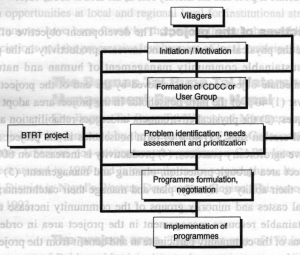
Figure 5.4: Stages of programme development in BTRT project area
1. Initiation and motivation
Formation of user groups or CDCCs is a prerequisite for support for the development activities from the BTRT project. Initiatives for bringing the villagers together and forming the user groups are usually taken at the local level by such people as local leaders, school teachers, educated persons or ex-servicemen. These people inform and try to mobilize the villagers.
The field staff of the project, and in particular the Women Motivator and Farmer Assistants, have been quite successful in motivating the villagers to conduct development activities through the user group approach. The Women Motivators and Farmer Assistants are recruited from the VDCs where the BTRT field offices are located and are assigned to the field office in their own VDC.
2. Formation of CDCCs and user groups
The villagers at village or ward level, motivated to carry out development activities, come together under the leadership of any of the villagers described above or under the guidance of the BTRT project staff. Meetings of villagers who are potential members of the user groups are held, possibly in the presence of BTRT field staff. The decision to form a user group or, in a broader perspective, a CDCC is submitted to the BTRT field office for necessary information and formalization. Recently, it has become common practice to register these CDCCs under the Chief District Officer as non-governmental organizations.
Most of the CDCCs are involved in more than one activity. Therefore, it is common for most CDCCs to form subcommittees in addition to the executive committee, to look after and execute specific development activities. These subcommittees consist of three to five members. The members are usually chosen in a mass meeting for their initiative, knowledge in the particular field and the area of residence. The CDCC in Bastola Village, Majhthana VDC, Ward no. 6 can be cited as a good example of having undertaken different development activities through specific subcommittees. In addition to the executive committee, four subcommittees have been formed in this CDCC. A construction subcommittee has been established to look after, supervise and monitor the construction of stone wall, checkdams and plantations in Ahale Khahare Khola (stream) area. An agroforestry subcommittee is carrying out agroforestry activities in one hectare of barren land. The agriculture subcommittee is responsible for vegetable and fruit cultivation, and the forest subcommittee is implementing and monitoring community forestry management and protection according to the rules specified in the working plan for the community forests.
3. Problem identification, needs assessment and prioritization
Usually, formation of CDCCs is initiated to discuss the perceived problems faced by some or all of the villagers in a locality. When meetings are held, different problems, constraints and perceived needs are discussed. These meetings are attended by BTRT project staff, who provide guidance in identifying and explaining opportunities related to resource development. Also, a needs assessment is conducted by the group in a meeting under the guidance of BTRT staff. Priorities for development activities are fixed. These are then submitted to the field office with a request to undertake the prioritized activities.
Activities are planned based on the problems, constraints and needs identified by the CDCC members in the village meeting, or by the CDCC executive committee in consultation with the members. The BTRT encourages communities to use people's participation to formulate their own development activities for their own benefit, using available resources. Not all activities planned by the communities are undertaken by BTRT because the project is limited by the predetermined series of activities targeted in its annual plan, and because of budgetary constraints. Therefore, the BTRT staff orients the CDCCs to formulate their plans to match its targets and budget. Provision is usually made for the inclusion of CDCC plans in the annual project plan and budget in the coming year if the plans are technically feasible and socially in conformity with the objectives of BTRT.
4. Programme formulation and negotiation
Prioritized development activities submitted to the field office of BTRT for possible technical and financial support undergo a series of steps before final approval by the project manager. Programmes are formulated after necessary negotiations with the villagers or CDCC members. The five major programmes that are formulated to create awareness of soil erosion, mitigate land degradation and increase productivity of the project area are: (1) land use planning; (2) land productivity conservation; (3) infrastructure protection; (4) natural hazard prevention; and (5) community soil conservation. Negotiations between BTRT and the CDCC members may take place for only some programmes out of the list and for labour contributions through people's participation. The BTRT project, according to its established policy, supplies the technical input, required amount of non-local materials and cash payment to cover the skilled and semi-skilled labour. The people's participation in the form of labour contribution is fixed through the decision of CDCCs.
5. Implementation of programmes
The implementation of development activities or programmes is a joint effort of the villagers (CDCCs) and the project. The share of effort of any one party depends on the type of activity or programme. For example, the efforts or contributions of the villagers in the management and protection of community forests are much more than in the construction of a drinking water system.
No stepwise, specific printed or audiovisual tools are being used for the methodological steps 1-3 (above). However, videos and slide shows on interesting rural community development activities are organized from time to time. Usually, these are organized in the initial stages to motivate the rural community and to initiate intervention by the BTRT project and field staff. The project staff also uses flip charts related to conservation farming. This is used more for teaching different steps and techniques of conservation farming than for the different methodological steps. The project also produces annual wall calendars and brochures for distribution to rural communities on such topics as the techniques of conservation farming, growing different cash and fruit crops or livestock health and sanitation. To some extent, these printed materials help in the initial steps taken by the rural communities themselves. The BTRT staff act as facilitators to initiate group discussions on problems and needs. The priority problems and needs assessed by the rural communities in meetings become the basis for planning development activities for the particular group of rural people or the community.
There are no specific guidelines on the number of meetings, working sessions or time planning needed for each of the stages to enable a new user group to be fully operational. The time needed can differ significantly depending on the type of activity, the type of community, the time perspective of expected results and the socio-economic conditions of the participants. Planning of new activities requires more time than planning of activities with which the communities are familiar. All villages are different, and some are more heterogeneous than others. Planning of activities for which different groups will be accountable, and from which all of them are supposed to derive equal benefits, is more time consuming than the planning of activities with a more homogeneous group. In addition, activities that give quick results require less time planning and group meetings as compared to the activities with long-term results. Finally, participatory planning and decision-making are to be considered as time investments of those who are directly involved. It is well known that time availability is limited in the villages, particularly among the poorest. Therefore, mobilization and organization of these groups will take more time than mobilization of the more privileged.
During the second phase, BTRT staff members at the field stations have been successful in promoting a participatory approach and forming CDCCs in the communities. The hiring of Farmer Assistants and Women Motivators from the local communities has increased the confidence of the local people in BTRT project activities. The involvement of most of the CDCCs in implementing participatory activities at the local level seems to confirm that the communities consider the project as their own. The people have realized the dramatic situation they may have to face in the near future if the existing forest resources are not properly protected and managed and new tree plantings are not initiated on common lands. Many CDCCs are thus effectively protecting and managing forest resources and using forest products on a sustainable basis. There have been important changes in the local communities' technical and administrative capacity to manage and benefit from local forest resources.
Several forest user committees, working under the CDCCs as well as independently, have prepared workplans involving the participation of their members, including women, the poor and the low castes. They have demonstrated technical capacity for management and benefit sharing in the establishment and management of community forest nurseries, as well as in silvicultural operations such as pruning, thinning and harvesting of forest products by rotating among different patches or strips of forest. The sustainable administration of forest production through management and benefit sharing among user group members involves ensuring protection by watchmen or members themselves, and obeyance of rules and regulations specified in the management plan. It also includes management of the group's funds, raised from contributions, subsidies from BTRT and sale of forest products. The forest user committees have gained the required administrative capacity for these kinds of responsibilities.
The CDCCs have proven to be an adequate organizational structure, permitting the elaboration of a global framework for planning development in which a number of wards or villages participate. At the same time, the CDCCs delegate ongoing planning of specific activities to the different groups. In other words, at CDCC level a kind of development policy plan is prepared and approved (identifying the required institutional linkages with line agencies), while at the level of the different committees further detailed plans for implementation are prepared. The workplans prepared by the villagers or CDCC members are submitted to the concerned Forest Area Office and District Forest Office for necessary action. Forest Office actions are geared towards approval of the workplans and handover of the community forest to the CDCC or user group.
The importance of using local knowledge in the elaboration of community forestry management plans has been demonstrated by villagers belonging to different CDCCs. Their knowledge of forestry resources and their organizational and managerial skills in protecting and managing forests for sustainable use were demonstrated while preparing the Community Forestry Plans of their village or ward.
In order to strengthen local capacity, training is considered an important part of BTRT project activities. Training is provided to build knowledge of different aspects of human and natural resource management. The managerial skills acquired through training are then used to plan development activities for the future. Technical training related to income generating activities has greatly contributed to the strengthening of planning capacity at individual as well as CDCC levels. During the training, selected farmers are requested to prepare sketch maps of their respective households to plan conservation activities. They also prepare crop calendars. This provides them with opportunities to learn by doing the activities themselves. These farmers then act as promoters in the community to disseminate the techniques of conservation farming to the other villagers.
The socio-cultural context at local level can limit the ability of participatory planning to empower disadvantaged groups. Although most of the CDCCs comprise villagers of differing socio-economic status, educational levels and ethnic groups, they tend to be dominated by the local elite. Literate villagers tend to show supremacy over illiterate members and influence decision-making. It is not uncommon, therefore, that participatory planning is limited to needs assessment and subsequent participation in implementation through labour contribution. Decision-making on priorities and activities to be undertaken is in the hands of the more influential members of the CDCCs. In particular, the dominant position of the artisan class seems to be a widespread phenomenon. This, of course, is not conducive to planning that responds to the needs of different interest groups at local level. Therefore, there is every chance of arousing the suspicion, among the poor and the low castes, that participatory planning only means favouring the desires of the artisan or elite group. The poor, the low castes and women are not proportionally represented in the participatory planning process. Since most of the low caste members are daily wage labourers, it is very difficult for them to participate in the planning process, and thus their role in participatory planning is very marginal.
The target-oriented development programmes of line agencies, including BTRT, set back participatory planning. Most of these agencies (and the project) have annual targets that are to be achieved within the particular fiscal year. These target-oriented programmes may be partially based on the needs assessment of the villagers (CDCCs) in the previous year, since the CDCCs submit their programmes for inclusion in the next year's target and budget. As the programmes of the agencies are target-oriented, they are often in a rush to implement the programmes within the allotted time frame. Thus, the scope of participatory planning in decision-making and implementation is somewhat restricted.
On the other hand, the consolidation of different user groups into CDCCs for their better management has reduced overlapping of these groups in the community. Participatory planning of development activities is done through a series of general meetings of members of CDCCs, of the executive committee or of sub-committees for specific activities. The attendance of the members at the general meetings has been satisfactory for most of the CDCCs. Opportunities have been provided for women and the poor from lower castes to participate in different committees. Moreover, the meetings of executive committees and subcommittees of several CDCCs are held open for attendance by all interested CDCC members, to allow better coordination and participation in the planning process.
