This Section commences with a brief review of the current knowledge of mariculture-related aspects of the biology of Trochus niloticus, followed by a step-by-step guide to trochus rearing, from spawning through to ranching on the reef.
Trochus niloticus was first reared successfully in Palau by Jerry Heslinga and his colleagues (Heslinga 1981; Heslinga and Hillmann 1981). Subsequently, trochus has been reared experimentally at the Green Island Research Station in north Queensland, Australia (Nash 1985) and at the Orpheus Island Research Station, north Queensland (Nash, unpublished data). Trochus has also been reared on a small scale at Baie de Saint-Vincent in New Caledonia (Anon., 1986). This work is continuing.
Attempts have also been made to rear trochus in Vanuatu in recent years (della Patrona 1986), but have met with only limited success. More recently, trochus has been reared successfully in Okinawa, Japan to a size of several millimetres diameter (Yamaguchi, personal communication, January 1989). Ranching trials with these have been initiated to investigate site- and size-related patterns of mortality.
High survival rates during the hatchery phase have been achieved (Nash, unpublished data), using the methods described below. High survival rates during this phase and the nursery phase have apparently been achieved in Okinawa, where several hundred thousand juveniles are currently growing in tanks (Yamaguchi, personal communication, January 1989).
A description of the techniques and procedures of the various culture and ranching phases is now presented. Further details on these topics may be found in the literature (Heslinga 1981; Heslinga and Hillmann 1981; and Nash 1985, 1988, in press). Much of what follows is more or less standard mariculture procedure. The techniques and procedures described are given as a guide only, and are not presented as a fixed methodology that must be adhered to strictly.
As foreshadowed in Section 2, trochus culture may be divided into six phases:
the spawning phase;
the hatchery phase;
nursery phase no. 1;
nursery phase no. 2;
the ocean nursery phase; and
the ranching phase.
It may not be necessary to use all six phases. For example, nursery phase no. 2 may be dispensed with if trochus juveniles are outplanted at a very small size, and the ocean nursery phase may be by-passed if satisfactory survival rates in the ranching phase are achieved.
Trochus niloticus spawns with an approximate lunar periodicity; spawning is most often observed within a few days of new moon (Heslinga and Hillmann 1981; Nash 1985; della Patrona 1986). Traditional knowledge of Yorke Island fishermen (Nash in prep.) and ni-Vanuatu fishermen (personal communications, January 1989) supports this. (Fishermen do not observe spawning, but trochus are more easy to find at new moon: this is because they emerge from the coral and tend to move into shallow water to spawn (Nash 1988; in prep.).) Spawning generally occurs in the early evening, between about 6 p.m. and 10 p.m.
Female trochus on the Great Barrier Reef were observed to spawn half a million to two million eggs in a 5–15 minute spawning session; mostly about one million eggs were spawned per session (Nash 1985). This is substantially more than the 10,000 to 100,000 eggs reported by Heslinga and Hillmann (1981), or the 5,000 to 100,000 eggs reported by della Patrona (1986) in Vanuatu.
Spawning is always initiated by males, although females do not always spawn in response to male spawning. At the Green Island Field Station, females were observed to spawn about half as frequently as males (Nash 1985).
Behavioural changes in the trochus occur shortly before spawning. These changes allow the spawning to be anticipated and prepared for - for example, by siphoning the faecal material from the bottom of the adult tank and preparing a tank for rearing the larvae. The most obvious change in behaviour is that the trochus spend an increasing amount of their time at the waterline, instead of near the bottom of the tank. Shortly before spawning, the trochus cease feeding, and hold their heads partially retracted. The right siphon, from which the eggs or sperm are released, is also extended more than usual, and may be closed at the tip.
Spawning may last from about 10 minutes to an hour in males, and from about 5 to 15 minutes in females.
Trochus are more likely to spawn if they are well-fed. Unless food supplies in the tanks are plentiful, it is better to use freshly-caught trochus as the broodstock. It is recommended that trochus be collected one week before new moon each month, and kept until they spawn. If they do not spawn, they should be returned to the sea and replaced with fresh trochus one week before the next new moon.
If trochus are purchased from a fisherman, rather than collected by Fisheries Department employees, it should be arranged to collect them from the fisherman the same day he collects them; he should bring them from the sea and keep them in a cool, moist place (such as in a basket in the shade, with a cloth dampened with seawater covering them). The arrangement whereby he leaves them in an enclosure in a mangrove area close to home until collected by Fisheries employees is not recommended; the high temperatures and lack of water movement may either stress them or induce spawning, or both.
Alternatively, Fisheries Department employees could collect the trochus themselves. This may be preferable because (i) it could be ensured that the trochus were absolutely fresh; (iii) the ‘used’ trochus could be returned to the reef when the fresh ones are collected; and (iii) it would be cheaper: no payment for the trochus would be necessary.
The most suitable site for this may be Toukoutouk Bay, part of which is presently leased, along with the adjacent land, from the traditional owners by a long-term expatriate. It may be difficult in other reef areas because of ownership rights to the reefs of local villages. The lessee may be willing to allow trochus to be taken from his reef if they are replaced each month, and if any trochus which die are paid for.
Since males spawn prior to females, the water at the time of egg release contains sufficient sperm to fertilize the eggs; hence, addition of sperm is not necessary. In fact, sperm densities may become too high, and it may be necessary to increase the water flow to flush out most of the sperm before the females begin to spawn.
Stop the flow of water to the tank as soon as spawning by female(s) commences. Eggs may be collected in either of two ways:
When spawning by females has finished, or when sufficient eggs have been spawned, siphon the egg-laden water into a bucket, taking care to leave any faecal material that may be on the bottom of the tank. It is better to agitate the water then siphon from the water column rather than from the bottom of the tank, although siphoning from the bottom may be unavoidable if there are many eggs remaining on the bottom.
Leave the bucket of eggs to stand for about 30 minutes to allow the eggs to settle, then carefully decant most of the water from the bucket. Then transfer the remaining water and the eggs to a tank prepared for rearing the larvae through to the settlement stage. Sieving techniques may be used if necessary, but, in rearing trials to date, this has not been necessary (Nash, unpublished data).
Remove the eggs with a siphon hose held just over the trochus' siphon as she ejaculates. The time of ejaculation can be determined precisely by her behaviour: she will slowly relax her shell so that her body is well extended, then pinch off the end of her siphon. As soon as the siphon is pinched off, ejaculation is only seconds away. The shell is pulled vigorously down onto the body at ejaculation, and eggs are expelled under pressure. (Spawning by males is the same.)
Again, addition of sperm is not necessary, as the water siphoned off with the eggs contains an adequate concentration of sperm.
Eggs collected this way are generally cleaner than those collected by siphoning all the water from the tank, as described in (1) above. The eggs are also much more concentrated, and may be transferred directly to the larval rearing tank.
Count the number of eggs in a measured subsample of the water (say 5 ml), and then estimate the number in the entire volume of water in the tank. Do this two or three times to make sure that the count is accurate. Make sure that the water is stirred up first, so that the eggs are evenly distributed in the water, and not all lying on the bottom of the bucket.
The hatchery phase is of three to five days' duration, from the collection of fertilized eggs through to settlement of the veliger larvae to the bottom of the tank.
The larvae may be reared in either rectangular glass tanks or circular fibreglass ones. Observation of larval behaviour and condition is much easier in glass tanks, but if large numbers (millions) of larvae are to be reared, fibreglass is a more suitable material for constructing larger tanks.
Clean the larval tanks thoroughly beforehand, preferably with a 10 ppm chlorine solution, before rinsing with clean seawater and left to dry.
Transfer the fertilized eggs to the larval rearing tank(s), and add clean seawater to give a final egg density of 4 or 5/ml. Water cleanliness may be increased by passing it through 10 or 20 μm filters.
There are two approaches to rearing trochus larvae: the first is at low densities (5/ml) in large volumes of seawater, with regular changes of water using standard sieving techniques to retain the larvae. The second is at high densities (20–30/ml) in low volumes of seawater, with suppression of bacterial growth by the addition of the broad-spectrum antibiotic Chloramphenicol (=chlormycetin succinate). Virtually 100 percent survival of the larvae through to settlement has been achieved by the antibiotic method (Nash, unpublished results).
The low-volume method is recommended because the routine use of antibiotics may promote the evolution of resistant strains of bacteria (although this is less likely to occur with a broad-spectrum antibiotic like Chloramphenicol, which attacks bacteria in several different ways at once). Nevertheless, the high-density antibiotic method is useful if high larval mortality rates are experienced; this is most likely to occur in early larval rearing attempts, particularly if the hatchery staff are inexperienced. The antibiotic method is recommended at such times because the sooner a batch of larvae has been grown successfully past the settlement stage, the sooner the problems associated with the juvenile stage can be addressed and overcome.
If using the antibiotic method, add Chloramphenicol to the rearing tank as soon as the fertilized eggs have been added, to make a final concentration of 5 mg/l (=5 ppm). Stir the water to mix it through. This concentration is sufficient. Do not add the antibiotic at a higher concentration than this. It will not be any more effective if a bigger dose is added.
Gently aerate the water in the tank with an air stone. Twenty-four hours later, add the same amount of Chloramphenicol once more, and leave to stand. Repeat this two more times (that is, until the end of day 3 after spawning), and the next day the larvae will be ready to transfer to the tank in which they will be grown for the next few months.
If very clean water is used for rearing the larvae, it is generally not necessary to change the water at all during the larval stage when the antibiotic method is used. This is an advantage, because the less rough treatment the larvae get, the higher the survival rate will be.
The nursery phase has been divided into two separate steps. The first covers the period between larval settlement and growth to about 3 mm diameter. The second is from 3 mm until growth to outplanting size.
This division is considered necessary because of the increasing food requirements as the trochus grow. Very small juveniles are unable to deplete the algal growth on the surfaces of the tank, even if they are in very large numbers, simply because they are small. Different tank designs, and continual replenishment of algal food supplies, are necessary for the larger juveniles.
The tanks to be used for this phase should be cleaned two weeks before the settled larvae are to be added, and water flow through the tank commenced to allow an algal film to develop on the tank surfaces.
At water temperatures of 28–30°C, larvae are ready on day 4 to be transferred to the tank assigned for juvenile growth. (Development may be slower at lower temperatures.) Larvae may be transferred from the larval tank to the juvenile tank with a clean bucket.
Ensure that no larvae are swimming in the water column, then commence water flow to the tank. Aerate the water gently; this will both oxygenate the water and promote water movement, preventing areas of ‘dead water’ from forming.
Once the larvae have been transferred to the juvenile tank, it will be no longer possible to clean it. Overgrowth by filamentous algae may be inhibited by partial shading to reduce light levels.
Monitor the conditions in the juvenile tanks daily. Things to check are the flow of water, water temperature, algal growth, and aeration.
Juvenile trochus should become visible to the unaided eye about one month after settlement. When the modal diameter is about 3 mm, harvest the larvae by scraping the walls of the tank. Remove as much of the algae as possible by washing the scrapings through a 1 mm sieve, with a 0.5 mm sieve placed beneath it. Examine the finer sieve for small juveniles. If these are numerous, they may be returned to the tank for further growth.
Transfer the washed juveniles to the tanks used for the second nursery phase. Since depletion of algal food becomes an increasing problem as the juveniles grow, particularly if they are very abundant, it is necessary to increase the area of the surface available for algal growth. This may be done using techniques adopted in abalone culture (Ino 1980): filling the tanks with racks of plates. The surface area of a tank can be increased many times this way.
Algal food supplies in the tanks can be maintained by continual replacement of the plates with fresh ones which have been suspended in the sea for about two weeks to develop a film of diatoms and algae. The juveniles can be scraped from the old to the new plates, and the old ones scrubbed and placed in the sea to replenish their algal film. The frequency with which the plates will have to be changed will depend on the quality of the water, water temperature and the density of juveniles in each tank.
At a size yet to be determined, the juvenile trochus can be transferred to suitable habitat on the reef. During this phase, the juveniles are placed in cages or structures which provide protection from predation and allow them to acclimate to the natural benthic environment (see also Section 6.3). The necessity for this phase will depend on the size at which the juveniles are transferred from the land-based nursery and the severity of predation on unprotected juveniles.
Evidence to date (G. Heslinga, personal communication) suggests that the mortality rate of unprotected juveniles is likely to be very high, although evidence from studies in the Great Barrier Reef region suggests that survival rates of juveniles may be maximized by placing them on suitable reef top habitat on reefs that are more elevated. The reasons for this are given in Nash (1988) and Appendix II.
Cage designs are considered only briefly here. Information on this may be obtained from the literature on abalone ranching (Ebert and Ebert 1986, 1988). These authors describe a rather complex transplantation cage used for abalone in California. Simpler cage designs are likely to be more appropriate for trochus, particularly from the aspect of ease of construction. A design worth considering is a predator exclosure constructed from rolls of plastic mesh. The mesh is fixed to the substrate along its edges, allowing the juveniles to move about freely on the coralline substrate beneath. This design has been used in the ocean nursery phase of giant clam (Tridacna gigas) culture (Barker et al. 1988).
If the ocean nursery phase is adopted, the transition from this to the ranching phase will occur gradually as the juveniles move out of the caged area. Harvesting will then occur when commercial size is reached. In Vanuatu, the legal minimum size of 9 cm maximum shell diameter is reached at about three years of age (Bour and Grandperrin 1985).
In order to evaluate the effectiveness of ranching as a means of enhancing the natural trochus stocks, it is important to compare the abundance of trochus reaching legal size in the ranching area with that in a similar unseeded area. This experiment should be suitably replicated.
Two phases which may not be necessary are the second land-based nursery and the ocean nursery. The former can be by-passed if it is decided to place juveniles on the reef at a very small size, because algal food demands will not be great. This option may be chosen if it becomes evident that it is not economically feasible to grow the juveniles to 10–30 mm diameter before outplanting. As described in Section 6.3, the increased mortality rate on the smaller juveniles when placed on the reef will be offset to some extent by the much lower costs of producing young seed, as well as by the much larger number that can be produced.
The ocean nursery phase may be avoided for one of the following reasons:
if satisfactory survival rates through the ranching phase can be achieved without it;
if juveniles are placed on the reef at a very small size (that is, directly from the first nursery). The cage would be of too large a mesh size to exclude the predators of the very small trochus.
It will not be possible to decide which phases to adopt until the project is underway.
Hatchery rearing of trochus as a management tool
by Warwick J. Nash
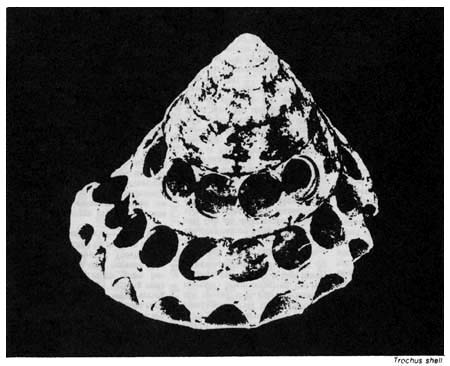
FASHION has played a large part in the recent re-emergence of Australia's trochus shell fishery which has been operating, on and off, since early this century.
At present cleaned trochus shell, which is used for buttons on high-quality shirts, can return more than $4000 a tonne to the fisherman and not surprisingly, there is growing interest in the fishery from many quarters.
This includes some of the islands of Torres Strait where the Australian trochus fishery first began.
Recent surveys into the state of the stocks and the feasibility of trochus mariculture have been commissioned by the Yorke Island Community Council (Ref. 1). Re-establishing a trochus fishery for Erub (Darnley) Island has also been proposed (Ref.2).
The author is an abalone research officer with the Tasmanian Department of Sea Fisheries.*
* GPO Box 619F, Hobart, Tasmania 3001.
History
Trochus shell (Trochus niloticus L.) and pearl shell (or mother-of-pearl) have been used to make buttons since the 1870s when the Japanese began to adopt Western-style clothing fastened with buttons instead of their traditional kimono, which was fastened by a sash around the waist (Ref. 3).
The trochus fishery in Queens-land enjoyed a colourful history from its beginnings in Torres Strait in 1912 until the introduction of plastic buttons brought about its demise in the 1950s.
The fishery then lapsed until the mid-1970s when the fashion houses of Europe, and later Korea, decided to revert to the use of buttons made from natural products on their top-range shirts (Ref. 4).
The increase in demand for trochus shell was matched by an increase in shell value which, in turn, led to a re-development of the fishery world0wide.
At present the annual global catch is between 3000 and 5000 tonnes (Refs 4, 5). Although Australia's contribution to this in the past has been as high as 1300 tonnes in 1953, it presently appears to be sustainable at about 500 tonnes (Ref. 6).
The price paid to fishermen for cleaned trochus shell in Queens-land has been steadily increasing: it fetched about $ 1200 a tonne (FOB) in late 1982, exceeded $2000 a tonne in 1985, and at present top quality shell can fetch in excess of $4000 a tonne.
Management
The regulation of fishing effort is essential for achieving sustainable high yields in virtually all fisheries, and history has shown that trochus are particularly prone to overfishing. Almost without exception, overfishing has occurred wherever trochus have been harvested commercially (Refs 5, 6, 7).
Their vulnerability is attributable largely to their sedentary habit, and to the fact that they inhabit a well-defined area of coral reefs — the windward edge in shallow water generally no deeper than five to eight metres.
Although trochus tend to retreat to crevices and overhangs in daylight hours, and are camouflaged by algal encrustations on their shells, they can still be found readily by experienced trochus divers.
Therefore fishing pressure needs to be carefully controlled.
Re-seeding depleted stocks
One of the management options available to the fishery manager is the re-seeding of depleted stocks with hatchery-reared juveniles. It differs from other management options by actually increasing the stock beyond its natural size.
However, it is an option which is often not exercised because of one or more of the following reasons:
the species is not amenable to rearing in a hatchery;
the larval rearing methods have not been worked out, either because of lack of interest or lack of funds;
a very large commitment of facilities, manpower and funds would be needed to produce seed in large enough quantities to significantly increase the fishing yield;
it is simply not economical to rear the species in a hatchery; and/or
it has been considered that survival rates of the outplanted seed to harvestable size would be too low to be worth while.
Compared with most species, trochus is an easy animal to rear because the eggs are lecithotrophic, so that the developing larvae feed on their yolk reserves instead of cultured unicellular microalgae grown under sterile conditions. Also, the planktonic larval stage is brief (three to four days) and the newly settled juveniles feed on the diatoms and algae which grow readily in tanks in the presence of sunlight.
In addition trochus from the Townsville region northwards spawn all year round with an approximate lunar periodicity (Ref. 6). There is evidence that spawning by more southerly populations occurs only in the summer months (unpublished data).
In a recent trial at the Orpheus Island Research Station, 70 km north of Townsville, a survival rate of larvae of nearly 100 per cent was achieved between spawning and settlement four days later. If it can be shown that trochus seed can be grown in large numbers in tanks, then it would seem that stock enhancement by hatchery-reared juveniles is a feasible management option.
These results are encouraging, but in the absence of information on the likely survival rates of the juvenile trochus once they are placed on the reef to grow to harvestable size, it would be premature to proceed with large-scale juvenile production.
In the only known transfer of hatchery-reared juvenile trochus to the reef (in Palau, Micronesia), almost total mortality was observed within a couple of days of outplanting, with only remnants of crushed shells being found (G. Heslinga, personal communication).
Thus, unless it can be established that juvenile trochus will not suffer very high mortality when placed on the reef, stock enhancement would not be a feasible management option.
An example of this is the abalone (Haliotis) fishery in Japan, where, despite the annual production of several million abalone seed in hatcheries, there has been no increase in the annual catch of adult abalone (Ref. 8). Although not established with certainty it is likely that the cause is very high mortality soon after outplanting.
Therefore it would seem that the prospects of stock enhancement of trochus populations with hatchery-reared juveniles are poor. However, things are not as bleak as that, because there are several pieces of evidence which suggest that juvenile survival rates differ greatly between populations, with some being quite high.
First, trochus fishermen distinguish between two types of reefs: ‘swim reefs’ and ‘dry picking’ reefs.
Swim reefs are those which are exposed for only a few days each month during low water spring tides, whereas dry picking reefs are exposed much more frequently than this, because they are more elevated. Trochus are often collected by walking at low tide on these reefs—hence their name.
Second, trochus are typically much more abundant on dry picking reefs than on swim reefs. In addition, and related to this, juveniles are seen in greater abundance on dry picking reefs.
This pattern of more trochus on dry picking reefs than on swim reefs is not coincidentally caused by transient fluctuations in abundance on reefs through time, since information supplied by old trochus fishermen shows that reefs that are good trochus reefs now were good trochus reefs in the 1950s. Therefore some reefs are intrinsically good trochus reefs and some are not.
If these observations are tied in with the fact that juveniles inhabit the reef top immediately adjacent to the seaward reef crest (that is, the zone which becomes exposed at low water), it may be hypothesised that there is a casual relationship between juvenile survival rates and the frequency and duration of reef exposure.
Juveniles on swim reefs are underwater more often, and for longer periods, and therefore exposed to higher levels of predation by fish, than those on dry picking reefs. Juvenile trochus may avoid predation by hiding in holes and crevices and under rocks, but they must emerge to feed. At such times they are exposed to predation.
If this hypothesis is correct (that patterns of trochus abundance are determined by higher predation rates of juveniles on swim reefs than on dry picking reefs), then the implication is that patterns of distribution and abundance of trochus are determined by post-settlement mortality rather than mortality in the planktonic larval stage. This is not to say that pre-settlement mortality is not occurring, but it suggests that it is not so high that it masks post-settlement factors.
At first glance, this may seem to contradict the hypothesis that the distribution patterns of coral reef fish are determined by factors operating on the planktonic larval stages (Ref. 9). However, the larval life span of fish is usually three weeks or more, compared with three to four days for trochus.
It is likely that the absolute mortality rate of the planktonic larval phase between spawning and settlement is directly correlated with the duration of this phase, although the mortality rate per unit time may be more or less constant.
If this hypothesis were correct, then survival rates of hatchery-reared juvenile trochus may be maximised by placing them on dry picking reefs at low tide at night (when most predators are not active).
Whether the resulting survival rates to harvestable size would be high enough to make hatchery production economically feasible can only be determined by doing it. This could be tested in a suitably controlled and replicated experiment by placing small juvenile trochus in suitable habitat on both dry picking and swim reefs, and monitoring survival rates.
It cannot be ruled out that juvenile survival may be higher on dry picking reefs because the algal food is of higher quality or quantity than on swim reefs, rather than because of predation differences. This could be tested by comparing survival rates of caged and uncaged juveniles on the reeftop on swim reefs. Higher survival rates in cages would indicate that predation was the important factor.
Although caging would exclude other grazers (fish) as well as potential predators of juvenile trochus, this is not seen as a problem since differences in predation rates of caged and uncaged juvenile trochus should be apparent within a few days — too soon for differences in algal abundance between caged and uncaged areas to occur, or to affect the survival rates of the trochus.
The possibility cannot be ruled out that high mortality of hatchery-reared juveniles when placed in the sea is because of behavioural differences between these and wild juveniles; the former may wander around in exposed areas when their wild counterparts are hiding in the coral, as has been found for Californian abalone (Ref. 10).
Cryptic behaviour may be learned, or may be cued to the tides. If the latter, it may take some time for juveniles released on the reef to synchronise their activity cycles with the tides. It may be necessary to test this possibility before any conclusions about relative mortalities on dry picking and swim reefs could be drawn.
The results of this experiment would be of importance to the trochus fishery, but its relevance may extend to other fisheries, such as for abalone, which has a similar larval life history and breeding biology (Refs 11, 12).
The patterns of juvenile abundance observed for trochus may not have been detected for abalone because larval abalone settle in subtidal areas (Ref. 13) and so would not be sensitive to different exposure levels of the reefs which they inhabit.
The results of this experiment may suggest that enhancement of trochus (and perhaps abalone) stocks with hatchery-reared juveniles would be successful only if areas of low juvenile mortality could be identified. Until that time, hatchery production would not be feasible.
References
Nash, W.J. (1987). A survey of trochus stocks in the Yorke Island region, Torres Strait, with an assessment of the feasibility of trochus mariculture on Yorke Island. Report commissioned by the Yorke Island Community Council.
A CEEDS proposal for Erub Island Community Council. Aboriginal Development Commission, Torres Strait Branch, 1987.
Kataoka, C. (1983). ‘The progress of the pearlshell fishery in the South Pacific’ [in Japanese]. Mem. Fac. Fish. Kagoshima Univ. 32: 1–28.
Carleton, C. (1984). ‘Miscellaneous marine products in the South Pacific: A survey of the markets for specific groups of miscellaneous marine products’. South Pacific Forum Fisheries Agency. Honiara, Solomon Islands.
Heslinga, G.A. and Hillmann, A. (1981). ‘Hatchery culture of the commercial top snail Trochus niloticus in Palau, Caroline Islands’. Aquaculture 22: 35–43.
Nash, W. J. (1985). ‘Aspects of the biology of Trochus niloticus and its fishery in the Great Barrier Reef region’. A report to Fisheries Research Branch, Queensland Department of Primary Industries, and the Great Barrier Reef Marine Park Authority.
Bour, W. and Hoffschir, C. (1985). ‘Evaluation et gestion de la ressource en trocas de Nouvelle-Caledonie’. Unpublished ORSTOM Report, New Caledonia.
Ino, T. (1980). ‘Abalone and oyster’. Fisheries in Japan, Vol. 9. Jpn. Mar. Products Photo Materials Association.
Dohery, P. J. (1983). ‘Tropical territorial damselfishes: is density limited by aggression or recruitment?’. Ecology 64: 176–190.
Schiel, D.R. and Welden, B.C. (1987). ‘Responses to predators of cultured and wild red abalone. Haliotis rufescens, in laboratory experiments’. Aquaculture 60: 173–188.
Ebert, E. E. and Houk, J. L. (1984). ‘Elements and innovations in the cultivation of red abalone Haliotis rufescens’. Aquaculture 39: 375–392
Shepherd, S. A. and Turner, J. A. (1985). ‘Studies on southern Australian abalone (genus Haliotis). VI. Habitat preference, abundance and predators of juveniles’. J. Exp. Mar. Biol. Ecol. 93: 285–298.
Shepherd, S. A., Clarkson, P. S. and Turner, J. A. (1985). ‘Studies on southern Australian abalone (genus Haliotis). V. Spawning, settlement and early growth of H. scalaris’. Trans. R. Soc. South Aust. 109: 61–62.
Introduction
There are several possible causes of the high mortality of trochus in the aquarium at the Vanuatu Fisheries Department in Port Vila. These include:
the stress of handling between the time of harvesting and the time of placement in the tanks at the Fisheries Department;
poor water quality (polluted with waste or spillage from nearby ships);
low oxygen levels (little water movement in the bay, and high temperatures);
toxins entering the water supply in the aquarium from either the intake line, the pump, the outflow line into the tanks, or the tanks themselves.
Methods
To test the contribution of each of these factors to trochus mortality, 30 trochus were collected from the reef in Toukoutouk Bay on January 17th, 1989 and taken immediately to the Fisheries Department, where they were sorted randomly into four groups and subjected to the following treatments:
Group I (7 trochus) was placed in a small wire mesh cage which was suspended from a support post of the intake line, about one metre from the intake. The cage was about 3 m below the surface and about 0.75 m above the bottom.
Group II (9 trochus) was placed in a circular concrete tank with water flow but no aeration;
Group III (9 trochus) was treated the same as Group II, but with aeration of the water as well;
Group IV (5 trochus) was placed in a 130-I glass tank inside the laboratory. The tank was aerated and circulated through an in-tank charcoal filter but not changed during the experiment. The water in this tank was collected from Port Vila Bay near the Fisheries Department. Fish, invertebrates and seagrass had been maintained in this tank for several weeks prior to the experiment; water quality therefore was satisfactory.
Treatment I was to test the quality of the water itself. Treatments II and III were to test the effects of the pump, plumbing and tanks; Treatment III included aeration to determine whether trochus were dying because of lack of oxygen. Treatment IV was to assess the effect of collection and transport from the reef to the aquarium; the quality of the water in this tank was high: other organisms (seagrass, small fish, crustaceans and bivalves) had been kept in this tank for some time with no mortalities. Deaths of trochus in this tank could therefore be attributed to the stress of collection and transport.
In the non-aerated tank (Treatment II), water exchange was promoted by placing an outer sleeve around the standpipe so that water was drained from the bottom, with water inflow at the top.
The condition of the trochus was noted twice daily, except for those in the sea cage; these were observed once a day. Poor health of the trochus was indicated by poor adhesion to the tank and feeble retraction response when prodded.
Temperature was recorded each morning in each treatment.
Results and discussion
The trochus in the sea cage and in the recirculating aquarium (treatments I and IV) survived the experiment. Those in the aerated flowthrough tank (treatment III) began to look unhealthy three days after the experiment began, and were all dead a day later. Those in the tank without aeration (treatment II) began to look unhealthy after four days, and three were dead a day later. The next day (day 6), four more were dead and the remaining two were sick. The following day all were dead.
It is concluded that the cause of death is some aspect of the aquarium facility; quality of the water being pumped from the sea was not the primary cause of death.
Starvation was ruled out as a cause of death, because its duration (one week) was much shorter than that of trochus kept without food in the flowthrough seawater system at the Green Island Field Station in north Queensland (unpublished observations).
This experiment was not designed to distinguish between the contribution of individual components of the aquarium system (pumps, plumbing and tanks) to mortality, because there was insufficient water flow to increase or replicate the treatments. Nevertheless, potentially toxic components have been identified. These are
the brass gate valves used to regulate the flow of water into the tanks;
the pump housing; and
iron oxide (rust) leaching into the tanks from cracks in the wall.
It is noteworthy that the trochus in the aerated tank died more quickly than those in the non-aerated tank. This also occurred with trochus that were held in the tanks prior to this experiment. Aeration itself is an unlikely cause of death because there are no toxic fumes generated from the air blower, which is powered by an electric motor. A more likely cause was the extensive rust deposits in the aerated tank; rust was absent from the non-aerated tank.
To verify that rust contributes to trochus mortality, it would be necessary to place trochus in both the rusted and clean tanks, with aeration supplied to the clean tank. If trochus continued to die more quickly in the rusted tank, then rust could be identified as toxic to trochus.
The fact that the trochus died in both tanks with flowing seawater, whether rusted or not, indicates that there is more than one source of contamination within the system.
It is important that high mortality rates in the aquarium system at the Fisheries station only appeared late in 1988. Until that time, trochus had been kept in the system by Didier Tourrel for several months at a time (J.-M. Guerin, personal communication). It would appear then that there has been a recent change in the conditions in the system, but it proved impossible to determine what this change was.
| January 10, 1989 | Departed Hobart, Tasmania, Australia, 6.40 a.m. |
| January 11 | Arrived Port Vila 11.05 a.m. Checked into a hotel, then went to the Fisheries Department station. Visited the village of Ératap on the southern coast of Éfaté with Jean-Michel Guerin and Felix Nguyen to arrange for a trochus fisherman to collect a further 20 adult trochus for spawning trials. Held limited discussion with the fisherman about when trochus are most abundant. Inspected the aquarium system, and prepared the tanks for spawning trials. Generally familiarized myself with the Fisheries Station and its facilities. |
| January 12 | Inspected the submerged intake end of the intake line. Removed the intake strainer and cleaned it, then replaced it on the line. Measured flow rates before and after cleaning. Drained and cleaned the tanks before refilling. Wrote up notes. Night-time inspection of the trochus for signs of spawning activity. |
| January 13 | Inspected the now-defunct Macrobrachium (freshwater shrimp) farm at Mélé with Jean-Michel and Felix, with a view to assessing its suitability as a trochus hatchery. Re-visited Ératap to pick up the 20 trochus collected by the trochus fisherman. Attempted to induce spawning of these trochus back in the tanks by thermal stress, without success. Wrote up notes. Night-time inspection of the trochus for signs of spawning activity. |
| January 14 | Went to Mélé Islet (Hideaway Island) with Jean-Michel to search for trochus on the reef. Saw quite a few juveniles (3–5 cm diameter) around coral boulders on the reef top a couple of hundred metres from the reef edge. No adult trochus were seen, despite careful searching over the reef edge. Night-time inspection of the trochus for signs of spawning activity. |
| January 15 | Wrote up notes. Inspected the trochus for state of health and signs of spawning activity. Five were dead, and the remainder looked sick. |
| January 16 | Examined gonads of dead and dying trochus with the aid of a microscope. Ovaries look moderately full, and late-development or ripe eggs were seen. Arranged to collect fresh trochus to determine the cause of death. Wrote up notes. |
| January 17 | Went to Toukoutouk Bay with Jean-Michel and Felix to collect trochus for the experiment to determine the cause of death in the tanks. Set up the experiment. |
| January 18 | Dismantled the pump to inspect the impeller for wear. Monitored the trochus in the mortality experiment. Wrote up notes and letters to trochus workers. Night-time inspection of the trochus for signs of spawning activity. |
| January 19 | Monitored the trochus in the mortality experiment. They all look healthy. Wrote up notes. Night-time inspection of the trochus for signs of spawning activity. |
| January 20 | Bought charts of Vanuatu and Éfaté. Trochus in the tanks starting to look sick, but those in the sea near the intake seem fine. Held discussions with Fisheries Department personnel about trochus culture in Vanuatu. Visited Melanesian Shell Products (button factory), observed the production of button blanks, and had a general discussion of trochus with the assistant manager. Wrote up notes. |
| January 21 | Monitored the trochus in the mortality experiment. Wrote up notes. Held discussions with Drew Wright (Forum Fisheries Agency) and Gary Preston (South Pacific Commission Inshore Fisheries Project). |
| January 22 | Drove with Jean-Michel, Felix and Simon Diffey to check the reefs along the south coast of Éfaté as far as Eton for trochus and trochus habitat. Snorkelled over elevated intertidal reef flat near the south-east corner of Éfaté, but saw only few juvenile trochus. Inspected the trochus in the mortality experiment. |
| January 23 | Wrote up notes. Held further discussions with Fisheries personnel and Drew Wright. |
| January 24 | Gave a seminar on the feasibility of trochus culture and ranching as a management strategy. The people who attended the seminar are listed below. Terminated the mortality experiment. Finalized my trip. Held final discussions on trochus culture. Departed Port Vila for Brisbane at 11 p.m. |
| January 25 | Arrived in Hobart at 11.30 a.m. |
List of people who attended the seminar on trochus culture and management
| Ernest Bani | Environment Unit, Ministry of Lands, Minerals and Fisheries |
| Serge Bourdet | Manager, Melanesian Shell Products Pty. Ltd. |
| Chris Bowley | Principal Extension Adviser, Village Fisheries Development Project, Fisheries Department, Port Vila, Éfaté, Vanuatu |
| Albert Carlot | Research Officer, Fisheries Department, Port Vila, Éfaté, Vanuatu |
| Esperance Cillaurren | ORSTOM, Port Vila, Vanuatu |
| Gilbert David | ORSTOM, Port Vila, Vanuatu |
| Alsen Fred | ni-Vanuatu Fisheries student at the University of the South Pacific, Fiji |
| Jean-Michel Guerin | Volontaire Service National, Fisheries Department, Port Vila, Éfaté, Vanuatu |
| Jackline Reuben | Second Secretary to the Minister for Lands, Minerals and Fisheries |
| Mike Riepen | Economic Adviser, Fisheries Department, Port Vila, Éfaté, Vanuatu |
| Ravi Robin | Principal Fisheries Extension Officer, Village Fisheries Development Project, Fisheries Department, Port Vila, Éfaté, Vanuatu |
| Bruce Robinson | Administrative Officer, Fisheries Extension Service, Village Fisheries Development Project, Fisheries Department, Port Vila, Éfaté, Vanuatu |
| Naomi Sope | Fisheries Administration Officer, Fisheries Department, Port Vila, Éfaté, Vanuatu |
| Drew Wright | Project Co-ordinator, Forum Fisheries Agency, Honiara, Solomon Islands |
| Name | Position |
| Mr Albert Carlot | Research Officer, Fisheries Department, Port Vila, Éfaté, Vanuatu |
| Ms Esperance Cillaurren | ORSTOM, Port Vila, Vanuatu |
| Mr Gilbert David | ORSTOM, Port Vila, Vanuatu |
| Mr Jean-Michel Guerin | Volontaire Service National, Fisheries Department, Port Vila, Éfaté, Vanuatu |
| Dr René Grandperrin | ORSTOM, Noumea, New Caledonia |
| Mr Jerry Heslinga | Manager, Micronesian Mariculture Demonstration Center, Koror, Palau, Micronesia |
| Mr René Laurent | Plantation owner, Devil's Point, Éfaté, Vanuatu |
| Dr John Munro | Director, ICLARM South Pacific Coastal Aquaculture Project, Honiara, Solomon Islands |
| Mr Gary Preston | Senior Inshore Fisheries Scientist, South Pacific Commission, Noumea, New Caledonia |
| Dr Claude Reichenfeld | Director, ORSTOM, Port Vila, Vanuatu |
| Mr Mike Riepen | Economic Adviser, Fisheries Department, Port Vila, Éfaté, Vanuatu |
| Mr Hideyuki Tanaka | Project Manager, FAO/South Pacific Regional Aquaculture Development Project, Suva, Fiji |
| Mr Drew Wright | Project Co-ordinator, Forum Fisheries Agency, Honiara, Solomon Islands |
| Professor Masashi Yamaguchi | Department of Marine Sciences, University of the Ryukyus, Okinawa, Japan |