The Fishery Programme Officer was requested by Mr. H Tanaka, Regional Aquaculturist, to travel to Tarawa, Kiribati on behalf of the South Pacific Aquaculture Development Project (GCP/RAS/116/JPN) with the following terms of reference:
to study the state and potential of milkfish smoking in the country.
to look into ways of improvement of smoking techniques under local conditions.
to investigate future development possibilities of smoked milkfish products in view of present and potential markets in and outside the country.
to carry out a preliminary marketing test of smoked milkfish in Fiji.
Due to the fact that travel was only foreseen to Tarawa, the scope of this study must be limited to the situation on this atoll, it being understood that development of smoked milkfish products could be equally possible from Christmas Island which has a direct air link with Hawaii.
With the lowered demand for Milkfish as bait for Pole and Line fisheries, the Temaiku Baitfish farm in Tarawa started to direct its efforts towards producing milkfish for human consumption. Milkfish is sold fresh to local consumers at the farm and at some stage, fish was exported fresh to Nauru. This export ended however with the suspension of the Air Nauru flights to Tarawa.
Some staff members of the fisheries division having attended an FAO/DANIDA workshop on Fish handling and Processing in the Philippines, smoke processing of milkfish was tried at the bait farm in order to increase the utilization of this species. At present, milkfish is smoked now and then upon request of interested buyers for feasts and government functions. No attempts were made to organize regular marketing of the product.
A tray smoker was constructed by the Fisheries Division. It consists of a concrete stone masonry fire chamber of 1m × 1m × 70 cm, with a rudimentary smoke divider of loosely overlapping steel plates. The air inlet is an old paint tin of 30 cm diameter, with the bottom knocked out, set into the masonry. This supports up to five wooden trays (1m × 1m × 20cm) with a bottom of chicken wire, and is topped by a rooflike hood with a small smoke outlet spared out. When asked where this design came from, reference was made to an article on agrowaste dryers (fig.5 in Roberts, 1986).
The fish is delivered from the ponds in buckets or plastic bags in pre-rigor condition, some being still alive. They are then prepared for smoking in a shed that houses the derelict block-ice machine. Water is available from a rainwater tank or pumped from a well. The shed is open at all times, the ceiling and walls in bad condition.
The milkfish is prepared for smoking by splitting the fish kipperwise, cutting out and discarding backbone and tail (which are consumed by the staff for lunch), and the gills. Guts and gills are disposed of as fish feed in the ponds. It is interesting to note that the milkfish stomach (which resembles a chicken stomach) is considered a delicacy (raw) by the workers. The fish is not scaled prior to smoking.
The fish are then soaked in brine for “some time”. Nobody had a clear cut idea about the strength of the brine or the brining time. The final salt content therefore was source to complaints from consumers because of its inconsistency.
Smoking is done by laying the fish on the trays immediately after preparing, and building a fire under it with coconut husk and green leaves of the “Te Ren” tree. The latter was done “to provide for more smoke” (more water vapour in reality). There was no temperature or fire control, the inlet being filled with coconut husk and leaves so as to block the entrance. The temperature was measured to raise above 130°C. Smoking is carried on for four hours. The fish was turned after one hour and a half.
After smoking, the product is packed, without prior cooling, in clear plastic bags and sometimes sealed (a heat sealer being present at the farm). Nowhere is there chilled storage available for keeping the product.
There was no time nor equipment to organize a serious storage trial, so a very basic experiment was done with the first batch of fish smoked. Two lots of fish, smoked on Friday 14/4 according to the original practice, were stored under respectively bad and horrible conditions.
Fifteen fish were stored open (i.e. not packed in a bag but loosely covered with a plastic against condense water drip) in an old kitchen fridge (temperature 9 °C) and regularly inspected. By Thursday 20/4, the fish had lost some of its gloss, with a blander taste, but was readily consumable.
Ten fish were packed in a polyethylene bag, heat sealed and stored in a locker at the bait farm were daytime temperatures raised to 31 °C. On Monday 17/4, visual inspection revealed no spoilage. On Wednesday 18/4 the pack was opened, slight bacterial slime had developed on the fish, no strong off-odours were detected, the product however was discarded without tasting.
The greatest problem with selling milkfish in Tarawa is its price. After calculation of costs, the bait farm is selling fresh milkfish at A$ 2.50/kg. It has then to compete in the market with caught fish of which the most plentiful, Skipjack Tuna, is selling at A$ 0.50/kg. Thus, the demand for milkfish is low.
The diet of the population of the Atoll on Tarawa is limited in diversity and heavily dependent on the availability of imported products and the arrival of ships from Fiji and Australia. In the period of this study e.g., bread, milk or fruits were not available. Smoked milkfish is therefore received enthusiastically by the population, as it represents a welcome change in the normal choice of food.
By regularly smoking part of the production, the milkfish farm might be able to at least double its sales of fish, providing it is able to sell at an acceptable price. In the smoking trials, it was therefore not the aim of achieving a smoke dried product with long storage life, but a tasty, good looking product with limited weight loss from water evaporation, a certain gain in shelf life being a bonus.
The Fisheries Division has expressed its wish to try and export smoked milkfish products to Fiji or the Marshall Islands. In the current situation this would present a health risk because of the lack of hygienic surroundings and the doubtful quality of the available water supply. The feasibility of a small fish factory (marketing aspects included) should be further reviewed in a follow-up to this study.
After observing the local practice at the fish farm, a discussion was held with the staff on different possible improvements. These were later carried out in different trials and it is hoped the workers will continue to carry out the recommendations shown.
It was decided to focus on a mock-kipper type of product, as that was more in line of the product already being produced. As starting point the work of Bannerman (undated) was used. In view of the tropical conditions, cold smoking was abandoned (air temperatures being higher then 30 °C) for a mild hot smoking process.
Purely as an example, a trial was done to smoke milkfish, Philippines fashion (Mendoza, 1986; anon., undated). This method includes pre-cooking of the fish to soften the bones. There was however no advantage to be found in these techniques, as more equipment is required, without much better results. These techniques allegedly solve irritation by the many bones in milkfish. However, as small milkfish were always used (120 – 150 gr/piece), the bones were never considered offensive by those who tried the product.
The recommendations listed below are given because they can be achieved without major investments, and would improve product form and safety greatly.
During the study period, the room of the ice plant shed, in which fish is normally processed was cleaned of all rubbish, and scrubbed.
Further:
The old block-ice machine should be removed from the room.
The ceiling of the room should be repaired and fly-screens installed on all windows, a fly screen door should shut of this area from the other rooms.
A water supply (tap) should be installed in the processing room and the unused sink in the building housing the storage and offices could be moved here.
Drainage for the sink and in the floor should be installed and maintained.
The cracks in the concrete floor should be filled and the floor slightly sloped to prevent stagnation of water.
A good working table (not wood) should remain in permanence for fish processing only (the one present is adequate, provided rust on the metal parts is removed and the metal painted and maintained in the future).
As the smoking racks are broken and rusted, new ones should be constructed.
A good cleaning programme should be implemented and followed up:
Floors, table and tools (knives, buckets etc.) should be thoroughly cleaned before and after each processing operation, a disinfecting agent should be used when cleaning.
Walls and ceiling should be cleaned from dust and cobwebs at least once a week.
The area around the shed and smoking kiln (where the fish is dried) should be maintained free of rubbish and pests (i.e. removing the old metal scrap laying around at present), and inspected and cleaned regularly.
The smoking racks should be cleaned of dust before use and renewed when rust appears on the wires. Formation of rust can be prevented by regular use, stacking them with the hood on top on the smoker when not in use and carefully allowing smoke to deposit on the wire when new.
The landing of the fish at the smoking site cannot much be improved, as they arrive at the processing shed in pre-rigor condition, sometimes even alive. Cutting (1965) stated that fish obtain a better gloss when smoked after rigor has passed, but in view of the non existent storage possibilities (no ice available), processing without delay should be encouraged.
Fish was normally not scaled before smoking, to save time. Scales, however, prevent smoke deposition on the fish as well as the utilization of the whole fish afterwards. As it was tried to make a product that looked kipperlike, it was decided that fish would be scaled in the future.
When removing the backbone (taking away most of the small bones of the milkfish), the last centimeter and the tail should be left on. This makes the product more like a traditional kipper, and makes the product look bigger, giving an idea of more value for money to the consumer.
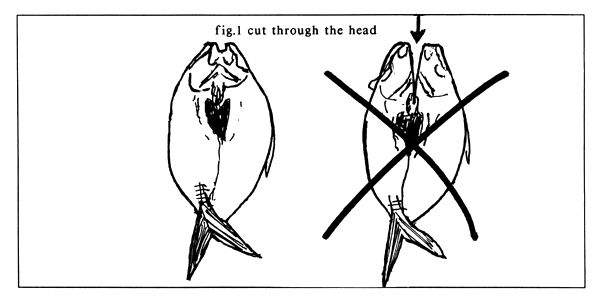
When cutting through the head, care should be taken not to slit through the “throat” (see drawing). This type of cut prevents a half head falling off during processing.
Uncontrolled brining led to notable differences in salt content of the product. Consistency of the salt content of a product is more important than consumer preference, which will differ from person to person. As the bait farm has many scales and balances in working condition, it should become a habit to carefully weigh the salt an water when making a brine.
The worker who normally makes the brine was asked to operate as usual but water and salt were weighed. It was found that 650 grams of salt (fine salt, dry to the feel) was used in 5 liters of water (130 gr./1.). The fish (about 2 kg in one batch) were dipped in the brine for “5 minutes”. Again, standardisation of the process is required here. As none of the workers possesses a watch, the dip time is normally inconsistent. A wall clock or other timing device might be installed in the processing room to overcome this problem.
Brine concentration and dip time were recorded and standardized, but not changed, since the workers are used to the existing process. It should be looked upon that in the future, the brining is carried out using a balance and a clock to obtain a product of consistent salt content. It should also be noted that the brine should be made stronger when handling larger batches, as the brine weakens when more fish is dipped into it. When setting up a larger operation, a new practice, utilizing saturated brine (which remains constant in strength as long as it remains saturated), should be considered.
This process step was introduced, as fish were previously smoked when still wet. Pre-drying helps smoke uptake by the fish, shortening the smoking time. In the sunny and dry surroundings in Kiribati, this is easily done by spreading the fish on the smoking trays and exposing them to sun and wind (lifting the trays off the ground on poles, e.g.). Pre-drying is finished when the fish feels dry to the touch, this is obtained in about 20 minutes, the fish should be turned after about 10 minutes. Care should be taken to scare off flies at this time. During the trials however, wind speed was high enough to prohibit the flies from coming near the fish.
In the existing practice, fish were steamed for three to four hours over a wet smoke from green “Te ren” leaves and coconut husks. Though this sterilizes the fish the end product was overcooked and therefore quite brittle. It was found also that the green leaves imparted a bitter taste to the fish.
During the trials, different ways of temperature control were shown. The use of a smoke pot, controlling air in- and outlet, the use of sawdust. Difference was shown between water vapour and wood smoke, as often a dense white water vapour is mistaken for good smoke.
In the time available, it was impossible to standardize or optimize the smoking process. It was therefore limited to showing possibilities. It has not been proven possible to reduce smoking time as requested by the workers. Although the product could be ready in texture and taste in a shorter time, the full three to four hours are needed in order to give the product a typical golden colour. The use of sawdust from the boat yard (Pacific Maple) proved the best results. When using sawdust, one should be assured that the wood has not been treated.
A proposed smoking scenario could be the following:
Dense sawdust smoke is applied for the first two-three hours, while temperature is kept under 50 °C.
After this, temperature is raised to around or above 75 °C, to slightly cook the fish. The length of this heat shock and exact temperature should be further investigated. The end product should not have lost the elasticity of the meat, but not look raw.
The final check should be on the colour of the product, and smoking time should primarily depend on this criterium.
Important: Temperature control should be carried out with a thermometer and not by feeling, which is not accurate enough. Nowadays simple and inexpensive dial probe thermometers are on the market for about US$ 25,- a piece. The Smoking unit should purchase a small stock of these (they tend to get lost) and they should be continuously used during the process (reading and correcting fire or airflow every five or ten minutes). Alternatively, a digital probe thermometer could be used, allowing for a faster reading. It will teach the workers in the initial trials to associate the amount of fire with the correct temperature, and further contribute to the production of a more constant quality of the product.
Some trials were done at improving colour formation through simple and available additives, but this did not prove worthwhile.
During smoking, the trays should be turned at regular intervals to provide for even smoking of all fish, as the smoke density is not the same in different corners of the smoking kiln. Also, to obtain more equal smoking, the upper trays should be changed with the lower at some stage during the operation.
Halfway during the smoke process, the fish should be turned on the trays to prevent unsightly marks from the wire on the fish skin.
Careful attention should be given to properly cool the product to storage temperature before packaging. This is easiest done the same way as the pre-drying. When insufficiently cooled down, water will condense on the packaging material, greatly speeding up spoilage. In the case of chilled storage, the fish should always be cooled to the lowest temperature before packing.
The Temaiku bait farm has a heat sealer for forming plastic bags. However, as the product is now, paper (of the kind used by butchers) would probably be a cheaper material. The paper having the advantage of absorbing eventual condensation water, while still protecting the product from pests and dust. Packing in clean carton boxes would further prevent damage to the product.
As an indication of product safety, measurements of the Water Activity (Aw) of the fleshy parts of smoked milkfish (batch' 17/4) were taken in triple with Lufft -Aw meters, calibrated at .75 against saturated NaCl. The Computer Room of the Fisheries Division in Tanaea proved a good place for water-activity readings, having a constant temperature of 20 °C. At the same time an introduction was given to some Fisheries Officers on Water Activity and background literature indicated.
The readouts varied around .92 ± .01. According to Lupin (1986), this provides a safe product against the best known health hazard bacteria (C. botulinum, Salmonella, Shigella), but does not exclude other spoilage bacteria, yeast or moulds. Ideally therefore, the product should be kept refrigerated (although no facilities exist at present in Tarawa), and one cannot over emphasize the importance of sanitation and good handling practices.
According to the persons who tasted the product, a higher salt level (leading to lower Aw values) would still be acceptable. It is however not recommended to dry the product more during smoking, as this would further reduce weight, adversely influencing the price of the product, which is now already regarded as expensive.
A sample of twenty fish, smoked according to the improved practice on Thursday 20/4, were taken back to Fiji and stored in a kitchen refrigerator (5 °C) in an open container. By the time this report was written (7/5/89) the fish were still in edible condition.
There is little doubt that local sales of this product can be expanded, if the product is prepared on a regular basis with established sales outlets or with regular orders from potential users like the Otintaai and Kiribati Hotels. To achieve this, the Temaiku Fish Farm should build up trust that the product will be readily available when requested and of sufficient constant quality. With some care this is not too difficult to achieve.
It has been indicated that there is a potential outlet in the outer islands. The shelf-life of the product (roughly one week, when handled acceptably) should in most cases allow for this opportunity. A system for smooth ordering from the farm should be established for buyers/travellers to these islands. E.g., a traveler taking the plane on a Friday, should place his order on Wednesday, allowing for processing, cooling and packing on Thursday. He would then be able to collect his order on Thursday afternoon.
The recommendations listed above are only sufficient for an improved production for local consumption. If export should be the aim of this venture, additional investments in material and staff training would be necessary, including chilled storage possibilities, adequate packaging technology, and the training and appointment of a motivated manager.
At present, three international destinations can be reached from Tarawa by air: Majuro, Funafuti and Nadi. There are talks of renewed flights to Nauru and eventually, an airline might link Tarawa with Honolulu in the future. With cargo space ensured, marketing trials to these destinations might be considered. For export to Honolulu, a similar smoking venture might be set up in Christmas Island (which has an existing air link).
At this stage, it was not thought useful to try and introduce the product with retailers or potential buyers in Fiji as no firm information on price, quantity or terms of delivery can be given. The product was however distributed to some people in Fiji who are potential consumers of this product and the response was mildly positive, where taste and presentation are concerned.
Further, some information was gathered in order to facilitate future marketing research for this product.
The way the product is prepared at present, labour time is not counted, as the handling and smoking is carried out by the workers of the Temaiku fishfarm, when they have no other activities. They therefore sell the fish at live weight value, the smoking being carried out as a service to the buyer.
The yield of the product (improved version) is as follows:
| Fresh weight: | 100.00% |
| Weight after kippering: | 64.70% |
| Weight after smoking: | 37.25% |
(figures based on a small sample and therefore subject to improvement)
This means that at a fresh weight price of A$ 2.50 /Kg, the price of the smoked product without labour or overhead costs included should at least be A$ 6.71 /Kg, or, considering the fresh weight of a fish is an average 120 g (44.7 g smoked), a price of A$ 0.30 /piece.
Prices for air freight of fish products were obtained from Air Terminal Services (Fiji) Ltd., who are freight agents for the Airline if the Marshall Islands.
| Majuro - Tarawa: | US$ 0.60 /lbs | US$ 1.32 /kg |
| Tarawa - Funafuti: | US$ 0.80 /lbs | US$ 1.76 /kg |
| Tarawa - Nadi: | US$ 1.60 /lbs | US$ 3.53 /kg |
As this is a flat freight rate, not taking into account the perishable nature of the product, the Kiribati Government might try to secure better freight prices for fish products with this airline in the future, as such special rates for fish exist in many other countries.
Concurrent with the planning of further capital investments, a thorough marketing research for this kind of product should be carried out in the potential markets.
Anon. (undated). Manipulation, Preparation et Commercialisation du Poisson Cultive. FAO Filmstrip commentary Booklet.
Bannerman, A. McK. (undated). Kippers. Torry Advisory Note No. 48, Torry Research Station, Aberdeen, 15 pp.
Cutting, C.L. (1965). Chapter 2: Smoking. 55–105 In: G. Borgstrom (Ed.). Fish As Food, Volume III, Academic Press, London, 1965..
Lupin, H.M. (1986). Water Activity in Preserved Fish Products. 16–55 In: Reilly, A. & L.E. Barile (eds.) Cured Fish Production in the Tropics. Proceedings of a Workshop on the Production of Cured Fish. University of the Philip-pines in the Visayas, Diliman, Quezon City, Philippines, 14–25 April 1986, vi+236 pages ISBN 971-91034-0-X.
Mendoza, L.S. (1986). Traditional Methods of Smoking Milkfish in the Philippines. 146–161 In: Reilly, A. & L.E. Barile (eds.) Cured Fish Production in the Tropics. Proceedings of a Workshop on the Production of Cured Fish. University of the Philippines in the Visayas, Diliman, Quezon City, Philippines, 14–25 April 1986, vi+236 pages ISBN 971-91034-0-X.
Roberts, S.F. (1986). Agrowaste Fish Dryers. 108–130 In: Reilly, A. & L.E. Barile (eds.) Cured Fish Production in the Tropics. Proceedings of a Workshop on the Production of Cured Fish. University of the Philippines in the Visayas, Diliman, Quezon City, Philippines, 14–25 April 1986, vi+236 pages ISBN 971-91034-0-X.