1. INTRODUCTION: THE HISTORICAL CONTEXT
The monitoring machinery of the Uganda Fisheries Administration operated quite well up to the early 1970s. During the subsequent 15 years or so the country experienced a traumatic period of civil strife, economic disruption, and general decline. The ability of established national institutions to function effectively in support of the nation's socio-economic welfare suffered severely, mainly as a result of three factors. These included: lack of motivation amongst official personnel as their terms and conditions of service steadily deteriorated; lack of job and indeed any sort of security in the country; and the rampant incidence of incompetent people finding their way into responsible public offices. In the field of fisheries this situation resulted in little initiative being exhibited by the statistics monitoring personnel.
From around the early 1970s national economic performance fell drastically and remained low as a result of faulty economic management decisions and other factors. This led to shortages of goods and high prices on the domestic market, and to a decline in the country's exports. Resultant deterioration in the balance of payment position, limited the country's ability to meet import requirements (MPED 1976; IMF 1980). For the Fisheries Department, these circumstances meant that resources and basic inputs for statistics collection, processing, and evaluation could not be easily obtained. Essential items like weighing scales, stationery, and calculators, not to mention more expensive equipment like vehicles and computers, were simply no longer available in sufficient quantities. Even funds to meet the day-to-day field data recording expenses were inadequate and irregularly available.
A series of internal wars commencing in 1978 contributed further disastrous consequences for the country's welfare, both indirectly and directly. Indirectly, resources were diverted from the support of normal social and economic activities to underwrite war efforts. And in a direct way, there was widespread destruction of structures, looting of equipment, and disruption of activities as the fighting raged on. The fisheries information systems came to a standstill in many areas at this time. A great deal of equipment and volumes of useful records were lost or destroyed through the looting which occurred throughout the wars and for some while thereafter.
Moreover, as the statistics monitoring activities remained low or moribund over many years, fisheries personnel were unable to stay in practice, with obvious negative effects on their professional skills. Both field data collection staff and the data processing staff at Headquarters suffered in this way. Also, newly recruited officers had little or no opportunity to acquire much in the way of practical experience.
The overall state of affairs led gradually to a crippling loss of capability in the Fisheries Department to monitor the resource base and its exploitation. Thus a complete reversal was experienced in the status of fisheries information systems from that which existed up to the early 1970s. At the same time, however, critically important developments were taking place in the industry. These developments, discussed below, include the decline in inputs in the industry in the early 1980s, and the changes in the nature of the fisheries of Uganda -- particularly with regard to the upsurge of Nile perch in Lake Victoria.
Available catch returns for the 1970s and 1980s should be taken as indicative only, in light of the monitoring problems just noted. They suggest however that the generally positive trend in annual fish catches witnessed in the years up to the late 1970s was sharply reversed at a time when the effects of the of national economic collapse and strife had become particularly acute (see Fig. 1, Annex).
Stringent import controls, introduced as the balance of payment position of the country continuously deteriorated adversely affected fishing activities. Gear scarcity began to be felt as foreign exchange could no longer be easily secured for its importation. The Uganda Fishnet Manufacturers Company plant in Kampala, the only net manufacturing plant in the country, operated at very low capacities with long periods of zero production because of lack of nylon yarn and spare parts, amongst other problems. Outboard engines, their spare parts, and the fuel to run them were all hard to come by. Whilst some appreciation of the complex of events during this period has been possible to reconstruct (Reynolds and Greboval 1988), it was impossible to gauge the precise effects on production at the time; nor was there any contemporary account of how fisherfolk responded to the situation in terms of adopting alternative fishing practices, or simply withdrawing from fishing altogether.
In terms of distribution, the difficult security and economic situations manifested themselves in the disruption of existing product flow patterns and the development of new trade routes. Transportation difficulties were experienced as vehicles and their spare parts and fuel became scarce and expensive, and as roads deteriorated due to lack of regular maintenance. The long established fish trade between the western lakes of George, Edward, and (to some extent) Albert and the country's capital, Kampala, virtually ceased. This trade had involved many tonnes of tilapia every month. Consignments of the western lakes fish instead were increasingly diverted across borders into neighbouring Zaire and Rwanda. Furthermore, a new trade developed in which Lake Kyoga became the main supplier of fresh fish to Kampala (Reynolds and Greboval 1988).
In the composition of the products marketed, fresh fish began to feature less prominently than processed fish as a result of the poor transportation facilities and a collapse of infrastructural facilities needed for distribution fresh product. Some years earlier, high-value export trade had already suffered a setback following a period of poor performance and eventual failure of the The Uganda Fish Marketing Corporation (TUFMAC). This public enterprise was based on Lake George and operated fairly well through the 1950s and 1960s, processing and marketing tilapia from the western lakes (Dunn 1989).
As part of a general objective of the Government to rehabilitate different sectors of the economy and restore production and institutions to the levels of the early 1970s, various steps have been undertaken (MPED 1987). For the fisheries, several foreign funded projects were launched which entailed strong input supply components (MAIF 1983). These included:
IFAD/World Bank Agricultural Rehabilitation Project (ARP) and later, Agricultural Development Project (ADP), which has been supplying inputs mainly on Lake Kyoga.
World Bank (IDA Credit) which financed the purchase of yarn and spare parts for the Uganda Fish Net Manufacturers Company to enable them to resume production.
Euro Action Accord, for the supply of inputs to Lake Albert and the Albert Nile.
EEC - Artisanal Fisheries Rehabilitation Project (AFRP), to channel supplies to areas not covered by the projects above.
Uganda Commercial Bank (UCB), Rural Farmers Credit Scheme, covering the whole country.
Italian Government Funded Integrated Fisheries Development Project, covering areas on Lakes Victoria and Kyoga.
The People's Republic of China Government aided Sino-Uganda Fisheries Joint Venture, planned to undertake fishing on Lake Victoria.
The emphasis on enhancing gear supply did not always yield positive results. During the period of gear scarcity, certain labour intensive fishing practices were adopted and these were continued even after inputs became more readily available. Such practices include: beating of the water to drive fish into nets (popularly known as “tycoon” fishing); the active use of gill nets as surrounding nets; and the use of beach seines and cast nets. (Reynolds and Greboval 1988; SEC Fld Rpts 1989)
In terms of post-harvest sector development, two projects were intended to facilitate better handling, preservation, processing, and distribution of fish products:
A People's Republic of China-aided project to construct an ice plant and fresh fish marketing centre in Kampala; and
The previously-mentioned Italian Government-funded Integrated Fisheries Development Project, which involves two fish processing schemes: improved hot smoking and cold smoking/chilling.
On another front, for the past few years there has been a massive importation of commercial vehicles to alleviate the transport problem. This has been accompanied by a programme of road repairs undertaken on most of the major and a few of the minor roads to facilitate communication and the marketing of various products (MPED 1987, MF various years). As a consequence of these two developments, the fish trade has been quite considerably enhanced.
Transformations in the mode of exploitation and the very composition of the fisheries resource were also occurring in the early 1980s. On Lake Kyoga, the widespread use of illegal fishing gear and fishing practices adopted in the period of gear shortages, in the face of the Fisheries Department's weakened ability to enforce regulations, led to changes in size composition of catches particularly for the main species, Lates niloticus. This situation was aggravated by the decline in the water level over the last decade by about 1.5 metres due to prolonged drought, causing reduction in the breeding and nursery grounds, thus diminishing the productivity of the lake. (Marriot et al. 1988; Reynolds and Greboval 1988; Twongo 1988)
On Lake Victoria, the explosion of the Nile perch after 1983 (Okaronon et al. 1985), widely discussed in various scientific and popular fora, was a major event in the fishery. Tremendous changes have taken place in the industry as a result of this development (Reynolds and Greboval 1988). There have been increases in production and changes in catch composition, with the Nile perch taking over the lead from the tilapia. The quantities of canoes and gear on the lake increased and the gear composition changed in favour of larger meshes. Processing and marketing activities and patterns of consumer preference have all adjusted to the new realities of the fishery.
2. RECENT PLANNING AND MANAGEMENT INITIATIVES
The events of change described above have had far reaching consequences for the industry. It is imperative that national fisheries management and planning authorities take the full implications of these events into careful account. However, because of the collapse of Fisheries Department monitoring capabilities since the mid-1970s, the information base is fraught with problems of incompleteness and unreliability. These in turn pose severe hindrances to meaningful management and planning for the industry. In an attempt to redress this situation several measures have been instituted. The main ones include:
Strengthening the Fisheries Training Institute through budgetary allocations and an EEC grant, in order to train personnel to staff the statistics system.
Upgrading the research capabilities of the Uganda Freshwater Fisheries Research Organization (UFFRO) through budgetary allocations, for better resource investigations.
Use of assistance from the International Development Research Centre (IDRC) to fund the Nile Perch Project at the Uganda Freshwater Fisheries Research Organisation (UFFRO), in order to investigate new developments in the fishery.
Inclusion of a fishery component in the IFAD/World Bank ADP, in order to survey, evaluate, and generate an action plan for the Lake Kyoga fisheries.
The implementation of three EEC-funded studies, namely:
The Fisheries Sector Survey 1988, by the Planning Unit of the Ministry of Animal Industry and Fisheries, to provide preliminary data on the sector that could be used for planning as well as a guide for further investigations.
The AFRP/UFFRO Fishery Survey 1988/89, initiated as a follow-up study to evaluate the impact of the input supply programme of the AFRP.
A fishery survey in Queen Elizabeth National Park (Lakes Edward and George), undertaken as a part of the Conservation of Natural Resources Project.
3. FISHERIES STATISTICS AND INFORMATION SYSTEMS
Whilst the above mentioned undertakings are expected to make major contributions, the Fisheries Department regards the FAO/UNDP FISHIN Project (UGA/87/007) as the principal means through which shortcomings in the statistical data and information systems should be corrected. The intention is to rehabilitate and upgrade national monitoring and reporting machinery to function effectively and on a permanent basis (FAO/UNDP 1987). Priority target regions for the Project are those which include the fisheries of Lakes Victoria, Edward and George. The Project was officially commenced in October 1988, with the posting of the CTA and the preliminary activities of the Project Bio-Statistical (BIOSTAT) group. The work programme of the Project Socio-Economic (SEC) group got underway rather later, in May 1989.
The broad objectives of Project activities are those of fisheries staff development, characterisation and analysis of the industry, and the formulation of policy alternatives and management plans. The training objective will largely be achieved on an in-service basis, through the participation of Headquarters, Regional, and field level Fisheries Department personnel in workshops and refresher courses.
Different types of field census and survey exercises will be mounted with a view toward the creation of a comprehensive socio-economic information base on the fishing industry in the six project Regions of Tororo, Jinja, Entebbe, Masaka, Kalangala and Kichwamba. Initially the information compiled from the field exercises will mostly complement that which is now being collected on a routine basis by Fisheries Department staff. Eventually, however, the current system will be revised and upgraded to allow for the regular monitoring of socio-economic factors within the industry. Survey work will incorporate a census of fishing and processing units and a country-wide study of long distance fish marketing. Findings should provide a basis for effective development planning for the industry.
Total Project cost is approximately US$ 1 million, with an external component of about US $ 0.9 million to meet the provisions for inputs, foreign technical personnel and operating costs. The Project is equipped with 4WD vehicles (4), motor-cycles (7), powered boats (8), bicycles (30), and other minor items necessary to the conduct of field investigations. For the purpose of the survey administration and data analysis the six regional field offices and Project headquarters have been equipped with typewriters, along with calculators, stationery, and basic office supplies. Two IBM micro-computers have been installed at Project offices in Fisheries Department Headquarters in order to facilitate data storage and analysis as well as the production of reports.
The survey personnel are under the supervision of the project Chief Technical Advisor (CTA) and the National Project Director (NPD). The core SEC working group is headed by an FAO-fielded Socio-economic Advisor (SEA) who collaborates with a Senior Fisheries Economist provided by UFFRO and a Fisheries Officer (Marketing) from the Fisheries Department. The SEC group is responsible for identification of information requirements, the design, planning, and supervision of all aspects of socio-economic survey activities, analysis of field investigation results, and reporting of principal findings.
Project field staff consists of the six Regional Fisheries Officers (RFOs) in the survey regions and a total of about 30 Assistant Fisheries Development Officers (AFDOs), Fisheries Assistants (FAs) and Fish Marketing Assistants (FMAs). These personnel will be deployed to assist in the supervision of field data collection. There is provision for consultants of various specialities to be utilised as and when the need arises.
An important task in the planning of fieldwork has been the identification of bottlenecks that could hinder successful implementation. These consist mainly in the resources and personnel available for survey activities.
Original estimates of Project costs have proved below the mark because of continuous marked inflation in the country. It has therefore become necessary to seek increases in the Project budget. The situation with regard to the local component of the budget is particularly difficult. To begin with, the funding provided to meet the Government contribution to the Project is quite limited. Furthermore, the process of obtaining its release from the Treasury is long and slow and causes implementation delays. In addition, it is very difficult to obtain upward revisions to accomodate inflation pressure because of the strict expenditure controls instituted under the national budget management.
National staff limitations are another source of constraint. The number of survey personnel, both at the Headquarters and in the field, is inadequate for the magnitude of the work needing to be done. The skills of many of these staff also need to be improved upon, as explained earlier. In addition, the level of motivation of these staff, as in the rest of the national Civil Service, is rather low due to poor remuneration and generally difficult working conditions.
Field staff are also faced with the problem of lack of mobility to organise survey activities. This should be alleviated partly through the provision of Project motor-cycles, motor-boats and bicycles for the work in each region. The Project regions are very large areas, however, generally covering about three districts. The situation is made more difficult by the poor state of the roads to most of the landings. The marketing survey, which is to cover the whole country, is also expected to come up against the problem of insecurity which still lingers on in a few areas.
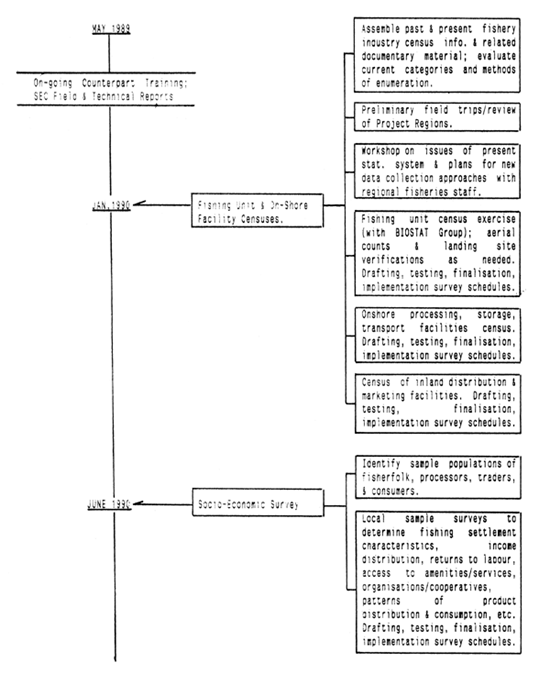
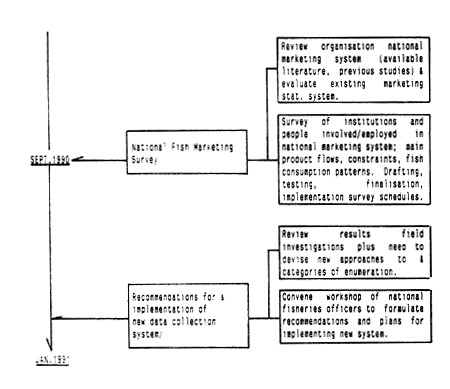
Fieldwork has been planned as a series of activities through which required socio-economic information would be built up. They include: compilation of existing information; preliminary field trips to survey areas; fishing unit and on-shore facilities censuses; sample surveys of activities of fishing operators, traders and consumers; and a national fish marketing study.
Existing information on the industry is being evaluated so as to determine areas of thin or deficient coverage. This is being done through scanning available literature and establishing contacts with other institutions or projects whose activities involve studies and characterisations of the fisheries sector, particularly those noted in Section 2 above. A comprehensive field document is now being drafted which will provide an inventory of available information and identify priority areas for further investigation (Reynolds et al., 1989).
A series of preliminary field trips has been undertaken by the SEC Group, to cover the major fishery regions and marketing centres. The purpose of these visits is to gain necessary orientation to local circumstances, and to meet Fisheries Department field staff, fisherfolk, traders, consumers, and community leaders. General information on landing sites, fishing communities, fishing and fish processing activities, marketing and the related transport and storage facilities, are all now being collected. This will lay the groundwork for more intensive surveys. The trips are being documented by a series of SEC Field Reports (SEC Fld Rpts) which are circulated to relevant institutions and personnel for their information and comments.
A census will be conducted of the fishing units and fish transportation, processing, storage, marketing and other service facilities. The fishing unit count will cover the entire shorelines of the relevant lakes within the Project regions. The use of aircraft for this exercise is envisaged. Fisheries Department field staff will be deployed to help in ground operations.
The inventory of available information and census findings noted above will be used to guide the formulation of the main socio-economic survey of fisherfolk, traders and consumers. In the survey, investigations will focus on landing communities, fishing operations, and the disposal, processing and storage of catches. These investigations will look into a wide array of issues, including: sizes and services/amenities establishments of fishing settlements; participation of local community members in fishing as boat, gear, or labour owners; alternative income opportunities which are available and their relative importance; mobility of fisherfolk, including reasons for migration, timing, and destinations involved; and community organisation, in terms of such institutions as Fishing Committees, Co-operative Societies, the Head Fisherman (Gabunga). Qualitative and quantitative information will be collected on the fishing factors and the economics of fish production. The question of producer prices will be examined with reference to the availability of buyers and and access to storage, transportation, road facilities. Processing operations in terms of modes used, facilities available, and the economics of the operations will be investigated. Post-harvest sector investigations will cover such other aspects as the number of people employed in processing activities, participation by women, the problem of woodfuel supply, and demand for various types of processed fish products. Stratified random sampling will be used in the survey, with the actual stratification scheme to be determined on the basis of preliminary census findings in order to ensure representativeness. Survey schedules will be designed as appropriate but will be pre-tested in trial locations prior to the commencement of investigations. The Fisheries Department field staff, and any additional personnel deemed necessary, will be enlisted and trained to carry out data collection. The SEC Group will be responsible for the processing and analysis of data and the preparation of relevant SEC Fld Rpts, working papers, and field documents.
A national fish marketing study will be undertaken which will also cover long distance trade and marketing activities related to those fisheries regions which are not part of the core Project regions -- namely, Lakes Kyoga and Albert. Investigations will focus on the organisation of fish marketing in the country, bearing on such points as the number of people employed and the institutions involved, facilities available, main product destinations, and bottlenecks to the free flow of fish through the country. The economics of fish trading activities will be investigated to determine ways of minimising costs for the benefit of both traders and customers. Fish consumption patterns will be studied as well, with a view towards identifying consumer tastes and preferences on the market and other relevant factors such as fish prices vis-a-vis consumers' incomes.
In preparation for the implementation of Project activities, a number of preliminaries have had to be looked after. Upon completion of Project initiation formalities, a first task was to recruit the personnel for the Project. FAO was to field two advisors, namely the CTA and the SEA. At the same time national Civil Service staff, who included the NPD, the BIOSTAT and SEC counterparts, and field personnel, were assigned duties. Service and supporting staff were also hired directly by the Project. Availability of the right candidates for the various technical posts was problematical. Although the Project officially went into operation in October 1988, staffing was not complete until May 1989. Fieldwork activities had to be resheduled quite drastically as a result.
At the time staff were being assembled, the tasks of securing release of funds and procurement of inputs were also being undertaken. This was important to ensure smooth programme implementation. In the event, however, procurement has taken a considerable period of time. Most of the inputs, including vehicles, computers, motor-cycles, outboard engines, typewriters, bicycles and other small items have had to be ordered from suppliers overseas, with delivery time lags of over six months.
Major preparations have also been made in the area of training for the national staff to improve on their professional capabilities. The following activities have been provided for:
In-service training for Headquarters counterpart staff, conducted on a routine basis for the duration of the project, is planned to provide experience in survey design and implementation and offer skills in the use of computers. Counterpart personnel have to date been involved in report writing and have attended courses on Lotus 1-2-3 and DBASE at the Rank Consult Technology Centre in Kampala.
Periodic refresher courses for both Headquarters and field staff to upgrade data collection and compilation skills.
A national workshop for Project counterparts and senior departmental staff to discuss ways and means of rehabilitating and upgrading fisheries information management.
In order to enhance their professional experiences and skills, SEC counterparts will be encouraged to participate in regional workshops on fisheries management and planning organised by the FAO/UNDP Regional Project for Inland Fisheries Management in Eastern/Central/Southern Africa (RAF/87/099). In this connection, the Senior Fisheries Economist attended the IFIP/SWIOP Workshop on the Economic Aspects of Fisheries Development and Management, held in Dar-es-salaam between 30th October and 9th November, 1989. The Fisheries Officer (Marketing) attended the FAO Workshop on Fishery Credit and Marketing Development held in Bangkok, Thailand, 13 – 17 November, 1989 (see SEC Field Report No. 11). A programme of study tours to neighbouring countries is also being planned with this purpose in mind.
Arrangements have been made for SEC counterparts to take part in short-term intensive courses in (a) fisheries planning, management, and development and (b) fish marketing at Humberside International Fisheries Institute, U.K. The marketing course is scheduled for January-March 1990, whilst the one on planning, management and development is set for April-July 1990.
Another important practical preparation for field survey work will be the design and testing of questionnaires. Trial runs will provide indications of how to improve investigation approaches and techniques, and give an opportunity for survey personnel to acquire field experience before the main survey exercises commence.
Fisheries administrative capabilities in Uganda, particularly as reflected in the operations of the monitoring, reporting, and information systems so crucial to effective management and development of the resource base, were considerably weakened as a result of events of civil war, economic disarray, and prolonged misrule which commenced in the 1970s and continued more or less unabated until very recently. In consonance with the national programme for reconstruction now being mounted, the Fisheries Department with the assistance of several donor governments and agencies is instituting an array of measures and projects intended to foster general recovery of the fishing industry, including re-establishment of effective administrative services.
With regard to data collection and information systems, it is intended that the FISHIN Project, UGA/87/007, will play a central rôle in rehabilitating and upgrading monitoring and reporting mechanisms, facilities, and staff skills. The aim is improve and tune these systems so that they are operating effectively once again and can continue to do so on a sustained basis.
The Project team is an interdisciplinary one, composed of national and international staff with backgrounds in both bio-statistics and socio-economics. Team members collaborate closely with one another in organising and implementing their activities and sharing the available resources in hardware and personnel. Close collaboration is also maintained when it comes to dealing with the various constraints which impede Project undertakings both in the office and the field. As noted in this report, these are mainly to do with budgetary limitations in the context of the country's difficult economic circumstances. Acquisition of goods and services with available financial resources sometimes proves exceedingly difficult and expensive. Other manifestations of such limitations are to be seen in low staffing levels, low levels of training and in-service skill development, and poor motivation in some instances.
Socio-economic (SEC) group activities under FISHIN are only of recent commencement but are being fully integrated with those of the Bio-statistical (BIOSTAT) group members of the team to realise the entire package of Project objectives. As detailed earlier in the sections on methodology and practical preparations, steps are being taken to strengthen the socio-economic data/information base of the Fisheries Department, and to ensure its effective operation on a permanent basis. As laid out in diagram form in the Annex (Fig. 2), the work programme is fairly ambitious. It involves, amongst other things: an inventory of existing literature and other archival resources; a preliminary assessment of present conditions in the six Project regions, and of the present state of socio-economic data collection in terms of quality, parameters measured, and need for expansion and/or improvement; fishing unit and on-shore facilities censuses; field surveys of fisherfolk, traders, and consumers; and a national marketing study to cover areas outside of the core Project regions.
An integral part of this work programme is training to foster the development of national staff professional skills. In addition to routine in-service training, counterpart personnel will be invited to participate in refresher courses and workshops organised by the Project team, and also to participate in regional study tours and intensive short courses in fisheries management, development, and marketing at institutions abroad.
Dunn, I.G., 1989. Fisheries Management Study in the Queen Elizabeth National Park. Mission Report for EEC Project No. 4100.037.42.44, Conservation of Natural Resources. Rome: AGRICONSULTING, 35p.
IMF (International Monetary Fund), 1980. IMF Survey. Vol.9, No. 5. Washington D.C., pp 66–67.
FAO/UNDP Project UGA/87/007, 1987. Project Document. Kampala.
FD (Fisheries Department, The Republic of Uganda). Annual Reports (various years). Entebbe: Government Printer.
Marriot, S.P., P.R. Manacop and T.T. Twongo, 1988. Report on the Survey of Lake Kyoga. (Preliminary Draft). Jinja: UFFRO (mimeo).
MAIF (Ministry of Animal Industry and Fisheries, The Republic of Uganda), 1983. Blue Print for Fisheries Development in Uganda. Kampala.
MF (Ministry of Finance, The Republic of Uganda). Background to the Budget (various years). Entebbe: Government Printer.
MPED (Ministry of Planning and Economic Development, The Republic of Uganda), 1976. The Action Programme - A Two Year Economic Rehabilitation Plan - 1977/78 to 1978/79. Entebbe: Government Printer.
MPED (Ministry of Planning and Economic Development, The Republic of Uganda), 1987. The Reconstruction and Development Plan - 1987/88 to 1990/91. Entebbe: Government Printer.
Okaronon, J.O., T.O. Acere, and D.L. Ocenodongo, 1985. The Current State of the Fisheries in the Northern Portion of Lake Victoria (Uganda). FAO Fish. Rep., (335): 89–98.
Reynolds, J.E. and D.F. Greboval, 1988. Socio-economic Effects of the Evolution of Nile Perch Fisheries in Lake Victoria: a review. CIFA Tech. Pap., (17): 148 p.
Reynolds, J.E., J. Wandanya, and D. Nyeko, eds., 1989. Fisheries statistics and information management in Uganda: past approaches, current status, and future prospects. Field Document No. 1, FISHIN Notes and Records. Fisheries Statistics and Information Systems, FAO/UNDP Project UGA/87/007.
Twongo, T., 1988. Recent Trends in the History of Lake Kioga - Uganda. In D. Lewis (ed.), Predator-prey relationships, population dynamics, and fisheries productivities of large African lakes. CIFA Occas. Pap., (15) 140–51.
FIGURE 1: TOTAL ANNUAL CATCH (UGANDA), 1960 – 1988.
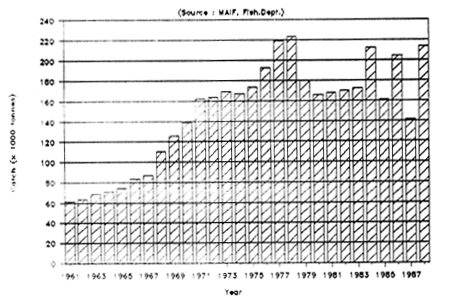
FIGURE 2: FISHIN PROJECT, TENTATIVE SOCIOECONOMIC WORKPLAN
FISHIN NOTES & RECORDS
LIST OF DOCUMENTS
(To Dec. 1989)
BIOSTATISTICAL (BIOSTAT) FIELD REPORTS
Coenen, E., 1988. Mission report, Tororo District, 29/11 – 1/12/88. BIOSTAT Field Report No. 1, FISHIN Notes and Records. Fisheries Statistics and Information Systems, FAO/UNDP Project UGA/87/007. (Dec. 1988).
Wadanya, J., 1989a. Report on the tour of Kichwamba Region: the area of Lakes George - Edward and Kazinga Channel Complex. BIOSTAT Field Report No. 2, FISHIN Notes and Records. Fisheries Statistics and Information Systems, FAO/UNDP Project UGA/87/007. (Feb. 1989)
Wadanya, J., 1989b. Report of the visit to Kigungu Landing. BIOSTAT Field Report No. 3, FISHIN Notes and Records. Fisheries Statistics and Information Systems, FAO/UNDP Project UGA/87/007. (Feb. 1989).
Coenen, E., & F.L. Orach-Meza, 1989. Mission report to Mwanza (15–26/2/89): HEST/TAFIRI and DANIDA Regional Seminar on Lake Victoria. BIOSTAT Field Report No. 4, FISHIN Notes and Records. Fisheries Statistics and Information Systems, FAO/UNDP Project UGA/87/007. (March 1989).
Tumwebaze, R., 1989a. Mission report to Kasenyi Fish Landing (20/01/1989). BIOSTAT Field Report No. 5, FISHIN Notes and Records. Fisheries Statistics and Information Systems, FAO/UNDP Project UGA/87/007. (June 1989).
Tumwebaze, R., 1989b. Report on the tour of Masaka Region - Lake Victoria. BIOSTAT Field Report. No. 6, FISHIN Notes and Records. Fisheries Statistics and Information Systems, FAO/UNDP Project UGA/87/007. (June 1989).
Nyeko, D., 1989. Report on the tour of south-western lakes: George and Edward landings. BIOSTAT Field Report No. 7. FISHIN Notes and Records. Fisheries Statistics and Information Systems, FAO/UNDP Project UGA/87/007. (July 1989).
Ikwaput, J., 1989. Report on the mission to Iganga District, 29/5 – 2/6/1989. BIOSTAT Field Report No. 8, FISHIN Notes and Records. Fisheries Statistics and Information Systems, FAO/UNDP Project UGA/87/007. (July 1989).
SOCIO-ECONOMIC (SEC) FIELD REPORTS
Odongkara, O.K., 1989a. Visit to Kasenyi Landing: 20th January, 1989. SEC Field Report No. 1, FISHIN Notes and Records. Fisheries Statistics and Information Systems, FAO/UNDP Project UGA/87/007. (May 1989).
Odongkara, O.K., 1989b. Preliminary report on Kichwamba Region landings: 4th – 7th February, 1989. SEC Field Report No. 2, FISHIN Notes and Records. Fisheries Statistics and Information Systems, FAO/UNDP Project UGA/87/007. (May 1989)
Reynolds, J.E., C.T. Kirema-Mukasa & O.K. Odongkara, 1989. Trip to Jinja Town and UFFRO. SEC Field Report No. 3, FISHIN Notes and Records. Fisheries Statistics and Information Systems, FAO/UNDP Project UGA/87/007. (May 1989).
Reynolds, J.E. & C.T. Kirema-Mukasa, 1989a. Visit to Kampala markets. SEC Field Report No. 4, FISHIN Notes and Records. Fisheries Statistics and Information Systems, FAO/UNDP Project UGA/87/007. (May 1989).
Reynolds, J.E. & O.K. Odongkara, 1989a. Preliminary notes on Iganga District landings. SEC Field Report No. 5, FISHIN Notes and Records. Fisheries Statistics and Information Systems, FAO/UNDP Project UGA/87/007. (June 1989).
Reynolds, J.E. & C.T. Kirema-Mukasa, 1989b. Notes on Kichwamba Region. SEC Field Report No. 6, FISHIN Notes and Records. Fisheries Statistics and Information Systems, FAO/UNDP Project UGA/87/007. (July 1989).
Reynolds, J.E. & O.K. Odongkara, 1989b. Fish marketing and distribution in Tororo and Mbale Regions: a brief survey. SEC Field Report No. 7, FISHIN Notes and Records. Fisheries Statistics and Information Systems, FAO/UNDP Project UGA/87/007. (Aug. 1989).
Reynolds, J.E., F.L. Orach-Meza, & E.J. Coenen, 1989. Moyo District fisheries conditions and prospects. SEC Field Report No. 8, FISHIN Notes and Records. Fisheries Statistics and Information Systems, FAO/UNDP Project UGA/87/007. (Sept. 1989).
Reynolds, J.E. & F.L. Orach-Meza, 1989. Management of Lake Victoria fisheries -- deliberations of the CIFA Meeting, Mwanza, Sept. 1989. SEC Field Report No. 9, FISHIN Notes and Records. Fisheries Statistics and Information Systems, FAO/UNDP Project UGA/87/007. (Sept. 1989).
Reynolds, J.E. & O.K. Odongkara, 1989c. Socio-economic aspects of fisheries development in Uganda: The ‘FISHIN’ Project. SEC Field Report No. 10, FISHIN Notes and Records. Fisheries Statistics and Information Systems, FAO/UNDP Project UGA/87/007. (Nov. 1989).
Kirema-Mukasa, C.T., & J.E. Reynolds, 1989. Brief notes on fisheries production, marketing and credit facilities in Uganda. SEC Field Report No. 11. FISHIN Notes and Records. Fisheries Statistics and Information Systems, FAO/UNDP Project UGA/87/007. (Nov. 1989).
OTHER DOCUMENTS
Nyeko, D., 1989. Past and present fisheries statistical systems in Uganda -- a bibliographic study. BIOSTAT Working Paper No. 1, FISHIN Notes and Records. Fisheries Statistics and Information Systems, FAO/UNDP Project UGA/87/007. (April 1989).
Wadanya, J., 1989. Fisheries statistical training needs: initial assessment. BIOSTAT Working Paper No. 2, FISHIN Notes and Records. Fisheries Statistics and Information Systems, FAO/UNDP Project UGA/87/007. (July 1989).
Ikwaput, J. & R. Tumwebaze, 1989. The present status of fisheries data collection and analysis in Uganda. BIOSTAT Working Paper No. 3, FISHIN Notes and Records. Fisheries Statistics and Information Systems, FAO/UNDP Project UGA/87/007. (Sept. 1989).
Wadanya, J., & D. Nyeko, 1989. Fisheries statistical systems in Uganda. BIOSTAT Working Paper No. 4, FISHIN Notes and Records. Fisheries Statistics and Information Systems, FAO/UNDP Project UGA/87/007. (Sept. 1989).
Orach-Meza, F.L., E.J. Coenen & J.E. Reynolds, 1989. Past and recent trends in the exploitation of the Great Lakes fisheries of Uganda. Occasional Paper No. 1, FISHIN Notes and Records. Fisheries Statistics and Information Systems, FAO/UNDP Project UGA/87/007. Paper presented at the International Symposium on Resource Use and Conservation of the Great Lakes. Bujumbura, 29/11 – 2/12/89. (Nov. 1989).
Reynolds, J.E., J. Wadanya, & D. Nyeko, eds., 1989. Fisheries statistics and information management in Uganda: past approaches, current status, and future prospects. Field Document No. 1, FISHIN Notes and Records. Fisheries Statistics and Information Systems, FAO/UNDP Project UGA/87/007. (Nov. 1989).
FISHIN PROJECT - UGA/87/007
FAO/UN
P.O. Box 521
KAMPALA, UGANDA