


Appendix 5. INFORMATION STRUCTURE REQUIRED FOR SOUTH AFRICA
INTRODUCTION
The National Forests Act No. 84 0f 1998 mandates the Minister to monitor the forests with reference to matters referred to in section 4(6). In order for the Minister and the Department to do this, an information service that will deliver information in a suitable format, respond to various needs over time and support the generation of various reports is required. Added to this, capacity to analyse and interpret relevant information on the resource is required.
PURPOSE OF FRIS
The problem in forest sector information in South Africa is not only confined to unavailability of information on natural forests, woodlands and community Forestry, but it is also about information that is fragmentary, uncoordinated and partial in nature. Added to this, we do not have a system that can pull this information to together and present it in a suitable format that can be used for planning and policy-making.
The purpose of FRIS is to:
- To fulfil the objective of the act ( production of the "state of the
forest") report;
- Pull information from different sources and present it in a format that is
useful for policy making;
- To make information accessible to vast variety of end users; and
- To package information for the production of different reports as
required.
Forest Resource information Service thus has three basic principles:
1. It should be simple;
2. Workable; and
3. Accessible.
USES AND USERS
Several different users would employ the system, including:
- The Department, for regular reporting on the state of the forests (to Parliament and the international community), and as a basis for policy analysis, and also as a facility for disseminating information widely;
- The forest industry in South Africa;
- Research organisations and educational institutions;
- Other government departments, such as the department of Environmental Affairs and Tourism;
- Development and environmental NGOs;
- Members of the public and
- International organisations, such as the FAO and CIFOR
REQUIREMENTS/FEATURES TO DEVELOP FOREST RESOURCE INFORMATION SERVICE
Broadly, the requirements include amongst others, the following:
- Technical assistance from relevant institution;
- It should allow for effective capture and administration of information gathered routinely or expressly for forest resource assessment and give assurance that information meets predetermined standards;
- It should provide access to relevant information bases hosted by other directorates and organisations;
- It should allow time series over time as required by the New Forest Act;
- It should provide direct access by internet to users;
- It should conform to the standards of the Department of Water Affairs and Forestry;
- It should be compatible with international system for our reporting obligations.
The service should enhance problem solving process mechanism and increase the response rate to queries from the public:
It should be able to answer questions such as: Are South African Forest resources being managed and utilise sustainable or not?
This can be broken down into measurable items such as:
- How much biomass is out there?
- What is the potential growth?
- What is the rate of harvesting?
- How is it changing over time?
- Does the species mix remain the same or are some species diminishing?
- What are the ecological, economic and social changes; and
- Which are pressured areas.
EXAMPLES OF INFORMATION SOURCES
Core information bases will include the following:
- Extent and state of indigenous forest;
- Appropriate information on woodlands;
- Information on plantation forests, such as the Commercial Timber Statistics, as well as appropriate information on the wood industries;
- Community forestry information;
- Socio-economic information on all forest types e.g NTFP and any other relevant information;
- Fire Statistics;
- Research information;
- Household survey
- Pressures on forest resources; and
- Any other relevant information
The sources of this information would include at least the following:
- The Department itself, through specific monitoring and assessment projects, such as the regular forest statistical survey, information from indigenous forests; woodlands, community forestry, as well as from the information base for afforestation permits;
- Other government bodies, such as Statistics SA and the Department of Environmental Affairs and Tourism;
- The Forest Owners Association and other industry organisations; and
- The CSIR and ARC.
INFORMATION BY FOREST TYPES AND LAND OWNERSHIP FOR EACH PROVINCE
| |
INDIGENOUS FOREST |
WOODLANDS |
Commercial plantations |
Broad categories |
State |
Not state |
State |
Not state |
State |
Not state |
| |
Production |
Harvesting |
Productiob |
Harvesting |
Productiob |
Harvesting |
Productiob |
Harvesting |
Productiob |
Harvesting |
Productiob |
Harvesting |
WOOD Roundwood - Sawmill - Pulpwood - Mining - Poles - Fuelwood for industrial use - Fuelwood for household ues - Charcoal |
|
|
|
|
|
|
|
|
|
|
|
|
NTFP Thatch and grass Mushrooms Wild fruits and nuts Wild herbs Honey Medicinal plants Baskets Etc |
|
|
|
|
|
|
|
|
|
|
|
|
Food |
|
|
|
|
|
|
|
|
|
|
|
|
Health |
|
|
|
|
|
|
|
|
|
|
|
|
| |
|
|
|
|
|
|
|
|
|
|
|
|
| |
|
|
|
|
|
|
|
|
|
|
|
|
Household items |
|
|
|
|
|
|
|
|
|
|
|
|
Decoration |
|
|
|
|
|
|
|
|
|
|
|
|
| |
|
|
|
|
|
|
|
|
|
|
|
|
Animal Fodder |
|
|
|
|
|
|
|
|
|
|
|
|
| |
|
|
|
|
|
|
|
|
|
|
|
|
Fertiliser/mulch |
|
|
|
|
|
|
|
|
|
|
|
|
Environmental impacts |
|
|
|
|
|
|
|
|
|
|
|
|
PROPOSED ASPECTS FOREST RESOURCE INFORMATION STRUCTURE
- Forest types
- Land tenure
- Product/service category
- Wood /timber
- Non Timber Forest products
- Public Goods and Services
· Market or Consumer category
Industrial
Household
Public
- Public and non-consumable products
- Principles, Criteria and Indicators
In terms of the of the New Forest Act (1998) information needs to be compiled and analysed to meet the objectives of the following Principles and Indicators
NO |
PRINCIPLES |
CRITERIA |
Type of information required for each
criteria |
CRITERIA |
1. |
The forest resource base(Section 4(6)a(i)) |
- Natural forests in South Africa are protected (Section 3(3)(a))
- A minimum area of each woodland type is protected (section3(3)(b))
- An appropriate level of plantation forest resource is promoted
|
- Extent and distribution of protected forest in South Africa
- Extent and distribution of minimum woodlands in South Africa
- Extent and distribution of plantation resources in South Africa
|
- Natural forests in South Africa are protected (Section 3(3)(a))
- A minimum are of each woodland type is protected (section3(3)(b))
- An appropriate level of plantation forest resource is promoted
|
2. |
Biological diversity in forests is conserved(section 4(6)a(ii)) |
- Diversity of natural forest and woodland ecosystems and habits is conserved
- Diversity of species and genetic resources
- Plantation forests are planned, developed and managed so that the loss of biological diversity is avoided, or where this cannot be, is minimised and remedied
- Indigenous tree species are promoted for their economic, social and environmental value
|
- Diversity of species found
|
- Diversity of natural forest and woodland ecosystems and habits is conserved
- Diversity of species and genetic resources
- Plantation forests are planned, developed and managed so that the loss of biological diversity is avoided, or where this cannot be, is minimised and remedied
- Indigenous tree species are promoted for their economic, social and environmental value
|
3. |
The health and vitality of forests is promoted and maintained(section 4(6)(a)(iii)) |
- Forests managed to promote their resilience
- Invasive alien species are controlled
- Forests are protected from harmful pests and diseases
- Measures are taken to minimise the impact of pollution on forests
- Fire is controlled in forests
- Degraded forests are rehabilitated
- The impact of wild and domestic animals is controlled
|
- Extent and distribution of invasive
species
- Pest and diseases
- Impacts of pollution
- Fire statistics
- Extent of degraded forests
- Extent of the impacts of wild and domestic animals
|
- Forests managed to promote their resilience
- Invasive alien species are controlled
- Forests are protected from harmful pests and diseases
- Measures are taken to minimise the impact of pollution on forests
- Fire is controlled in forests are rehabilitated
- The impact of wild and domestic animals is controlled
|
4. |
The productive functions of forests is promoted and maintained(Section 4(6)(a)(iv)) |
- The flow of forests goods and services(Section 2(x)) is sustained
- There is an optimum mix of goods and services from forests(NOTE: Includes timber and non-timber forests products)
- Forest and industrial processing operations aim for optimum recovery rates and waste minimisation
|
- · Extent of utilisation of forest goods and services including NNTFP
|
- The flow of forests goods and services(Section 2(x)) is sustained
- There is an optimum mix of goods and services from forests(NOTE: Includes timber and non-timber forests products)
- Forest and industrial processing operations aim for optimum recovery rates and waste minimisation
|
5. |
The productive and environmental functions of forests are promoted and maintained (section 4(6)(a)(v)) |
- The potential yield of water is maintained
- The quality of water discharged from forested catchments is maintained
- The management of forests contributes to the prevention of desertification
- Forest soils are conserved
- Forest management takes into account the ability of forests to sequester carbon
- Forest management uses chemicals with caution
|
- Extent of desertification
- Carbon sequestration
|
- The potential yield of water is maintained
- The quality of water discharged from forested catchments is maintained
- The management of forests contributes to the prevention of desertification
- Forest soils are conserved
- Forest management takes into account the ability of forests sequester carbon
- Forest management uses chemicals with caution
|
6. |
Traditional rights of access and use are respected, and aesthetic, cultural heritage and spiritual values are protected (Section 4(6)(a)(v) |
- Traditional rights of access and use are understood and respected by forest owners and managers
- The public has adequate access to forests for recreational, cultural and spiritual needs
- Sites of cultural heritage and spritual importance are protected
- Forests are managed to conserve and enhance scenic and amenity values
|
- Indigenous knowledge management
|
- Traditional rights of access and use are understood and respected by forest owners and managers
- The public has adequate access to forests for recreational, cultural and spiritual needs
- Sites of cultural heritage and spritual importance are protected
- Forests are managed to conserve and enhance scenic and amenity values
|
7. |
The distribution of economic, social, health and environmental benefits from is fair(Section 3(3)©(iii) |
- Forests are developed and managed so that persons or categories of persons disadvantaged by unfair discrimination, are advanced
- Forest management contributes to the long-term social and economic well being of workers and employees
- Forest management contributes to the long-term social and economic well beinbg of local communities
|
- Quantitative information on the yield of goods and services from forests
- Assessment of sustainability
- Overall catalogue of benefits yielded and their socio-economic value
|
- Forests are developed and managed so that persons or categories of persons disadvantaged by unfair discrimination, are advanced
- Forest management contributes to the long-term social and economic well being of workers and employees
- Forest management contributes to the long-term social and economic well beinbg of local communities
|
8. |
The policy and legislative and institutional sustainable management of forests are secure and appropriate |
- Forest policy is subject to periodic review(Note that indicators should reflect national, provincial and local policies)
- The sustainability of the forests and their management is regularly and appropriately monitored
- The management of forests complies with all relevant legislation and customary law
- There are opportunities for the public to participate in the development and review of forest policy and legislation
- Government and civil institutions have the capacity to monitor, regulate , and develop forests
- There is inter-sectoral co-operation with respect to the management of forested landscapes and land -use planning
- Forest owners and communities have access to appropriate advice and support
- Planning for the sustainable management of forests takes into account the requirements of principles 2 to 7
- The institutions responsible for research on forests are adequately resourced, organised and equipped so as to carry out their tasks effectively
- The institutions responsible for education and training are properly resourced, organised and equipped to develop a qualified workforce of appropriate strength and adequately informed public
- There is sufficient investment and reinvestment in the management of forests and the promotion of processing and marketing of timber and non-timber forest products
- The South African public is adequately informed on the state of the forests and their management
|
· |
- Forest policy is subject to periodic review(Note that indicators should reflect national, provincial and local policies)
- The sustainability of the forests and their management is regularly and appropriately monitored
- The management of forests complies with all relevant legislation and customary law
- There are opportunities for the public to participate in the development and review of forest policy and legislation
- Government and civil institutions have the capacity to monitor, regulate , and develop forests
- There is inter-sectoral co-operation with respect to the management of forested landscapes and land -use planning
- Forest owners and communities have access to appropriate advice and support
- Planning for the sustainable management of forests takes into account the requirements of principles 2 to 7
- The institutions responsible for research on forests are adequately resourced, organised and equipped so as to carry out their tasks effectively
- The institutions responsible for education and training are properly resourced, organised and equipped to develop a qualified workforce of appropriate strength and adequately informed public
- There is sufficient investment and reinvestment in the management of forests and the promotion of processing and marketing of timber and non-timber forest products
- The South African public is adequately informed on the state of the forests and their management
|
FRIS STRUCTURE
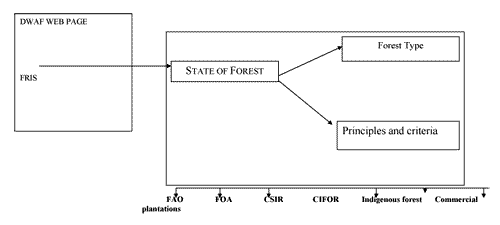
The table does not necessary mean we will be collecting this information for each criteria. We acknowledge that some of the information will be available at some of the institutions. The challenge is to develop a metadata base linking you to relevant available information site in the country. Furthermore, for any other reports, the information will have to repackage and presented in a format that is suitable for the intended beneficiary.
Conclusion
FRIS must be responsive to different needs. It should be accessible, easy to use and must have an in-built analysis tool. It should be able to:
- Direct users to different information system;
- Package information for different reports;
- It should allow for queries and
- Be able to identify information gaps. And finally
It should be able to address our long-term needs.
