


Because of their community mobilisation capacities and participatory outreach, NGOs are often the most appropriate partners to work with in the immediacy of a post-disaster situation. In some developing countries, though, foreign funded NGOs are seen as agents of global players and any criticism of policies by them may implicitly be considered as threatening to destabilise the government; conversely, local population groups may frown upon DRM projects simply because initiated by government. Being able to identify and “seize” the right entry point therefore remains an element of under-estimated importance if the commitment of local actors, especially towards the implementation of preventive measures in DRM that may not correspond to their own top priorities, is sought.
To convince individuals and groups of the necessity to invest in DRM, it has been found in Latin America that where local governments work with “key resource persons” who hold the respect of communities to pass on the message, significant results can be achieved (see the box in this Section).
18.1 Local actors in disaster prevention (source: adapted from Bollin 2003)
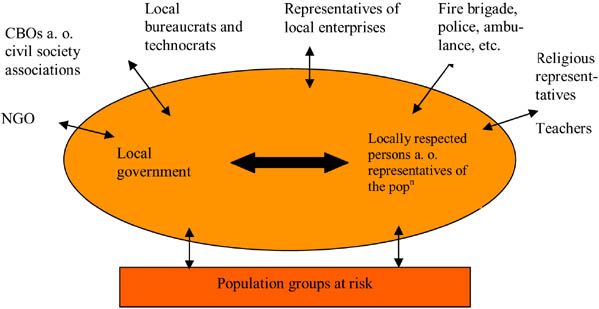
To “win over” people and convince them of the different initiatives it is advantageous to know about their motivation to participate. GTZ experience with the concept of “community-oriented disaster risk management”[12] has shown that the following are such driving factors: 1) The reduction of hazard risk of oneself and one’s family or of others; 2) The strengthening of self-help capacities that can also be transferred to other areas of intervention (e.g., potable water supply, collective marketing) - for many participants, this implies a boost of self-esteem; 3) Access to basic and intermediate education for persons who have almost no other such opportunities; 4) The possibility of actively taking part in organised social life; 5) The lead example of a respected person or opinion leader; 6) Concrete recompenses such as walkie-talkies, or, possibly, additional income sources; 7) Participation can improve the image of a person, institution, enterprise or party; 8) Social pressure (e.g., on local government) or being delegated (by an organisation, an institution, an enterprise, or a village).
Public campaigns, alerting at-risk communities of steps to take to reconstruct their homes and livelihoods, are more successful if a community itself feels it has been consulted about the requirements of the rehabilitation effort. The agreement of low-income families to relocate away from sites at risk from further flooding or earthquake damage is more likely if they have been involved at all stages of risk assessment.
Table: Proposal for an effective Information- and Documentation-System for Community-Oriented Disaster Prevention in Central America
|
Who needs |
Local Risk Management Group |
Local government |
National Emergency Commission or other national institutions involved in risk management |
Tertiary stakeholders (CEPREDENAC, GTZ, international organisations, other local governments, NGOs, etc.) |
|
What type of information |
· Impact assessment |
|||
|
· Identification and analysis of internal
and general problems encountered in the process |
· Problem identification at municipal level |
· Problem identification at national level |
· Summarised presentation of experiences |
|
|
What for |
· To know the degree of progress achieved in the area in terms of LRM (impact) |
|||
|
· Improve work carried out |
· Complementarity of measures on the part
of the alcaldía to reduce risk in the municipality |
· Support local effort |
· Support local effort or that of national
institutions in LRM |
|
|
In what form? |
· Studies - internal or external evaluations |
|||
|
· Meetings |
· Meetings |
· Meetings and visits |
· Written presentation |
|
(Source: Bollin 2001; adapted and transl. by author)
The Total Disaster Risk Management Approach (TDRM) provides a local, meso and macro level framework (see the Box in the next Section below) that can be used as a tool to facilitate the integration of all necessary steps to achieve improved DRM capacity. Linking the immediate and medium term, “the incorporation of analyses from hazard and vulnerability assessments and contingency planning exercises into regional or country strategy and project identification is the key to linking preparedness and prevention” (WFP, 1998: 6).
Analytical and activity programming methods can be usefully articulated at the meso- and macro levels by complementary tools. The construction of risk scenarios for delimited areas, sectors or populations, considering particular hazard and vulnerability factors, the social processes and actors behind these and the development context in which risk is manifested, may be a particularly relevant to diagnose hazard risk. Many disaster risk management issues are beyond the capacity of the individual household, requiring community and/or broader social interventions, including public sector action at regional and national levels. Local government associations and Community-Based Organisations (CBOs) such as inter-village development committees, including federations of local DRM groups, can act as focal points for collecting, systematising and providing the necessary technical inputs. Other meso-level tools are all those that can be applied at district, provincial, regional or geo-hydrological levels such as, for example, (risk-conscious) watershed planning and river basin planning.
Remote sensing and Geographic Information Systems (GIS) can add value to socio-economic disaster hazard risk assessments implemented through community-based fieldwork. In India, some of the most vulnerable communities along the coast have recently been identified with the help of the Orissa Remote Sensing Application Centre (ORSAC) so that they could be divided up amongst the NGOs for Community Based Disaster Preparedness (CBDP) training. CBDP has started to emerge as an important issue, and the UN has brought together all NGOs with plans in disaster preparedness to provide a coordinated approach to CBDP. The latter must be updated regularly through information- and documentation systems (such as the one proposed in the table in this Section) by making use of all available channels of primary and secondary data collection, especially at the meso (district, provincial or regional) level.
|
[12] Translated from the
original German concept of „Gemeindeorientiertes
Katastrophenrisikomanagement“. |
