


Many valuable tree species in Nepal are under threat of extinction. For better conserving these species, there is a need for a long-term commitment, strong economic base and trained manpower. In the absence of these resources, conservation of endangered and threatened forest tree species cannot move ahead as it should. It is urgent to stop the genetic depletion of forest trees to preserve future opportunity. Identification of endangered tree species, establishment of gene banks and development of appropriate propagation techniques are urgently needed to initiate conservation programme.
A practical way to preserve the valuable tree species is not only to conserve but also to utilize at the same time. Therefore, it is necessary to estimate the present status of tree species and to develop and implement a conservation and utilization programme. This would assist in supplying the needed forest products, help in carrying out management of the environment and improve the economic condition of people.
Increasing pressure on land could be minimised by making efficient use of land resources to produce more wood from the same area. In the context of forestry, it could be possibly done through a tree improvement programme (TIP), which aims to improve productivity of forests through the application of technological advances in tree breeding and propagation. In addition, TIP plays a role in conserving the genetic diversity of forest trees through the selection of plus trees from different parts of the country and establishment a genebank.
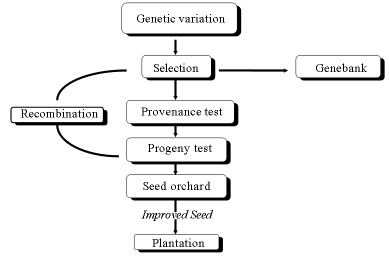
TIP is a good option for the improvement of productivity and genetic conservation of forest trees simultaneously. The TIP in Nepal is in its infancy and is seeking a long-term commitment of the government and other assisting bodies. There are various scattered activities and coordination of these could enhance the TIP. This classical model of TIP (Figure 2) can contribute to the genetic conservation of forest trees through the establishment of a genebank and provenance trial.
Figure 2. Classical model of a tree improvement programme
The Department of Forest Research and Survey (DFRS) has a history of forestry research in Nepal since 1965. Forestry research has focused largely on plantation forestry. Taking note of a World Bank report in 1970 that “all the hill forests will be wiped out in 20 years time and Terai forests in 15 years”, plantation forestry became the major activity of the forestry sector. Majority of the activities conducted were provenance and progeny trials.
All the donors contributing in forestry sector had plantation programmes.
The DFRS (then Forest Survey and Research Office, later Forest Research Division) has been supported by the DFID (then ODA) to carry out research activities. Silvicultural Research Project (which was later followed by Forestry Research Projects I and II) had a main thrust on plantation research. During 1979 to 1996, a number of plantation and tree improvement studies were conducted: some 159 studies were documented focusing on the aspects of seed, seedlings and plantations (Appendix 1).
There is still a substantial number of plantation and tree improvement studies, which have not been reported and are still ongoing. Appendix 2 provides a summary of the most important reports and publications on these fields.
There are two institutions active in tree domestication within the Ministry of Forest and Soil Conservation. These are the DFRS and the Tree Improvement and Silviculture Component (TISC, previously Tree Improvement Programme). There have been discussions to create an understanding between the DFRS and TISC as to which activities of tree improvement should each organisation carry out to avoid duplication.
TISC is mandated to supply seed required for plantation activities in the country. TISC carries out identification, registration and management of natural seed stands of important tree species; establishment of breeding seed orchards has been initiated in different parts of the country. Detailed information on the seed stands is not available. The major goal of the programme is to conserve genetic diversity of forest trees and to supply quality seeds on a reliable basis.
The demand of farmers for fodder and fruit species in Nepal is met by many different species in small quantities from each species. Due to the scattered nature of farmers’ locations, the demand could be best met through a decentralised distribution of seed carried out by farmers' associations, cooperatives and private suppliers. TISC has initiated decentralised distribution of seed through seed cooperatives. Seed cooperatives were established with the aim to collect and supply all the common seeds required for plantations. At the same time, TISC encourages and assists the cooperatives to collect and distribute more specialized seed, such as medicinal plants, important fodder trees, etc. In recent years, TISC has initiated more specialized activities in seed collecting, storage and distribution (NTFP, medicinal herbs, fodder seed, etc). Information on seed and seedling distribution by TISC is listed in Table 3 below. It can be seen that 17 166 kg of seed was distributed within a period of six years, in addition to many millions seedlings.
Table 2. Distribution of seeds and seedlings by TISC between 1992 and 1998
Species |
Total seed distributed (kg) |
Total no. of seedlings |
Alnus nepalensis |
52 |
1 548 000 |
Albizia lebbeck |
802 |
6 416 000 |
Bauhinia spp. |
404 |
469 375 |
Bassia butyracea |
300 |
75 000 |
Choerospondias axillaris |
3339 |
4 006 680 |
Cedrus deodara |
48 |
268 800 |
Dalbergia latifolia |
64 |
448 000 |
Dalbergia sissoo |
7513 |
33 808 950 |
Eucalyptus camaldulensis |
69 |
13 840 000 |
Grevillea robusta |
3 |
15 000 |
Hippophae spp. |
13 |
123 000 |
Juglans regia |
797 |
15 940 |
Juniperus spp. |
4 |
6300 |
Leucaena spp. |
178 |
4 096 300 |
Michelia champaca |
744 |
1 488 000 |
Pinus spp. |
1874 |
20 581 500 |
Prunus cerasoides |
254 |
304 200 |
Sesbania spp |
14 |
216 000 |
Tectona grandis |
694 |
346 750 |
Total |
17 166 |
88 073 795 |
In situ conservation of plant genetic resources is more effective and realistic. Plant species grow and regenerate in native environment. It protects the reservoir of gene for potential use in future. FGR of Nepal are preserved in national parks, and wildlife and hunting reserves. This activity started in the early 1970s aiming to conserve a representative sample of ecosystems. Currently, Nepal has eight national parks, four wildlife reserves, three conservation areas and one hunting reserve. Preserved areas cover 16.5% of total area of the country.
These protected areas do not adequately represent all the ecosystems of the country. Most of the protected areas are located in the lowland Terai and high Himalayas. There is a major gap in the reserve system in the middle hills (500m to 3500m altitude); only 10% of the existing reserves are located in this range. The omission is significant because the middle hill zone contains 61% of Nepal’s forest, out of which 57% is shrublands that are the important breeding habitats for many bird species (Hunter and Yonzon 1993). Middle hill forests also consist of many valuable tree species. The potential of many forest tree species is yet to be identified, validated and scientifically managed. The Department of National Parks and Wildlife Reserves is the primary agency managing these conservation areas.
A major problem with in situ conservation is the conflict between reserves and local people. Hence, involving community in the conservation efforts becomes important. However, interests of local people and the conservation authority managing these areas could be different. The sources of conflicts are forest resource use, crop damage and livestock depredation (Studsord and Wegge 1995). Efficient management of the buffer-zone areas could be a possible solution to preserve genetic resources of conservation area.
Forest User Groups (FUGs) are formed to protect, manage and utilize the forest outside the reserve areas. Similarly, conservation groups are formed in the fringes of these areas. Projects active in these areas are providing training on income generation to these groups to uplift their economic conditions.
The threatened and endangered species require some protective measures to maintain a genetically viable population in the wild. It is impractical to design an in situ conservation programme based on individual species. So, it is necessary to design a complementary ex situ conservation programme.
Community forestry is a viable alternative approach for in situ conservation of forest trees outside the protected areas. However, a major problem is the motivation of the FUGs in conservation of genetic resources. The FUGs are more interested in utilization of forest resources than in conservation of biodiversity. Occasionally there could be some conflict due to differences in motivation of the FUGs and conservationists. Hence, some level of ex situ conservation becomes important. This is especially true in the case of rare and endangered species and valuable species used in tree improvement programmes. The Government of Nepal has adopted a policy to hand over all the accessible forests to the local communities in lots that they are willing and able to manage. About 61% of the total forest area of Nepal is potential community forest area.
The DFRS and TISC are the two organizations under the Ministry of Forest and Soil Conservation responsible to carry out ex situ conservation of forest trees in the country. Their major activities include identification, registration and management of natural seed stands of important tree species and establishment of breeding seed orchards in different parts of the country. The major goal of the programme is to conserve the genetic diversity of forest trees and to supply quality seeds on a reliable basis for the success of plantation programmes.
TISC has established breeding seed orchards to conserve the genetic resources of Dalbergia sissoo and D. latifolia. Each of these orchards is expected to yield about 400 kg of seeds annually. The seed produced in the orchards should be at least 20% more productive (Thomson 1995). TISC is also promoting the identification, registration and management of local seed sources. The main aim is to make each district self-sufficient in seed supply of highly demanded species and to conserve plant genetic resources.
For the conservation of threatened and endangered species, ex situ conservation is more practical than in situ, because these species require more protective measures. This method is more costly to operate, though. In developing countries like Nepal, where poverty-related issues are more important, policy makers could rarely be convinced to finance ex situ conservation of plant genetic resources.
The DFRS and TISC are responsible in carrying out tree improvement studies in the country. Studies carried out by these organizations focus on identification and registration of natural stands of commercially important species as well as on genetic improvement.
• Identification of seed stands
During the identification process, registration and management of natural seed stands of important tree species are done. A total of 116 seed stands of 20 different species have been surveyed in 33 districts, out of which 54 seed stands have been registered in 28 districts. The main aims of this programme are to make each district self-sufficient in seed supply of highly demanded species and to conserve genetic resources.
• Establishment of breeding seed orchards
Breeding seed orchards (BSO) of Albizia lebbeck, Azadirachta indica, Bauhinia purpurea, Choerospondias axillaris, Dalbergia latifolia, D. sissoo and Michelia champaca have been established in different parts of the country. A minimum of 25 plus trees of each species were selected from the natural stands to minimize the risk of inbreeding depression. A BSO for D. sissoo was the first one to be established in the country; the species has been the most popular plantation species in the Terai. The BSO for D. sissoo is replicated in three districts, Chitwan, Sunsari and Banke districts in successive years representing three development regions, that is, East, West and Mid-west.
• Genetic improvement of chir pine
For the genetic improvement of chir pine, the DFRS has identified 115 plus trees from eight districts and is in the process to initiate their multiplication. The DFRS is planning to establish BSOs in different parts of the country to ensure the production of quality seeds. For more information see Appendix 3.
• Provenance trials
The Forest Research and Survey Centre (FORESC) has conducted a provenance test of the two most popular species of the country, namely Dalbergia sissoo and chir pine on different sites of the country. In addition, provenance tests of other important species, such as Eucalyptus camaldulensis, Azadirachta indica, Alnus nitida, Pinus caribaea and Gliricidia sepium have also been carried out.
• Mass multiplication of Eucalyptus
The DFRS has established a clonal bank in Sunsari District in the Eastern Region for mass multiplication of Eucalyptus camaldulensis to meet the growing demand of FUGs and private farmers. Some 30 plus trees of Eucalyptus spp. have been selected in Sagarnath Forest Development Area. Scaring was conducted at the base of the selected plus trees to allow juvenile growth. Cuttings of this juvenile growth were used to establish a clone bank. Regular cuttings from the clone bank will be taken out to produce seedlings.
• Domestication
Domestication of fodder, fruit, timber and fuelwood trees and growing them in marginal agricultural lands has been practised by farmers using their indigenous knowledge. In many parts of the country, farming consists of tree-crop-animal systems (Figure 1). The success of farming system depends on the contribution of these three elements and the dynamic interplay between them (Thomson 1995). Most farmers understand this very well and plant trees on their farmlands. Many tree species found in farmland are either lost or rarely found in their natural habitats. Germplasm of these tree species have been preserved in the farming system and the farmers are regularly watching and learning the dynamism of the species.
To date, more than 7000 FUGs have been formed and more than 999 951 ha of forests has been handed over. The programme has been successful in involving a total of 1 406 947 households in managing the forests. The programme is found to be effective to rehabilitate the forest cover and improve the forest condition. However, limitations that need to be addressed have been observed:
• Human resources available at the Department of Forest are not sufficient to train the FUGs in the aspects of technical skills, institutional development and self-reliance.
• Due to the increase in population, demand for forest products in many areas has grown significantly. Because of this, the forest management planning has been unable to meet the increased demand, and community forests do not produce enough to fulfil the need of users. It is questionable how long the people would accept this situation, before over-extraction becomes routine.
• Participation of women and minority groups in decision-making, together with the dominant elite needs to be improved for equitable sharing.
• Boundary conflicts between the FUGs and equitable sharing of benefits among the users.
