
|
 |
Above: Reduced impact logging recognizes that tropical forests are places where people live.
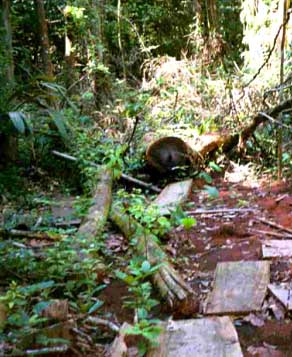
Right: Sawing
logs on-site can reduce extraction impacts.
|
|||
Above: Reduced impact logging recognizes that tropical forests are places where people live. |
|||
Reduced Impact Forest Harvesting |
|||
|
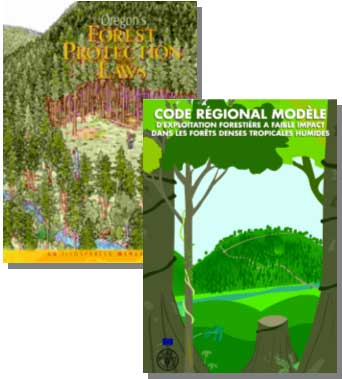
Reduced-impact logging (RIL) techniques are being designed and implemented around the world in order to improve resource use efficiency and conservation in the management of forested areas for timber production. Forestry enterprises are consequently targeting more sustainable, polycyclic timber harvesting in permanent production forests. RIL, the harvesting element of a sustainable forest management programme, is fundamental to achieving this goal. In this issue of the Forest Harvesting Bulletin, we examine some recent RIL activities and take note of other important efforts world-wide. What is Reduced Impact Logging (RIL)?The term "reduced impact logging" has come to mean improved forest harvesting. It is actually a package of practices and technologies and includes more than simply felling and extracting timber. Killmann et al. (2001) defined RIL as: "Intensively planned and carefully controlled implementation of harvesting operations to minimize the impact on forest stands and soil, usually in individual tree selection cutting." RIL is not a new concept, rather a transfer of well-established approaches from temperate forests to the tropics (Dykstra 2001). Although practices vary somewhat according to local conditions and circumstances, RIL generally includes, but is not limited to, the following: Research comparing RIL and conventional logging in Brazil, Ecuador, Guyana, Indonesia, Malaysia and Suriname has conclusively demonstrated that, at similar levels of extraction, RIL reduces residual tree mortality and better conserves the ecological integrity of managed forests. The results of economic studies on the benefits of RIL are less conclusive, although recent studies in the Eastern Amazon suggest that despite the perceived investment risks, RIL harvesting operations were less costly and more profitable than conventional logging. Promoting RILOregon's Forest Protection Laws: An Illustrated Manual is a recent publication showing how improved forest practice may be implemented as law. This 160 page illustrated manual is designed to help forest landowners, operators and foresters manage forestlands under the rules of the Oregon Forest Practices Act. It describes the rules and rationale behind them, and illustrates how forest operations can be managed in compliance with them. Regrettably, the archaic measurement system of the United States is used throughout the manual. This is an interesting manual for anyone concerned
with improving forest practices. It shows how one jurisdiction has
addressed the problem. It includes an abundance of high quality photos and
graphics. Copies of this manual can be ordered for ten dollars. Send a request to info@ofri.com . FAO significantly advanced the concept of RIL when it produced the FAO Model Code of Forest Harvesting Practice. Building on this, FAO worked with the 29 member countries of the Asia-Pacific Forestry Commission (APFC) and various partner organisations, including ITTO, to develop the Code of Practice for Forest Harvesting in Asia-Pacific, which was published by APFC in 1998. Attention has now shifted to the implementation of the code, developing national codes, training, and generating political commitment. Recently, FAO has been working with Central and West African countries to draft a regional code for that part of the world. This code written in French, Code régional modèle d'exploitation forestière à faible impact dans les forêts denses tropicales humides d'Afrique centrale et de l'Ouest, will be available from autumn 2003. The English version will be published early 2004 and a detailed description of the model code will be provided in the next issue of the Forest Harvesting Bulletin.
RILSIM: A financial simulation modelling system for RILOne important way of promoting RIL is to allow individual loggers a preview of the impact of RIL on their profits. In 2001, a team of international experts began developing software with the primary aim of assisting loggers, government forest officials, policy makers and the private sector to better understand the financial costs and benefits of reduced impact logging practices. 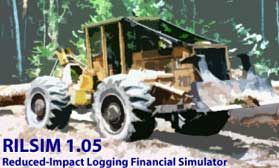
RILSIM (Reduced Impact Logging Simulator) is a discrete-event deterministic computer simulation model designed to permit users to rapidly compare the cost of reduced impact logging against the cost of conventional logging under identical local site conditions. Data entry is achieved through a series of "data forms" that users complete based on local conditions, wages, equipment costs, logging activities, production rates, and other factors relevant to the analysis. The analysis then shows the profitability of using RIL. Aside from permitting rapid comparison of logging costs, RILSIM has also been designed as a teaching tool, with a "context sensitive" help system that describes the principles of financial analysis and guides users through each stage of a simulation run. It is intended to be useful for not only loggers but also for government foresters, specialists in development assistance agencies, university students, members of environmental groups, and the general public. The model will be available from July 2003, at no cost if downloaded over the Internet (www.apfcweb.org) and for a nominal fee on CD-ROM and can operate on computers with little memory and limited disk capacity. It is easy to install and use and requires no additional software. RILSIM is compatible with Windows 95 and all the later versions of the Microsoft Windows operating system. The software has been written in Microsoft C++ and the source code is available to users who might want to translate text into other languages or tailor the analytic procedures to their specific requirements. |
|
Commercial timber harvesting in the natural forests of MozambiqueFAO Forest Harvesting Case Study 18
The forest industry in Mozambique is composed mostly of small-scale enterprises with production capacities below 2,500 m3 per year. This study analyzes five enterprises in northern, central and southern Mozambique to establish knowledge on the efficiency of commercial forest harvesting. Efficiency was evaluated by means of operational, organizational, energy, and financial indicators. Operational data were collected through time studies with continuous timing. Costs per machine-hour were calculated with the Production and Cost Evaluation Programme-PACE (FAO 1992). Intermediate results on output were then related to inputs, yielding indicators for operational, organizational, energy and financial efficiency. The operating sites are characterized by the following data table. Note the striking variation in quantities measured among the sites. Table 1: Operational characteristics
Some findings: Table 2: Productivity within work cycles [m3/ha]
Table 3: Financial characteristics [US$/m3]
A typical small-scale logging enterprise starts production on the basis of a cutting license granted for 500 to 2,500 m3 without investing in a management plan, road network, or spatial structuring. Scattered timber resources strangle raw-material flows right from the beginning. Extraction and transport bring high unit costs for fuel, lubricants, tyres, and wages, which internal accounting perceives as production costs. Sales revenues hardly cover the expenses of current production. In order to save apparent profit, the company reduces expenses for fuel and spare parts by slowing down current production rather than taking positive action. Many companies were entangled in this spiral of declining efficiency that finally forced them to suspend their harvesting activities. Recommendations from the study focus on raising extraction intensity through harvest preparation and optimised use of all available commercial species, and on reducing production costs by restricting transport distances and allocating processing units as close as possible to logging areas.
Health and Safety
|
|||||||||||||||||||||||||||||||||||||||||||||||||||||||||||||||||||||||||||||||||||||||||||||
Education databaseThe forestry education database provides information on short courses available worldwide on forestry and related subjects. Users can search according to training area, institution and country. Besides providing information to students, the database gives education and training institutions the opportunity to advertise the short courses they offer. For more information, email: FREE@fao.org or check the database at: www.fao.org/forestry/for/forc/free/education/courses.asp . |
 Dr. Heinrich is retiring from FAO after nearly 30 years of service.
Rudolf Heinrich would like to take the opportunity of his farewell from FAO to thank his staff members for their dedication and hard work throughout the years, and in making a substantial contribution in assisting FAO Member Countries in furthering the cause of forest development, sustainable forest conservation and utilisation.
He also wishes to thank all those who have through the years extended to him collaboration, friendship and support through his many professional and personal contacts during his work assignment with FAO.
Rudolf Heinrich has been associated with FAO since January 1972. His main work with FAO was in the fields of forest harvesting, engineering, trade and marketing, evaluation of the environmental impact assessment of forest operations, forest workers safety and health, ergonomics, forest road construction and road transport, environmentally sound forest management, sustainable forest practices and project management for sustainable forest development comprising environmental, social and economical factors.
In 1983 he was appointed Chief of the Logging and Transport Branch. Under his leadership, the Branch was renamed Forest Harvesting and Transport Branch, which in recent years became the Forest Harvesting, Trade and Marketing Branch of the FAO Forestry Department at headquarters in Rome.
During his assignment with FAO, Dr. Heinrich was frequently called to lecture at various universities throughout the world, such as, Munich (Germany), Oregon (USA), Valdivia (Chile), Garpenberg (Sweden), Harbin (China), Los Baños (Philippines), Bogor (Indonesia), Chapingo (Mexico), Paraná (Brazil) and Vancouver (Canada).
He has also carried out a number of consultancies with International and Bilateral Organizations, such as, World Bank, WFP, ILO, UNIDO, UNDP, EU, ECE, IUFRO, CIFOR, ICRAF, FINNIDA, SIDA, GTZ, NORAD, Austrian Development Aid and USAID.
During his assignment with FAO, Dr. Heinrich has produced more than 70 publications in his field of expertise and carried out for FAO Member Countries more than 100 special missions.
From January 2000 to July 2001, Rudolf Heinrich was on sabbatical leave from FAO and served as a Special Envoy at the Austrian Embassy in Italy dealing with international forestry development projects.
Besides his tasks as Chief of the Forest Harvesting, Trade and Marketing Branch, Dr. Heinrich has been a member of the Secretariat of the FAO/ECE/ILO Committee on Forest Technology, Management and Training and presently he is Chairman of the IUFRO Working Group on Forest Operations in the Tropics.
Recently, he received the honour of being nominated as a permanent member of the Academy of Forestry Sciences in Florence.
The FAO Forest Harvesting Bulletin team wishes to express its gratitude to Rudi Heinrich for the longstanding successful leadership in publishing the Bulletin since 1992 and his close and cordial friendship.
Dr. Rudolf Heinrich can be contacted in the future at the following address:
Dr. Rudolf Heinrich
INT FOREST CONSULT (IFC)
Via Gorgia di Leontini, 260
00124 Rome, Italy
Tel (+39) 0650913788/0650918101
E-mail: rudolf.heinrich@tin.it
Asner, G. P., Keller, M., Pereira, R. & Zweede, J. C. 2002. Remote sensing of selective logging in Amazonia assessing limitations based on detailed field observations, Landsat ETM+ and textural analysis . Remote Sensing of Environment, Vol.80, No.3, pp. 483-496.
Carret, J. C. 2002.
Challenges of sustainable management: the dense forests of
Cameroon
. Bois et Forets des Tropiques, No. 271, pp.
61-78.
Tropiques, No. 271, pp.
61-78.
Costantini, A. & Doley, D. 2001. Management of compaction during harvest of Pinus plantations in Queensland: I & III . Australian Forestry, Vol.64, No.3, pp. 181-185, 193-198.
Fath, H. 2002. Commercial timber harvesting in the natural forests of Mozambique , Forest Harvesting Case Study 18, FAO, Rome, 66 pp. See page 5.
FAO 2002. Second expert
meeting on harmonizing forest-related definitions for use by various
stakeholders.
Proceedings of the meeting in Rome 11-13 September 2002. Arabic, Chinese,
English, French and Spanish (see Climate 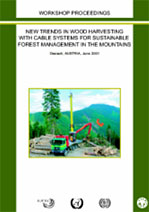 Change at
www.fao.org/forestry ).
Change at
www.fao.org/forestry ).
FAO 2003. State of the World 's Forests . FAO reports every two years on the status of forests, recent major policy and institutional developments and key issues concerning the forest sector (see www.fao.org/forestry ).
FAO 2003. New Trends in Wood Harvesting with Cable Systems for Sustainable Forest Management in the Mountains . Proceedings of the workshop in Ossiach, Austria, 18-24 June 2001, Rome, 366 pp.
Giuffre, L., Fernandez, R., Lupi, A., Heredia, O. S., & Pascale, C. 2002. The effect of different techniques of forest harvest residue management on some properties of a Kandiudult soil in North-eastern Argentina . Agricultura Tecnica, Vol. 62, No. 1, pp. 143-149.
Holmes, T. P., Blate, G. M., Zweede, J. C., Pereira, R. Jr., Barreto, P., Boltz, F. & Bauch, R. 2002. Financial and ecological indicators of reduced impact logging performance in the eastern Amazon . Forest Ecology and Management, Vol. 163, No. 1/3, pp. 93-110.
Jackson, S. M., Fredericksen, T. S. & Malcolm, J. R. 2002. Area disturbed and residual stand damage following logging in a Bolivian tropical forest . Forest Ecology and Management, Vol. 166, No. 1/3, pp. 271-283.
Montagnini, F., Finegan, B., Delgado, D., Eibl, B., Szczipanski, L. & Zamora, N. 2001. Can timber production be compatible with conservation of forest biodiversity? - Two case studies of plant biodiversity in managed neotropical forests . Journal of Sustainable Forestry, Vol. 12, No. 1/2, pp. 37-60.
Neary, D. G., Moir, W. H. & Phillips, B. G. 2001. Harvesting-related soil disturbance: implications for plant biodiversity and invasive weeds . Forest Research Bulletin, No. 223, pp. 17-32.
Parrotta, J. A., Francis, J. K. & Knowles, O. H. 2002. Harvesting intensity affects forest structure and composition in an upland Amazonian forest . Forest Ecology and Management, Vol. 169, No. 3, pp. 243-255.
Pereira, R., Jr., Zweede, J., Asner, G. P. & Keller, M. 2002. Forest canopy damage and recovery in reduced-impact and conventional selective logging in eastern Para, Brazil . Forest Ecology and Management, Vol. 168, No. 1/3, pp. 77-89.
Seixas, F. & Oliveira Junior, E. D. de 2001. Soil compaction due to wood harvest machines traffic . Scientia Forestalis, No. 60, pp. 73-87.
Spathelf, P., Seling, I. & Nutto, L. 2001. Efficiency of different forest policy approaches for the conservation of the Brazilian Amazon forest: preservation, management of natural forests or plantation forestry ? Forstarchiv, Vol. 72, No. 6, pp. 251-261.
Wallbrink, P. J. & Croke, J. 2002. A combined rainfall simulator and tracer approach to assess the role of Best Management Practices in minimising sediment redistribution and loss in forests after harvesting . Forest Ecology and Management, Vol. 170, No. 1/3, pp. 217-232.
Meetings2nd International Precision Forestry Symposium, 15-18 June 2003, Seattle, Washington. Sponsorship and support by USDA Forest Service, FERIC and IUFRO (see the web site: www.cfr.washington.edu/outreach/PreFor ). 3rd International Wind and Trees Conference, 17-24 August 2003, Zurich, Switzerland. Contact: Reinhard Lassig, Email: laessig@wsi.ch . Council on Forest Engineering (COFE), 7-10 September 2003, Bar Harbor, Maine, USA. Annual COFE Meeting (see: www.cofe.org ). Forest Operation Improvements in Farm Forests, 9-14 September 2003, Logarska dolina, Slovenia. This workshop is organised by the Joint FAO/ECE/ILO Committee, IUFRO and the Slovenian government (for further information please contact Joachim.Lorbach@fao.org or see the web site: www.unece.org/trade/timber/tc-meet.htm ). XII World Forestry Congress, 21-28 September 2003, Québec City, Canada. "Forests, source of life" is the theme for this largest international meeting in the field of forestry (see: www.wfc2003.org ). High-tech Forest Operations for Mountainous Terrain, 5-9 October 2003, Schlaegl, Austria. A two day technical conference followed by an optional visit to Austrofoma 2003, a live demonstration and presentation of forest machinery in Austrian forest conditions. The focus is on skyline harvesting technology and environmentally sensitive forest practices (see: www.boku.ac.at/austro2003 ). Seminar on Close-to-nature Forestry, 14-19 October 2003, Zvolen, Slovakia. A seminar organized by the Slovak Forest Research Institute and the Joint FAO/ECE/ILO Committee (see: www.unece.org/trade/timber/tc-meet.htm ). International Conference on Quality Timber Products of Teak from Sustainable Forest Management, 2-5 December 2003, Peechi, Kerala, India. ITTO and IUFRO. Contact: K. M. Bhat, kmbhat@kfri.org, Kerala Forest Research Institute, website: www.kfri.org/html/k0500frm.htm New Roles and Modes of Operation of Forest Services, September 2004, Netherlands. A seminar by the Joint FAO/ECE/ILO Committee (additional information will be available at: www.unece.org/trade/timber/tc-meet.htm ). Environmentally Sound Forest Roads and Wood Transport, 2004, Hungary. A seminar by the Joint FAO/ECE/ILO Committee (additional information will be available at: www.unece.org/trade/timber/tc-meet.htm ). Seminar on Forest Operations, 2004, China. IUFRO Division 3 (additional information will be available at: http://iufro.boku.ac.at/iufro/ ). |
 Second Forest Engineering Conference
 Simmone Rose joined FAO on 1 April 2003. She will work with FOPH in the field of post harvest impact assessments. A national of Guyana, she holds a PhD in Forest Ecology from Utrecht University, The Netherlands. Ms. Rose has spent most of her professional career with the Tropenbos-Guyana Programme where she has studied the effects of conventional and reduced impact logging on the residual forest stand. More recently she has been involved in restoration of fragmented riparian zones in Far-North Queensland, Australia.
 This case study was written by Henning
Fath and published in 2002.
This case study was written by Henning
Fath and published in 2002.