English only
|
|
| Agenda Item 4.2 | Conference Room Document 49 English only |
second fao/who global forum of food safety regulators
Bangkok, Thailand, 12-14 October 2004
(Prepared by Finland)
Hygiene proficiency refers to the employees continuously updating their knowledge and skills and participating in training events in the food sector. Employees whose work entails special risks related to food hygiene or who handle unpacked, perishable foodstuffs, shall since the beginning of 2002 demonstrate their proficiency either by a hygiene proficiency certificate or a vocational or training diploma.
Hygiene proficiency is a statutory obligation considered to be part of in-house control in both food establishments governed by the Health Protection Act and in establishments governed by the Hygiene Act (foods of animal origin). Such establishments include, for example, restaurants, food kiosks and stores, institutional kitchens and food production plants.
Employees who handle unpacked, perishable foodstuffs, shall pass the proficiency examination or demonstrate corresponding knowledge and skills by a vocational or training diploma. The proficiency requirement also applies to self-employed entrepreneurs who work in their own food establishments. At present, a diploma or proficiency examination certificate obtained in some other country is not accepted in Finland.
Every employee in the food sector has to be proficient in the following subject areas included in food hygiene: fundamentals of microbiology, food poisoning, hygienic work practices, personal hygiene, maintaining clean conditions, in-house control and legislation.
The National Food Agency is in charge of the hygiene proficiency examination system and maintains, updates and develops it. The National Food Agency has the right to stipulate matters related with the organizing of the examinations in practice. The National Food Agency may also stipulate the grounds for the proficiency examinations and how the examinations are drawn up, as well as the requirements for approval of the examination. The National Food Agency also guides and controls the proficiency examiners and provides guidance and instructions to municipal authorities.
Food establishments' compliance with the hygiene proficiency requirements is controlled in connection with other food control activities. Food establishments are controlled by municipal health protection authorities as well as the authorities stipulated in the Decree on Food Hygiene of Foodstuffs of Animal Origin. In order to facilitate the control, entrepreneurs are required to keep a record of persons employed in the establishment that shows how their sufficient food hygiene proficiency has been demonstrated.
The requirements of the control authorities can often be satisfied by the employer by producing a summary of the employees and a description of how the required hygiene proficiency has been demonstrated. If necessary, however, the authority may demand a hygiene proficiency certificate to be produced.
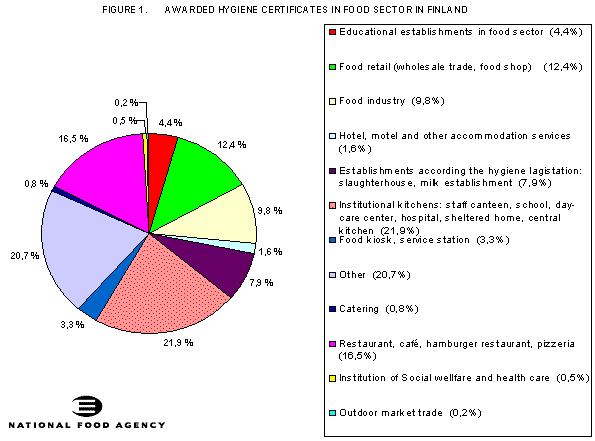
Some 1300 independent proficiency examiners accredited by the National Food Agency organize Proficiency Examinations in different parts of the country. The examiners announce the examinations, mark the examination forms and report to the National Food Agency on examination attendance and approved examinations. The examiners can also award the Certificate on the basis of sufficient vocational training or diploma. The proficiency examiner always personally signs the Hygiene Proficiency Certificates and Proficiency Cards and awards them to every candidate that has passed the examination. A list of accredited proficiency examiners can be found on the Internet site Hygiene Proficiency at http://www.elintarvikevirasto.fi/hygos/ under Proficiency Examiners. The examiners can be contacted directly, e.g. by e-mail.
The proficiency examiners are divided into three categories. Examiners in Category 1 are authorized to act as municipal food control authorities. Examiners in Category 2 are instructors or teachers. In Category 3, examiners shall possess extensive work experience in the practical application of food hygiene and in-house control as well as experience as a coordinator of in-house control, and shall have worked as a supervisor or a manager, or in a corresponding position.
The National Food Agency maintains and updates a question bank, which the proficiency examiners can access on the Internet to download a set of questions (in either Finnish or Swedish) for each examination event. The set consists of 40 true/false statements and the candidate has to get at least 34 of them correct to pass the examination. The written examination has to be completed in 45 minutes.
A proficiency examiner may apply to the National Food Agency for permission to organize the Proficiency Examination in some other language than Finnish or Swedish, or as an oral examination or as a demonstration examination. The use of an interpreter may also be permitted in special cases.
In 2002, 50 examinations were organized under special conditions. In 2003, the number of special examinations is on a steep increase, with 250 special examinations organized by the end of the year. Examinations were organized, for example, in Chinese, Turkish, Russian and English, as oral examinations in Finnish or Swedish, in sign language and also as demonstration examinations.
In order to organize a special proficiency examination, the examiner shall fill in an electronic notice form in the question bank and apply for a permission to organize the examination under special conditions. The National Food Agency approves the notice and records all the examinations organized as special examinations. This way the National Food Agency is better able to develop the system to meet the needs of the examinees.
In the summer and autumn of 2003, the National Food Agency conducted an extensive questionnaire-based survey among the proficiency examiners and examinees. The purpose of the study was to collect opinions on the functioning of the hygiene proficiency system from various viewpoints. At the same time, the National Food Agency wanted feedback on how the Agency had succeeded in maintaining, supervising and controlling the system. On the basis of the study, the overall grade given to the National Food Agency was good.
In line with European food hygiene regulations (852/2004/EC), the employer decides how knowledge is updated and who shall take part in training events. A company may provide training to the entire staff, or only to the employees who handle unpacked, perishable foodstuffs. Training can also be offered to suppliers, warehouse and maintenance employees, etc. The role of the managerial staff is emphasized in how hygiene proficiency is applied in practice as part of in-house control. If the managers do not understand or appreciate the practical application of hygiene proficiency and the benefits it offers, the employees will not necessarily understand the useful value of the system, either. Although there are no regulations on training, the planning and documentation of training is an important part of in-house control. The training material can be freely selected (e.g. www-material, books, brochures, guides etc.) as can also the form of training (e.g. classroom training, group work, distance and Internet learning, self-studies, etc.). The desire to learn and to apply what has been learned in practice must come from within the company – not from external sources!
As part of in-house control, hygiene proficiency serves as an aid for the control authorities, alleviating the sometimes tedious task of teaching basic food hygiene for company employees. The purpose of hygiene proficiency is not to tie the resources available to control, but on the contrary, to release resources. No special efforts are required to ensure the enforcement of the hygiene proficiency obligation, but it can be monitored as part of normal control practice. On the other hand, the enforcement of the obligation can be used to ”encourage” entrepreneurs to pay attention to the issues involved in hygiene proficiency and in-house control. Hygiene proficiency can be used to remind the entrepreneurs to update their in-house control programmes.
Hygiene proficiency covers the basic level of knowledge in food hygiene. Hygiene proficiency is a comprehensive entity described through a stepwise approach. On the various steps of hygiene proficiency (1-4) the decision on how and what needs to be updated and applied in practice, are the practical benefits of the knowledge gained, and is made inside the company.
In the future (after Jan. 1st, 2006), every employee who handles unpacked, perishable foodstuffs should be able to demonstrate his/her food hygiene proficiency (certificate and card). This will make the system more equal, and also facilitate the task of the control authorities and the employers in monitoring the enforcement of the obligation.
Hygiene proficiency refers to continuous learning and updating of knowledge in issues related to food hygiene. It is also important to monitor and measure what practical achievements have been made with hygiene proficiency. The National Food Agency is responsible for controlling and developing the hygiene proficiency system by collecting information, for example, from companies, municipal control authorities and proficiency examiners. After a transition period (1.1.2002 - 31.1.2004) surveys will be conducted to establish what has been achieved through hygiene proficiency and how the system should be developed. The companies can also measure the results of hygiene proficiency by analyzing e.g. their in-house control or quality programmes or by carrying out personnel and customer satisfaction surveys.