

English only
|
|
| Agenda Item 5.1 | Conference Room Document 63 English only |
second fao/who global forum of food safety regulators
Bangkok, Thailand, 12-14 October 2004
(Prepared by Thailand)
Food safety is one of the most desirable things for consumers. Unsafe food does not only affect consumers' health, but can also lead to a great economic impact on every country. At present, consumers' awareness of food safety has been increasing. Pathogenic microbial and chemical contamination in the food chain, and health impacts from some advanced technologies (e.g. GM food or genetic engineering products and food irradiation) are all among their concerns. Therefore, the most essential regard is the confidence of consumers in safety of foods.
Major causes of unsafe foods include: 1) microbiological hazards - pathogenic microorganisms, such as Samonella spp. and Shigella spp.; 2) chemical hazards - toxic chemicals in foods, such as heavy metals and hazardous chemicals from soil, water, and food contacted containers; pesticides; and some prohibited food additives and veterinary medicines; and 3) physical hazards – filth from unhygienic production and transportation, such as bristles, insects, and dirts.
To reduce the previously mentioned major food hazards, the Thai Government has set up a food safety policy and has implemented a strict food safety monitoring and control system in the country by focusing on food processing throughout the whole food chain (described as From-Farm-To-Table concept). All related stakeholders from both governmental and private sectors need to be responsible and put their efforts on the traceability and food safety control in the country in order to keep the quality and standard of Thai foods high and able to meet the international food quality and standard level. This is for the ultimate goal of consumer protection and fair international food trades.
The Ministry of Public Health has a major role in consumers' health protection. By the virtue of the provisions of Food Act B.E. 2522 (1979), the main duty of the Ministry of Public Health includes: controlling food products before and after being launched to the markets, defining food quality and standard according to the international standard, issuing food production license and food importation license, controlling food production hygiene, inspecting and controlling quality of foods that are produced and distributed in the Thai markets, and processing legal action according to the law. Additionally from the Ministry of Public Health, the Ministry of Agriculture and Cooperatives is also an organization authorized to conduct food safety surveillance and enforcement according to the food law.
Due to the food safety policy pursued by Thai Government – “Safe and Wholesome Food for All in 2004”, the Ministry of Public Health, coordinated with the Ministry of Agriculture and Cooperatives and other authorities, has implemented a measure for a strict and regular surveillance and monitoring on contaminants, focusing on 6 chemicals (borax, formalin, sodium hydrosulfite, salicylic acid, beta agonists, and pesticide residues) in all types of food available in the Thai market. All food producers, food vendors, restaurants, and supermarkets are all requested to cooperate with the governmental sector to control the safety of their food products.
The following strategic approaches have been implemented:
Cooperation between the Ministry of Public Health and other related authorities - such as the Ministry of Agricultural and Cooperatives, the Ministry of Interior, the Ministry of Industry, the Ministry of Commerce, the Customs Department, Royal Thai Police, Bangkok Metropolitan Administration, and Provincial Public Health Offices- is needed for the development and strengthening of food safety monitoring and control system throughout the whole food chain (starting from the raw material importation, food production at farm to factory level, and food distribution to consumers). In addition, the Ministry of Public Health has implemented a measure to motivate food producers and vendors to be more responsible on their food quality and safety by issuing food safety logos to those complying with food safety requirements.
The imported foods, raw materials for food production, and pharmaceutical products need to be inspected and controlled as mentioned in the following.
1.1.1 Processed foods and raw materials
To protect consumers from consuming unsafe or contaminated or illegal imported foods, Thai Food and Drug Administration, Ministry of Public Health, is responsible for collecting samples of imported foods or raw materials and sending them for analysis. If it is found that an imported food item or raw material does not comply with the prescribed standard, that food item or raw material will be detained or recalled, and legal action will occur. Moreover, that food or raw material will be monitored and analysed to confirm its safety before distribution for every lot of the next importation.
1.1.2 Veterinary medicines and pharmaceutical products
Ports of entry of pharmaceutical products are specified by the Notification of Ministry of Public Health, Re: Specified ports of entry for pharmaceutical products. Thai Food and Drug Administration, Ministry of Public Health, works cooperatively with Provincial Public Health Offices in the provincial areas to set up “mini-labs” at all ports of entry for strict inspection and testing of imported veterinary medicines and pharmaceutical products.
1.2.1 Veterinary medicines and pharmaceutical products
A special team has been established for monitoring and surveillance on contamination problems related to inappropriate uses of some veterinary medicines and pharmaceutical products in the country. This team is responsible for inspection of manufacturing sites and importation sites, of veterinary medicines and pharmaceutical products, including of pharmacies in both central and local areas.
1.2.2 Processed foods
In order to guarantee the safety of processed foods in the market, Thai Food and Drug Administration has emphasized that food production sites need to follow the good manufacturing practice criteria as prescribed by law. In addition to the GMP inspection of food production sites, Thai Food and Drug Administration also continuously monitors and randomly checks the quality and labelling of processed food sold in the Thai markets.
Mobile units are used for primary testing and monitoring on contaminants in foods available in the Thai markets (especially in fresh markets) by cooperation between Provincial Public Health Offices and Bangkok Metropolitan Administration.
The Ministry of Public Health works collaboratively with the Provincial Public Health Offices and Bangkok Metropolitan Administration in conducting the inspection on 2,002 targeted fresh markets all over the country, and providing reports directly via e-inspection system to the National Food Safety Operation Center.
Thai Food and Drug Administration has realized on the importance of the consumer empowerment. Food safety project at schools has been implemented to encourage school children to pay more attention on food safety and to do some food monitoring at schools (Youth Volunteers' Food Safety Project). There have been, at present, totally 10,256 schools throughout the country with approximately 300,000 youth volunteers participating in this project. These young volunteers are also expected to raise the importance of this food safety awareness issue to their families and communities. Moreover, Thailand also has local health volunteers participating in the food safety surveillance and monitoring in the community level.
Additionally, Thai FDA has established a center for receiving any complaints from consumers through “1556”, which is the 24-hour Thai FDA hotline.
It has been reported that mini-labs can increase food monitoring capability. Screening tests of imported foods by the mini-labs at the checkpoints or ports of entry lead to the quicker food analysis. Hence, the time of foods being quarantined and waiting for analytical results at the ports of entry is minimized. Therefore, it is very beneficial to food items that are easily spoiled.
The Ministry of Public Health currently plays an important role in analysis of food contaminants and false declaration of pharmaceutical products. However, due to tremendous routine workloads, following processes have been used for the development of an efficient food analysis:
Topic 1.2 : Food-borne Diseases Surveillance
Microbial agents and chemical contaminants, including other hazards that may make food injurious to health of the consumers, are among the public concerns and are involved with the global increase in the incidence of food-borne diseases.
Food-borne diseases do not only affect people's health and well-being, but they also have economic impacts on individuals and countries. In many developing countries, food-borne disease outbreaks from bacteria, such as Escherichia coli and Salmonella spp., impose a substantial burden on health care systems and can markedly reduce the economic productivity of the countries.
In addition to food-borne diseases from microorganisms, food containing toxic substances, either those occurring naturally (e.g. tetrodotoxin in puffer fish), or those resulting from contamination with chemicals (e.g. heavy metals, pesticides, and misused additives) can also lead to illnesses.
The incidence of major food-borne and waterborne diseases in Thailand is reported as follows.
The morbidity rate of Acute Diarrhea in Thailand was increasing every year from 1,027.6 per hundred thousands population in 1986 to 1,883.4 per hundred thousands population in 1998, and started to slightly decrease in the following years. Whereas, the mortality rate of Acute Diarrhea started to decrease from 1.0 per hundred thousands population in 1986 to 0.25 per hundred thousands population in 2000. (Figure 1)

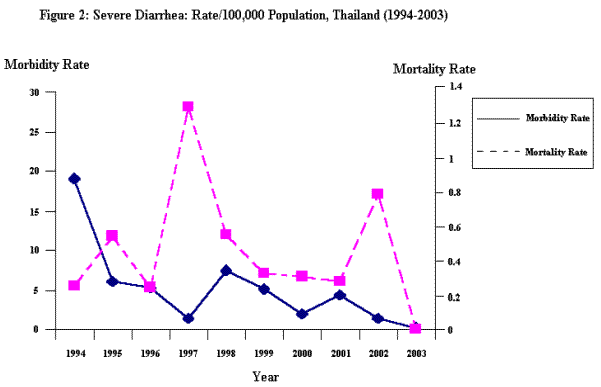
The morbidity rate of Severe Diarrhea was gradually decreasing from 18.96 per hundred thousands population in 1994 to 0.22 per hundred thousands population in 2003. However, the mortality rate was reported to decrease from 0.25 per hundred thousands population in 1994 to 0.01 per hundred thousands population in 2003. (Figure 2)
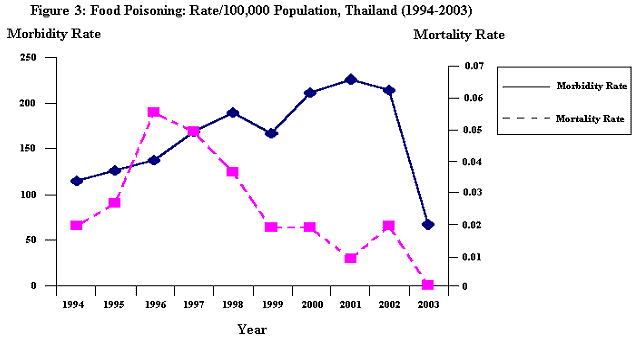
The morbidity rate of Food Poisoning was increasing from 113.6 per hundred thousands population in 1994 to 225 per hundred thousands population in 2001, and markedly decreased to 67.79 per hundred thousands population in 2003. However, the mortality rate was reported to decrease from 0.02 per hundred thousands population in 1994 to 0 per hundred thousands population in 2003. (Figure 3)
According to the epidemiological reports, it is found that diarrheal diseases in people living in poor environmental sanitation and people with poor personal hygiene have been reported as a major public health problem in Thailand for many years. The highest incident rate of diarrheal diseases in Thailand is reported in children less than five years of age. Causative pathogenic bacteria are mostly Salmonella spp. and Escherichia coli. Major causes of the diseases include contaminated food and drinking water, poor personal hygiene, and poor consumption behaviors. Therefore, to minimize the food contamination, hygienic practice in food preparation processes and consumption of clean and cooked food are very important.
Food-borne and waterborne disease surveillance in Thailand has been initiated since 1969. In 1980, the Communicable Diseases Act B.E. 2523 became fully effective in order to monitor and control all communicable diseases in the country. According to the Act, monitoring and prevention of food- and water-borne diseases is specified in the following aspects.
These diseases include: Acute Diarrhea, Severe Diarrhea (Cholera), Food Poisoning, Dysentery, Enteric Fever, Salmonellosis, Typhoid Fever, Paratyphoid Fever, Shigellosis, Amoebiasis, Hepatitis, and Hand-Foot-Mouth disease.
Epidemiological Surveillance Networking in Thailand is comprised of all related healthcare services in community, sub district, and regional levels – regional hospitals, general hospitals, community hospitals, health centers, and private hospitals; Provincial Public Health Offices in the provincial level; and Bureau of Epidemiology as the national reporting center as illustrated in Figure 4.
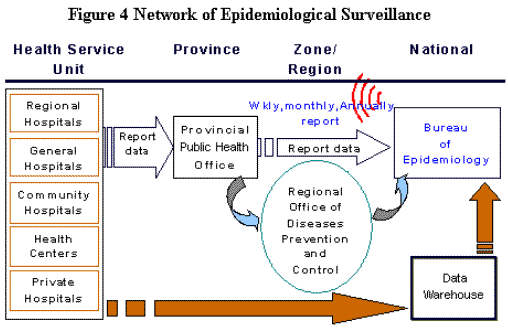
Case reports in the community and sub district levels will be gathered and analysed by “Software-Epidem”. The analysed data will be, later, sent via electronic files to the Provincial Public Health Offices, and Bureau of Epidemiology, respectively. All data will be finally analyzed and summarized as epidemiological reports representing the country situations as a whole. The national epidemiological reports can be divided into 3 following categories:
In the community level, there are local public health volunteers collaboratively working with community health personnel and reporters to conduct disease surveillance in the communities and to provide information on disease incidence and/or outbreaks to the communities.
In the emergency cases of outbreaks or diseases from food contamination, a special team, which is composed of epidemiologists, sanitation personnel, health education personnel, and personnel from Department of Communicable Disease Control, will give a prompt response in subdistrict, district, and provincial levels to investigate the source of diseases and/or outbreaks, and try to effectively prevent and control the outbreaks within 10 days after the cases are reported. After the complete investigation has discovered that there is a contamination in food and/or water, such discovery will be quickly reported to Provincial Public Health Offices and the Food and Drug Administration to initiate the legal action to the violators.
In addition, Thailand also has a master plan for Salmonellosis control in 2002-2006. This plan has been set up for decreasing the Salmonella spp. contamination in feeds and foods in order to reduce diarrheal risks among consumers. In Thailand, “WHO's Salmonella and Shigella Center” has been established in the Department of Medical Sciences, Ministry of Public Health, for identification and confirmation of Salmonella spp. and Shigella spp. existing in foods, water, human, and environment. This Center also provides workshop and training courses on Salmonella spp. and Shigella spp. analysis for staff working in Provincial Medical Sciences Centers and other related parties in order to extend the analysis network throughout the country.
Measure taken for epizootic diseases and zoonoses prevention and control is under the Epizootic Diseases and Zoonoses Control Act B.E. 2499 (1956), Re: Prohibition of importation of animals and animal products from countries with epizootic diseases and zoonoses into Thailand. Additional to the Thai Food and Drug Administration of Ministry of Public Health, the Department of Livestock Development of Ministry of Agriculture and Cooperatives, is another organization responsible for safety control of animals and animal products from farm level to the consumption level. Animal products are thoroughly inspected at farms, manufacturing sites, and distribution sites. Prevention, surveillance, and control of food-borne diseases in humans caused by food-borne pathogens and infective agents in animals, such as Salmonella spp., E. coli, Brucella spp., Trichinella spiralis, tubercle bacillus, Mycobacterium paratuberculosis, and prion protein are apparently the main focus.
Since there are currently many new emerging zoonoses, cooperative networking between related agencies is needed. In order to prevent the transmission of diseases from animals to humans, an epidemiological surveillance network has been established under the cooperation between Ministry of Public Health and Ministry of Agriculture and Cooperatives. Bird flu outbreak at the beginning of the year 2004 is an example of a zoonosis that needs a strong cooperative network between Ministry of Public Health and Ministry of Agriculture and Cooperatives to prevent and control the disease: Department of Livestock Development, Ministry of Agriculture and Cooperatives, is responsible for disease prevention, surveillance, and control in animals and infected areas; Epidemiology Division, Ministry of Public Health, is responsible for disease prevention, treatment, and surveillance in humans; and Department of Medical Sciences, Ministry of Public Health, is responsible for confirmation of avian influenza diagnosis in humans. In addition, information sharing and networking with private sector, FAO/WHO, and OIE regarding to epizootic diseases and zoonoses has also been established.
Hence, cooperation between Ministry of Public Health, Ministry of Agriculture and Cooperatives, and other related parties is an important measure needed to ensure the food safety and hygiene throughout the whole food chain, leading to the ultimate goal of consumers' health protection. In addition, education for all related parties – public health personnel, food producers, food vendors, food handlers, and consumers – should be also focused for a more efficient disease prevention and control system.
Due to emerging problems of unsafe food from the contamination of pathogenic microorganisms and zoonoses, an efficient food-borne and waterborne disease surveillance system needs to be developed for consumer protection. Following main issues should be focused:
1. Development of strategic approaches to strengthen the capacity building between related parties.
2. Development of an efficient epidemiological surveillance network in order to be ready prepared for a response on new emerging diseases.
3. Development of performance capacity of related personnel in conducting disease surveillance.
4. Development of laboratory capability, including test kits, to diagnose new emerging diseases and food contaminants.
5. Development of information network and database system both at national and international levels.
6. Encouraging accessibility of the public to test kits for better self protection.
7. Development of more variety of field test kits.