English only
|
|
| Conference Room Document 96 English only | |
second fao/who global forum of food safety regulators
Bangkok, Thailand, 12-14 October 2004
(Prepared by Japan)
In order to prevent spread of the diseases resulting from food, it is important to perform the preventive measures in advance, to perceive occurrence at an early stage and to respond as promptly as possible. However, it is sometimes difficult to judge whether a patient's disease is caused by eating contaminated food or not.
Therefore in Japan, there are two surveillance systems regarding the food-born diseases, one is for the food-poisoning, and the other is for the pathogens which cause food-poisoning, and they are carried out based on The Food Sanitation Law and The Law Concerning the Prevention of Infectious Disease and Medical Care for Patients of Infections (The Infectious Disease Control Law) respectively. Departments in charge are the Food Safety Department and the Health Department, and they closely work together.
On-line network system has been introduced for these surveillance, and one can quickly collect, analyze, disseminate, and disclose information on nationwide.
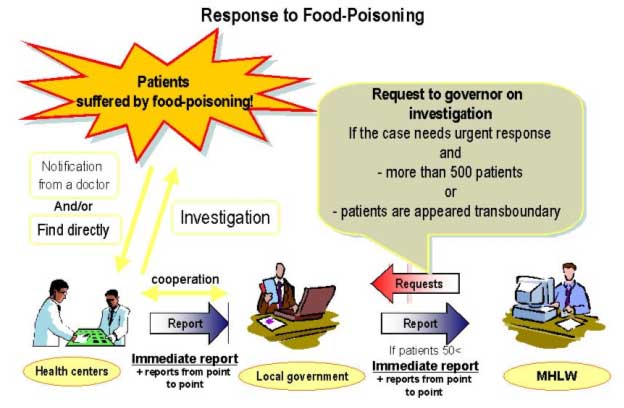
Once a food-poisoning case occurs in Japan, various steps are taken based on the Food Sanitation Law. These steps include the investigation of causes, measures to prevent the spread of damage and recurrence, and report to the Minister of Health, Labor and Welfare (MHLW).
First, the doctor who diagnosed the patient suffered by a food poisoning is required to notify the Director of the nearest health center within 24 hours. When receiving the notification or otherwise knowing the occurrence of a food-poisoning case, the health center must concern epidemiology investigation about this case as quickly and report in writing to the food-safety departments of the local government. The food-safety departments of the local government must then report in writing to the MHLW. After this case was settled, the number of patients and deaths etc. are reported monthly to MHLW with online information distribution system (Wide-area Information-exchange System for Health, labour and welfare administration (WISH) system).
In particular, when a serious food poisoning occurs, the corresponding food-safety departments of the local government must promptly notify MHLW by appropriate ways such as telephone and facsimile to prevent further spread. MHLW and the Food Sanitation Council which is an advisory group of the Minister which consists of microbiologist, representative of the consumer group, medical doctor, experts of public health, analysis, veterinary science, science of fisheries etc. analyze outbreak status of the food poisoning and issues directions to the local government.
Furthermore, cause of large-scale-sizing and broadening by diversification of food circulation, The Food Sanitation Law was amended in 2003. MHLW can request to the local government on investigation, if the case needs urgent response and more than 500 patients or patients are appeared transboundary.
In the Infectious Diseases Control Law, all infectious diseases of new categories I through V are designated as the targets of The National Epidemiological Surveillance of Infectious Disease (NESID). All category I through IV infectious diseases and 14 kinds of category V diseases are required notifying all the cases. Those Infectious Diseases related to food (cholera, shigellosis, typhoid fever, and paratyphoid fever), patients, suspected cases, and asymptomatic carriers are the targets, and patients and asymptomatic carriers of enterohemorrhagic Escherichia coli infection of category III are the targets. As same as the surveillance of food poisoning, the doctor who diagnosed the infectious disease is required to notify the director of the nearest health center within 24 hours. When receiving the notification or otherwise knowing the occurrence of the infectious disease case, the health center must concern epidemiology investigation about this case as quickly and report in writing to the health departments of the local government. Upon receiving the patient information from a health center, the health departments of the local government must send the information to the national infectious disease surveillance center* through the computer-network system. (*: The national infectious disease surveillance center has been organized in order to play a central role in the national surveillance. The Infectious Disease Surveillance Center (IDSC) of the National Institute of Infectious Diseases (NIID) fulfils this function and is also the contact point of WHO Global Alert and Response Network (GOARAN).)
The national IDSC must immediately compile, analyze and evaluate the patient information received from the health departments of the local government and send the information on incidence of target diseases in the whole country to the health departments of the local government and MHLW through weekly report or other media. Moreover, the report is included the data about analyzing the gene of a pathogenic organ and a spread in Japan. In particular, when a serious infection disease occurs, the corresponding health departments of the local government must promptly notify the MHLW by appropriate ways such as telephone and facsimile to prevent further spread. MHLW and the national IDSC analyze outbreak status of the infection diseases and issues directions to the local government.
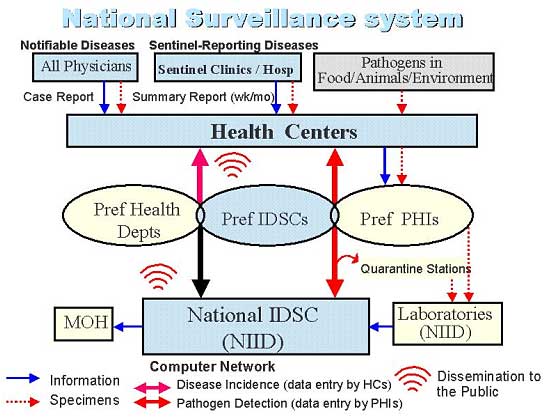
*Explanation is omitted about the organization of inspection of a specimen.
IDSC : The Infectious Disease Surveillance Center
PHI : Public Health Institute (Laboratories)
Foodborne diseases may initially be dealt with as infectious diseases when specific cause is not identified. Therefore, Department of Food Safety and Department of Health should share information and respond to outbreaks in a coordinated manner. This kind of cooperation is ensured both at the national and the local government level.
Since an international network has already been established and functioning for infectious diseases (GOARN network), it is important to establish the similar network for food safety which complements and supports existing GOARAN network.