

by
AMEDEO FREDDI
In Egypt, it appears that the development of brackish water aquaculture is still being based on extensive and semiintensive rearing methods, having the natural production of fingerlings as principal seed source.
The artificial reproduction technics, which are being employed in fresh water aquaculture to-day (various species of carp and tilapia) must not be considered absolutly necessary for marine fish aquaculture in this country, at the present moment.
However, the programme on the development of intensive aquaculture, made out by the G.A.F.R.D. (General Authority for Fish Resources Development) schedules artificial reproduction for marine shrimp and fish.
Bearing this in mind, this report would suggest starting marine artificial reproduction as a training activity, which would not call for a large productivity immediately, so that specialized staff may be formed and the different technics completely understood. This should, in the future, be a sound advantage for Egyptian aquaculture.
At present, the supply of brackish water fingerling species is ensured by fishing alone. The fingerlings are fished at the opening of large lagoons where they gather together during the trophic migrations.
The capture of species, such as gilthead sea-bream and mullet, which are interesting for semi-intensive or extensive rearing, is required (these are found naturally in great quantities. About 800.000 gilthead sea-bream fingerlings were caught between April–May in 1983 (Sadek 1984) in the Bardawil and Manzala lagoons, and around 18 000 000 mullet were captured between Aug. 83 and April 84 and placed into the farm at Reswa (Sadek 1984). During the fishing season 1984–85, 138 000 000 fingerlings were caught, 8.000 000 of which were gilthead sea bream (Sadek pers/com).
In economic terms, the fingerlings captured, one thousand mullet of 2 cm in length, gave a return of around 4 L.E (1 L.E = 0.77 US $) and one thousand gilthead sea bream fingerlings of the same length a return of 4–5 L.E. (reaching 15 L.E. for one thousand of 2 g each).
A particular situation arises with sea-bass fingerlings, it's the low market evaluation (5 L.E for one thousand of 2 g each) due also to the fact that they cannot be used in the rearing models here employed (extensive and semi-intensive). A great amount of sea-bass fingerlings have been remarked in an outflow channel of the Manzala lagoon, close to Damietta, during the mission.
In Egypt, the supply of marine fingerlings is not produced through artificial reproduction, principally because industrial fish rearing has only been developed recently and, as already stated, because there is a great natural supply of “seed”. ARtificial reproduction is scheduled only in two projects: in the Bardawil lagoon for the production of 500 000 sea-bass fingerlings and 2 500 000 shrimp post-larvae (p 22 - Penaeus japonicus) and in the Edko lagoon for the artificial reproduction of mullet.
The introduction of artificial reproduction in Egypt must be planned while taking into consideration that:
The choice of marine species, suitable for artificial reproduction in Egypt shall depend on the above stated, as well as the presentation knowledge of rearing methods.
The sea-bass must not be disregarded, although it cannot be introduced into semi-intensive pr polyculture systems, as it is a great predator. Nevertheless, there where artificial reproduction is carried out, this species is the best known, and can be produced intensively; the results obtained, at present show its good adaptability to artificial environmental conditions. The survival during the first rearing period is already considered acceptable, when estimating it's rearing feasability.
This species must be considered the most indicated when starting a programme of marine fish reproduction both to teach technics and to have these adapted to new local conditions.
The fingerlings produced during the first pilot programme could be employed as an approach for intensive rearing methods which seems acceptable when included within an integrated aquaculture model.
After a first season with sea-bass for artificial reproduction, gilthead sea=-bream shall be the second most interesting species to be taken into consideration for egyptian aquaculture.
Artificial reproduction of gilthead sea-bream still presents such problems as high mortality at first feeding stage, or the swimming bladder disease, so that an acceptable standard survival rate, during larval rearing, has not yet been achieved.
It must be realized that the efforts carried out to reproduce this species at productive level, are very recent, and the first productive results have only been achieved in France Italy and Spain during the last three or four years.
In spite of this, artificial reproduction of gilthead sea-bream is practiced more and more every year in private industrial farms which also shows progressively, better results.
Here following are the many positive points, which make the rearing of this species so interesting:
Gilthead sea-bream may be reared in polyculture with mullet but not with shrimp, as it is a direct predator of the latter.
The wide use of mullet rearing is linked with their great diffusion throughout the world, to their adaptability to extreme conditions of temperature salinity and dissolved oxygen, and to their feeding habits, as they fully exploit secondly food resources (organic detritus). Moreover, they seem very suited to polyculture and to the simplified extensive and semi-intensive aquaculture models
Among the various species of mugilidae, one of the most interesting from a growth point of view, is great mullet Mugil cephalus. In Egypt, this is clearly seen where it reaches a weight of 340 g in forty weeks, when reared in the farms of Reswa (Sadek 84).
Even though mullet rearing is so widely spread, the results obtained with artificial reproduction are not yet satisfactory. Many efforts have been made to increase the artificial reproduction of grey mullet fingerlings, summerized in detail in the review by Nash and Shehadeh 1980, but the possibility of intensive production suggested by them has not given the results expected when put into practice. For this reason, the artificial reproduction of grey mullet must, at present, be regarded as a secondary activity in a productive programme, while an advantage can be obtained by this activity, as it can be carried out during the Summer (July – August) in the same structure as that used in Winter (November–February) for the reproduction of sea-bass and gilthead sea-bream.
It should be appropriate to recall at this point that the controls carried out on the data, concerning the capture of fingerlings from April 82 – April 84 in the Manzala outlet channel at El Gamil (Sadek 84) grey mullet show a very high frequence (22, 86%) especially when compared with that of sea-bass (1, 05%) and gilthead sea-bream (0,95 %).
So, the necessity to have a source of fingerlings of this species from artificial reproduction, seems uncalled for at the present moment.
When starting, artificial reproduction technics on marine fish, it would be advisable to employ the appropriate structure. It should be small in size, thus low costing and it must be kept in mind that it will not be employed with the sole purpose of financial profit at the beginning. It should be built near the other productive structures existing there already, as it could benefit from their facilities, and personnel
Furthermore, as it is to be small in size, less water is needed, this being one of the principal problems with artificial reproduction of marine fish in the places visited, salinity levels being very low (10 – 15%0 S). The small amount of water required could be obtained from a well which, as seen close to Alexandria, gives a good quality salt water supply.
It must be recalled here that larger productive facilities, requested for the future development of aquaculture in Egypt shall be planned in the appropriate sites, especially with regard to good quality water resources.
Even though the structure proposed is to be a small one, it must comprehend a whole rearing model, so permitting a complete experience in artificial reproduction.
Two possibilities may be taken into consideration:
to make use of a structure existing, where the rearing facilities could be implanted.
to build a new permanent structure, within an existing farm.
In the second choice, a greenhouse or prefabricated building is most indicated.
The hatchery will comprehend different sections :
broodstock maintenance and spawning. The maintenance of a small broodstock must be scheduled, this ensures having fertilized eggs at disposal during the spawning season. About 40–50 kg broodfish could be scheduled, stocking could be carried out in an earth bottomed pond of about 100 m2 in surface area, which could be sheeted in plastic eventually. Spawning should be carried out in a 3 – m3 tank.
live food culture. During the first larval rearing period, live prey must be given to the larvae. A small intensive rearing unit for phyto-zooplankton culture can be planned inside the hatchery, while two or three low cost tanks (10 – 15 m3) shall serve for the production of “green water” and for zooplankton rearing outside the enclosed structure.
larval rearing unit. The larval rearing unit shall comprehend four to six fibreglass tanks of 1 – 2 m3 in volume. Production can be roughly estimated at 30.000 to 70.000 post larvae (depending on the number of tanks employed and their capacity) for every productive cycle. Normally, during the December – March period, two to three cycles could be achieved with sea-bass.
This unit will also comprehend a water recycling system (biological filtration)
fingerling rearing unit. It shall comprehend 10 – 15 tanks (fibreglass or concrete tanks) having a capacity of 4 – 6 m3 each. This unit shall also have a recycling system. Experiments on post larvas rearing may be carried out in larger outdoor tanks as the egyptian climate permits so.
facilities. The principal facilities shall comprehend a laboratory, a workshop and a storage room. In the event of these facilities being available in an existing structure, a small room shall be reserved for the principal equipment (microscope, principal equipment for water analysis, refrigerator, glassware etc…).
Among those sites visited, during the mission two different farms could be taken into consideration :
the Airport farm situated near Alexandria airport.
An integrated rearing model (ducks-tilapia) exits where tilapia are intensively reared in floating cages. The polyculture of carp and mullet is also carried out in this same freshwater channel. Found there also is a room containing larval rearing concrete tanks and a phyto-plankton rearing unit. Brackishwater is also available from a well. a salinity level at 22 %0 S and a temperature of 24 ° C have been registered.
Sore improvements on equipment and technical assistance can be scheduled.
the Reswa farm (Port Said) located in Port Said governaterate to the south of the town close to the Suez Canal.
Its seems to be the site most indicated to set up a small hatchery. In fact a very large semi-intensive rearing scheme for brackishwater fish is already in operation and artificial reproduction will be well combined with training activities on rearing and fishing technics applied there.
As salt water is lacking, a survey must be carried out on the water quality available from an excavated well.
There must be a constant quality-quantity supply of water for the hatchery. Thus a number of controls must be carried out over a relatively long period when a new well must be excavated.
The quantity: The quantity of required water must be defined previously. The adoption of a hatchery having a recycling system will limit the amount required but the “open circuit” (the water is not recycled) must always be taken into consideration.
- Closed circuit: The larval rearing system could comprehend six 2 m3 tanks and an 8 m3 biological filter. The fingerling rearing unit will comprehend fourteen 6 m3 tanks and a 70 m3 biological filter. The total water volume being 180 m3, 10 % must be added as a rough estimate for pipes stocking tanks etc…
The water exchange will be 10 %/day of the total volume; which means about 20 m3 / day (0.25 1/sec).
Open circuit : Usually employed for the fingerling rearing unit alone. It will receive a maximum total renewal every hour. The rearing tanks having a total volume of 90 m3 which must be exchanged every hour, a maximum quantity of 25 1/sec is demanded.
The quality : The salinity level will be the principal parameter to check. High salinity values (37 % 0 S) seem necessary for regular spawning (sea-bass; zanuy - Carillo 1984) while too low salinity levels (5 – 10 %S) could have a negative effect on the first larval development (gilthead sea-bream Freddi et Al. 1981).
Usually water from a well has low dissolved oxygen content but this problem can be easily overcome by using aeration.
Harmful gasses, such as hydrogen sulphide, are frequently found present, but here again this problem can be easily solved by aeration.
The ammonia content must be tested together with the possible presence of metals (iron content is frequently found in well water).
A rough estimate of the investment costs can be formulated.
A further, more detailed estimate will be given after the site has been defined definitively. For this reason such costs, as drilling etc…, are not indicated here.
The final financial estimate will be feasible only when all the necessary verifications, such as the importation of equipment (quantity, quality, importation fees, etc…), legislative grants, etc.. are carried out.
| Investmente estimate: | ||
| U.S.D. | U.S.D. | |
| Greenhouse of 400 m2 | 20 000 | 20 000 |
| Broodstock section: | ||
| 1.000 m2 earth bottomed tank, lined with plastic sheet | 800 | |
| 2 × 5 m3 concrete spawning tanks equip with filters and elec. heaterd | 1 100 | 1 900 |
| Phyto-zooplankton unit: | ||
| 3 × 100 1. fibreglass tank | 450 | |
| 3 × 5000 1 " " | 750 | |
| 2 × 10 m3 low cost tanks | 300 | |
| Equipment (microscope, stove, water filitration system, scales etc) | 1 300 | 2 800 |
| Larval rearing unit: | ||
| 6 × 2 m3 fibreglass tanks | 2 500 | |
| Biological filter | 1 500 | |
| Pumps ( 2 × 150 1./min) | 400 | 4 400 |
| Fingerling rearing unit: | ||
| 14 × 6 m3 fibreglass tanks | 6 500 | |
| Biological filter | 6 000 | |
| Pumps (2 × 30 1. sec.) | 3 000 | 15 500 |
| Water distribution | 5 000 | 5 000 |
| Aeration system | 2 000 | 2 000 |
| Heating system | 1 500 | 1 500 |
| Electrical system | 2 000 | 2 000 |
| Facilities (Office, laboratory, storage room, workshop) | 5 000 | 5 000 |
| Various and unforeseen | 6 500 | 6 500 |
| Total | 71 600 |
An emergency generator (30 Kw) is necessary when there are power cuts. If the hatchery is built inside a productive farm, it is very likely that an emergency generator may be found there already.
The pumping station cost has not been included here. We could schedule two pumps of 30 1/S. each ( 3 000 US D) while the costs of drilling a well shall be calculated depending on the site chosen.
A minimum staff needed for such a structure will include a technician and workman. Here again the importance of taking advantage from existing productive activities shall be considered. A watchman and, periodically, a second workman shall be necessary, but they must not be included in the normal staff of the hatchery.
There seems to be a good natural supply of marine fish fingerlings (Ishak et al, 1982; s. Sadek, 1984) for the rearing activity, for yet a long period. Moreover, this supply could be greatly improved on, by developing the fishing technics.
With such a quantity of seed, the artificial reproduction could play a minor part in the development of aquaculture in this country.
On the contrary, the artificial reproduction of marine fish should be developed as a long term investment so that with the formation of a technical staff and the realization of appropriate structures, the dependence on the natural stocking of fingerlings may be reduced. This could become necessary in a short time if aquaculture in Egypt is to assume greater production. The natural stock of fingerlings could be exhausted and the regular supply of fingerlings, which is the base of a productive programme, could become unsubstantial.
A small but complete structre is proposed (Annex 1) so to reduce the initial investment, thus allowing at the same time to teach the different technics applied in a hatchery. This training, which will permit the verification of the participation of egyptian personel, into training courses, organized by MEDRAP, in other countries.
The cost estimate here, only takes into consideration the investment and must be taken as a preliminary indication of the economic effort requested. A second mission will have the task of defining the site (here the Reswa farm is suggested) so that the final project together with the productive programme may be drawn up.
It has been suggested to begin with sea-bass as the artificial reproduction of this species is the best known at present, but the reproduction of gilthead sea-bream and shrimp Penaeus japonicus ) must be considered as the most intensive and extensive methods. Other species, such as grey mullet, sole and sharpsnout sea-bream (Diplodus puntazzo could complete the productive scheme of the hatchery later on (Annex 2).
One of the most critical factors for the realization of the hatchery suggested, is, at present, the quality of the water employed ; its low salinity values could inhibed regular spawning (S. Zanuy, M. Carillo 84) and the first larval development (A. Freddi et Al. 1981). A series of tests must be carried out to verify if water from a well (with higher salinity values) could be employed. Future developments for larger structures will greatly depend on this problem and the site shall be chosen where good quality water is obtainable.
Finally, the production of artificial food for fish must be considered. This has only been programmed in Egypt recently (at present cattle feed is employed; Sadek 1984). artificial feed will be imported entirely for the present, so that the reproduction of those species suitable for extensive rearing is favoured here again. The absence of good artificial feed will not however hinder larval rearing, which have a diet based purely on live food, produced in the hatchery. At weaning stage, small quantities of dry feed together with fresh food (trash fish) are necessary. For the larval diet the possible utilization of the Artemia natural production must be considered.
- Freddi A., L. Berg and M. Bilio (1981) - Optimal salinity - temperature combinations for the early life stages of gilthead bream, Sparus auratus L. J. World, Maricul, Soc 12 (2) : 130–136
- Ishak M.M., S.A. Abdel-Malek and MM. Shafik (1982) -Development of mullet fisheries (Mugilidae) in lake Quarum, Egypt. Aquaculture, 27 : 251.260
- Nash, C.E. and Z.H. Shehaded Ed. (1980) - Review of+ breeding and propagation techniques for Grey Mullet, Mugil cephalus L. Iclarm, Manila, Philippines, pp.87
- Sadek S. (1984) - Développement de l'Aquaculture en Egypte - Thèse présentée l'Institut National Polytechnique de Toulouse (France) ; P. 120
- Zanuy S. et M. Carrillo (1984) - La salinité : un moyen pour retarder la ponte du bar. In : G. Barnabè et R. Billard Ed. L'Aquaculture du Bar et des Sparidés.
INRA publ. Paris : pa. 73 – 80.
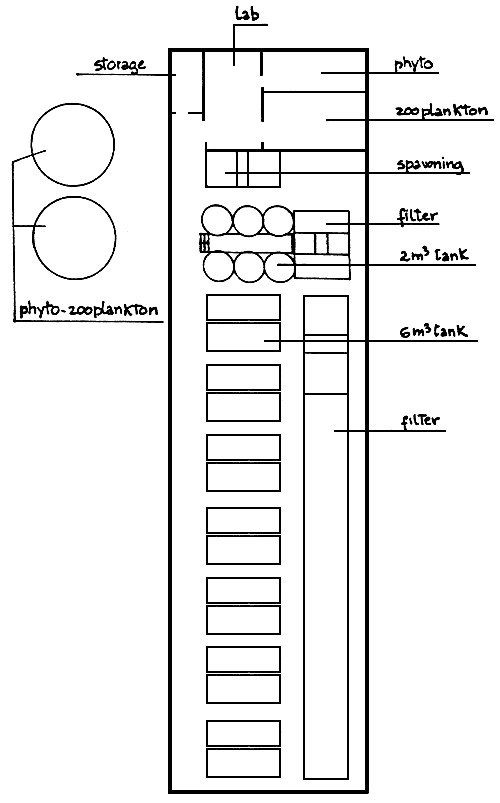
ANNEX 1 : Exemple of pilot hatchery
ANNEX 2
| SPECIES | OCT. | NOV. | DEC. | JAN. | FEB. | MAR. | AP. | MAY. | JUNE. | JULY. | AUG. | SEP |
| Sparus aurata | ||||||||||||
| Dicentrarchux labrax | ||||||||||||
| Soleas vulgaris | ||||||||||||
| Mugil cephalus | ||||||||||||
| Diplodus puntazzo | ||||||||||||
| Penaeus japonicus |
Suggested scheme of production for a hatchery in Egypt. Productive programme based on the alternance of different species.
