

Information System in Support of the Mediterranean Aquaculture
The seminar reiterates the need to develop an information system specifically for aquaculture as a priority need for the development and improvement of production and marketing of aquaculture products.
The proposed system as presented, discussed and reviewed (Annex 2) is considered by the seminar to meet the requirements of all parties concerned producers, decision makers and services involved in aquaculture.
It is recommended to adopt the proposed step approach by initiating immediately building up the system with some countries having already an ongoing data collection system and relevant activities. Concurrently with the above immediate action, the remaining countries will be networked as information recipient centres. These countries should then join the regional information system as soon as possible. All countries concerned should be equipped with a basic hardware, software, and having an appropriate skill. The special attention given to the above is dictated by the conviction that the successful implementation of the system necessitates the active involvement of all the participating countries, and that failing to do so will not allow to meet the requirements and the objectives of the Project. Those countries that do not possess at the moment such basic hardware should equipped under MEDRAP II. The inclusion of the latter countries will enable them to move progressively from simple recipients of information to suppliers of data preferably by the end of phase 1.
The seminar recommends that the first phase should be as follows:
- design and implementation of the regional information module to put regional and international information at the disposal of all the MEDRAP II Countries (members and associated countries) in a readable and comparable format.
The regional information system will be mainly alimented with:
Non reserved national data of regional interest which the countries are able to put at the disposal of the Project;
information coming from regional and international sources.
Provisions of basic EDP equipment (electronic data processing) to few countries namely Lebanon, Syria, Bulgaria and Albania, as soon as the implementation phase starts. This action was considered necessary by the seminar, because, while evaluating the present status of data information systems, all the MEDRAP countries do not have such minimal EDP facilities for this purpose.
The second phase, consolidation will progressively include all the remaining countries both as recipients of information and contributors of data. During this phase associated and members countries will be included in the system.
For the third phase, expansion on a self-sustainable basis, the seminar recommends that effort should be made to catalyse the involvement of the final users (producers, traders, banks, services, etc….).
The seminar further recommends that:
- Phase 1 be implemented by MEDRAP II for a period of 12 months. However, 18 months is recommended.
- Phase 2 should be foreseen under MEDRAP II, but also through additional external financial sources like associated countries, EEC, etc….
The recommended duration should be 36 months.
- Phase 3 eventually self-sustaining.
Annex 2
MEDRAP Document Number
Mediterranean Regional Aquaculture Project
Seminar on Documentation and Information
Cairo, 11–13 December 1991
S I P A M
AN INFORMATION SYSTEM FOR THE PROMOTION OF AQUACULTURE IN THE MEDITERRANEAN REGION
Conceptual Design
prepared by
Salvatore R. Coppola
Fishery Resources Officer
Fisher Resources and Environment Division
Fisheries Department
FOOD AND AGRICULTURE ORGANISATION OF THE UNITED NATIONS
Rome, December 1991
PREFACE
Project UNDP/FAO/89/00512 MEDRAP (Mediterranean Regional Aquaculture Project) Phase II is engaged in the promotion of aquaculture development through the establishment of a permanent mechanism for cooperation/coordination in the Mediterranean region. The Project aims at the creation of a network of regional aquaculture development institutions together with the strengthening of such institutions and the aquaculture input supply industry. Once the project had started, the need to strengthen the network activities through the establishment of an information system to assist aquaculture activities at national and regional levels became evident.
This paper present the conceptual design of an Integrated Information System to be developed and installed in the MEDRAP II Project area. This system should provide aquaculture/fishery managers, planners, producers and services with a regional desk information system fed with input from various inter-related sources.
It is a system that will produce useful and usable information through organized methods of selecting, storing, retrieving and reporting on data available from national, regional and international (FAO) offices. It is emphasized that this is the revision of a working document which was discussed and agreed by the delegates of thirteen MEDRAP countries. All the country representatives and MEDRAP National Coordinators actively participated in building up the conceptual design during the three-day Seminar on Information and Documentation hold in Cairo (Egypt) from 11 to 13 December 1991.
INFORMATION SYSTEM FOR PROMOTING AQUACULTURE IN THE MEDITERRANEAN
S I P A M
SYSTEM OVERVIEW
The proposed regional information system, SIPAM, originated mainly from three factors:
the strong demand for corporate information from the many scientists and administrators involved in planning and promoting aquaculture activities and evaluating projects at the national and regional level,
an urgent need of private and public investors, producers and suppliers for regional and international information, specifically (or especially) for this sector, in order to promote the import/export of aquaculture products and equipment, training possibilities, prices, national and international rules and standards, legislation, feeding and pathology, etc., are also part of the above needs, and
a pilot experience carried out at the formulation stage of a similar information system in Latin America (SIPAL: Sistema de Information para la Planificación de la Acuacultura en América Latina).
The outcome will procedure a continuous flow of information which could be used for evaluating, measuring, maintaining and controlled events and performance in aquaculture.
The current widespread availability of reasonably low-priced computers and micro-computers of great capacity makes a project for incorporating a large amount of such multi-disciplinary information into a Desk Information System possible.
INFORMATION SYSTEM FOR AQUACULTURE PLANNING IN THE MEDITERRANEAN
SIPAM
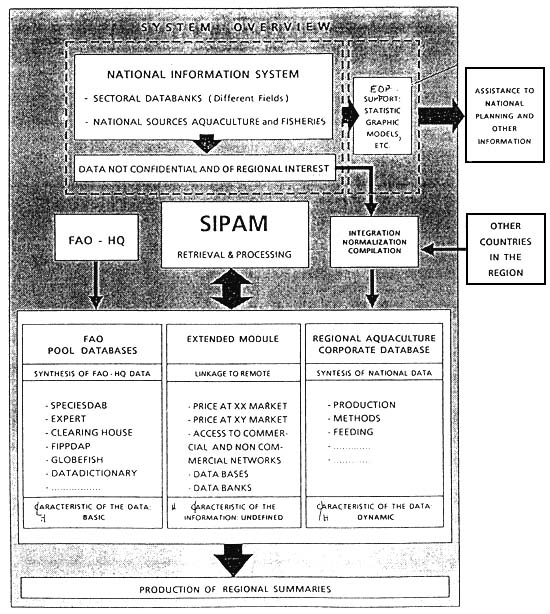
SIPAM - Conceptual design
Fig. 1 - System Overview
This paper presents the components of the proposed information system and explains the most important elements related to them. This preparatory work, along with the conceptual design, will enable an appropriate system analysis to be undertaken to match the identified functionalities (in terms of Objectives and Requirements) with the actual products, techniques and data/information available. For a better understanding of the technical terminology used in this report a glossary of computer terms is given in Appendix 2.
The primary objective of SIPAM is to provide the MEDRAP project, and through it the countries adhering to the project and associated countries, with an instrument and a methodology for rapid and targeted access to data and information of different types and from different sectors and sources. This technology will allow all users to establish their own “made-to-measure” research procedure tailored each time to suit their requirements.
A by-product of this Systems will be the exchange of data and information between peripherals (Countries/End-user Centres) and the centre (FAO/MEDRAP project) putting in motion a process of feedback.
In order to rationalize the development and implementation of the system, enhance the possibility of its success, increases its use by and interest of all parties concerned, the system will be made up of three Basic Modules:
- To permit each Country access to the regional data, the project will design and implement a REGIONAL Module and put at the disposal of the countries available information in a readily accessible manner. This module will be fed with non-confidential data and information of regional interest which each country has put at the disposal of the project.
- Alongside the regional sub system, the project will develop an FAO-HQ Module containing and managing some of the FAO officially-distributed databases.
- As complementary data, an EXTENDED SIPAM Module containing information from other data sources external to MEDRAP and FAO will be developed. In this Module data from commercial and non-commercial remote networks may also be considered if found necessary and useful for the completeness of SIPAM.
The overall SIPAM system will work using data and information in a structured and standardized mode to allow exchange and aggregation for textual, analytical and graphical manipulation.
Figure 1 presents the Sipam System Overview, whereas Figure 2 is an outline of a typical retrieval process around which the system will be designed.
However, all MEDRAP and associated countries, regardless of whether they are “data donors” or “information recipients”, will be provided with the same information system.
The first qualifying characteristics of the proposed system is the basic role of the end user in its design and implementation. It is emphasized that the system will be mainly designed by the users themselves, based on their concrete need, and will not follow the normal logic of data dissemination per se.
The second peculiarity is that each country will continue to be free to install and manage its own Data Bases or Information Systems. The Project may eventually be asked to assist interested countries in developing data entry procedures, or automatic data capture interfaces, in downloading/uploading national data (manually or automatically) into the regional sub-system.
A third characteristics variable is that countries will not be burdened with requests for additional Data Collection Operations to feed this System. However, it is clear that if a country/institution has no on-going data collection system covering items of information within a certain application, the Regional Module (aggregation of national information) will not contain its data.
The Conceptual Design phase must identify the objectives and requirements of the SIPAM Information System.
This is a delicate phase because it immediately precedes the very important one of system analysis where the objectives and justification have to have been already defined. The system analysis phase will, in practice, define the feasibility and at what cost (in terms of resources, risk, etc.) the project can be implemented.
Once the objectives and goals have been defined, the information system SIPAM can be seen as being made up of the following components:
A predefined architecture
A set (assembly) of human resources
A set of automatic and manual instruments for the collection, aggregation, retrieval and processing of data
A set of procedures and techniques to meet the objective
A predefined data-information model.
As described in the following section, the System will be constructed using a totally open architecture, i.e., a modular architecture. SIPAM will be composed of “blocks”, each defined by its area of application. The blocks will not be bound to interest to specific external specifications (hard/software); instead, it will be possible to tailor each block to different external formats as necessary according to the interfacing systems hardware/software platforms) all converted to the same format.
This approach has the advantage of enabling the System to be developed stepwise with the possibility of adding to and expanding the elementary modules. It also enables more than one building team to work on different part of the System independently and simultaneously. In fact, in the development of the overall System, different tasks will be assigned to different units.
The SIPAM Structural Hierarchy will be as follows:
SIPAM Information System : A Relational Data Base Management System (RDBMS) to manage a collection of three Base Modules as well as two Accessory Modules, one for Data processing operations and one reserved for System maintenance.
INFORMATION SYSTEM FOR AQUACULTURE PLANNING
IN THE MEDITERRANEAN
S I P A M
DECISION MAKING PROCESS
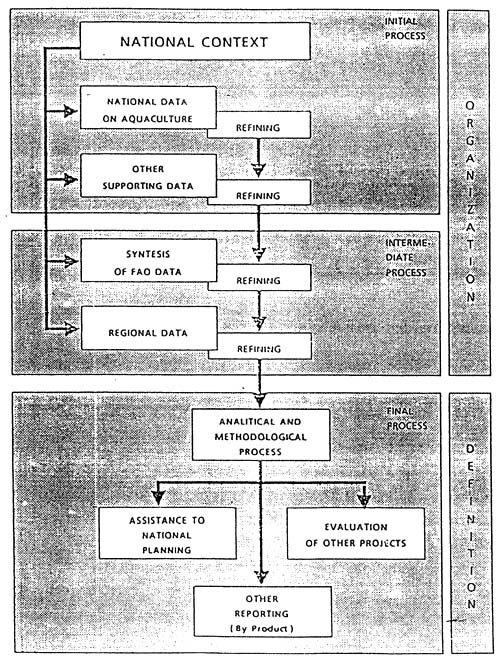
Fig. 2 - Decision-Making Process
the information, regardless of whether it is aquaculture data, fishery data or complementary data.
Three major components are normally involved in the design and implementation of any information System.
| DESIGN UNIT | DEVELOPING UNIT | END USERS |
In the SIPAM Concept, the above become reorganized as follows:
The Design Unit
Each of the applications to be developed (Elements) will be considered as stand-alone applications with certain INPUT/OUTPUT or LINKAGES constraints to be fitted into each of the Modules.
The design unit is composed of the following:
The Tasks of the Design Unit
This group of experts, coordinated by the SIPAM System Manager, will decide which applications should be developed and the priorities, as and when required.
Once an application is identified, the design unit will prepare in detail the Application specifications which should contain inter alia:
Objective: Stating why that item was considered to be of particular interest.
Possible Source of Data:
Users of Particular Interest:
Data Entry Format:
Data Manipulation:
Data Retrieval Format:
The Five Modules are the following :
REGIONAL MODULE
FAO-HQ MODULE
EXTENDED MODULE
DATA PROCESSING MODULE
SYSTEM MANAGEMENT MODULE
Each Module is a collection of many Elements each representing one Stand-alone Application of various types:
Numerical Application
Bibliographic Application
Descriptive Retrieval
Graphical Application
Data Communication
Data Base Management Application
Access to Commercial Analytical/Graphical/WordProc. Tools
Access to Specialized Analytical/Graphical/WordProc. Tools
System Maintenance Routines
etc…
Each Element of the Base Modules will consist of three standardised functions:
Interphase To Source of Data
Perform Pre-defined Retrieval/Processing Functions
Output To Pre-defined Formats (Screen/Paper/Export)
The Data Flow will be the following:
| From/To | MEDRAP National Coordinators with SIPAM HQ |
| From/To | FAO-HQ with SIPAM HQ |
| From/To | MEDRAP National Coordinators with End-Users |
| From | Remote DataBases To SIPAM HQ |
| From | External Networks To SIPAM HQ |
| From/To | Remote SIPAM Work-Stations with SIPAM HQ |
| From | KeyBoard To SIPAM |
Import/Export Data will also follow a pre-established time pattern. Data should be captured, complied, normalized and distributed for three different time schedules:
| Yearly/Monthly | For static and little dynamic data |
| Weekly/Daily | For dynamic data |
| Occasionally | For permanent data (Reference Files), |
| Occasional data, etc. |
and constitute three different Up-loading/Down-loading procedures. Data uploading and down-loading must be made according to type, frequency and use of
Suggestions:
Constrains:
The SIPAM System Designer should assist this unit at the beginning in order to establish a consistent working method. It is not important that a data processing expert assist the unit at the outset of the work.
To be successful the design unit should foresee the optimum that can be obtained from a certain type of data/information, and design the INPUT/OUTPUT requirements as if they were to be carried out manually. It is also recommended to always bear in mind the scope, type and nature of the data to be entered into the system.
The Developing Unit
Once the Application has been conceived, the Analyst and/or programmer will translate the requests into a software tool. At this moment modifications or suggestions may be incorporated into the original design.
For the successful implementation of this work it is imperative that the project provides the services of a full-time System Manager. This person, who does not necessarily need to have informatics or aquaculture qualifications, will ensure the correct and timely execution of all the phases of the programme for the development and implementation of this system. The terms of reference of this officer are given in Appendix 3.
In addition to the System Manager, the project has to foresee the following personnel inputs:
- Top-level analyst/computer programmer Consultant for the development of the Regional Module (based in Rome, FAO HQ or MEDRAP HQ).
- Contract for a compute programmer to assist in assembling the FAO Module into SIPAM (based in Rome FAO HQ).
- Programmer to ensure the system maintenance, undertake data downloading/uploading, train regional and national experts in the use of SIPAM, participate in the development, improvement and maintenance of the system (based in MEDRAP HQ).
- consultants to prepare reports and technical material.
Each country participating in this activity should involve national aquaculture planning and computer programming experts in this exercise as required.
The End-Users
The end-users can be classified by group according to the position they occupy and the field of their interest. The major end-user group is the staff of the fisheries and aquaculture service in the various national offices in the Region who will be using SIPAM mainly for reporting and planning purposes, but also to answer queries from their private sector. This group is also the most important one for data supply. Among a second group of end-users are aquaculturists, economists, fishery specialists, investors and traders in the industry, trade, and education institutions, in both the public and private sectors. The SIPAM National Coordinator should organize its own national end-user group.
This system will be designed as in integrated information system, that is a homogeneous system in which the end-user is not aware that it is built of different basic elements. It is important to note that in designing this system the end-user and his needs, and not the wish to produce one more instrument of data dissemination without a pre-established target, are the main consideration.
For reasons of compatibility with FAO standards, and for other technical and operative reasons, the networking hardware is configured around a platform based on the INTEL 80386 micro-processor family. The elements that need to be integrated to constitute the network through non-rigid connections are of a different nature and effort.
- At the system architecture level national, international and FAO environments used have to be made colloquiable.
- At the structure level different connecting protocols (interphases) to manage products coming from different environments needs to be developed both for the input/output procedure and for the format and structure of the data.
- At the function/service level data format interchange with applicative software (standard commercial software) and connection to different peripherals such as printers, scanners, modems, as well as electronic mail, must be foreseen.
At this level the different national working languages to be used in the system must also be taken into account. Therefore, the system will be provided with a multi-language data dictionary to allow quick and standardized user interfacing.
The system will be developed, both in the centre and at the periphery, on identical hardware in order to optimize the products and ensure the network performance. The configurations described in Appendix 1 do not necessarily need to be completed at the beginning of the project since they have been designed to be expanded as necessary although they all have to be completed and fully operative by the third phase of the working plan (see Work Plan and Schedule of Work).
The system architecture will be designed on a “STAR” pattern with non-rigid connection in which the certre of the STAR represents the manager/server and the points represent the users. The System will have two operational levels one is the centre and one at the periphery. For an easier understanding of the above pattern a chart follows (Fig.3). In this particular case the system is developed around a network in which the centre of the STAR is represented by the MEDRAP project headquarters where the System Manager/server pilots all the applications at regional level. At the edges of this STAR are the countries and other end-users in the region. The Network is complete with two more connections, one representing the link to the FAO Fisheries. Department SIPAM back-stopping team as Data/Information Supplier/Receiver, and a second one to an ideal node to connect remote databases and Networks.
The hardware configurations of the work-stations forming the project network are given in Appendix 1.
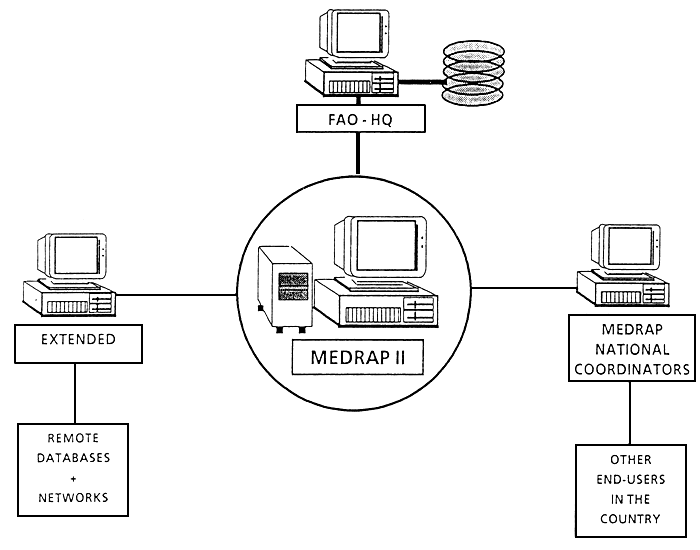
SIPAM-Concptual design
Fig. 3. SIPAM-Regional Desk Information Network
The analytical function of the system, as well as the word processing, statistical analysis, graphics, project management, etc., will be carried out in one area of the system (Data Processing Module) which will make use of commercial software possibly standard within the FAO family. This Module may also contain programs and procedures developed by the project to allow standardized and repetitive data processing, report generation, etc. The commercial software may be integrated with built-in macro instructions to perform certain operations.
For the SIPAM software development, dBase IV is the selected Relational Data Base Management System, not only because it is an internationally accepted de facto standard, but also because many FAO applications, as well as national applications, have already been developed using dBase. For the supporting software the use of the following, classified as FAO standard is foreseen:
| Word processing (Multi-language) | Word Perfect 5.1 |
| Spreadsheet | LOTUS 123 |
| Graphic | Harvard graphics |
| Statistical package | STATGRAPHICS |
| Project management tool | MS/project |
| High-level language (only external routines) | BASICA/PASCAL/C… |
| Aquaculture planning Tools | To be decided |
The above packages are acceptable at the time of writing and, in any case, are only indicative and may be charged and/or added to at any moment.
The functional process of the system (Fig.4) will follow the same pattern as the Decision-making Process shown in Figure 2.
The development of the software is strongly influenced by the structural design of this network (STAR) which has been conceived to allow the integrated system to be developed in a modular way independently from the two levels of implementation. To make full use of the above structure a slightly unconventional approach has been chosen in the development of the system. The first level network which covers the project headquarters, FAO-HQ and the remote centres applies a so-called “TOP-DOWN” strategy. This strategy is typical of a vertical initiative in which, without taking too much account of the final characteristics of the user, the application is developed and imposed. For the application of this strategy the initial components (FAO databases with their ‘known’ specifications and environments) of the system are known beforehand. The FAO information module will be developed and implemented using this strategy and will be distributed by the project headquarters to the end-user centres.
The national centres will manage the flow of the data between the various national sources of data and themselves and will be responsible for the interfacing procedures (installation, training, setting-up, etc) to the Regional Module. This Module, to be developed in the SIPAM Headquarters (regional information module), will have the dual task of interacting with the project headquarters and with the country. Since this module is strongly dependent on the various national contexts, a “BOTTOM-UP” strategy is applied. For this, a methodology which permits the identification of many simple problems and their solution independently is applied. This module will therefore be developed by consolidating and expanding the system, both in dimension and application, as new blocks are added from the bottom upwards. This is a strategy where the analyst does not need to know initially all the situations he will be faced with (different national contexts).
One of the most interesting features of this programme of work at the cooperation level is the direct involvement of national personnel and the endusers in the development and system enhancement of the interfacing Modules. This approach (to use national staff) is considered a basic condition for the success of the programme of work during and after project implementation.
The software to be developed is limited to that for the management of the FAO and regional information modules and the input/output protocols for uploading/downloading FAO and regional databases, maintenance systems and the interphases with the various and different national systems. Towards the end of the project procedures for tele-maintenance and teleupdating via modem through a “carbon copy” approach both from Rome FAO-HQ and from the project headquarters in Tunis, should be in place. This approach will allow the System Manager to temporarily control the remote work station through a modem and special software.
INFORMATION SYSTEM FOR AQUACULTURE PLANNING
IN THE MEDITERRANEAN
S I P A M
OPERATIONAL PROCESSING CHART
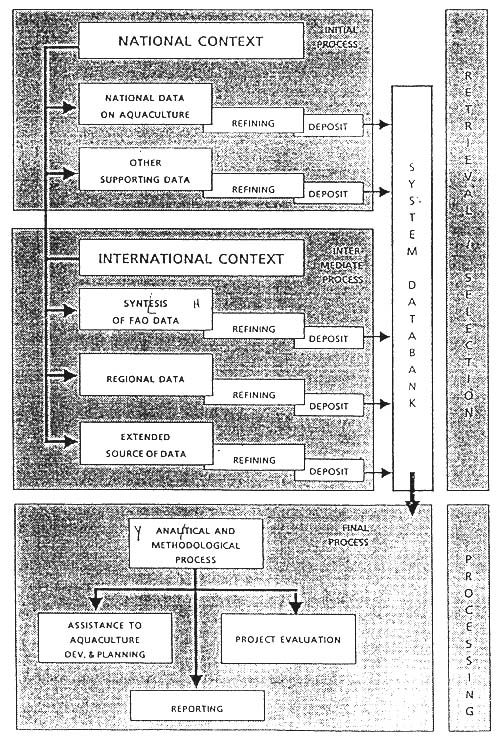
SIPAM-Conceptual design
Fig.4. Operational Processing Chart
The data information flow will be developed within a strategy defined by a working group, composed of national, regional and project experts, which will indicate the information needed. The major concern here is the possible inadequacy of some national infrastructures to support the proposed strategy and the obligation to provide additional resources for this work. The data/information flow will grow in a selective manner without duplicating existing work already carried out by other organizations/institutions. The members of the working group will be in contact with each other to identify and disseminate information of interest from various national regional and international sources. At this point the project must make a great effort, both in the research of data/information and in reaching agreement with the various institutions, to obtain authorization to receive and utilize the data/information needed.
In fact, as far as the relationship with FAO is concerned, this subject is regulated by Director General Bulletin No 90/22, and is the object of discussion by a working group set up by the Director-General to give guidelines on this matter. The project MEDRAP will be responsible for obtaining the data/information alimenting the FAO information Module (FAO sources).
Regarding the national data/information to be integrated in the sub-regional and regional systems (Regional information Modules), the national coordinators will be responsible for obtaining such authorization. However, the project should prepare a standard draft letter of agreement between the project and the national institution concerned or other supplier of data to be used as a basis.
It is essential for the present and future life of this system that all data entering the SIPAM network be appropriately authorized.
The data/information model used in this system will be of a complex type (Fig.5), i.e., data and information are linked at three levels. At the basic level the data collected through a system is processed and published according to given methodology, standards and frequency (output).
At the second level, some of the information produced at the basic level becomes data (input) to be processed and analyzed together with data and information coming from other sources within the same field.
At the third level (complex model), some of the information produced at the basic and second levels becomes data (input) to be processed and analyzed together with data and information coming from sources of a different nature.
Figure 5 is the complex data information model shown which assembles all three levels.
DATA INFORMATION MODEL
COMPLEX MODEL.
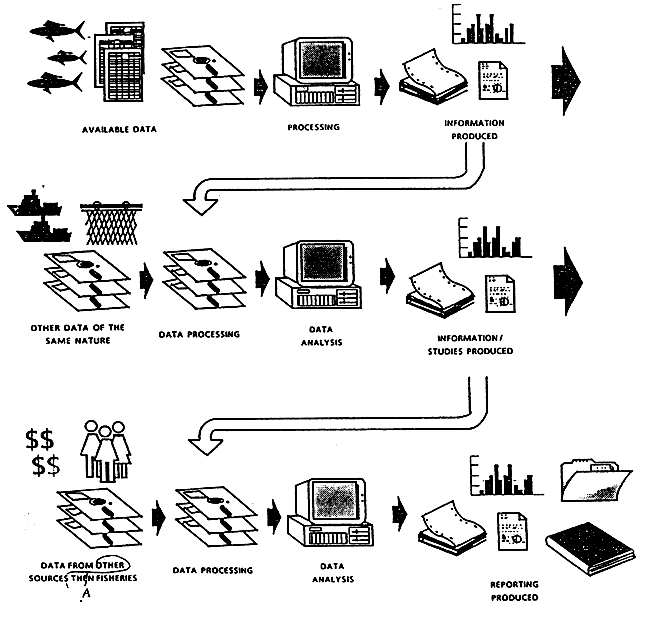
Fig. 5. The Complex Data Information Model
The MEDRAP Project (through its Headquarters in Tunis), FAO-HQ backstopping and few selected countries within the Project area, will launch a programme of work with the aim of establishing an integrated information System to assist national and regional operators in the field of aquaculture. This target will be accomplished by:
- developing the methodology and providing a tool to collect and process in a systematic way information useful for aquaculture development in the region. In addition to their own complied data, the countries will have direct access (from the same work station) to regional data and FAO data
- designing and implementing a Regional Module to put regional information at the disposal of the countries in a readable and comparable format. The Regional Information System will be alimented with non-confidential national data of regional interest which each country has put at the disposal of the Project
- designing and implementing an FAO Information Module which will incorporate all the available authorized FAO data-bases of interest to this programme of work
- designing and implementing a network linking remote sources of data and networks with the EXTENDED SIPAM Module through automatic data transmission
- assisting the selected countries in the use and maintenance of the system
- extending the network whenever possible to other countries and other selected end-users
Time Schedule:
Preparatory work : December 1991 – June 1992
Discussion review and approval of the above design
Ordering of the remaining computer equipment
Identification of few countries to be included in the pilot Regional Information System
Identification of possible source of funding
Complete delivery and installation of the remaining work-stations Identification of a retrieval approach (Terminology, Function, Keyboard usage. Logic data selection flow, etc.) most commonly used in a Desk Information System in the selected countries
Inventory of al pertinent national, regional and international data/information available for possible inclusion in SIPAM
Analysis of the immediate needs and the available national data in the selected countries
Phase I - System Design and Development : July 1992 – June 1993
Design and implementation of the pilot FAO Information Module
Design and the Regional Information Module
National coordinators of the selected countries reorganize output from national data/information systems into the SIPAM National Information Module structure (with advice from the MEDRAP Project)
Development of interfacing protocols to integrate national systems into the Regional Information Module
Revision and implementation of the Regional Information Module
Preliminary testing, evaluation and validation of the two Modules
Setting-up the pilot EXTENDED Module through arrangements and contracts with governmental and non-governmental institutions for direct access to their on-line DataBases and Networks. The information captured from these systems will be treated according to the agreed contract and processed with the same logic as in the other two Modules
Integration of the three Modules into the system
Phase II - Evaluation/Revision/Improvement : July – December 1993
Delivery to and installation of the full configuration in the selected Centres and countries (training, etc. included)
Evaluation of the delivered system
Revision and improvement of the system
Delivery of associated documentation.
An additional phase may be envisaged before delivering the System:
Phase III - Consolidation/Expansion : January – June 1994
Expansion of the coverage of the system
Installation of the system into some other centre and/or countries
Completion of the System by finalising the EXTENDED Module.
The Work-Plan will be completed with the analysis and evaluation of the whole programme of work, delivery of final documentation and finally by setting-up a SIPAM on-line accessible network (anticipated 6 months).
For the first year of implementation of SIPAM (Phase I) the following resources should be allocated:
| US$ | |
| Full-time SIPAM System Manager to coordinate all EDP and non-EDP activities - duty station SIPAM HQ | 36 000 |
| Full-time Computer programmer SIPAM System development Assistant - duty station SIPAM HQ | 24 000 |
| Consultant/contract high-level Analyst Programmer (regional module) - duty station Rome HQ - SIPAM HQ | 12 000 |
| Consultant/contract Computer Programmer (FAO module)- duty station Rome HQ | 3 000 |
| Preparation of Reference Manuals | 5 000 |
| Hardware already purchased by MEDRAP | 40 000 |
| Hardware to be completed | 20 000 |
| Purchase of special software | 3 500 |
| FAO Backstopping missions (4) | 10 000 |
| End-Users WG Meetings (2 × 5 persons) | 25,0001 |
The above estimates refer to a system using one working language only (English or French). Should the system be “translated” into other languages (i.e., English/French, Arabic), this component should be evaluated separately by the Project.
Server/Manager Work-station. 1st level (Project HQ)
IBM PC or 100% compatible with the following characteristics:
- Desk top type
- CPU 80486 at 33 MHz 4MB RAM expandable
- Colour monitor 14" VGA card
- 1 M. disk drive unit 1.44 Mbytes 3.5"
- 1 F. disk drive unit 1.2 Mbytes 5.25"
- 1 H. disk drive 100 Mbytes or more - Acc.time < 30 m.sec
- International advanced keyboard 102 keys
- 2 Parallel ports
- 1 Serial port RS232C
- Bus mouse Microsoft or Microsoft compatible
- 1 back-up tape unit
- 1 Modem Haynes compatible 960/1200/2400 band rates
- 1 Advanced Arabic keyboard
- 1 Advanced French keyboard
- 1 Matrix dot printer wide carriage (136 chrs) with NLQ capability/24 pins/260 chrs/sec IBM/EPSOM compatible parallel interface
- 1 Laser printer HP Laserjet III compatible parallel interface
- 1 Scanner HP SCANJET compatible
System Development. 2nd level work-stations (Project HQ)
It is strongly advisable to parallel the above microcomputer with another one similar in characteristics and lower in performance (because of cost) to the used for system development, as sever back-up unit, and for other duties to be assigned.
IBM PC or 100% compatible with the following characteristics:
- Desk top type
- CPU 80386SX at 16 MHz 2 Mbytes RAM expandable
- Colour monitor 14" VGA card
- 1 M.disk drive unit 1.44 Mbytes 3.5"
- 1 H.disk drive 100 Mbytes or more - Acc.time < 30 m.sec
- 1 International advanced keyboard
- 1 Parallel port
- 1 Serial port RS 232C
- 1 Bus mouse Microsoft or Microsoft compatible
- 1 Modern Haynes compatible 960/1200/2400 band rates
- 1 Matrix dot printer wide carriage (136 chrs) with NLQ capability *24 pins *260 chrs/sec. *IBM/EPSON compatible* parallel interface
Backstopping, Training, Seminars, Demonstrations etc., 2nd level work-stations (Project HQ)
IBM PC or 100% compatible with the following characteristics:
- Portable type
- CPU 80286 at 12 MHz 640 Kbytes RAM Expandable
- 1 Back lit L.C: monitor VGA compatible
- 1 M.disk drive unit 1.44 Mbytes 3.5"
- 1 H.disk drive 20 Mbytes Acc.time < 30 m.sec
- 1 Parallel Port
- 1 Serial port
- Travel accessories (bag/batteries, etc.)
- 1 Diconix or Canon portable printer with travel accessories
2nd level work-stations (National centres)
IBM PC or 100% compatible with the following characteristics:
- Desk top type
- CPU 80386SX at 16 MHz 2 Mbytes RAM expandable
- Colour monitor 14" VGA card
- 1 M.disk drive unit 1.44 Mbytes 3.5"
- 1 H.disk drive 100 Mbytes or more - Acc.time < 30m.sec
- 1 International advanced keyboard
- 1 Parallel port
- 1 Serial port RS 232C
- 1 Bus mouse Microsoft or Microsoft compatible
- 1 Modern Haynes compatible 960/1200/2400 band rates
- 1 Matrix dot printer wide carriage (136 chrs) with NLQ capability *24 pins *260 chrs/sec *IBM/EPSON compatible* parallel interface
FAO HQ Rome (for system design, datacommunication and feedback)
One Project 2nd level work-station temporarily located in the backstopping Division (FIR). This system will be delivered to one of the end-users on completion of the work.
NOTE. All work-stations will be provided with identical software covering:
- DOS Operating System (Rel 5.xx)
- Word Processing
- Spreadsheet
- Data base Management System
- High level language
- Data communication software
- Tools
- Specific applications software
Application program -- Computer program that performs an end-user function, rather than a system-oriented function.
ASCII files -- Files in which the individual characters are represented according to a numerical code (and its internal representation as a binary number) that conforms to the American Standard Code for Information Interchange. Such files are widely used to transfer data between different hardware and software environments. ASCII was created for this purpose.
Backup - The process of making secondary copies of a file or files in the event that the original becomes damaged.
Configuration -- The assortment of equipment (disk, diskette, terminal, printers etc.) in a particular system.
Computer network -- An interconnection of computer systems, terminals, and communication facilities
Data -- Known facts, numbers, letters and symbols for storage and manipulation by a computer system expressed in character form. Data can be though of as the basic elements of information used, created or otherwise processed by an application program.
Data communication -- The movement of coded data from a sender to a receiver by means of electrically-transmitted signal.
Datafield -- A group of memory or screen location within a database that are logically linked to hold information of a given kind. Typically, the user may regard datafields as place to store a certain kind of data.
Database -- System of arranging data in structured way in a computer system, for user access or for processing by application programs.
Dataset -- A series of data elements or units of information that are logically arranged in a particular format.
Datasheet -- A printed page on which data are arranged according to a specific format.
DOS -- An acronym for Disk Operating System, the program used in the microcomputer environment to control the use of hardware and integrate the use of this hardware so that is available to software applications.
Down-loading -- Data/Information transfer from a central level system (Organization HQ) to peripheral systems (Departments)
Driver -- A software program that controls the action of a peripheral device not otherwise controlled by the operating system.
Export -- The transport of data out of an application. Typically, this will involve translation from the internal format of the application to a variety of alternate formats that may be used by other programmes as input. (see also Import)
File -- collection of logically related records or data treated as a single item.
Format -- The way in which data are physically arranged in a file.
Hardware -- A term used to indicate the physical part of a computer, such as the keyboard, memory, printer, monitor, as opposed to the software.
Export -- The transport of data into an application. Typically, this will involve translation from the format of the external application into the standard used by the ongoing application.
Information -- Data that are communicated
Interface (Hardware) -- An electronic assembly to enable two computer systems to communicate with each other (wired).
Interface (Software) -- Series of programs that allow the system to exchange data from one format to another.
Main Menu -- A horizontal bar that presents the user with a series of choices, one of which will be selected to perform that activity.
Menu System -- A kind of program design that uses a sequence of choices that permit the user to choose among them by pressing a key (usually the Enter Key). These choices are arranged on the screen much as a restaurant menu presents a series of selections.
Operating System -- The software program that controls the various parts of a computer (keyboard, screen, hard drive, printer, etc.) and puts them to work together to perform useful work. SIPAM will work on computers which use the PC-DOS or MS-DOS Operating system.
Non-rigid connection -- A type of manual file transfer between computer systems through removable supports (diskette, tape) occasionally carried out.
Package -- A set of computer programs tied together through a menu system.
Platform -- A computer, its peripheral devices and activities working together.
Procedure -- A specific program or task to which a computer solution can be applied
Record -- A collection of related data items.
References Files -- Authority files containing reference variable such as country codes, names and attributes; items codes, names, attributes etc.
Relational Database -- A file or system of files used to contain data that is structured to permit the data to be readily input and output. When constructed of multiple files, relations between individual data fields in the different files can be linked to permit data in one field of one file to act as means of retrieving information in one or more data fields in the other file or files.
Rigid connection -- Type of connection in which a group of computer systems are connected to each other by communication lines to allow automatic and controlled file transfer at regular intervals.
Software -- Computer algorithms (programs) that are written in a computer language that make the computer (hardware) perform work (write to the screen, print, sort, etc.).
Up-loading -- Data/Information transfer from peripheral systems to a central system
Under the general supervision of the Project Director and the System Designer and the overall guidance of the SIPAM User Working Group (UWG) be responsible for all the data administration functions to build up the proposed information system SIPAM.
In particular be responsible for:
- Nominating, coordinating and leading the SIPAM UWG
- In close collaboration with the Analyst Programmer consultant prepare the system design of SIPAM environment.
- In close collaboration with the Analyst Programmer consultant, and following the advice of the UWG, prepare the design of the various element composing the regional module
- Organize, plan, coordinate and support all the activities related to the development of SIPAM
- Monitor the development and implementation of SIPAM
- Be responsible for requesting and receiving the necessary approval for using data/information
- Organize and distribute the appropriate documentation
- Perform other related duties as required
QUALIFICATIONS
University degree in statistics, or computers science, or economics, or mathematics
Proved professional experience in data administration
Working knowledge (level C) of English, French, Spanish or Arabic and limited knowledge of one of the other three
Knowledge of data processing and data analysis methodologies
Knowledge of Micro computer operation and RDBMS (Relational Data Base Management Systems)
Under the general supervision of the Project Director and the direct supervision of the Data Manager provide technical assistance for the development, maintenance, and distribution of the information system SIPAM
In particular be responsible for:
- Assisting in the design, development, tuning and maintenance of the various modules of the system
- Performing and testing developed procedures
- Assisting the end-user to assess the new system
- In close collaboration with the Data Manager, developing and maintaining the data dictionary, technical documentation and related technical and procedural manuals.
- Performing other related duties as required
QUALIFICATIONS
University degree in computer science, or electronic engineering or closely related field of specialization.
Proved professional experience in EDP.
Working knowledge (level C) of English, French, Spanish or Arabic and limited knowledge of one of the other three.
Good knowledge of data processing methodologies and techniques.
Ability to use Micro computers and basic software products such as WP, Spreadsheet, dBase and some high-level language.
Ability to write clear and concise technical documents and reports.
EGYPT Report
Egypt has a population of about 55 million with an average growth rate of 2.36. The current fish production is about 350.000 ton. Egyptian Government policy is to increase the production through different activities to attain self sufficiency at 700.000 ton in year 2000 since the country has great potential for fish production.
The strategy of the General Authority for Fish Resources Development can be achieved by executing and implement of the objectives came down on the second five year plan 1986/87: 1991/92 and the third year plan 1992/93 : 1997/98. The plans are built up on different national projects. Emphasis has been put on the intensification of fish farming depending on the drainage and lakes water to feed these activities.
The implementation means identified in the plans are:
- Development of 100,000 Feddan of traditional fish farms
- Development of 10 intensive fish farms and 10 hatcheries for fresh water fishes
- development of cage culture along the banks of the Nile
- Development of planting 100,000 Feddan of rice fields
- Construction of a marine hatchery
- Construction of two fish feed plant on Barsik fish farm and on Manzala fish farm
- Construction of Marine fish farms.
Because of the importance of information in making decisions, an Information Centre has been built in 1985. The centre equipped with three PC Computers, three printers and four microfilm.
Training courses executed for the information staff, in using the computer and the microfilm and using most of the popular PC applications.
The National Centre for Aquaculture Resource Researches has its own information centre equipped with thirteen PC computers with six printers and one plotter.
The National Insitute for Oceanography and Fisheries under the umbrella of Acadamy of Science Research use one PC Computer with one printer.
Many advanced training courses in the computer field had executed since then, so the information centre now helping the decision makers. the fish farms owners and the academy researchers. The information centres make database for fish production, water quality, fish food and fertilizer and private fish farms.
What we need now is:
Any satellite information about Egypt shores, depth natural food and fish stock on computer applications and paper maps.
Updated information about lakes, lagoons and Nile which can assist the decision makers.
Training courses in the field to statistical analyse and bio-static programs.
RECOMMENDATIONS
Install 2 PC Computers equipped with a communication system, through which we can communicate internally and abroad, and by which we can update most of our information feed any local information centre about any data concerning fish and one portable PC Computer.
The information centre should be supplied regularly with any print out documentation from MEDRAP and/or FAO.
Increase the user's ability in aquaculture information centres by training courses in computer using and applications concerning fish farming and fish stock assessment.
Training courses for the users on fish statistics and analysis;
Training courses for the users by MEDRAP's computer professionals
ALBANIA Report
ALBANIA
THE PRESENT SITUATION OF THE NATIONAL INFORMATION SYSTEM ON AQUACULTURE.
During the past political system of Albania, the planning of aquaculture as well as in the other economical activities was centralised. Everything in connect with the investiments, construction, equipment, and development of the aquaculture farms, determination of prices for their product was centralised and the last decision belonged to the Government or to the other Organisms of Government.
In this planning system, in respective of proposals of the aquaculture farms on above mentioned fields, always the last word belonged to the Government, who took these decisions taking in consideration only the economical possibilities of the Government and neglected the interest of the aquaculture farms and producers. This planning of aquaculture was organised on basis of short and long term plans (1 and 5 years plans).
This centralised planning of aquaculture had put down a lot of studies, constructions, researches on aquaculture field which needed a large financial support, a great cooperation with institutes of other countries, which have more experience, and import of modern tecnology, in coastal lagoons as well as in mariculture. This mode of planning of aquaculture has hindered the development and renovation of aquaculture farms according to modern aquaculture.
In summary of this all, the planning started from aquaculture farms, then was discused in the Townhall, General directory of Fishery, the proper Ministry, and the last decision took the Government. This planning procedure needed a 6 month term.
The main investments in the aquaculture field, in Albania, were made in these 10 last years, i.e: there are build hatcheries and farms for fingerlings production and farms for production of carp and Trout fishfamily for market.
In new condition of development in Albania with process of privatisation the biggest number of aquaculture farms will be private.
They can then decide about their own planning of product and determination of prices for this product. That way the planning will be not more centralised on the Governments hands.
On the other hand the information and coordination system will be established in the Research Station of Fishery, which belong to the General Directory of Fishery. This center will collect all the needed information and support that way the aquaculture development. In can say here that, in Albania, till now we have not any computer information system as well as a person qualified for this activity.
So I can say that for this center of information and coordination we have neither computer, fax or telex etc. And I think, that in this economical situation of Albania we our selves can not supply this center.
About point 3 in the qustionaire I can not give you any explanation, because we have neither any experience in planning on the private sector conditions (private aquaculture production), nor the needed equipments. That way I can repeat here that we need an urgent technical and material assistance if possible.
I think that this assistance for my country is very important if we and you all desire Albania to be an active participant in this project MEDRAP 11, changing information with the other member countries and that way this project can arrive his objective to develop some countries (like Albania) and to make sure a cooperation between all the Mediteranien countries.
December 1991.
TUNISIA Report
PROJECTS EN COURS DE REALISATION
| REGION | PROMOTEURS | NATURE DU PROJET | COUT (MDT) | PRO°ESCOMPT | VAL EXPORT° | EMPLOI | |
| SEBKHA DE KORBA | A.LAZOGHLI EL-SAMEK | - - | Ecloserie Elevage de loup | 2 650 | 100 T | 1 660 | 18 |
| SELLOUM | A. BELKHECHINE | - - | Encloserie Elevage de Loup Daurade (crevette) | 5 000 | 500 T Loup Daurade 300 T crew) | 9 500 | 148 |
| RADES | H.CHAMSEDDINE P.DU MAGHREB | Production, élevage de poissons | 2 450 | 450 T | 7 200 | 30 | |
| KERKENAH | SALAH.B.AMOR | Unité de grossis sement (loup) | 120 | 8 T | 128 | 4 | |
PROJETS EN COURS D'ETUDES
| REGION | PROMOTEURS | NATURE DU PROJET | COUT (MDT) | PROD°ESCOMPT | VAL EXPORT° | EMPLOI | |
| KALAAT EL ANDALOUS | WAHID EL HADJRI DELIMED | - | Ecloserie et élevage de loups | 8 000 | 300 T Loups 140 T crevette | 5 700 | 44 |
| - | Ecloserie et élevage de crevettes | ||||||
| SEBKHA DE KORBA | SLAHEDDINE DHAOUI | - | Ecloserie et élevage de loups | 3 600 | 150 T | 1 800 | 30 |
| SELLOUM | BELKHIRIA - BSB - | - | Ecloserie et élevage de poissons divers | 5 000 | 200 T loups 70 T Daurade 30 T Crevettes 50 T Divers | 3 500 | 65 |
| POULINA | - | Ecloserie et élevage de loups, Crevette et Palourdes | 5 300 | 200 T Loups 25 T Crevette 40 T Palourdes | 3 000 | 70 | |
| MED ALI KARA | - | Elevage de Loups Daurade et Crevette | 3 000 | 150 T Loups 50 T Daurade 30 T Crevette | 3 300 | 55 | |
| HADDAH MOHAMED | - | Ecloserie et élevage de poissons Divers | |||||
| MONCEF PRAD | - | Ecloserie et élevage de Loup et Daurade | 4 800 | 300 T | 3 000 | 60 | |
| BORJ OUNGHA | ALI SALLEM | - | Phase 1:élevage de loups et Daurades | 1 665 | 252 T Daurades 10 T Loups 65 T Palourdes | 2 750 | 14 |
| - | Phase 2: écloserie | ||||||
| NAKTA MAHRES | SAMET MAHER SOTEB | - | Grossissement et épuration de Palourde | 109 | 17 T | 81 | 6 |
| SEBK. AWAGED KERKENAH | POULINA | - | Ecloserie de crevettes | 2 800 | 100 T | 1 480 | 20 |
| RASS DIMES | HAMROUNI SOTUNOL | - | Ecloserie de loups élevage de loups Dde Crevette | 5 600 | 250 T | 2 500 | 60 |
| OUED CHAABA GABES | SAGA | - | Ecloserie de poisson Palourdes et Crevett | 12 000 | 254 T poissons 120 T Palourde 1 T Crevette | 3 600 | 70 |
| - | Elevage des 3 esoéces | ||||||
| KORBA | AFRIQUE TRAVAUX | - | Ecloserie intégré | 7 000 | 300 T Loups | 6 600 | 30 |
| - | Elevage loups (Daurade) | ||||||
PROJECTS REALISES
| REGIONS | PROMOTEURS | NATURE DU PROJET | COUT (MDT) | PROD°ESCOMPT | VAL EXPORT° | EMPLOI | |
| BOUGHRARA | A SUD TUNISIEN | - | Eclosorie | 7 000 | 400 T | 6 400 MDT | 132 |
| - | Elevage de loup en bassins et en cage | ||||||
| AJIM-JERBA | Pècherie de Djerba | Grossissement de Daurade et loups | 2 500 | 100 T | 1 200 | 30 | |
| HERGLA | AQ. Tunisienne | Eclosorie | 3 800 | 120 T | 1 900 | 35 | |
| Elevage de loups et Daurades. | |||||||
| BORJ.OUNGUA | AMEUR B.AMOR SUD-AQU | - | Elevage de Palourdes Mulets et Daurades. | 600 | 70 T | 500 | 10 |
| SEBK.MELEH | DRIDI BRAHIM BIOMARA TN | - | Ecloserie Palourdes | 660 | 100 T Palourdes | 500 | 10 |
| - | Elevage de divers poissons. | ||||||
| GHEDABNA CHEBBA | DINAUSORE Y. KRICHEN | - | Ecloserie Palourdes vente et grossissen | 220 | 86 T | 400 | 5 |
| GARGOUR SFAX | POLYMAR | - | Ecloserie Palourdes | 240 | 100 T Palourdes 30 T Autres | 600 | 12 |
| - | Elevage de Palourdes | ||||||
LISTE NOMINATIVE DES PROJECTS
AGREES/AQUACULTURE
SITUATION ARRETEE AU 05/12/91
| P R O M O T E U R | INVESTISSEMENT | AUTOFINANCEMENT |
| LA FERME PISCICOLE DU GRAND MAGHREB | 500 000 | 500 000 |
| EL GHOUL, MAHMOUD B. YOUSSEF & FILS JAOUHAR | 240 000 | 190 000 |
| STE EL SAMEK | 2 700 000 | 810 000 |
| BIOMARE TUNISIE (BTL, BHDA) | 810 000 | 245 000 |
| STE AQUACULTURE TUNISIENNE | 3 835 000 | 1 150 000 |
| STE AQUACULTURE TUNISIENNE (EXTENSION) | 1 165 000 | 350 000 |
| L'AQUACULTURE TUNISIENNE | 580 000 | 174 000 |
| STE TUNISIENNE D'AQUACULTURE (EXTENSION) | 600 000 | 180 000 |
| STE TUNISIENNE D'AQUACULTURE (EXTENSION) | 865 000 | 365 000 |
| CENTRE NATIONAL D'AQUACULTURE (CGP) | 581 487 | 581 487 |
| MONCEF B ALI B MOHAMED EL MESSAOUDI | 48 500 | 10 057 |
| AMEUR BEN AMOR “SUD AQUACULTURE” | 245 000 | 46 575 |
| SALAH B AMOR | 84 000 | 1 680 |
| STE POLYMAR | 161 700 | 35 650 |
| LES PECHERIES DE JERBA | 2 330 000 | 700 000 |
| SOCIETE MED D'AQUACULTURE | 3 350 000 | 1 000 000 |
| LABRAX TUNISIE | 1 235 000 | 369 000 |
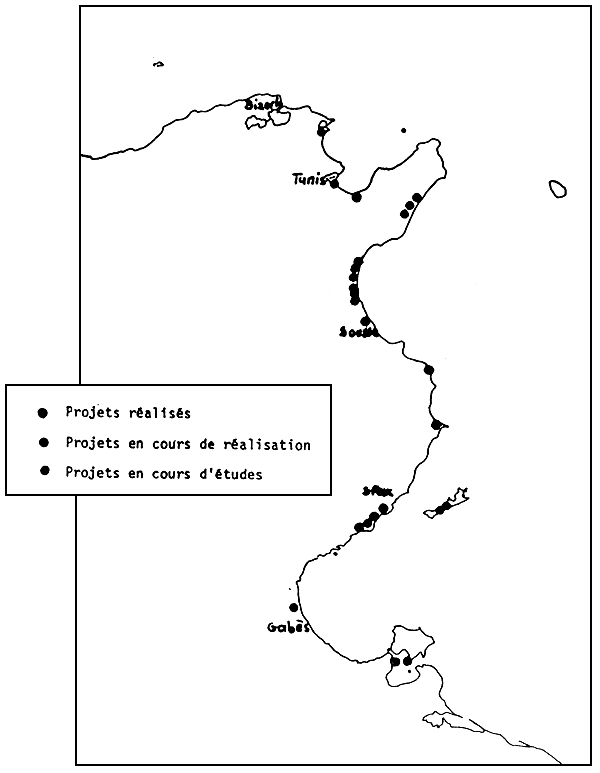
Sites de projects aquacoles
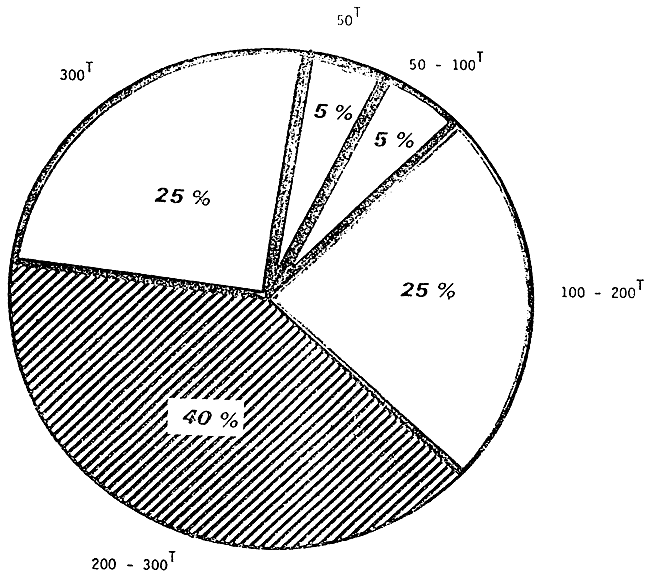
Répartition des projets aquacoles en fonction de leur productions potentielles
PORTUGAL Report
In Portugal Aquaculture is gradually being considered an economic activity of great importance.
On one hand due to the fact of Portugal being considered a country of recognized natural potentiality for the development of this activity and on the other hand, the above mentioned activity will eventually complement the fishing fleet production which is today facing serious difficulties regarding not only the state of degradation of certain stocks but also the lack of access to the fishing zones of other countries.
The catches of the commercially more valuable fish species have been constantly reducing.
Besides that, a growing volume of this kind of catches have been exported to some of the more demanding community markets, leaving our internal market without that kind of products.
Thus, aquaculture can contribute to raise the offer of these products, satisfying our internal demand at a more reasonable price.
And so, since the adhesion of Portugal to the Community we have been concerned with the development of this important activity.
This process of development will have to obey a conjunct of actions taking into consideration the existing difficulties in order not only to solve them, but also to incentivate private initiative, which is the main force to set motion this development.
In the coming five years Portugal will adopt as first objective in its aquaculture policy the expansion of production.
Besides that, Portugal will give top priority to the more profitable investments, we would say the better concieved and dimensioned ones, So, we consider highly important to give support to the intensive and semi-intensive maritime species projects.
We also pretend to incentivate the growing not only of highly commercial value indigenous species but also of bivalves which represents about 80% (eighty per cent) of the total national aquaculture production.
In order to plan all this process of development in 1989 a conjunct of legal documents was elaborated to regulate this sector of activity:
- the exploration of maritime species places;(FARMS)
- the installation of growing places for maritime species;
- the licences for these explorations;
- the financing of these investment projects.
Regarding the exploration conditions of the growing of maritime species places, the products of these establishments will have to obey all the rules of quality, sanitation and salubrity for the general fishing products.
The polluting effects of waters and neighbouring grounds have to be avoided.
This exploration is subdue to previous licensing done by the state Fishing Department of our sea Ministry (Naval and Fishing Ministry).
Regarding the instalation of growing places for maritime species which is subdue to a previous autorization from the Minister responsable for the fishing sector and also from the Minister responsible for territory planning and also from the Minister responsible for the public maritime territories.
These places must satisfy the following:
- they must have the necessary salubrity conditions for the growing of maritime species;
- they must not interfere with the there existing activities;
- they can not be located in natural banks of maritime species where the preservation of which is considered very important;
- they can not go against the established regulation of areas already subdue to a certain land planning.
- they can not interface with navigation;
- they can neither alter the seatide movements nor interfere with the solid stream transport. (this means the solid things transported by the water stream)
The authorization to the installation of growing places for maritime species is required through proper document including:
- the owner's identification;
- the name, localization and area of the establishment;
- the authorized species and the methods of growing.
The requests for the instalation of the establishments can be either in March or in September.
The licensing process of their exploration must obey the following:
- the licence will be required to the State Fishing Department;
- the State Fishing Department will decide in a period of 90 days after having consulted the National Institute for Fishing Investigation;
- the licence can not be passed unless the information from the above mentioned Institute is favourable.
This licence will be valid for a period of 10 years, renewed for the same period upon a request of the person interested.
The maritime species places or establishments will be four different types:
- for reproduction (hatchery);
- for growth and fattening;
- for maintenaince (for the species that are waiting for commercialization, exportation or depuration);
- for improvement (where a bettering of the quality of the species caught in the sea will be done).
Regarding the financial support, the Plurianual orientation programme for aquaculture will provide the table with the reference of the investments to be followed by this activity.
Those interested in obtaining in obtaining a financing for their aquaculture projects in the ambit of the above mentioned Programme must present them for appreciation in the Financial Institute of Support to Agriculture and Fishing Development.
This Institute will analyse them properly after having collected the necessary information (opinion) from the State Fishing Department, from the National Institute for Fishing Investigation and in certain cases even from the Environment Department.
For fresh water aquaculture this Institute will collect the necessary information (opinion) from the Forestry Department.
Portugal must send to the European Community a report on its anual progress to show the modifications occured in this sector of activity as a result of the fullfilment of the Plurianual Orientation Programme.
In order not only to know the production and the evolution of this activity but also to be able to plan it. It was launched for the first time in 1991, a survey to all aquaculture producers.
In reference to the Information System, this one is obtained through the above mentioned survey, complemented with a field work done by the State Fishing Department technicians.
Afterwards the referred information is put into various tables which belong to the National Data Base for Fishery located in the Cabinet of Fishing Study an Planning.
The above mentioned tables are managed (operated) by a System of Data Base Management - ORACLE - through a UNIX SYSTEM V (operative system). The machine being a UNISYS 5000/95 (five thousand and ninety five).
The table users get the information from the tables through the SQLPLUS (structured query language).
The main users of all this information will be the following:
- The Government Administration in order to plan and control all this activity;
- all the Departments that do investigation in this area;
- all the economic agents (entrepreneurs).
The technicians who collected, manage (operate) and deal with all this information are respectively qualified in biology, mathematics and economy.
The available information is the following:
- the identification of the establishment - name, localization, area, etc;
- the owner's identification - name, adress, organizations producers may belong to;
- the exploration state of the establishments - in activity or not and others;
- the type of establishment - growth, fattening, hatchery or others;
- the production regime of the different species;
- the feeding;
- the production and sale;
- the supply - the buying of the hatchery production or the catch in their natural environment. Fishing technics utilized;
- the personnel engaged in production - family member workers, other kind of workers, permanent workers, temporary workers, technical staff and others.
CYPRUS Report
In Cyprus, the Department of Fisheries is the responsible Government Department for Aquaculture Development.
This Department has developed the procedures and mechanisms for the collection of various data which refer to sevral aspects of aquaculture for the last 22 years, since aquaculture was initiated in cyprus.
The data mainly refer to statistics on production or are exprimental data, market data, economic data, water monitoring data statistical data on the issue, by the Dept, of angling licences in the reservoirs, imports-exports of fish, fish food, addresses of suppliers of equipment and services for aquaculture etc.
All the above data were collected and stored until recently, in files. Processing of them by hand was taking place.
The various divisions of the Fisheries Department now are equipped with computers, including the Division of Aquaculture, for data storage and processing. The relevant personnel is being trained in their use to be able to undertake the smooth running of the relevant programmes. The computerization of the aquaculture data has already started and an example of this work will be demonstrated in the framework of this seminar.
The information system which is being developed is located at the Dept. of Fisheries in Nicosia which is expected to work in close cooperation with the MEDRAP II Sub-Regional Center which is housed in the same premises. The person in charge of it is the National Coordinator who is also the Director of Fisheries.
The users of the system once developed, are expected to be mainly the following :-
Personnel of the various sections of the Dept of Fisheries and mainly that of the Division of aquaculture.
Personnel of other government Dep. and related institutions dealing with the various aspects of aquaculture i. e. financing, controlling monitoring etc.
The private fish farmers and the prospective aquaculturists.
Bodies and organizations outside the government which are involved with aquaculture.
persons from the private sector who undertake studies on aquaculture like feasibility studies, environmental impact studies, market research studies etc.
The information of primay importance refers to:-
Technical information (both descriptive and numerical) on aquaculture and related subjects.
Market information (prices, quantities, importers-exporters of fish etc.)
Financial information.
Equipment, supplies and services to aquaculture.
Directories of producers, training institutes, research institutes, experts researchers on crucial aspects of aquaculture.
Information on legal aspects like licencing, monotoring controlling aquaculture.
Socio-economic information.
Cyprus acknowledges the usefulness of the SIPAM which is expected to fill a gap in planning aquaculture development in the MEDRAP II and provide a tool to member countries (both to government and private sector) for the further development of aquaculture. Such a system is expected to give the opportunity for the sharing and exchange of information within and outside the region.
CROATIA Report
ON THE OCCASION OF M E D R A P II
SEMINAR ON DOCUMENTATION AND INFORMATION SYSTEM ON
AQUACULTURE
Cairo, 11 – 13 December 1991
CROATIA (YU) - Information capabilities and needs in aquaculture
A computerized information service doesn't exit for aquaculture. At the moment such a data base is only operating for Oceanography. The linkages among aquaculturists are provided through association of producers which is publishing a Journal (quarterly) devoted Marine fisheries and aquaculture.
Most of the communications between institutions are done without necessarily going through the coordinating institution.
Amicable relationships between aquaculturists are of significant importance in facilitating the exchange of views, informations and materials.
The research problems are widely shared among scientist themselves. The existance of an advisory group within certain national programme including leadership is a common practice. Some nonregular workshops and meeting are also contributing to the exchange of ideas and methodologies and may also report on the results of research currently underway.
The computer informatized linkage between producers and researchers would be appreciable. A computerized data base system should provide possibility of introducing into information on aquaculture collected for the Mediterranean by MEDRAP, FAO itself and by PAP/RAC.
FAO GLOBEFISH Services
for International Trade of Fishery Products
Importance of fish trade
1. World fish harvest in 1989 was close to 100 million MT. It represents a source of income for over one hundred million people, both in the harvesting and in the post-harvest sectors. About one-third of the world catch goes into international trade and the total export value has than doubled from US$ 16,000 million in 1980 to US$ 33,000 million in 1989.
2. The share of developing countries in total fish exports expanded during the eighties but has been stable at 45% for some years now. Although obviously there are some agricultural commodities for which the share of developing countries is much higher (over 80%, e.g. some typically tropical products such as coffee, tea and rubber), for many important products such as meat, cereals and forestry products, the share of developing countries is as low as 15%, and for agricultural products as a whole it is less than 30%.
3. For many developing nations, fish trade represents a major source of hard currency earnings. The 1989 net-surplus from over imports of these countries was US$ 10,500 millions, exceeding i.e. those of coffee (US$ 8,600 million), tea (US$ 800 million) and rubber (US$ 3,100 million). For oils and fats where total export values and the share of developing countries is similar to fish, the net-earnings for these countries are also much lower (US$ 770 million).
Programme of Action No. IV: International trade in fish and fishery products
4. In recognition of the great importance of fish trade for developing countries and of the opportunities and obstacles existing for its further expansion, the FAO World Conference on Fisheries Management and Development, held in Rome in 1984, adopted a specific Programme of Action. As far as matters of international trade are concerned, the Programme of Action No. IV has three major components, namely the establishment of:
A multilateral framework for consultations on international trade in fishery products (COFI Sub-Committee on Fish Trade);
A network of regional fish marketing information and technical advisory services (INFOFISH, INFOPESCA, INFOSAMAK, INFOPESCA):
a system of international fish market indicators (GLOBEFISH Services).
COFI Sub-Committee on Fish Trade
5. The multilateral framework for consultations on international trade in fishery products was established by the FAO Committee on Fisheries in the from of its Sub-Committee on Fish Trade, in 1985. The Sub-Committee has met three times since its creation and inter alia developed a Technical Assistance Programme for Fishery Commodities and Marketing Development.
Regional Fish Marketing Information and Technical Advisory Services
6. While INFOFISH (since 1981) and INFOPESCA (since 1977) were already in existence at the time of the World Conference, INFOPECHE and INFOSAMAK have been set-up since then (1986). These Services, of which INFOFISH has become an independent inter-governmental organization in 1987, provide regular information, technical advice on products and processing, and training in post-harvest aspects of fisheries in their respective regions. They publish a fortnightly market newsletter (“Trade News” in their respective operating languages) and a bi-monthly magazine (“INFOFISH International”) in English with summaries in the other three languages). In Asia/Pacific and Latin America the participating countries pay annual financial contributions to cover part of the costs of running these services; the remainder being financed by donor support and by income from selling project services. INFOPECHE and INFOSAMAK are primarily funded by donor support supplemented by some revenues from selling project services.
GLOBEFISH
7. GLOBEFISH was established at FAO Headquarters in 1984 to centralize the collection of marketing information covering the main market areas, North America, Europe and Japan In response to information needs from those market areas as well as from other services, GLOBEFISH is meanwhile engaged in different activities:
GLOBEFISH Publications
GLOBEFISH Databank
GLOBEFISH Research Programme
GLOBEFISH Marketing Orientation Courses
International Conferences
GLOBEFISH Publications
Due to a network of contacts with private companies, industry associations, appointed correspondents, government institutions and of course the network of regional projects GLOBEFISH is in a position to collect up-to-date market information on a regular basis producing the GLOBEFISH European Price Report and the GLOBEFISH Highlights.
The European Price Report, a monthly periodical, covers 60 species (500 prices of mostly frozen products) sold to or in Europe, with a special section reserved for cultured species.
The GLOBEFISH Highlights, produced in English, French, Spanish and Arabic is a quarterly market analysis of main fish commodities giving production, trade and price trends. Both publications together with the INFOFISH Trade News and INFOFISH International are available from the regional services in a combined subscription; “The Full Net”. Selected parts are also available via telefax at cost price for subscribers.
GLOBEFISH Databank
GLOBEFISH runs an on-line database, stored in the United States, available via satellite, covering full text information on all areas affecting via market conditions of fishery products such as aquaculture fishing agreements, changes in fishing fleets, quotas, joint ventures, etc… In the statistical section special emphasis is placed on up-to-date monthly data.
GLOBEFISH Database Coverage
| Sections | Key Commodities | |
| - Production & Trade Statistics | - Shrimp | - Tuna |
| - Price Series | - Groundfish | - Salmon |
| - Product Development | - Cephalopods | - Crab |
| - Aquaculture | - Small Pelagics | - Lobster |
| - Joint Ventures | - Fishmeal | - Bivalves |
| - Investment | ||
| - Fishing Fleets | ||
| - Environment | ||
| - Quality Control | ||
| - Development | ||
| - Protected Species | ||
| - Company Profiles | ||
Besides the regional services of the FAO Fish Marketing Information System which distribute printouts to areas in their member countries on request, access is given to government offices in developed countries which contribute financially to the activities of GLOBEFISH They use the databank on their research efforts and for enquiries received form their domestic industry.
GLOBEFISH Sponsors
- NMFS (National Marine Fisheries Service, Washington, DC, USA)
- FROM (Ministerio de Agricultura, Pesca y Alimentación - Fondo de Regulación del Mercado de los Productos de la Pesca Cultivos Marinos y de Aguas Continentales), Madrid, SPAIN
- DFO (Department of Fisheries and Oceans Economic and Commercial Analysis Directorate; Ottawa, (CANADA)
- Ministry of Fisheries, Copenhagen, DENMARK
- Export Council of ICELAND
The sponsorship of GLOBEFISH offers the institution besides the direct access to the databank also certain training possibilities, the right to use the GLOBEFISH correspondent network, support in specific studies, participation in the GLOBEFISH research programme and a consultative role in the cornmodity conferences arranged with GLOBEFISH.
GLOBEFISH Research Programme
Each year a market research programme is agreed upon by donors as well as regional services. The studies are prepared by GLOBEFISH staff, sister services and hired consultants. The publications are available in advance to donors and are sold later through the regional services.
GLOBEFISH Research Programme Publications since 1989
| Volume 1 | Markets for Selected Aquaculture species (Salmon, Trout, Seabass, Seabream) |
| Volume 2 | Catering Market in Germany Fed. Rep. |
| Volume 3 | The European Shrimp Market - Coldwater versus Warmwater |
| Volume 4 | World Market Report for Bivalves (Oyster, Mussel, Clam, Scallop) |
| Volume 5 | The EEC Groundfish Market |
| Volume 6 | Markets in Europe for Small Pelagics (Mackerel, Sardine, Herring) |
| Volume 7 | Markets in Africa for small Pelagics (Mackerel, Sardine, Herring) |
| Volume 8 | Catering Markets in the United Kingdom |
| Volume 9 | Catering Market in Spain |
in preparation for 1991
- Markets in Asia for Small Pelagics
- The World Market for Live/Fresh/Frozen Crab and Lobster
- The World Eel Market
- Selected Fishery Products in the Catering Sector - France
- Selected Fishery Products in the Catering Sector - Italy
- Markets for Ready Meals in Europe
- Surimi Markets in Europe
- Markets for Fishery Products in Eastern Europe and USSR
GLOBEFISH Marketing and Quality Orientation Courses
In March 1991 a Marketing and Quality Orientation course will be conducted by GLOBEFISH in Poland. This three day course will highlight the essentials of market requirements, health and sanitary regulations, transport, insurance, export, financing etc. It is planned to have similar courses in other Eastern European countries. These courses are intended to create also a platform to discuss the status of the industry. Follow-up activities in the framework of the FAO Fisheries Department, such as specialized quality inspection courses, are planned for selected participants.
International Conferences
GLOBEFISH assists in the preparation of international trade conferences in collaboration with INFOFISH and FAO regional projects to spread up-to-date information about international fish markets, GLOBEFISH promotes especially participation of fishery industry representatives from developing countries and develops programmes and speaker contacts.
CONFERENCES 1989–1991
- Squid 89 Lisbon
- Seafood 90 Japan
- Tuna 91 Bali, 13–15 May 1991
- Small Pelagic Conference, Abidjan 10–12 June 1991
- Squid 91 Madrid, 6–8 November 1991
FAO GLOBEFISH
Fishery Industries Division
Rome, ITALY
Tel: (6) 5797-6389
Tlx: 610181
Fax: (6) 5404297
LEBANON Report
LEBANON
Aquaculture in Lebanon is not as yet a well-developed sector. There is no mariculture, and fresh-water aquaculture is restricted to trout farming. A national aquaculture programme is being developed with UNDP assistance.
There is therefore no centralised information system in support of aquaculture activities. Now that Lebanon is participating in MEDRAP II we welcome this activity and wish the developers to take into consideration the situation of the countries like Lebanon land there are a few) that are initiating aquaculture oriented activities. This must be taken into consideration while assessing the needs so that this group of countries eventually become an integral part of the Network.
