


Götz Schroth ([email protected])
When agroforestry began to attract the interest of development agencies some 20 years ago, the central question underlying much of the agroforestry-related research and discussion was how trees could be integrated into agricultural systems to increase their productivity and sustainability without negatively interacting with the crops. This question, which has by no means lost its relevance, focused mainly on the agroforestry plot or "system" where trees directly interacted with crops and soils. Over the past decade, both the scope and scale of agroforestry have widened. Agroforesters increasingly ask how farmers could best manage the whole set of natural resources at their disposal - including trees, woodlots and forests - to improve their livelihoods in a sustainable manner while maintaining or enhancing the environmental functions of the surrounding landscapes. These functions include the regulation of microclimate, water, soil and pest dynamics that directly concern the farmers, as well as services of global relevance, such as the conservation of biodiversity.
With this new view of agroforestry as an approach to sustainably manage natural resources in a landscape context, the scope for interaction between agroforesters on one hand and conservation scientists and practitioners on the other, has considerably increased. Conservation scientists know well that a system of protected areas is essential, but not sufficient for the conservation of tropical biodiversity. As only about 10 percent of the land cover of the earth is protected, most species of plants and animals live outside protected areas. Moreover, many protected areas are inhabited by people who also practice agriculture or are influenced by the agricultural landscapes that surround them. In most regions, areas of natural habitat (protected or not) in the land use mosaic are increasingly fragmented, forming islands in a matrix of agricultural land, and organisms inhabiting these islands that are unable to traverse the agricultural matrix may be genetically isolated and at risk of extinction. Consequently, it is important to recognize the role of managed areas in conservation strategies and to work with land users to create landscapes that provide a place for both people and wild biodiversity. Here, agroforestry has a role to play.
Despite this overlap of interests between agroforesters and conservationists, concerted efforts toward the creation of landscapes that offer a place for people and wild biodiversity are not as common as they should perhaps be. To lay a foundation for a better communication and closer cooperation between protagonists of sustainable rural development and biodiversity conservation, an interdisciplinary group of scientists has put together their ideas and experiences and produced a book on Agroforestry and Biodiversity Conservation in Tropical Landscapes that will be published by Island Press, Washington DC, in spring 2004. Edited by G. Schroth, G.A.B. da Fonseca, C.A. Harvey, C. Gascon, H.L. Vasconcelos and A.M.N. Izac, the book discusses the potential of agroforestry land uses that benefit biodiversity conservation within a framework of the following three hypotheses:
1. Agroforestry can help reduce pressure to deforest additional land for agriculture if adopted as an alternative to more extensive and less sustainable land-use practices, or can help the local population to cope with the limited availability of forest land and resources, for example, near effectively protected parks (agroforestry-deforestation hypothesis).
This hypothesis should not be misunderstood to suggest that the promotion of agroforestry practices in forest frontier areas as such would have a general, forest-conserving effect, although in certain situations such an effect may be observed. Of more general importance is the potential of agroforestry practices to develop synergisms with direct forest-protecting measures such as the establishment of parks.
Agroforestry practices that are more sustainable than alternative land-use systems, and that produce both timber and nontimber forest products, may help farmers to respect legislation or other measures that prevent them from occupying forest land and extracting forest resources from protected areas. In other words, combining agroforestry and direct forest conservation in land-use strategies may achieve more in terms of forest (and biodiversity) conservation than either measure alone.
2. Agroforestry systems can provide habitat and resources for partially forest-dependent native plant and animal species that would not be able to survive in a purely agricultural landscape (agroforestry-habitat hypothesis).
Tropical agroforestry systems such as shaded tree crops, silvopastoral systems with scattered trees and live fences, and shifting cultivation systems with long fallow periods, often contain or contribute to supporting many species of plants and animals-including some threatened species-that are not present in agricultural monocrops or pastures.
However, not all forest species are able to survive in such managed habitats, so even the most complex and diverse agroforests are not perfect substitutes for natural forests. The most diverse agroforestry systems (and those that harbor the greatest biodiversity) are typical systems that are extensively managed, so the tendency to increase land-use intensity, for example, by reducing tree shade or shortening fallow periods, may reduce the conservation value of such land-use types.
An important task for agroforestry research is to increase the profitability of traditional agroforestry practices while maintaining their biodiversity benefits as much as possible.
3. In landscapes that are mosaics of agricultural areas and natural vegetation, the conservation value of the natural vegetation remnants (which may or may not be protected) is greater if they are embedded in a landscape dominated by agroforestry elements than if the surrounding matrix consists of crop fields and pastures are largely devoid of tree cover (agroforestry-matrix hypothesis).
In view of the increasing fragmentation of the natural habitat in many areas, the management of agricultural landscapes has emerged as an important topic in biodiversity conservation strategies. Agroforestry systems can play an important role in such strategies, provided that no invasive species, or species that host pests or diseases of native vegetation are used. Agroforestry practices may make the agricultural matrix more permeable for wildlife by providing corridors and stepping stones. They may also buffer habitat islands from the more extreme microclimate, stronger winds and fires that are characteristic of agricultural and pasture areas, and provide additional food resources and temporary habitat for some forest species.
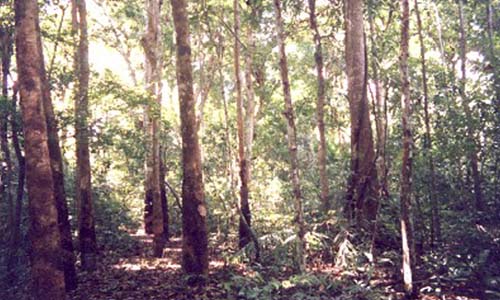
Complex agroforestry systems composed of tree crops and variable amounts of natural forest regrowth have been shown to host a large share of the native biodiversity, and produce a wider range of products, than simpler agricultural systems. Examples are the extensively managed and periodically abandoned, planted rubber grove in the Tapajos National Forest in the central Amazon, and the more widespread and better known jungle rubber systems of Indonesia (Photo by G. Schroth).
In combination, these three mechanisms could make agroforestry a powerful tool in biodiversity conservation strategies, complementing and supporting the essential role of natural habitat within and outside parks and other protected areas. The effective integration of agroforestry into conservation strategies is, however, a major challenge that requires integrated approaches across traditional disciplinary divisions. The forthcoming book Agroforestry and Biodiversity Conservation in Tropical Landscapes is intended as a step in this direction.
The author can be contacted at the University of Bayreuth, Institute of Agroecology, 95440 Bayreuth, Germany.
The following publications were compiled from contributions, research and the web sites of CSIRO Publishing, Barnes & Noble.com, Amazon.com, Science Publishers Inc., and the International Institute for Environment and Development:
Ground and Water Bioengineering for Erosion Control and Slope Stabilization
Scheduled for release in January 2004, this book addresses the rising need for effective measures to protect soil and water resources. It focuses on bioengineering for vegetative and vegetative-structural solutions to control erosion and stabilize sites affected by infrastructure and transportation development, mining, forestry and agriculture. Edited by David Barker, Ben Northcutt, Alex Watson, Mado Maglino, and Samran Sombatpanit, the book will be useful to engineers, government officials, multi-lateral agencies, NGOs, soil conservationists, foresters, ecologists, agriculturists and landscape architects. For more information, visit the Science Publishers Inc. web site at http://www.scipub.net/
Policy that Works for Forest and People: Real Prospects for Governance and Livelihoods
Scheduled for release in January 2004, this book discusses policy as the root of forest problems in many countries-loss of natural resources, inequitable access, lack of information and resources, etc. It is based on worldwide research and is considered as the most authoritative study to date of policy processes that affect forests. James Mayers and Stephen Bass analyze issues, options, and factors that determine different outcomes while providing practical advice in formulating, managing and implementing policies for improved governance, effective flow of use and economic benefits from the forest to those who depend on them. For more information, visit http://www.earthprint.com/go.htm?to=9276IIED.
Sharing Power: Learning by Doing in Co-Management of Natural Resources throughout the World
Scheduled for release in January 2004, this book helps readers understand co-management or collaborative management processes and develop and enhance them in practice. The book presents appropriate entry points, prerequisites for successful negotiations and methods and tools that can be used.
Examples of specific agreements and pluralistic management organizations are discussed and the experiences of the social actors in improving their management practices through learning by doing and participatory democracy are also described. The book was written by Grazia Borrini-Feyerabend, Michel Pimbert, Taghi Farvar, Ashish Kothari, Yves Renard, Hanna Jaireth, Marshall Murphree, Viky Pattemore, Ricardo Ramirez and Patrizio Warren. For more information visit http://www.earthprint.com/go.htm?to+92030IIED.
The Conservation and Improvement of Sloping Land: A Manual of Soil and Water Conservation and Soil Improvement on Sloping Lands
Three volumes comprise this manual written by PJ Storey. Volume 1: "Practical understanding" was released in 2002. It provides readers practical tips in carrying out various conservation practices including basic information on soil formation, chemistry, physical attributes and management. It also discusses the wrong ideas and practices concerning soil conservation, vegetation, livestock management, surveying, needs for research and development and extension policies and methods.
Volume 2: "Practical application - soil improvement," released in January 2003, further explains soil degradation as one of the most serious problems in the world today and that the only way is for people to farm whatever land is available to them to improve and/or maintain its productivity.
Volume 3: "Practical application -soil and water conservation," released in October 2003, focuses on past and existing efforts that are falling short of the objective of conserving soil and water resources. The manual describes the causes of soil erosion, the theory and practice of soil and water conservation, and presents procedures on constructing soil and water conservation measures. The manual also explains in detail the process of achieving practical and sustainable soil and water conservation, and provides farmers practical ways of constructing lasting terraces. For more information, visit the Science Publishers Inc. web site at http://www.scipub.net/
Sustainable Agriculture
Released in September 2003, the second edition of this book examines the problems resulting from the clearing and cultivation of more land, the faster growing of plants and animals, and the killing of insects and pests. These include the decline of soil structure, erosion, salinity, soil acidification, loss of fertility, nutrient loading of waterways, dams and chemical residue build up.
John Mason explains the concepts and long-term benefits of sustainable farming systems such as permaculture, biodynamics, organic farming, agroforestry, conservation tillage, and integrated hydroculture as means to address such problems.
The book also compares monoculture versus polyculture, and discusses the use of hybrids, the selection criteria for plants and stock, integrated pest management, and farm preparation of drought and floods. Diversifying the farm to include tourism and value addition prior to the sale of produce were also explored. For more information visit http://www.publish.csiro.au/
Integrated Natural Resources Management: Linking Productivity, the Environment and Development
Written by BM Campbell from the Center for International Forestry Research and JA Sayer of the Worldwide Fund for Nature, this book tackles the principles and applications of an integrated approach to natural resources management.
Released in July 2003, the book was developed from papers presented in a workshop in Penang, Malaysia in 2000. Topics deal with the wider integration of natural resources, the complexity of systems, and the redirection of research towards participatory approaches, multi-scale analysis. It also presents various tools for system analysis, information management and impact assessment. Case studies by international experts from Asia, Africa, Latin America and other countries from around the world are also presented. For more information, visit http://www.forestscience.info/books.asp
Landscape Ecology
Released in May 2003, this book introduces the concept of landscape ecology, the dynamics and structures of landscapes, the ecological processes within landscapes, and the applications of landscape ecology to landscape management. The book was written by Francoise Burel of the Centre National de la Recherche Scientifique and Jacques Baudry of the Institut National de la Recherche Agronomique. For more information, visit the Science Publishers Inc. web site at http://www.scipub.net/
Ecoagriculture: Strategies to Feed the World and Save Wild Biodiversity
Jeffrey A. McNeely of the IUCN-The World Conservation Union and Sara J. Scheer of Forest Trends examines the possibility of redesigning agricultural landscapes to address the needs of human populations and at the same time to protect and enhance biodiversity. Released in October 2002 by Island Press, this book presents a thorough overview of "ecoagriculture" - the management of landscapes for both the production of food and the conservation of wild biodiversity.
It outlines the ecoagriculture approach through various case studies that explore policies, markets and institutions. It also examines the global impact of agriculture on wild biodiversity and describes the challenge of reconciling biodiversity conservation and agricultural goals. For more information visit http://www.amazon.com/
Agroforestry: Science, Policy and Practice (volume 47)
Released in April 2002, the present volume of the book consists of 15 selected papers presented during the agroforestry sessions of the IUFRO 20th World Congress in Tampere, Finland.
The papers work on the premise that agroforestry is an interdisciplinary science and focus on the urgent need to assist farmers, forest dwellers, and landscape-level planners to achieve sustainable food, fuel and timber production.
Topics cover the economic valuation of financial and nonfinancial costs and benefits in agroforestry development, the value of sustainability, the integration of indigenous knowledge and perspectives and a model simulating tree architecture above and below ground. Case studies from Central America, the Caribbean, US, China, West Africa and Nepal are presented in this book. It was edited by Fergus L. Sinclair and published by Kluwer Academic Publishers. For more information visit Barnes&Noble.com.
Agroecological Perspectives in Agronomy, Forestry and Agroforestry
Written by Paul A. Wojtkowski and released in 2002, this book offers an in-depth look at the concepts, principles and practices of agroecology. Agroecology offers alternatives to the monocultural systems which lead to intensive chemical applications and genetic modifications at the cost of increased productivity.
Using agroecological principles such as a polyculture in agriculture or forestry, per area outputs can be increased, costs can be lowered, and climatic and market risks can be reduced. For more information, visit the Science Publishers Inc. web site at http://www.scipub.net/
Agroforestry in Sustainable Agricultural Systems
Edited by Louise E. Buck, James P. Lassoie and Erick C. M. Fernandes and released in 1998, this book compiles contributions that examine the environmental and social conditions that affect the roles and performance of trees in field- and forest-related agricultural production systems. Various types of ecological settings for agroforestry are analyzed within temperate and tropical regions.
Case studies from around the world discuss the science and practice of black walnut agroforestry in Missouri, domestication of tropical trees, water management and hedgerow agroforestry systems, and animals and agroforestry in the tropics. The case studies also present innovative strategies that have sustainably raised forests and tree products for commercial harvesting and provision of environmental services in land conservation and watershed management.
The roles of soil, water, light, nutrient and pest management in mixed, annual, woody perennial and livestock systems are also tackled. For more information, visit http://www.amazon.com/
Compiled and summarized by Leah P. Arboleda
