


The Project was inspired by the strong environmental movement in Cagayan de Oro. NGOs and people's organizations have taken bold steps that link public protests with affirmative action - in order to protect their environment and people's livelihood. They actively engaged in organized non-violent street actions, court cases, people's anti-logging checkpoints and other direct actions - integrated with the active organization of poor communities, livelihood activities, agricultural extension services, and negotiations for agrarian rights and stewardship contracts. Further, this mass-based movement has increasingly involved the city's growing middle class (university, media and professionals) not just as support groups but as actual environmental stakeholders.
ANGOC actively supported this growing movement by taking a lead role in linking NGOs and farmer groups with national government offices, media and international organizations. It provided technical support in documenting their experiences and translating them into policy proposals in their dialogues with policy makers. It also provided venues for sharing of information and experiences.
In 1996, ANGOC shared this experience with the Popular Coalition to Eradicate Hunger and Poverty (now known as the International Land Coalition or ILC) and proposed that it be supported as a pioneering example of civil society program and as a testing ground for the Coalition to work at the local level. It received unanimous support from the Popular Coalition with financial assistance coming come the International Fund for Agricultural Development (IFAD). In the interim period prior to the approval and release of project funds, Partners in Rural Development (PARTNERS), a Canadian NGO based in Ottawa, provided initial support to start off the process. Towards the end of the Project, the Japan's Grant Assistance for Grassroots Project of the Japanese Embassy supported the Project in its attempt to link the farmers to the market.
ANGOC and its local partners
ANGOC set up a field office to coordinate and monitor project implementation. It also adopted a few indigenous communities. However, it relied on its NGO partners and people's organizations (POs) for project implementation.
The major NGO partner is the Center for Alternative Rural Technology (CART). Established in 1986, CART has since been in the forefront of educating, mobilizing and organizing small farmers, marginal fishers, women, youth, urban poor and indigenous communities. It is a strong advocate of environmental protection and biodiversity, equitable distribution of land and women's empowerment and their integration in development.
Over the past 10 years, CART has organized over 200 people's organizations federated under the Task Force Macajalar (TFM). TFM is composed of organizations of farmers, fisherfolks, indigenous communities, women, youth and urban poor groups who have joined hands to protect the environment, advance sustainable agriculture and implement agrarian reform both in the lowlands and in the uplands of Northern Mindanao. Most of these groups have been transformed into cooperatives and are implementing various income generating projects.
ANGOC also linked up with local government units and national government agencies, particularly the Department of Environment and Natural Resources (DENR), Department of Agriculture (DA) and Department of Health (DOH). The issuance of the Certificates of Stewardship Contact, a tenurial instrument that allowed the indigenous communities to manage the forestlands for 25 years was a product of collaboration between the local officials and the DENR.
These linkages also led to the formation of the Clean and Green Board of the City of Cagayan de Oro through an executive order by the City Mayor. The Clean and Green Board is a multi-sectoral group composed of government agencies, non-government organizations, media, police and the military, church and other civil society organizations. It was mandated to investigate illegal removal, cutting and/or transporting of trees and other forest products in violation of forestry laws in all the remaining forests in the city (Ares, 1999).
Other groups that were involved in the Project include Xavier University-Ateneo de Cagayan College of Nursing, Committee of German Doctors and Rotaract Club (see Annex A for brief organizational profiles of partners).
The Project Site
The Project area covering five upland villages is located in southern part of Cagayan de Oro City, about 25 kilometers away. The lands are generally hilly and mountainous. The physiographic description is residual terrace to gently sloping to undulating.
Community infrastructures and basic services are very limited. There is no water supply system and electricity is limited to the main highway. The roads leading to the interior are plain surfaced or merely trail and impassable during wet season. There are no available communication facilities. Only elementary schools are available and those attending high school will have to go to another village. A government center provides primary healthcare but with minimal personnel. A pair of doctor and nurse usually goes to the community once or twice a week.
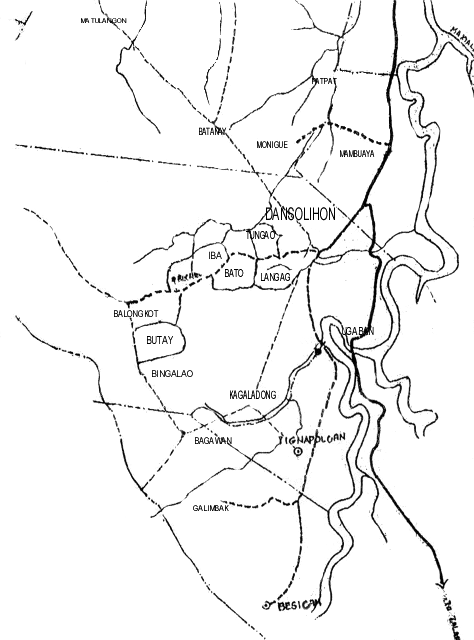
Figure 2. Map of the project site.
The villages can be generally described as economically-depressed communities. Commercial activity is minimal, limited to a handful of variety stores. Agriculture is the main source of livelihood with corn as the main crop accounting for about 90% of the total agricultural production. Other crops include coconut, pineapple and other fruit trees. Corn productivity is very low ranging from 0.5 to 1.0 ton per hectare, barely enough for consumption.
In Dansolihon, about 90% of the residents are Higaonons, an indigenous people. Higaonons are predominant in Northern Mindanao particularly in the Province of Bukidnon, the adjacent province to Cagayan de Oro. They refer to themselves as Dumaan (old) or Tumandek (originally from this place) but prefers to be called Tagabukid (from the mountains) to distinguish themselves from another indigenous community called Dumagats (from the sea). The lowlanders call them nitibo. They speak their own language called binukid and prefer to reside in the mountains (Ruiz, 1996).
They are dependent on the land for their survival. According to their cultural beliefs, their relation to the land is only as stewards as they believed only God (Magbabaya) and the guardian spirits can own lands. Swidden agriculture or shifting agriculture is the main form of cultivation. They also hold rituals before opening land for farming, before planting and before harvesting (Ruiz, 1996).
