

70 The participants approved the minutes of the meeting for adoption. The Chairperson Maria Antonia G. Tuazon thanked all the participants for their active participation and Hardinsyah for his contributions in preparing the report. Lastly, a Certificate of Appreciation was presented by the participants to Mr. Nandi, Secretary of the network for all his valuable contributions, especially those directed to ensuring food and nutrition security in the region. Mr Nandi is due to retire from FAO by the end of 2008.

Technical Meeting of the Asia-Pacific Network for
Food and Nutrition on Nutrition Interventions for Food Security –
can they work effectively in isolation?
22 – 24 July 2008, Bangkok, Thailand
LIST OF PARTICIPANTS
|
BANGLADESH |
A.F.M Saiful Islam |
|
INDIA |
Jai Singh |
|
INDONESIA |
Hardinsyah |
|
PHILIPPINES |
Maria Antonia G. Tuazon |
|
Chandrani L. Piyasena | |
|
THAILAND |
Visith Chavasit |
|
Pattanee Winichagoon | |
|
VIET NAM |
Truong Hong SON |
|
SPECIAL INVITEE |
Kraisid Tontisirin |
|
SECRETARIAT |
Biplab K. Nandi |
|
Peter Sousa Hoejskov | |
|
Natcha Thearapati |
OPENING ADDRESS
By
He Changchui
Assistant Director-General and
Regional Representative for Asia and the Pacific
Delivered at the
Technical Meeting of the Asia-Pacific Network for Food and Nutrition
on Nutrition Interventions for Food Security – can they work effectively in isolation?
Bangkok, Thailand
22 – 24 July 2008
Distinguished participants,
Colleagues,
Ladies and gentlemen,
It gives me great pleasure to welcome you all, on behalf of FAO Director-General, Jacques Diouf, and on my own behalf to the Technical Meeting of the Asia-Pacific Network for Food and Nutrition on “Nutrition Interventions for Food Security – can they work effectively in isolation?”
I find that this year’s topic is quite interesting and important, amid the current issues of soaring food prices and their impact on our efforts for poverty and hunger reduction, as well as worldwide responses by governments and international communities.
While stressing food shortages and emphasizing the need and actions for increasing agricultural productivity and market supply, it is also important to recognize the critical role of the agriculture sector in addressing other aspects of the problems of malnutrition.
Agriculture and nutrition are linked in many ways. Food security is one of the three pillars of good nutrition, along with good care and good health. Some of the key nutrition problems that the countries in the region are confronted with include undernutrition of mothers and children (associated with low birthweight), stunted growth in childhood, iron deficiency anaemia, iodine deficiency and vitamin A deficiency. Multidimensional nutrition interventions can potentially address most of these problems. However, food-based approaches need to be pursued vigorously so that they become a larger part of longer term global strategies.
In order to ensure that the conceptual understanding of food security and nutrition goes beyond food production, governments need to better understand the crucial role, function and impact of the agricultural sector not only on food production, but also on poverty and malnutrition. If agriculture can increase and better demonstrate its antipoverty and nutrition benefits, the sector is likely to generate more support for many important public goods that are associated with agricultural development.
It is therefore important to appreciate the interfaces between agriculture, nutrition and food science. Interactions need to be strengthened right at the productive stage so that cropping systems can be designed to achieve nutrition goals. Balanced nutrition should come from farms, not from pharmacies! Due consideration need also to be given to post-harvest phases so that losses are minimized. Such a strategy would have duel benefits -- it not only adds value to processed food products but also enhance the quantities available for consumption. Improved post-harvest technology, therefore, will maximize yields and minimize quantitative and qualitative losses. By seeking closer collaboration with the nutrition sector, agriculture can gain new insights into the needs of its primary end-users -- the consumers, whether poor or rich – and offer a more comprehensive national food basket that is the product of sound agriculture policies, including the fisheries and livestock sub-sectors.
Distinguish participants,
Ladies and gentlemen,
During the 1996 World Food Summit, food security was defined as “Food security exists when all people, at all times, have physical and economic access to sufficient, safe and nutritious food to meet their dietary needs and food preferences for an active and healthy life.”
This definition presents a comprehensive guidance for increased collaboration between agriculture and nutrition, in particular as it focuses on the needs of consumers across different dimensions: cultural (preferences), health (nutritionally adequate diet and safe food), utilization and sustainability.
As people’s incomes go up, their demand for foodstuffs other than cereals – namely fruits, vegetables, and animal products – increases dramatically. This rise in demand is due to a combination of income growth and shifts in taste preferences and increased urbanization. Increased intake of these products, which are rich in micronutrients, is consistent with improved nutrition status. Deficiencies in various minerals and vitamins, such as iron, iodine, folic acid, and vitamins A and D, are widespread in many developing countries, and the consequences of these deficits are especially serious for infants, children and women. The nutrition community should thus be seen as an ally of agriculture in indirectly stimulating demand for variety in the diet by directly stimulating the demand for micronutrient-rich foods.
With increased incomes, however, high consumption of fat, sugar and salt turns into an important risk factor associated with noncommunicable diseases such as coronary heart disease, diabetes, hypertension, and some forms of cancer. So these are the other forms of malnutrition. The nutrition community should act as a leading advocate by suggesting appropriate dietary preferences so as to combat the emerging problem of malnutrition in developing countries. I believe that national food based strategies and agriculture/nutrition policy instruments have a tremendous role to play in this context.
Consumers may have preferences for some locally produced foods. This preference is often explained not by economics, but by culture. The agriculture community must be aware of these preferences if it is to maximize its connection to consumers and its profits. The nutrition community has longstanding expertise in identifying the diversity of available indigenous foods, and the agriculture community should develop partnerships to tap into that expertise.
It is important to recognize that serious consideration needs to be given on the type of action or combination of actions that are most appropriate for combating problems of undernutrition under varying situations. The choice will depend on the actual nature and distribution of the malnutrition problem and its causes. Can any single intervention be prescribed in isolation? I understand this is the exercise you are challenged to undertake in the meeting and to come up with recommendations for future actions. I trust your focus will be towards the agricultural sector.
Although nutrition cuts across sectors, it is often placed in a line ministry – typically the Ministry of Health. In the absence of a strong motivation to develop cross-ministerial policies and programmemes for food and nutrition security, sector-specific homes for nutrition ends up favouring one sector at the expense of the others. This tendency to “departmentalize” nutrition should be totally discouraged. There is therefore a strong need for most institutions to internalize the latest generation of conceptual frameworks for addressing the issues of nutrition.
National level food and nutrition apex bodies that bring together line ministries, such as the ministries of agriculture, health, social affairs and finance have been successful in a few instances, typically under a very specific set of circumstances. We call for more countries to experiment with innovative arrangements and apply state-of-the art conceptual models of food security and nutrition.
Increased attention to nutrition can enable the agriculture sector to better meet its own needs in many ways. It can enhance the antipoverty and nutrition impacts of agriculture and ensure greater support for a broad range of important public goods that are associated with agricultural development, as mentioned earlier. Clearly, what is essential is a common goal or conceptual vision to guide both agriculture and nutrition in policymaking, strategy development and institutional innovation so that those commonalities can be realized for the benefit of people including in particular the large number of small farmers.
Distinguished participants,
With soaring cereal prices, in particular record high prices of major staple foods such as rice and wheat, there is a threat that more people are going hungry in the developing world. The increase in prices not only makes overall food less available and accessible, but reduces the variety and choices because poor people can only afford cheaper or low cost staples which lack in essential vitamins and minerals needed to maintain good health. As a result, millions are left at-risk for not only severe malnutrition, but also micronutrient deficiencies. The High-Level Conference on World Food Security held by FAO in Rome from 3 to 5 June 2008 was attended by 180 countries and the European Community. More than 40 Heads of State and Government pledged to ease the current food crisis. UN Secretary-General Ban Ki-moon emphasized the essential need to work collectively to address the root causes of food insecurity and poverty. There was a general recognition of the priority need for making more food available at reasonable prices, and to pay special attention to nutrition of children and women in communities at risk.
Transboundary animal diseases such as avian influenza, the 2004 Indian Ocean tsunami and the recent floods in Bangladesh and cyclone Nargis in Myanmar, are but few examples of how natural disasters that can ultimately affect livelihoods of poor people and their nutritional status. You may therefore, wish to address these issues in your deliberations.
I am confident that with your rich experience in the field you will be in a position to put forward your recommendation so as to have a better community outreach by imparting education and training on nutrition, health and hygiene, aimed at increasing awareness of the relationship between a balanced diet and disease prevention, and improving the overall health and nutritional status of communities in need. In doing so, I suggest that your prime consideration should be the agricultural sector with a definite focus on specific malnutrition problems.
Before I conclude, I should mention and extend my appreciation to the Asia-Pacific Network for Food and Nutrition which provides a coordinating forum for such technical meetings. I trust you enjoy attending this yearly meeting at RAP.
I now declare the Technical Meeting of Asia-Pacific Network for Food and Nutrition on “Nutrition Interventions for Food Security – can they work effectively in isolation?” open.
I thank you all and wish you a pleasant stay in Bangkok.
Technical Meeting of the Asia-Pacific Network for
Food and Nutrition on Nutrition Interventions for Food Security –
can they work effectively in isolation?
22 – 24 July 2008, Bangkok, Thailand
Timetable
|
DAY 1: TUESDAY, 22 JULY 2008 |
0830 hrs Registration
|
Opening Session |
| 0900 - 0930 |
Welcome Remarks Biplab K. Nandi, Secretary, ANFN, and Senior Food and Nutrition Officer, FAO Regional Office for Asia and the Pacific (RAP), Bangkok |
|
Introduction of Participants | |
|
Opening Address He Changchui, ADG/RR, FAO Regional Office for Asia and the Pacific (RAP) | |
|
Photo Session / Refreshment | |
| 1010 - 1040 |
Election of the Office Bearers Objectives, adoption of provisional agenda, timetable and organization of the Consultation |
|
Agenda Item 1:1 Review of currently used nutrition interventions |
|
Agenda Item 2: * Multisectoral dimension of nutrition programmemes – Constraints and Opportunities |
| 1040 - 1230 |
Briefing and group work |
| 1230 - 1330 |
Lunch hosted by ADG/RR, FAO RAP |
| 1330 - 1430 |
Group work continued |
| 1430 - 1600 |
Presentation of group work and discussion |
| 1600 - 1630 |
Coffee break |
| 1630 - 1730 |
Preparation of draft report by the working groups for the report of the meeting |
|
DAY 2: WEDNESDAY, 23 JULY 2008 |
|
Agenda Item 3: 2 Agriculture sector vis-a-vis stand-alone nutrition programmeme – A perspective |
| 0830 - 1000 |
Briefing and group work | |
| 1000 - 1030 |
Coffee break | |
| 1030 - 1200 |
Group work continued | |
| 1200 - 1300 |
Lunch | |
| 1300 - 1400 |
Group work continued | |
| 1400 - 1430 |
Coffee break | |
| 1430 - 1630 |
Presentation of group work and discussion | |
| 1630 - 1700 |
Preparation of draft report by the working groups for the report of the meeting | |
|
DAY 3: THURSDAY, 24 JULY 2008 |
|
Agenda Item 4: * Review of International Conference on Nutrition/World Food Summit Follow-up activities in the context of the MDGs |
| 0830 - 1000 |
Group work and discussion |
| 1000 - 1030 |
Coffee break |
| 1030 -1200 |
Presentation of the group work and discussion |
| 1200 - 1300 |
Lunch |
|
Agenda item 5: Adoption of report and closing |
| 1300 - 1400 |
Presentation and review of draft main findings and recommendations of the meeting |
| 1400 - 1430 |
Adoption of recommendations |
| 1430 - 1500 |
Closing of the meeting |
Agenda 1 and 2
List of Nutrition Interventions, Constraints and Opportunities
Group 1 Outputs
Below is an inventory of different interventions, direct and indirect, which have been implemented and an assessment of their limitations and opportunities based on experiences and documented evidence.
|
General category of interventions |
Specific examples |
Limitations and constraints |
Opportunities |
|
1. Food based interventions Food production Food subsidy |
Home food production Community Gardens School Food Production Food for workAccelerated Hunger Mitigation Programme Vulnerable group Feeding programmeme School Milk and School feeding Programmeme |
Lack of inputs and resources like land, water); preference for cash crops than food crops; Limited information on cost-effectiveness; Supportive ordinances like for stray animals. Same as above and limited people’s participation Lack of space and time Budgetary constraints Dole out mentality Management problems; Same Same Same |
Due to natural and economic crisis, more people tend to prefer self-sufficient economy. Same Can include in school curriculum. Promote collaboration between/among different sectors. Use FIVIMS information for targeting vulnerable groups Create job for farmers |
|
Dietary diversification |
Nutritious Food preparation and preservation and storage |
Lack of knowledge or understanding of consumer preferences dietary habits and resource requirements |
Involvement of target groups in the programme development process |
|
Food fortification |
Rice with Iron Noodles with Iron, iodine and VitA Fish sauce with iron and Iodine Sweetened condensed milk with Vit A law Oil with Vit A Salt with iodine mandatory Passage of Law like Food Fortification Law SPS Sprinkles (home fortification ) |
Technology transfer Distribution and marketing, consumer awareness, lack of supportive laws, Public private partnerships * Same * Same * No problem Same * Quality control Law enforcement Supplies |
Promotion of public-private partnership; Value-add to the fortified products (profitability). |
|
2. Micronutrient Supplementation |
Vitamin A (targeted) Iron (targeted infants, Pregnant) |
Supplies and distribution and lack of people’s participation, side effects, lack of knowledge and appreciation the supplements. Same as above; quality is perceived as inferior. |
Use FIVIMS information for targeting vulnerable groups. |
|
3. Nutrition Information, education and communication |
Advocacy for Politicians, LCEs etc. Nutrition counseling for target groups Mother’s classes Promotion of a Healthy Lifestyle (Diet+exercise+wt. and waist control) Health education Nutrition Labeling |
Messages lack focus, do not emphasize the importance of making investments on nutrition; Do not emphasize doable actions; Lack of understanding of target groups; Message conflict with prevailing socio-cultural and religious belief; Limited capacity of health/nutrition workers; Difficulty in demonstrating cost- effectiveness; Lack enforcement; limited capacity for verification of claims. |
Increasing awareness among politicians and policy makers on the importance of nutrition; Tapping politician and LCE as champion for nutrition; Growing health consciousness; Hunger for nutrition and health-related information Increase nutrition literacy; Advancing knowledge on creative and effective teaching-learning strategies. |
|
3. Public Health Measures Family Planning Prenatal and Neonatal care Postnatal and PSC care Dewormization Immunization Provision of safe water Toilet construction |
Responsible parenthood Supplementary feeding Breastfeeding promotion Appropriate Complementary Feeding Growth Monitoring For PSC For children For children and pregnant women Construction of artesian wells and arsenic mitigation Ordinances and provision of free toilets |
Limited logistics/supply; Lack of political will Influence of church/religious leaders (P,B); Dependence on donated food commodities which do not fit local tastes; Messages lack focus and consistency with other messages Same Same Fear of side effects; supplies from government perceived as of inferior quality; Lack of recognition of importance. |
Recognition that public health measures are necessary but not sufficient input to achieving good quality of life and national development. |
|
Integration of nutrition in other existing programmemes like in: |
School curricula (with DEd) Livelihood programmemes (with various national and local agencies) Agriculture and Fisheries Modernization (with DA) Local government programmes (in line with decentralization) Health programmes |
Lack of appreciation; Difficulty in operationalizing integration; Vertical and horizontal integration /communication lacking. |
Recognition that intersectoral involvement is necessary but not sufficient input to achieving programme success and maximization of the available resources. |
AGENDA 1
CURRENTLY NUTRITION INTERVENTIONS
GROUP 2
AGENDA 2
CONTRAINTS & OPPORTUNITIES OF MULTISECTORAL NUTRITION PROGRAMME
GROUP 2
Constraints:
Opportunities:
Suggestions:
Technical Meeting of the Asia-Pacific Network for
Food and Nutrition on Nutrition Interventions for Food Security –
can they work effectively in isolation?
22 – 24 July 2008, Bangkok, Thailand
Group Work
COUNTRY QUESTIONNAIRE
Questionnaire to be used and discussed during the up-coming technical meeting
Participants are requested to prepare this information
as input for presentation and discussion
Agenda 3
Presented by Group 1
Bangladesh, Philippines, Sri Lanka and Thailand
2008 Lancet
Lancet
1983 FAO Manual
FAO Manual
The use of the methodology emphasizes the need for data for deciding on criteria
The manual continues to be a very relevant and useful material that provides guidance for programme planning and management
Highlights also key requisites of programme implementation like community participation
Can agricultural or nutrition interventions as stand alone programmes work effectively?
Include nutrition objectives
Include nutrition indicators for M&E
Include nutrition component
Targeting of nutritionally vulnerable groups
Examples of Successful Programmes which have integrated nutrition
Population Education, Environment and Nutrition –brought the Agriculture, Environment and Population sectors together
Bangladesh
Integration of nutrition topics in primary, secondary and diploma agricultural curriculum
Nutrition-oriented training for different stakeholders
Sri Lanka:
Samurdhi – poverty alleviation programme includes food production
integration of nutrition and food science in rural finance
Thailand:
School milk programmeàbenefit to farmers and students
Agriculture-school lunchà student knowledge, better nutrition lunch
Constraints to effective integration
WHAT WILL BE MY KEY MESSAGES IF I AM TO CONVINCE THE AGRICULTURE OFFICIALS TO INTEGRATE NUTRITION?
AGENDA 3
Group 2
NUTRITION IN AGRICULTURE
Why Nutrition Should be the part of Agriculture?
Nutrition is the science of food and its relationship to health. Good Nutrition is the fundamental basic requirement for positive health, functional efficiency, &productivity
As the production and supply of food items is directly related to agriculture, therefore nutrition should be the prime responsibility of agriculture
What is undernutrition?
NUTRITION IN AGRICULTURE/ FOOD
HOW TO INTEGRATE NUTRITION INTO AGRICULTURE/ FOOD SECTOR
Policies and Actions:
Key messages to the agriculture sector
MDGs Commitments (3 out of 8 points related directly to role of Agriculture Development):
ICN Commitments (6 out of 9 points related directly to role of Agriculture Development):
Comments on Lancet article:
Comments on FAO Document:
Group I- Proposed Programme to showcase the importance of nutrition
General objective:
Specific Objectives
Project Components
Expected Outputs
Expected Outcomes
Group 2 Output
Addressing the food and nutrition needs of rural women in poorer areas of South and South East Asia countries
1. Background
Food and nutrition security is important for human development, especially of children and women. It has direct impact on national development. Inadequate food affects the nutritional status, productivity and health, which in turn affects the infant, child and maternal mortality.
More than 65 % of the total women population live in rural areas, and about 25-60 % of them are suffering from anemia, and 20- 45 % women are suffering from CED. More than 3.5 million mothers and children <5yr die due to underlying causes of under-nutrition (Lancet, 2008) and most of them are from developing countries
Inadequate food and malnutrition is not the result of a single cause but is in fact a multifaceted problem caused by factors like poverty, purchasing power, health care, ignorance and even the national policies relating to food, agriculture distribution are therefore necessary.
2. Rationale
As mentioned above the problem of malnutrition among women in rural SE and SEA is more serious and has inter-generational effects. Therefore, to eradicate the problem of malnutrition, the project will focus on women, especially rural women.
The project will be started on a pilot basis. At least one district for each country for the first year will be selected using FIVIMS data for selection.
A new model for improving food and nutrition status of rural women is being proposed where outputs, outcomes and impact will be determined This project is proposed in addition to the on going development programmes in those areas.
No such project proposal addressing the food and nutrition status of rural women in depressed areas has been taken. This project uses a food based approach to improve the nutritional status of rural women, mostly involved in agriculture sector. Moreover, the first and the third MDGs, namely eradicate extreme poverty and hunger, and gender equality and empower women, fall within the FAO mandate. Therefore, funds from FAO are solicited.
3.Project Framework
Objectives
Expected Out puts
Expected Outcomes
Expected Impact
|
4. Activities:
Selected activities to achieve the above objectives are as follows:
Technical Meeting of the Asia-Pacific Network for
Food and Nutrition on Nutrition Interventions for Food Security –
can they work effectively in isolation?
22 – 24 July 2008, Bangkok, Thailand
RESOLUTION
“Integrating Nutrition into Agriculture and other Development Policies and Programmemes”
Whereas, believing that people are the country’s key human resource capital and their quality determines to an immeasurable extent the state of a nation’s economic, social and political development;
Whereas, nutrition impacts heavily on the physical and mental performance, and consequently productivity in agriculture sector;
Whereas, recognizing malnutrition in all its forms is usually complex and multi- faceted requiring commitment and sustained efforts from various sectors;
Whereas, realizing also that political commitment needs to be translated into firm national policies supported by relevant plans and programmemes backed up by resources, an effective organizational structure and efficient management system that includes research, monitoring and evaluation;
Whereas, understanding and appreciating the key role of households and communities in addressing food and nutrition issues leading to achieving food and nutrition security;
Do hereby resolve to advocate for:
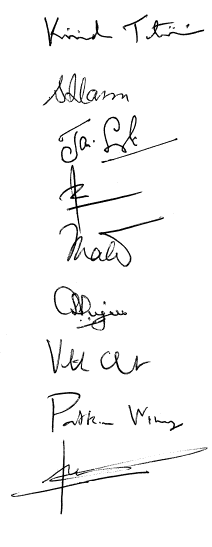
Signed this 24th day of July 2008 at FAO-RAP Office in Bangkok, Thailand.
|
Kraisid Tontisirin
A.F.M Saiful Islam Jai Singh
Hardinsyah
Maria Antonia G. Tuazon Chandrani L. Piyasena
Visith Chavasit Pattanee Winichagoon Truong Hong Son |
 |
1 To be used in conjunction with inputs of participants on questionnaire submitted
2 To be used in conjunction with inputs of participants on questionnaire submitted
