


Slide 1
INTERNATIONAL TROPICAL TIMBER ORGANIZATION
ITTO’s Criteria and Indicators
A Tool for Monitoring, Assessing
and Reporting on SFM
© ITTO 2003
Slide 2
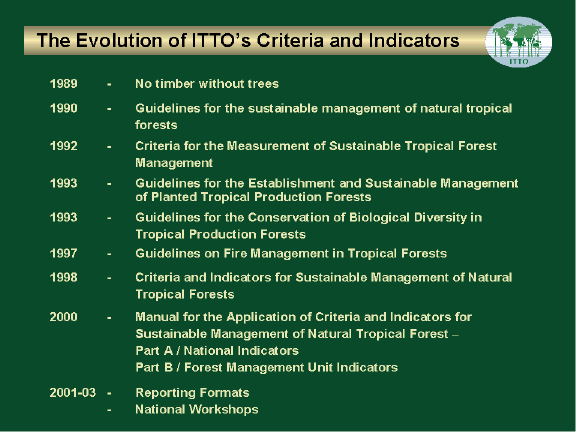
The Evolution of ITTO’s Criteria and Indicators
1989 - No timber without trees
1990 - Guidelines for the sustainable management of natural tropical forests
1992 - Criteria for the Measurement of Sustainable Tropical Forest Management
1993 - Guidelines for the Establishment and Sustainable Management of Planted Tropical Production Forests
1993 - Guidelines for the Conservation of Biological Diversity in Tropical Production Forests
1997 - Guidelines on Fire Management in Tropical Forests
1998 - Criteria and Indicators for Sustainable Management of Natural Tropical Forests
2000 - Manual for the Application of Criteria and Indicators for Sustainable Management of Natural Tropical Forest –
Part A / National Indicators
Part B / Forest Management Unit Indicators
2001-03 - Reporting Formats
- National Workshops
Slide 3
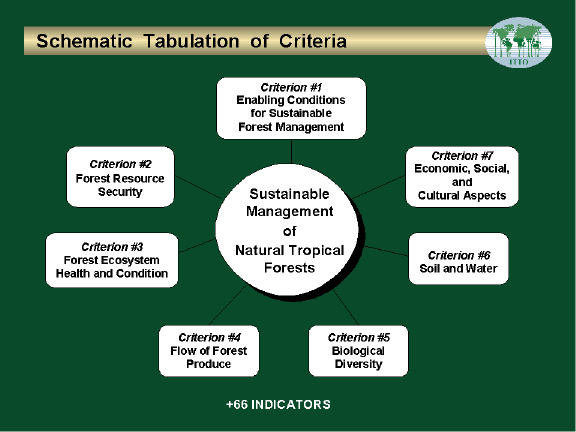
Schematic Tabulation of Criteria
Criterion #1
Enabling Conditions
for Sustainable
Forest Management
Criterion #2
Forest Resource
Security
Sustainable Management
of
Natural Tropical Forests
Criterion #7
Economic, Social, and
Cultural Aspects
Criterion #3
Forest Ecosystem
Health and Condition
Criterion #6
Soil and Water
Criterion #4
Flow of Forest
Produce
Criterion #5
Biological
Diversity
+66 INDICATORS
Slide 4
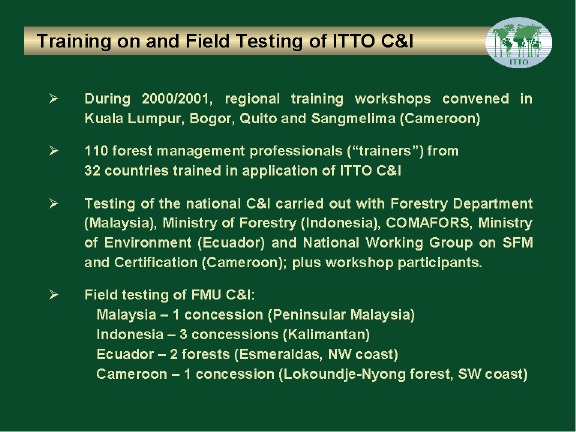
Training on and Field Testing of ITTO C&I
Ø During 2000/2001, regional training workshops convened in Kuala Lumpur, Bogor, Quito and Sangmelima (Cameroon)
Ø 110 forest management professionals (“trainers”) from
32 countries trained in application of ITTO C&I
Ø Testing of the national C&I carried out with Forestry Department (Malaysia), Ministry of Forestry (Indonesia), COMAFORS, Ministry of Environment (Ecuador) and National Working Group on SFM and Certification (Cameroon); plus workshop participants.
Ø Field testing of FMU C&I:
Malaysia – 1 concession (Peninsular Malaysia)
Indonesia – 3 concessions (Kalimantan)
Ecuador – 2 forests (Esmeraldas, NW coast)
Cameroon – 1 concession (Lokoundje-Nyong forest, SW coast)
Slide 5
Training and Field Testing Findings
ü Three quarters of 32 participating countries had difficulty to obtain data on 40-50% of the indicators
ü Main problem areas biodiversity, soil & water (no data)
ü Some indicators at FMU level (esp. endangered species, socio-economic measures) more applicable at national level
ü FMU level testing: size and ownership of concession/forest important with respect to data availability
ü Some overlapping/duplicate data requirements under different indicators
ü Some definitions too general (“light”, “heavy”)
ü Manuals need to be user-friendly
Slide 6
Other ITTO Work on Criteria and Indicators
§ Over $5 million since 1995 in Brazil, Cameroon, China, Colombia, Congo, Gabon and Indonesia explicitly on dissemination/development of C&I
§ Many other SFM projects incorporate use of C&I
§ Related activities for Indonesia (strengthen National Forest Program) and ATO (publication and adoption of ATO/ITTO Principles, Criteria and Indicators)
§ Also by Council decision, reporting on progress towards ITTO’s Objective 2000 to be based on C&I
§ Reporting Format developed in 2001 consistent with perceived requirements of UNFF, took into account results of training
Slide 7
Certification and Auditing
• Training and field testing showed main objective of many countries/forest managers was certification
• ITTO began developing auditing guidelines for SFM at 29th session, on basis of framework developed by Simula/Baharuddin
• Proposed audit guidelines based on ITTO C&I, adding another layer of “verifiers” to each indicator
• Several countries already working on standards of performance and national certification systems based on ITTO C&I; these countries will be best placed to provide information on SFM to ITTO and others
• Decision at 31st ITTC called for distribution of auditing guideline framework and for assistance to Members that wish to establish credible auditing systems for ITTO’s C&I
Slide 8
The Future
Ø More training and field testing (8 national level workshops with 50 FMU level participants each to be implemented in 2003/2004 – already 10 completed)
Ø More national auditing and certification schemes based
on C&I
Ø Updating/revision/refinement of C&I and Reporting Format
Ø Mangrove C&I?
Ø Potential for partner organizations to collaborate on training and assistance in capacity building, mobilizing required resources
Ø More collaboration between different processes (ITTO/ATO already; 2004 FAO/ITTO Expert Consultation follow-up to CICI 2003 a good opportunity for further dialogue)
Slide 9
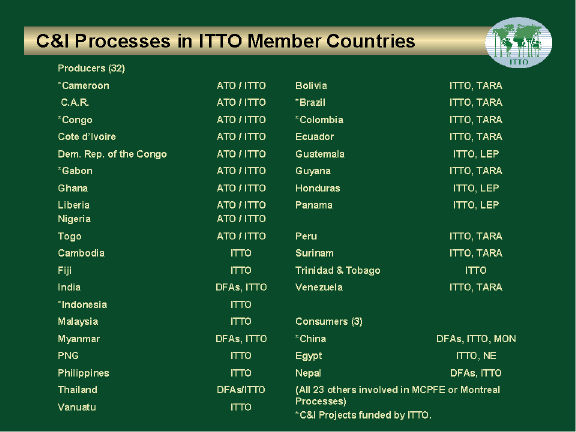
C&I Processes in ITTO Member Countries
Producers (32)
*Cameroon
ATO / ITTO
Bolivia
ITTO, TARA
C.A.R.
ATO / ITTO
*Brazil
ITTO, TARA
*Congo
ATO / ITTO
*Colombia
ITTO, TARA
Cote d’Ivoire
ATO / ITTO
Ecuador
ITTO, TARA
Dem. Rep. of the Congo
ATO / ITTO
Guatemala
ITTO, LEP
*Gabon
ATO / ITTO
Guyana
ITTO, TARA
Ghana
ATO / ITTO
Honduras
ITTO, LEP
Liberia
Nigeria
ATO / ITTO
ATO / ITTO
Panama
ITTO, LEP
Togo
ATO / ITTO
Peru
ITTO, TARA
Cambodia
ITTO
Surinam
ITTO, TARA
Fiji
ITTO
Trinidad & Tobago
ITTO
India
DFAs, ITTO
Venezuela
ITTO, TARA
*Indonesia
ITTO
Malaysia
ITTO
Consumers (3)
Myanmar
DFAs, ITTO
*China
DFAs, ITTO, MON
PNG
ITTO
Egypt
ITTO, NE
Philippines
ITTO
Nepal
DFAs, ITTO
Thailand
DFAs/ITTO
Vanuatu
ITTO
(All 23 others involved in MCPFE or Montreal Processes)
*C&I Projects funded by ITTO.
Slide 10
ITTO’s C&I and the FRA
ü “Status of Tropical Forest Management” publication to be published in 2004 by ITTO; 22 producer countries have already submitted first national C&I report to feed into this
ü All C&I processes should commit to a timetable and periodicity for publishing available data for member countries
ü Many countries will require more assistance than provided to date
Slide 11

ITTO’s C&I and the FRA (cont.)
ü Analysis/synthesis of results from country reports will require more resources in ITTO, we need to work with partners
ü Best to use existing data (C&I, TBFRA, FRA) if any direct collection of information from countries is required; IWGFS provides a good model for global coordination
ü Revision/updating of ITTO C&I and Reporting Format (scheduled for 2004/05) provides an excellent opportunity to work towards greater synergies with FRA, including possibility of a joint questionnaire approach
INTERNATIONAL TROPICAL TIMBER ORGANIZATION
Thank you
www.itto.or.jp
