Validated, transparent and traceable country reports constitute the foundation of FRA 2005. All country information published by FAO should be traceable back to the original national data source. A standard methodology of documentation and reporting has been developed for this purpose.
The compilation of country reports following the proposed standard methodology will guarantee transparency in the reporting process and provide traceability of the country information to be published by FAO. Furthermore, this methodology will facilitate the reporting process and eventually reduce the reporting burden for countries.
The standard methodology for country reporting is a process that consists of three main steps, each of which renders an output that should be included in the country report. The figure below shows the process and the output from each step. Each step is also explained in more detail below.
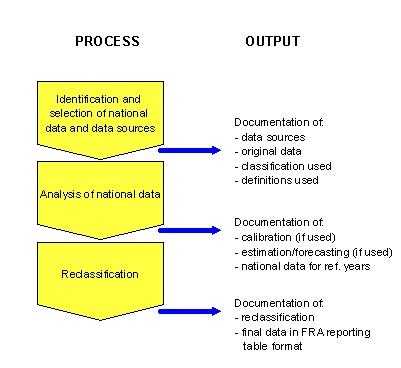
Figure 1. Outline of the standard methodology for country reporting to FRA 2005
Note that for each table, the National Correspondent should go through this process. Sometimes, minor deviations from the standard methodology might be necessary, but in such cases the deviations must be properly documented.
Based on the requirements of each specific table for FRA 2005, the country should identify all potentially useful data sources and evaluate the data sources according to content, completeness and quality. In the selection process it is important to choose data sources that use compatible sets of definitions and classification for different years in order to facilitate analysis of trends and estimation/forecasting of figures for the requested reference years. This means that select data sources should, if possible, allow for the establishment of a time series.
Once the selection of data sources has been made, these sources and corresponding data should be documented and included in the country report, following the structure outlined in the Template for Country Reports.
The documentation of each data source should cover at least the following:
• Full reference: Author(s), year of publication (if published), title and publisher.
• Reference year(s) for the data
• Quality assessment, according to the following classes:
o High quality
o Medium quality
o Low quality
• Coverage (complete national coverage or partial coverage)
• Classification and definitions used, related to the particular reporting table
Documentation of national data can be presented in tabular form. Note that only the original data relevant for each specific reporting table and used for the further analysis need to be presented.
It is very important to report also when no data or information are available. More detailed guidelines on how to report when no data are available is found in chapter 4.2.
This step comprises two steps that may or may not be necessary to carry out, depending on the characteristics of available national data. These include:
• Calibration
• Estimation and forecasting
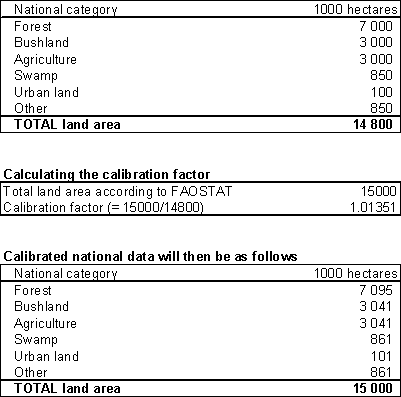
Calibration is used in order to make sure that reported area and area-related quantitative figures are consistent. For table T1, the total land area of a country report should match the official, reported land area according to FAOSTAT. Hence calibration may be needed in order to make these figures match. Similarly for tables T2 – T4, calibration may be needed to make total area of Forest and Other wooded land match the figures in table T1. For the other tables, calibration may sometimes be needed, particularly in cases when available data are partial or if the country believes that the national data considerably under- or overestimate the real values.
Example of calibration:
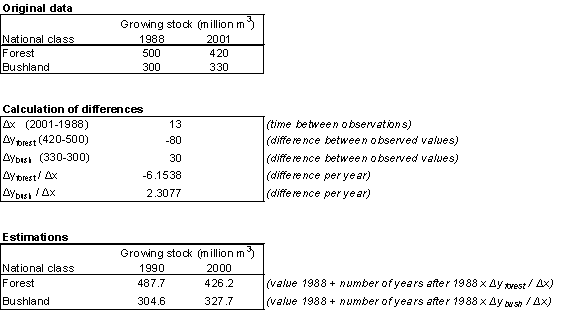
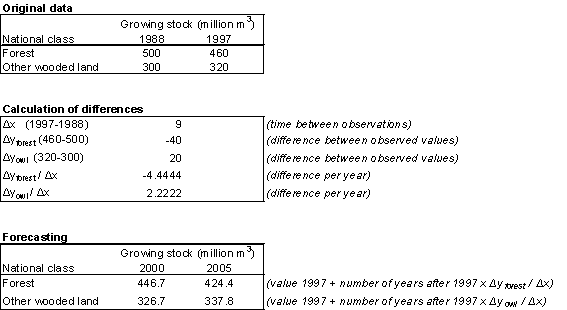
Estimation and forecasting of values may be necessary in order to report national data for the FRA 2005 reference years (1990, 2000 and 2005). Estimation is the process of interpolation between observations and forecasting is extrapolation of values to the future.
In order do decide whether estimation and/or forecasting are necessary, the following general principles apply:
• If the country has data sources that provide observed data for the years 1990 and/or 2000, these data sets can be used directly without any estimation.
• If available data sets do not correspond to the requested reference years, estimation is required.
• Data for 2005 will always be forecasts.
• Forecasts may also be necessary for reference year1990 and/or 2000 if the latest data set is older than the reference year.
The following examples show how estimation and forecasting can be carried out:
Example of Estimation using linear interpolation
Example of Forecasting using linear extrapolation
Estimation and forecasting can obviously be made using other methods than linear inter- or extrapolation as shown in the example above. Sometimes trends are not linear, and curvilinear relationships must be applied. The NC has to choose a method that is appropriate considering the available data. In case of doubt, contact the FRA team for advice.
It is important to stress that estimation and forecasting is not only a question of making mathematical calculations. It is equally important to assess whether the estimated/forecasted figures reflect reality. Many times there may be particular reasons why data from different years vary, and such variations do not necessary imply that there is a trend that can be used for estimation and forecasting.
From this second step, the output to the country report will be the following:
• Under sub-heading Calibration: A description of the calibration applied to data and formula used. If no calibration has been applied, this should be stated. If any other adjustments of original data have been made for the analysis (e.g. harmonization between different data sources), this should also be documented here.
• Under sub-heading Estimation and Forecasting: A description of how and for which years estimation and forecasting have been made or if original data have been used for some of the reference years. The formulas used must be included. This should also include an assessment of the reliability of estimated / forecasted values
• Documentation of national data for the reference years to be used as input for step three.
In order to make national data fit into the categories defined for FRA 2005, countries may have to reclassify the national data from the reference years. In some cases, when countries have National Forest Inventories that permit the direct calculation of data according to the FRA categories and definitions, the reclassification can be omitted.
Reclassification is usually carried out using a “reclassification matrix”, in which each national class is assigned a percentage that apply to each FRA category (see example below)
FRA category 1 |
FRA category 2 |
FRA category 3 |
TOTAL | |
National class 1 |
70% |
20% |
10% |
100% |
National class 2 |
30% |
50% |
20% |
100% |
For each reporting table, the NC must decide whether reclassification is needed and if so, elaborate a reclassification matrix, taking into account the different national classes and the FRA categories according to the table specifications. This is often a rather subjective assessment, but if there is information available that supports this reclassification it should be documented.
Example of reclassification
In the reclassification matrix below for table T1, the national classes and their respective area are listed on the left hand side. On the right hand side the FRA categories are found. For each national class, the percentage that belongs to each FRA category is assessed, making sure that the sum equals 100%. In the particular case of table T1, the category “Other land with tree cover” (OLWTC) is a subcategory of “Other land” and included therein, hence it has been put outside the total, and the percentages in this column refers to the percentage of the area under “Other land”.
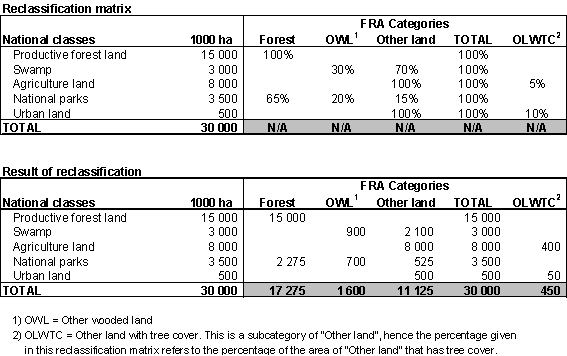
Reclassification should be applied for each reporting year. Many times, the same reclassification matrix can be used for all reporting years, but sometimes it might be necessary to make separate reclassification matrices for different years.
The output from the reclassification constitute the country data for the FRA reference years and categories and should be directly inserted in the relevant table in the country report.
Sometimes, national data from two different sources are using different definitions. In such cases, it may be necessary to perform a harmonization of national data before proceeding with the calculations, so that the national data follow a common standard regarding definitions. In some cases, where there are large differences between definitions in different national data sources, it might be better to reclassify each source directly to the FRA 2005 categories before proceeding with estimation and forecasting. However, this should be seen as an exception from the general rule that national classes should be maintained until the final reclassification step.