JOINT SESSION
Geneva, Switzerland, 5 - 9 October 2004
(Item 5 of the provisional agenda)
Note by the secretariat
1. It has long been recognised that inadequate law enforcement and other institutional questions are one of the major causes of deforestation, forest degradation and poor forest management all over the world. In recent years, the effects of inadequate forest governance (criminal behaviour, corruption, neglect etc.) have been highlighted, for instance in the FAO publication State of the World’s Forests 2001. International organisations including FAO, ITTO EU and the World Bank have programmes in this area and there have been several high level regional conferences (in Asia, Africa and South America, with another scheduled for Moscow in 2005).
2. In 2003, the Timber Committee heard a report on the topic and stated in its market statement:
“Forest law enforcement, governance and trade (FLEGT) is at present the main issue in the forest sector and the Committee’s annual Market Discussions provided a forum for a multi-stakeholder discussion. Illegal logging denies revenues to governments, industries and forest owners, puts downward pressure on forest products prices, negatively affects workers and compromises sustainable forest management. The Committee wants to work together with other organizations to determine the extent and causes of illegal logging and trade”.
3. However, so far most international activity has focused on tropical countries, with some attention to countries in transition. The issues are still not well understood, at the technical and policy levels, notably because of the inherent difficulties in analysing illegal activities, or ones whose main actors usually do not want to attract attention to their activities. In particular some major questions are:
• Is inadequate forest law enforcement a significant problem also in the ECE region?
• If so, what are the extent and causes of inadequate forest law enforcement in the region?
• What policies should be developed to improve forest law enforcement in the ECE region?
• What activities should be included under the heading of “illegal logging” or “forest crime”?
• How much of the wood resulting from these illegal activities enters international trade and is imported to the ECE region?
4. The objective of the discussion at the joint session is to discuss the issue of inadequate forest law compliance, taking advantage of the unique combination of market and trade expertise with expertise in forest policy resulting from the TC and the EFC meeting together. It is hoped delegations will exchange experience both on illegal logging in the region and on international activities to improve forest law enforcement and governance, and on that basis decide whether any specific activity by UNECE/FAO (the intergovernmental bodies or the secretariat in Geneva) is necessary.
5. A UNECE/FAO workshop will take place in Geneva on 16-17 September on the extent and causes of illegal logging in the ECE region. The objectives of the workshop are to provide a forum for discussion on forest law enforcement, governance and trade, illegal logging and trade of illegally-sourced forest products in the UNECE region, and in particular:
• identify the main types and causes of illegal logging in the region;
• try to estimate the extent of the problem, on the basis of national reports;
• give preliminary consideration to what international activity, if any, is desirable to combat illegal logging and trade in the UNECE region; and
• report the workshop’s proposals for follow-up to the joint session.
6. The abstracts and reports will be posted on the website as they are received. The joint session will be informed orally of the results of the workshop which is being organised with the support of FAO HQ and ITTO. Norway and the United Kingdom provided financial support to the workshop.
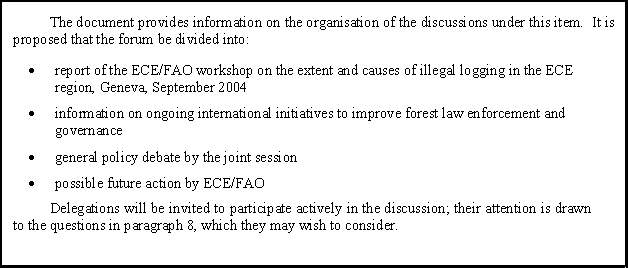
7. It is proposed that the forum be divided into four parts:
• report of the workshop discussions and conclusions (for information)
• ongoing international initiatives (for information)
• general policy debate (for discussion)
• possible future action by ECE/FAO (for decision)
8. Under the general policy debate, delegations may wish to consider addressing some of the following questions:
• Is weak forest law and governance a significant problem in the ECE region, or parts of it?
• What negative consequences are there from illegal logging in the region (in the countries where the illegal logging takes place and elsewhere)?
• What are the effects on forest products markets of the trade of illegally-sourced products, and of those markets on illegal logging?
• What are the main causes and possible remedies? To what extent are policy and legal failures contributing to the problem?
• Which institutions are addressing these issues at the national level and how could they be strengthened?
• What is the potential for international cooperation to improve the situation?
• What further research and/or monitoring is needed, and how should it be implemented and made available?