


FAO collects and analyses information on national and global forest resources and related parameters. This is a huge task which is presently carried out every five years. The latest report was recently launched. Ms Mette Loyche Wilkie presented the main findings of the Global Forest Resources Assessment 2005.
The Global Forest Resources Assessment 2005 covers more than 229 countries and territories. Around 800 specialists were involved worldwide. More than 40 variables were considered on forest extent, condition, uses and values, at three points in time: 1990, 2000 and 2005. 229 detailed reports were produced and 10 regional review workshops were carried out.
Forests are increasingly being conserved and managed for multiple uses and values. New comprehensive, unbiased information for policy makers is produced. Forests are facing threats ranging from forest fires, pests, invasive species and storms to degradation due to over-exploitation of forest resources and deforestation caused by agricultural and urban expansion.
With these threats and with competing interests for forest resources and forest land throughout the world, the need for a sound basis for decisions related to forests has never been greater.
This requires ongoing monitoring and assessment of trends that can measure progress in protecting, conserving and using forest resources in a wise and sustainable manner.
FAO has taken the lead role in coordinating such monitoring and assessment at the global level at 5 to 10 year intervals since 1946. Each assessment has had a slightly different focus reflecting the concerns of its time –FRA’s evolving focus:
1946 – timber
1980 – deforestation
2000 – conservation
The Global Forest Resources Assessment 2005 – or FRA 2005 as we call it - is the most comprehensive global assessment of forest resources to date. FRA 2005 covers six main themes and aims at assessing progress towards sustainable forest management
FRA 2005 has been a major undertaking. It started three and a half years ago with an expert consultation in Kotka, Finland, where the experts made two important recommendations for FRA 2005: First, to use the elements of sustainable forest management as the reporting framework and second, to increase the involvement of countries in the FRA process.
As part of our efforts to follow this advice, we held a global meeting for national correspondents to FRA in November 2003.
More than 100 countries were represented. Working together at this meeting, a set of tables, variables and definitions were developed and agreed and established a truly global network of national correspondents and partner organisations to implement FRA 2005.
Then, in 2004, ten regional and sub-regional workshops were facilitated to review country reports and discuss technical issues with national correspondents.
Within FAO, a dedicated team worked throughout the process to review country data with the national correspondents and to analyse the results. In November 2005, the key findings together with the national reports and the global statistics were released.
Two of the most critical factors behind the FRA 2005 process are:
First, country involvement: this is clearly the most significant success factor for FRA 2005.
• Country involvement does not happen by itself. It takes considerable effort to mobilise and coordinate the inputs from so many people –, and
• Because of this direct involvement of the forest ministries and agencies, it has had a built-in feedback mechanism to the national policy level – critical for policy reform and evolution in response to the changing situation on the ground.
Second, FRA experts worked with a set of agreed terms and definitions which ensured comparable information between countries and over time – enabling trend analysis at various levels of aggregation.
What does FRA 2005 tell us about the world’s forests?
It tells us that forests cover 30 percent of the land area of the planet Earth – or just under 4 billion hectares.
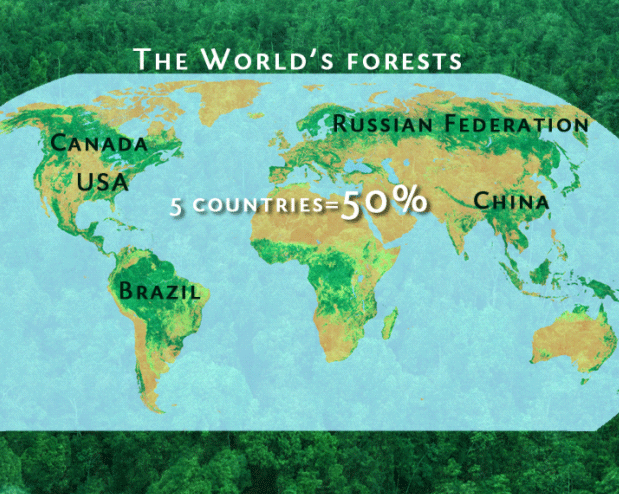
But, as can be seen, the forests are unevenly distributed. Half of the world’s forests are found in just five countries: Brazil, Russia, Canada, USA and China.
Map 2 with top five countries highlighted
These forests range from undisturbed primary forests to forests managed and used for a variety of purposes. Some of these are:
• Primary forests
• Modified natural forests
• Semi-natural forests
• Forest plantations
FRA 2005 also tells us that deforestation continues at an alarmingly high rate –around 13 million hectares per year. At the same time, the establishment of new forests and the natural expansion of forests on abandoned agricultural land have significantly reduced the net loss of forest area – especially within the last five years.
But still, the net annual loss of forest area is 7.3 million hectares, which, although 18 percent lower than in the 1990s, still amounts to 200 square kilometres of forest every day.
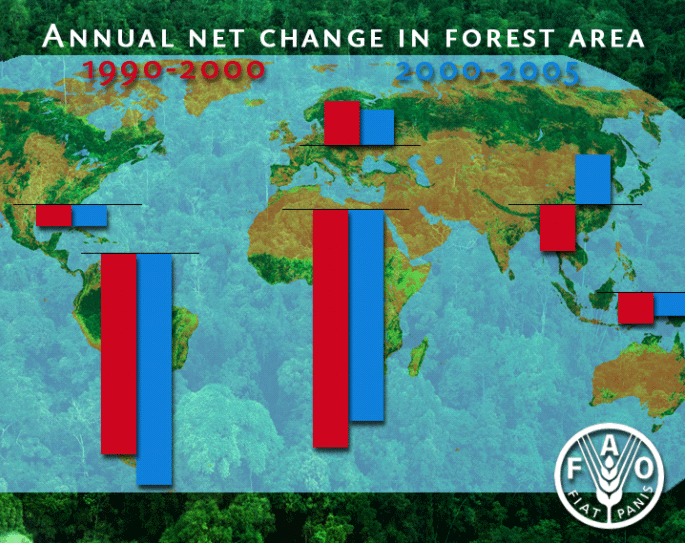
This map gives a quick overview of where the changes are happening, with the highest annual losses in South America and Africa. However, while the rate of loss appears to be increasing in South America, it is decreasing in Africa. Asia has gone from net loss in the 1990s to a net gain in the last five years. Europe’s forests continue to expand, while the North and Central America region and Oceania continue to register net losses.
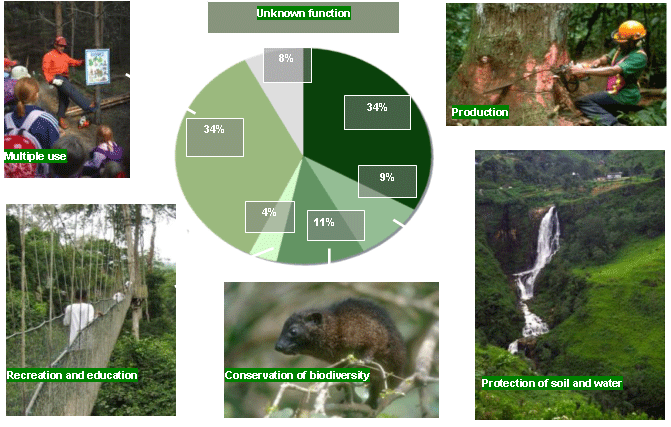
But FRA 2005 also contains some good news. More forests are being conserved and managed for multiple uses; they are playing crucial roles in mitigating climate change and in conserving biodiversity and soil and water resources.
Before answering to that question, it was stressed that FRA 2005 focuses on what happens in the forest. It does not cover the processing and marketing of forest products, nor does it address the legal and policy aspects of sustainable forest management. But it does provide information on a large number of variables related to the first six elements of sustainable forest management.
A closer look was taken at 21 variables covering these six themes and changes since 1990 for 12 sub-regions were analysed. Major changes were highlighted in red (negative) and green (positive).
The result is a very detailed picture of what is happening where. The following remarks were made:
• Firstly, the scale matters. The scale at which interpretations are made is crucial. At the global level, most trends seem largely stable or positive.
However, this picture changes dramatically when the information is broken down by region and sub-region. There we see considerable differences and alarming trends in several tropical sub-regions. (Example: Central and South America, South and South East Asia, several sub-regions in Africa.)

• Secondly, FRA 2005 shows that progress towards sustainable forest management is mixed. As can be seen, there are positive and negative trends in all sub-regions and regions – except for Oceania where trend data were missing for a number of variables.
Wood removals:
3 billion m3/yr;
US$64 billion;
NWFPs: Important, but difficult to quantify.
So the answer to the question: “What progress have we made towards sustainable forest management?” is: “It depends”.
While good progress is being made in many places and for many variables, forest resources are still being lost or degraded at an alarmingly high rate in some places. Overall, progress towards sustainable forest management is mixed in all regions and sub-regions.
Firstly, the results of FRA 2005 should be disseminated and discussed in the meetings of the Regional Forestry Commissions and other fora and the process and the outcomes should be evaluated.
Secondly, the FRA team will continue to work with countries to help improve information availability and quality and to further strengthen the sharing of experiences and networking among countries.
Thirdly, the next global assessment is scheduled for 2010. Plans are already underway to design the next assessment – including an Expert Meeting to be held in June 2006.
The Convention on Biological Diversity and the Framework Convention on Climate Change both have a number of information requirements related to forests. It is expected that FRA 2010 will take some of these on board and help streamline reporting on forests by working in partnership with the secretariats of these conventions, other members of the Collaborative Partnership on Forests and regional, forest-related processes.
The three key messages were summarized as follows:
1. Countries and FAO have collaborated in a global partnership to deliver FRA 2005.
2. FRA 2005 provides new knowledge on the situation and trends of the world’s forests, their management and uses. It shows that there is a very mixed progress towards sustainable forest management.
3. FRA and FAO work closely with countries, other partner organizations – including the Regional Forestry Commissions - to help implement sustainable forest management.
This was a short presentation of some of the key outcomes of FRA 2005. More information is available in the FAO website under: www.fao.org/forestry/site/24690/en
