
EPR/81/14
August 1981


| FOOD AND AGRICULTURE ORGANIZATION OF THE UNITED NATIONS | ESN:FAO/WHO/UNU/ EPR/81/14 August 1981 |
| WORLD HEALTH ORGANIZATION | |
| THE UNITED NATIONS UNIVERSITY |
Provisional Agenda Item 3.1.2 and 2.1.2
Joint FAO/WHO/UNU Expert Consultation on
Energy and Protein Requirements
Rome, 5 to 17 October 1981
MINIMUM PHYSIOLOGICAL REQUIREMENTS
AND
RECOMMENDED DIETARY ALLOWANCES
by
G.H. Beaton
University of Toronto
Ontario, Canada
BACKGROUND
A. Nutrient Requirements
There has been considerable recurring confusion in the literature with regard to the meaning, and hence the interpretation, of numerical requirement estimates as published in the various international and national dietary standards. The confusion is increased by the multiplicity of terminology used. FAO/WHO committees have used “recommended intake” and “safe level of intake” (and in the specific case of calcium, with a different conceptual meaning, “suggested practical allowance”); the U.S. uses “recommended dietary allowance”; the U.K. uses “recommended intake”; Canada used “recommended daily nutrient intake” and in the current revision, “recommended nutrient intake”. As was pointed out in 1972 by Beaton (1), the text descriptions of the meanings of these terms imply a clear agreement on the intended definition. The definition adopted by the FAO/WHO Ad Hoc Expert Committee on Energy and Protein Requirements (2) represents very well the consensus definition:
The (safe level of protein intake) is the amount of (protein) considered necessary to meet the physiological needs and maintain health of nearly all persons in a specified group.
As will be discussed later, the definition has several salient features that warrant emphasis. These include:
It is concerned with the maintenance of health and does not make specific provision for any effect that ill-health (whether that be nutritional deficiency, infectious disease, ,etabolic aberration, or other pathological situation) may have upon requirement.
It is set well above the average requirement. Conceptually it is set sufficiently high to encompass the requirements of nearly all persons in the specified group. As was correctly pointed out in a U.K. report (3) and subsequently noted in other reports, this implies that the published requirement estimate exceeds the actual requirement of almost all individuals. It was that logic that led the FAO/WHO committee to adopt the terminology “safe level of intake” as implying safety from deficiency (intake below requirement) for almost all individuals (2).
The requirement estimate is directly dependent upon the definition of health that is adopted. For example, in dealing with iron, a Joint FAO/WHO Expert Group (4) accepted that the definition of health included the existence of a reasonable body store of iron. The dietary requirement to maintain this status is greater than is the requirement to maintain an iron-depleted, marginally anaemic status although in the absence of clinically apparent signs of ill-health, some authors claim that mild anaemia is consistent with the definition of health (5). There would seem to be a general consensus among committees estimating human nutrient requirements that “maintenance of health” is meant to imply more than “prevention of disease” although there are certainly differences of opinion about the appropriate definition and criteria of health, and hence requirement, for specific nutrients (ascorbic acid provides good examples of such differences of judgement).
There is unanimity of judgement that the requirement estimates refer to levels of usual intake by individuals rather than intake on each day (2,6). It is a matter of convention and convenience that requirements are expressed as a rate of intake on a daily basis. This is not always explicit in the definition although it is usually implied in the text.
In every case, requirement estimates refer to the amounts of nutrients ingested. Of course, this will often be greater than the amount absorbed. It will be less than the amount served in most cases and will be less than the amounts in foods purchased (before taking into account the wasteage and cooking losses) in all cases. Importantly, allowances for digestibility, bioavailability and adaptive regulation of absorption are built into the estimate of nutrient requirement. (In the case of iron (4) a separate term “physiological requirement” was adopted to describe the requirement for absorbed iron.)
In every case, requirement estimates are applied to specified age/sex/ physiological state groups of individuals. The groupings are not uniform and seem to have had a number of underlying logics. It is not made explicit in all cases, whether the primary requirement estimate is in terms of body weight (or some other parameter) or per person with body weight adjustments a secondary derivative. This is an important omission from many requirement statements.
Several of these points have been discussed, in the connotation of FAO/WHO requirement estimates, by Beaton (7).
B. Energy Requirements
It is a consistent practice to publish estimates of average energy requirements referred to specific age/sex/physiological state groups. Thus the conceptual approach to the description of requirement differs between energy and nutrients (See Fig. 1). Unfortunately this is not recognized by all users and requires repeated emphasis if this major source of confusion is to be avoided in future applications and interpretations of published estimates of nutrient and energy requirements.
The definition adopted by the FAO/WHO committee in 1971 (2) is a reasonable portrayal of the consensus of dietary standards:
The energy requirement of persons is the energy intake that is considered adequate to meet the energy needs of the average healthy person in a specified category.
This definition implies all of the features discussed previously for the definition of nutrient requirements except number 2. The difference in approach is based upon two underlying considerations. It is accepted that:
for an individual there is potential harm if intake is consistently above or below his or her own requirement to maintain energy balance (i.e. risk increases in both directions). Therefore, it would be inappropriate, and “unsafe”, to recommend an intake sufficiently high to meet the needs of nearly all individuals as is done for the nutrients.
for energy, but not for nutrients, there is good reason to believe that if constraints to intake are removed, there is a high degree of correlation between individual intake and requirement. Therefore, it is unnecessary to recommend the ingestion of a level that is “safe” for nearly all individuals; rather, the objective would be to allow the individual to eat to satiation of his or her own regulatory processes (assuming that these are in proper functioning order in the individual in health - obviously this does not hold in the situation of anorexia secondary to infection).
While there is agreement among standards on the approach to the conceptual definition of energy requirements, there are important differences in the conceptual definition of “Energy requirement for what?” That is, a major problem in energy requirements is the definition and description of the level of activity/lifestyle to which requirement estimates apply. Early standards attempted to portray requirements for various levels of activity; more recent standards have presented global figures for specified groups and/or presented a statement of observed intakes (or ranges of intakes) in the particular population groups. For many types of application, this is far from a satisfactory situation.
Recently, a serious challenge to the simplistic definition and approach to describing energy requirements was issued by a UNU Workshop (8). The challenge is not so much to the underlying concepts as to the definition of health, including in the case of energy the level of physical activity and energy expenditure. Specifically, the Workshop recognized that individuals and populations can achieve energy balance at various levels of intake by adjusting voluntary energy expenditure. This would imply that the expected level of social function must be a part of the definition of health underlying the estimated energy requirements. The difficulty is exacerbated by the realization that the social setting may limit the opportunity or incentive to undertake physical activity and hence may limit energy requirement. That is, a low level of social function could be seen as the cause or the result of a low level of energy intake. The challenge, then, is to the definition and adoption of the implied lifestyle of the reference man and reference woman. The question is “Energy requirement for what?” and the mandate to the current FAO/WHO/UNU committee is to attempt to describe energy requirements in a manner that will be more useful to those assessing and planning food and nutrition aspects of national development.
The UNU Workshop prepared two tentative definitions of concepts of energy requirements. While the terminology may be appropriate or inappropriate, the concepts are useful (8):
“Subsistence Energy Need (SEN) is the energy intake that is considered adequate to meet the minimum needs compatible with health for persons of the specified age, sex and body size category. The SEN represents an average value for a group or population of such individuals. These minimum needs depend upon three major variables interrelated in a complex way: (a) age and sex, (b) body size and composition, and (c) climate and other micro-ecological factors. The SEN also includes the energy needed to maintain sedentary activity and should allow for an adequate rate rate of growth based on currently accepted standards, and desirable levels of mental and biological functions such as learning, immune mechanisms, pregnancy and lactation. It would be expected that groups with mean intakes below the SEN would exhibit signs of reduced body weight, altered body composition, reduced growth rate, or impairment of physiological functions.”
Although not stated in the above definition, it should be recognized that groups with intakes above the SEN also would be expected to show signs of dysfunction if their energy expenditures were in excess of intake (could not be reduced to the level of sedentary activity). The SEN can be seen as a lower limit of acceptable adaptation for groups (not necessarily socially acceptable adaptation!).
Conceptually the SEN has similarity to “maintenance requirement” as mentioned in the 1971 report (2) and in other national reports although the intended meanings and hence exact requirement estimates are not necessarily identical.
The second definition offered was:
“Recommended Energy Allowance (REA) is the sum of the SEN plus the extra energy considered necessary for (a) activity patterns greater than sedentary, or (b) replenishing an individual or population deficit (a transient increase in needs until rehabilitation has been achieved). The REA is seen as ensuring an intake adequate to meet the energy demands imposed by the individual's expected way of life as may be perceived in that society. The REA should allow for desirable functioning in that society. To avoid favouring obesity, it should not be set at a level above the desirable and feasible functioning in that society. Unlike SEN, observed levels of intake below the REA do not necessarily imply detrimental effect on health; they would imply a limitation to achievement of expected levels of function and, depending upon the nature of the distribution of intakes, might include a range of associated states, including actual ill health in some and adequate performance in others.”
The above definition departs in concept from the definition of nutrient requirements or of SEN in that it makes explicit provision for energy requirements during rehabilitation. It would seem preferable to delete this provision and deal only with “maintenance of health” offering advice on allowances for rehabilitation (or other situations) as separate items.
At the UNU Workshop, members pointed out that the concepts presented are not greatly dissimilar from the expression of estimates of energy requirement associated with different levels of activity in the FAO/WHO report (2). Their emphasis was on the need to present the concepts and requirement estimates in a manner that had more explicit relevance for planners and other users.
It can be argued that with the exception of famine areas, almost all populations are now in a state of equilibrium between energy intake and energy expenditure. In that sense, they are meeting their actual energy needs and maintaining the status quo at the population level. In many population, there may be a considerable social and developmental cost associated with achievement of this level of population adaptation. The cost may not be seen as active malnutrition defined by anthropometric indices and clinical signs (although it would be expected that the rates of clinical malnutrition would increase as populations adapt to lower and lower levels of intake-for a variety of reasons some individuals will be unable to make the required adaptations). Rather, the undesirable features of the population adaptation may be seen in the form of reduced social function.
This was discussed in general terms by the FAO/WHO Informal Gathering of Experts in 1975 (9) which made the suggestion: “For all countries, rural populations may be assumed to be at least moderately active. Urban populations may vary considerably. In the developed countries, perhaps half the urban population will be classified in light activity and while in developing countries the proportion may be less, until more useful information can be obtained, an assumption that 50% are in light activity and 50% in moderate activity may be a reasonable division” and for women: “In developed countries, urban female populations should probably be categorized as in light activity…… In developing countries it can be assumed that moderate activity probably represents the average for the female population.” This same group introduced a recommendation for a category of light activity for children. Unfortunately it did not direct major attention to either the social function capacity or, in children, the potential effects of low levels of activity on psychological development and learning. It did note: “It is emphasized strongly that although energy intake levels consistent with (light activity) are found in well nourished populations, there is no suggestion that such low levels of intake and expenditure should be recommended as desirable, particularly in young children.”
The charge of the UNU Workshop to the FAO/WHO/UNU committee is the issue of “energy requirement for what” be addressed in much more explicit terms. The inference is that the reference man and the reference woman should not be featured in the present report.
The hope of the present writer is that the FAO/WHO/UNU 1981 report will address energy and protein requirements in a much more parallel manner than happened in the 1971 report. For each it would be desirable to define average requirements and magnitude of individual variability for specified categories of individuals (age, sex, body size, growth rate, pregnancy, lactation); for energy it will be essential also to discuss how the mean requirement is expected to change with strata of “lifestyle” and to offer some guidance to users (including planners) on the field criteria to be used in selecting the lifestyle strata (activity categories).
An implication is that a factorial type of approach probably should be adopted for both energy and protein and that the traditional approach of past FAO and FAO/WHO energy committees, which seems to have been directed toward primarily the derivation of per capita energy requirement estimates, should be abandoned as unsatisfactory. While there is still interest in, and need for, per capita estimates, it is now apparent that there is considerable need also for approaches to describing the probable distribution of requirements within populations. In the same sense, attention and concern now focusses increasingly upon the functional sequelae of levels of feeding rather than on traditional anthropometric and clinical indices of malnutrition - at least for energy, the definition of health that underlies the requirement estimates must be carefully considered by the FAO/WHO/UNU committee.
PROPOSED TERMINOLOGY AND CONCEPTS
A. Protein
The concepts underlying requirement statements for nutrients are now quite consistent among international and many national bodies. It is recommended that these concepts be retained in the FAO/WHO/UNU report. It is recommended also that the published requirement estimate be set at the average requirement + 2 standard deviations with both the average and the accepted estimate of variability of requirement being stated explicitly in the report. Finally, it is recommended that the underlying requirement estimate refer to the level of intake of protein of good biological value needed to maintain health in alreadt healthy individuals. If adjustments to this requirement estimate are to be made for the nature of the mixture of dietary proteins or for conditions of ill health (e.g. rehabilitation, considerations for infections, etc.) these should be identified as specific adjustments appropriate to explicitly described situations.
The terminology is more problematic. By the argument presented above, the terminology “safe level of protein intake” should be continued. However, during the past ten years there has been an evolution of thinking and a growing interest in upper, as well as lower, limits to a safe range of intakes for a number of nutrients (consider, for example, current interests in fat and fatty acids). This pattern of thinking is portrayed diagrmatically in Fig. 2 based upon the current revision of the Canadian recommendations. In this portrayal, “safe range of intake” with a lower limit equal to what is currently called a “recommended intake” or “safe level of intake” and an upper limit defined in an analagous manner to imply low risk to the individual of harmful effects of excess, is meaningful. Conversely, as was recognized in 1971, neither “recommended intake” or “safe level of intake” is an entirely appropriate descriptor of this lower limit. At present there is no particularly appropriate term in general use. The following terminology and statement is proposed with the recommendetation that the committee consider again the matter of preferred terminology:
The recommended or safe level of intake of protein is the amount of dietary protein considered necessary to meet the physiological needs and maintain health of nearly all persons in a specified group.
It is recognized that of necessity this level of intake exceeds the actual requirements of almost all healthy individuals in the group. For the individual, it is a level of intake that carries a very low risk of inadequacy in relation to his or her own requirement (which remains unknown). In that sense it is a safe level of intake.
It is recognized that levels of intake above the recommended level are safe also, at least until levels that begin to have detrimental effects (e.g. exceeding the capacity of the kidney to excrete the end products of protein metabolism) are approached.
Therefore, the recommended or safe level of intake should be recognized as the lower limit of a safe range of intakes all believed to have equivalent biological benefit. There is no connotation that existing protein intakes observed in many populations should be lowered to the recommended or safe level of intake. Further, within the safe range of intake there is no implication that there is any biologically optimum intake.
It is recommended that this be followed by a discussion of the criteria of health and of protein nutritional status that are applied in defining protein requirement for purpose of this report. This could emphasize the use of, and limitations of the use of, nitrogen balance (or any alternative criterion applied) as well as the assumed growth rates, fetal growth, lactation output, etc. that apply to both protein and energy requirements. Specifically, this section should present the committee's judgement with regard to other criteria of adequacy that have been used in arguing that present estimates of protein requirements are too low. That is, the committee should take into account criticisms of the last report and either accept of reject the various criteria of adequacy that have been presented in those criticisms. To ignore these points is to leave the present report open to the same criticisms.
Obviously, this section should present the decision on the approach to taken with regard to adjustment of the requirement estimate for infection for dietary protein quality, for any other adjustments.
It is recommended that the concepts embodied in the above statement (or whatever statement be finally adopted) be presented diagramatically as in the accompanying figures.
B. Energy
There is now wide agreement that the appropriate descriptor of energy requirement is the average requirement for a specified group. It is recommended that this concept be continued. However, as previously discussed, there is growing recognition of the need to describe average requirements (and variability of requirements) associated with different lifestyles (different levels of physical activity and energy expenditure) and recognition that anthropometric criteria of health and satiation of energy requirements are not, by themselves, adequate. Also there must be recognition of functional capacity as a part of the definition - functional capacity expected for the particular societal setting. It is suggested that this may be achieved most effectively by adopting multiple conceptual definitions of energy requirements as was suggested by the UNU Workshop but with a modification of both the terminology and the definitions proposed in that workshop. The following terminology and statements are proposed:
Maintenance Energy Requirement is the level of energy intake that is considered adequate to meet the energy needs of the average healthy individual of a specified category, who is leading a very physically inactive, or sedentary, life. It is the level of energy requirement that represents the limit of social adaptation to low intake which is still consistent with the maintenance of mental and biological functions such as learning, immune response, growth, pregnancy and lactation, and appropriate body composition provided that there is no imposed requirement for physical activity above a sedentary level. It is emphasized that this level of intake would be inadequate for the average person if additional physical activity were required or expected; in this situation, one of the other areas of function would be expected to be impaired.
Normative Energy Requirement1 is the level of energy intake that is considered adequate to meet the energy needs of the average healthy person of a specified category who is leading, or is expected to lead, a life with activity above the maintenance level and at levels described in normative standards. This level of energy requirement includes the maintenance energy requirement plus the energy needed for these additional activities expressed both in “work” and in “leisure” activities existing or expected to exist in the particular societal setting under consideration.
(As noted earlier, these definitions require that there be a section of the report specifically describing the normative standards to which the various energy requirement estimates relate. This is unavoidable and indeed is essential to any effective recommendations the committee may offer, regardless of terminology)
Within a specified category, individuals vary with regard to their energy requirements. Thus it may be expected that approximately half of the individuals in a particular category of normative energy requirement will have needs above the level suggested as energy requirement and half will have needs below this level. Estimates of the magnitude of this variability are provided in conjunction with estimates of the Maintenance Energy Requirement and of the Normative Energy Requirement.
It is recognized that both of these definitions refer to average requirements of particular types of individuals. For the individual there is potential harm if energy intakes are consistently above or below actual requirement. In this regard, consideration of energy requirements is conceptually and practically different from consideration of protein requirements.
These definitions, like that for the recommended or safe level of protein intake, refer to the maintenance of health in already healthy individuals. If allowances are to be made for rehabilitation, compensation for infection, etc. it should be done in separate sections and for explicitly defined situations.
FORMAT OF REPORT
It is an already stated strong recommendation of the present writer that there be a much closer parallel in the treatment of energy and protein than existed in the 1971 report. It was perhaps a serious error on the part of the Chairman of that group (G.H. Beaton) to encourage and allow two subgroups to form and to work in relative isolation until they had each defined their individual approaches to their task - energy requirement or protein requirement. It was obviously difficult to integrate the two approaches into a single report. The utility of the report suffers from this.
It is recommended that this matter be considered very seriously at the opening of the present meeting and that every attempt be made to integrate consideration of protein requirements and energy requirements at every stage. As an outcome of such integration, it may be possible to present core recommendations (i.e. before adjustment for protein quality, for lifestyle differences, for rehabilitation/infection/etc) for the various age groups, for pregnancy, for lactation, etc. in joint discussions (i.e. the major headings would be the age groups and the sub-headings energy and protein).
In 1971, the committee argued that protein could not be considered separately from energy. It was not very effective in telling users how this should be done. Let us hope that in 1981 we can do a better job of explaining what we mean.
REFERENCES
1. Beaton, G.H. The Use of Nutritional Requirments and Allowances. Western Hemisphere Nutrition Congress III. pp 356–363. 1972.
2. Report of a Joint FAO/WHO Ad Hoc Expert Committee on Energy and Protein Requirements. WHO Tech Rept. Ser. No. 522, FAO Nutr. Meetings Rept. Ser. No. 52, 1973.
3. Department of Health and Social Planning. Recommended Intakes of Nutrients for the United Kingdom. Repts. on Public Health and Medical Subjects No. 120. Her Majesty's Stationery Office. 1969.
4. Report of a Joint FAO/WHO Expert Group on Requirements of Ascorbic Acid, Vitamin D, Vitamin B12, Folate and Iron. WHO Tech. Rept. Ser. No. 452, FAO Nutr.Meeting Rept. Ser. No. 47, 1970.
5. Beaton, G.H. The Epidemiology of Iron Deficiency in Iron in Biochemistry and Medicine, A. Jacobs and M. Worwood (ed). Academic Press, pp 477– 528. 1974.
6. Joint FAO/WHO Expert Committee on Nutrition. Eight Report. WHO Tech. Rept. Ser. No. 477, FAO Nutr. Meetings Rept. Ser. No. 49, 1971.
7. Beaton, G.H. and Patwardhan, V.N. Physiological and Practical Considerations of Nutrient Function and Requirement in Nutrition and Preventive Medicine, G.H. Beaton and J.M. Bengoa (ed), WHO Monograph Ser. No. 62, pp 445– 481, 1976.
8. Report of a UNU Workshop on the Uses of Energy and Protein Requirement Estimates. UNU Food and Nutrition Bull. 3:45–53. 1981.
9. Joint FAO/WHO Informal Gathering of Experts. Energy and Protein Requirements. Food and Nutrition 1:11–19.1975.
Fig. 1 Comparison of average requirement for energy and recommended intake for a nutrient. It is assumed that in each case individual requirements are normally distributed about the mean
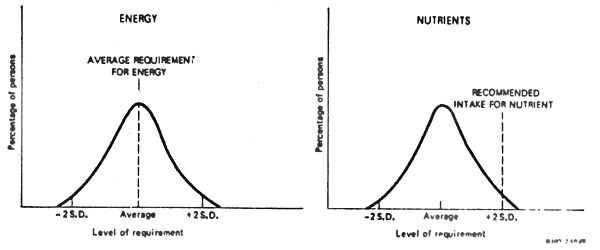
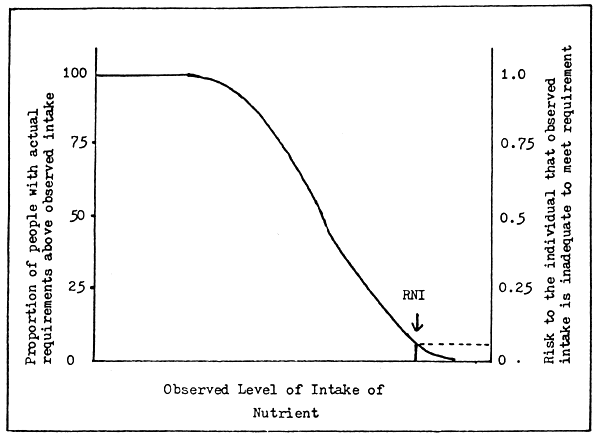
FIG. 2A.The Concept of Risk Applied to the Recommended Intake If the recommended or safe level of intake is set at the average requirement + 2 standard deviations (assuming a Gaussian distribution) then the probability/risk of the recommended intake being inadequate for a particular individual is only 0.025. This, and higher levels, are “safe” or low-risk levels of intake for individuals.
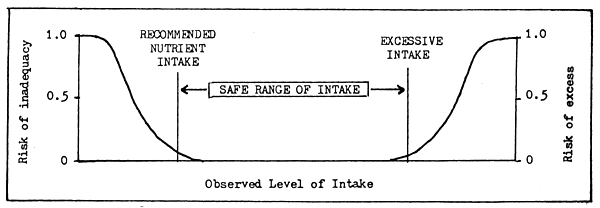
FIG. 2B The Concept of a Safe Range of Intakes It is assumed that risk curves for both inadequacy and excess may be described as in Fig. 2A. The safe range of intakes is associated with a very low probability/risk for the individual of either inadequacy or excess of the nutrient. All intakes in the range are equally beneficial and safe.
