


by
D.J. Boland and S.J. Midgley
Division of Forest Research CSIRO
P.O. Box 4008, Queen Victoria Terrace
Canberra, A.C.T. 2600 Australia
INTRODUCTION
A tall new species of wattle, Acacia ‘blayana’ A.B. Court (description in preparation) was discovered in a remote area of Wadbilliga National Park, southeastern New South Wales by Mr. John Blay on 1 May 1982. A. ‘blayana’ belongs to section Botryocephalae Benth., a group of about 30 bipinnate acacias which occur largely in southeastern Australia. This section includes black wattle (A. mearnsii), silver wattle (A. dealbata) and green wattle (A. decurrens), tall acacias which are cultivated successfully as exotics.
In February 1983 a team from the Division of Forest Research CSIRO and the Canberra Botanic Gardens was taken to the site by helicopter to make ecological observations and botanical collections. This article describes observations made on the visit and draws attention to the potential of this new species for fuelwood and agroforestry purposes in the cooler, highland areas of the tropics and subtropics.
DISTRIBUTION
A. ‘blayana’ occurs on the eastern side of the Great Dividing Range in Wadbilliga National Park about 300 km S.S.W. of Sydney and has a very restricted distribution. Several stands were sighted and mapped alongside the Brogo River and its tributary. Galoon Creek (lat. 36°37'S, long. 149°39'E); where it typically occurs along seasonally dry gullies running into these streams. The altitudinal range of the species is approximately 200–600 m.
CLIMATE
The distribution is in the warm sub-humid climatic zone. There is no meteorological station nearby but it is estimated, from a neighbouring station (Bega), that the mean maximum temperature of the hottest month is about 27°C, the mean minimum of the coolest about 0°C and approximately 30–40 frosts occur annually. The mean annual rainfall is about 900 mm with a fairly even monthly distribution but with a summer maximum.
ECOLOGY
A. ‘blayana’ occurs mostly in dry sclerophyll eucalypt forests and often immediately adjacent to cool-temperature rainforest. In some areas the species forms dense, almost pure stands. There is a noticeable reduction in tree size on drier sites. Typical creek-side associate species include Tristania laurina, Acacia implexa, A. mearnsii, Pittosporum undulatum and Ficus rubiginosa. The dry sclerophyllous associates include trees such as Eucalyptus wilcoxii and shrubs like Beyeria lasiocarpa. The rainforest is mostly dominated by Acmena smithii and Backhousia myrtifolia, and large trees of E. saligna/botryoides intrude. The species grows mainly on steep well-drained slopes on very shallow and slightly acidic (pH 5.5) soils derived from quartzose sandstone (Dr. M. Duggin pers. comm.)
WOOD
The sapwood is up to 2 cm wide and is probably susceptible to Lyctus attack; heartwood varies from golden to reddish brown, density is 690 kg m3. The wood is closetextured and hard and is attractive for wood turning and joinery for which it exhibits properties similar to A. melanoxylon, Tasmanian blackwood. It finishes to a pleasing sheen.
BOTANICAL NOTES
The largest tree seen was 19.5 m tall and 36 cm d.b.h. The species has an open crown with more or less ascending leaves and leaflets. Its most distinctive feature is the compound leaves with large elliptical pinnae (leaflets), about 2.5 × 0.5 cm (Fig. 1).
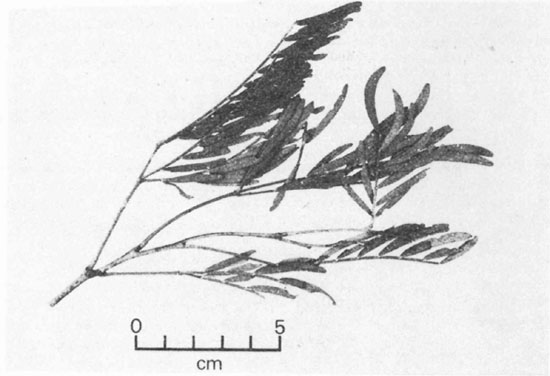
Fig. 1: Foliage of A. ‘blayana’ displaying the large elliptical pinnae
The new leaves and smaller twigs are covered with a surface bloom (wax) which gives the trees a distinctive blue canopy when sighted from above. The thin grey bark adheres strongly to the trunk after felling and is conspicuously speckled with lichens. Legumes collected off the ground under trees are about 6 × 1 cm (Fig. 2) and contain up to about 6 seeds. The seeds are oval (5–7 × 3–4 mm), blackish, have a small pale triangular aril and a large pleurogram (about 4 × 1 mm in surface dimension).
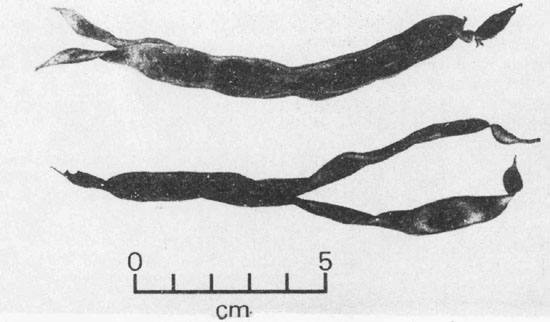
Fig. 2: Two legumes of A. ‘blayana’
Blay's acacia flowered heavily in September 1982 (J. Blay pers. comm.) and at the time of the visit in mid-February 1983 nearly all legumes were shed from standing trees and the seeds dispersed. Considerable damage to the fruits had been caused by birds or animals. It is estimated that the best seed collection time is early December.
CONCLUSION
While no information is available yet on growth rate, A. ‘blayana’s large size, its ability to form pure natural stands and its probable nitrogen-fixing ability makes it an appropriate species for inclusion in tree species trials in the cooler highland areas of the tropics and sub-tropics. Seed collections will be attempted by the CSIRO Tree Seed Centre in December 1983.
ACKNOWLEDGEMENTS
We wish to thank Dr. K. Bamber, NSW Forestry Commission, for information on wood properties and the Royal Australian Air Force for helicopter assistance. Information of the location of the stand was provided by Messrs. J. Blay and P. Cope. Mr. A. Court helped co-ordinate and participated on the field trip.
Article received September 1983
