


Chapter 9
The forest harvesting workforce
WHAT IT IS
The forest harvesting workforce includes two components: management and
labour.
Management
Forest harvesting operations require effective management and
administration, just like any other business. Personnel for large-scale industrial forest
harvesting operations will normally include managers, administrative and support staff,
planners and engineers and supervisors.
Labour
The workers who actually carry out the harvesting operations include
field supervisors and foremen, forestry and engineering technicians, machine operators and
their assistants, mechanics who repair and maintain machinery and manual workers.
GUIDING PRINCIPLES
Although forest harvesting is increasingly machine-intensive, labour
remains the most critical element for determining whether harvesting operations achieve
the goals described in this model code of forest harvesting practice. If workers are to
contribute effectively to these goals, they must be healthy, competent to carry out their
jobs as expected and motivated to do the work properly and efficiently.
Effective work units have three important characteristics: they are well
organized, the workers are healthy and motivated, and everyone in the organization knows
his or her job and how to do it efficiently and safely.
The goals of managers, supervisors and workers should be aligned as much
as possible so that they are mutually reinforcing.
All employees should enjoy satisfactory living and working conditions and
preferably should be provided with stable employment throughout the year.
Special attention must be paid to safety in view of the potentially high
risks inherent in timber harvesting. All operations, whether carried out by government
employees or by private companies or contractors, should comply with the national labour
standards.
Safety and efficiency can be complementary - the key is to do the job in
the best way, rather than always striving for the highest level of output.
Three things are essential if workers are to apply correctly the
principles outlined in this model code of forest harvesting practice:
- they must know what is to be done;
- they must know how to do it properly;
- they must be motivated to do it in the proper way.
Financial incentives can be very effective motivators. Where possible,
such incentives should reward safe, effective work rather than being based solely on
production.
Good work should also be acknowledged with non-financial awards;
recognition from a worker's peers, for example, can be highly motivating.
Workers should be made to feel that their contributions are important and
that by doing a good job they can contribute to a better environment. One way of
accomplishing this is to provide training in the ecological basis of forestry so that
workers will understand better the reasons for using practices that reduce environmental
impacts.

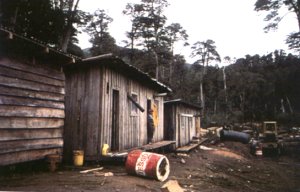
When forest harvesting operations are undertaken in remote areas it is
essential that clean, attractive housing is provided. Small but fully satisfactory houses
provide a positive incentive to workers (above). Poor-quality housing is unhygienic,
unattractive to workers with families and unsafe - note the oil drum and other refuse
nearby (below) (Photos by Kicki Johansson)
OBJECTIVES
- Managers should set goals, allocate resources, coordinate work and ensure compliance
with the organization's policies.
- Administrative staff should take care of facilities such as housing and offices,
maintain records and accounts and perform clerical work.
- Planning staff should carry out the activities that are necessary for the preparation
and updating of forest management and harvesting plans.
- Engineers should ensure the smooth operation and maintenance of tools and machines, and
should design, construct and maintain roads and other structures.
- Supervisors should oversee the actual harvesting operations and monitor production to
meet goals established in the forest management and harvesting plans.
- Under the supervision of the foremen, the labourers are actually responsible for
carrying out the harvesting operations. They should carry out the prescribed operations
efficiently and effectively; abide by safety regulations and environmental requirements;
avoid damage to remaining trees and regeneration; and use and maintain equipment and tools
properly.
POTENTIAL CONSEQUENCES OF AN INADEQUATE WORKFORCE
An inadequate workforce can result in:
- poor organizational management, as evidenced by poorly set goals, improper allocation of
resources, lack of coordination and failure of the work to conform to the organization's
policies;
- improperly administered facilities or unreliable records and accounts;
- inadequate or incorrect planning;
- improperly designed and constructed roads and other facilities;
- unsuitable, unsafe and poorly maintained tools and machines;
- lack of supervisory control, with consequent failure to achieve the production goals
specified in the management and harvesting plans;
- high levels of timber losses;
- excessive damage to remaining trees, regeneration and environmental values such as soils
and streams;
- reduced service life and high repair costs for equipment;
- low labour and machine productivity and high production costs;
- high accident rates;
- a dissatisfied workforce and high labour turnover.
RECOMMENDED PRACTICES
- All personnel should be adequately trained for the job, and this training should include
skill development, health and safety and environmental topics.
- Machine operators and cutters should undergo skill testing and be awarded a certificate
of competence.
- Operations should be based on clearly established safety regulations. Workers should be
provided with basic first-aid training, and provision should be made for the quick
evacuation of workers to medical facilities in the event of serious injury.
- Personal protective equipment should be provided to workers, and they should be taught
how to use it, how to maintain it and what it will do for them.
- Safety inspections should be carried out at regular intervals.
- All accidents with injury or equipment damage should be reported in writing on
standardized forms. Serious accidents should be investigated immediately and preventive
measures taken to avoid similar accidents in the future.
- Basic ergonomic requirements should be considered, including workplace layout, design of
machines and tools, working techniques, working time, rest patterns and nutrition.
- Adequate standards of comfort, sanitation, food and welfare are essential. Workers
should also be given opportunities for a satisfying social life outside working-hours,
especially in situations where company housing or camp facilities are provided.
- In situations where workers have no other access to medical care and social services
such as schools for their dependants, these should be provided by the employer.
- Social security should meet the general conditions prevailing in the country. Workers
should be adequately compensated in the event of an accident.
- Fair wages should be negotiated with the workers' representatives. If possible, stable
employment should be provided, with priority given to members of local communities.
- Relations between labour and management should be based on regular consultation,
consensus and fairness on both sides.