


Access to agricultural resources and services
Land. The majority of black farmers reside in Communal areas in which traditional authorities grant usufruct rights to households for crop production, grazing and access to common pasturage. Rural women gain indirect access through men as wives, daughters and sisters. The security of their tenure is jeopardized by discriminatory marriage customs and inheritance systems.
Livestock. On average, female-headed households own fewer livestock and are more likely to own no cattle at all, and thus have less access to what livestock provide: food, income from the sale of animals, meat and by-products, dung for fertilizer, draught power, and social and cultural status.
Forestry. Data collection needed.
Water. Data collection needed.
Credit. Small-scale farmers have historically been unable to gain access to credit through banks and government institutions which require titled land as security. Since independence, new governmental and NGO credit programmes are providing new sources of credit which are more available to small-holders. Gender-disaggregated data is required to assess their accessibility and impact. Since 1992, the Ministry of Agriculture, Water and Rural Development has provided loans to 450 small-scale communal farmers. Most of these have been for livestock, which is usually purchased by men. A credit union movement is growing of which women comprise 70-80% of the membership in the Southern Communal Areas and Owambo region. A serious legal constraint is that married women require the consent of their husbands to enter into contracts and loans.
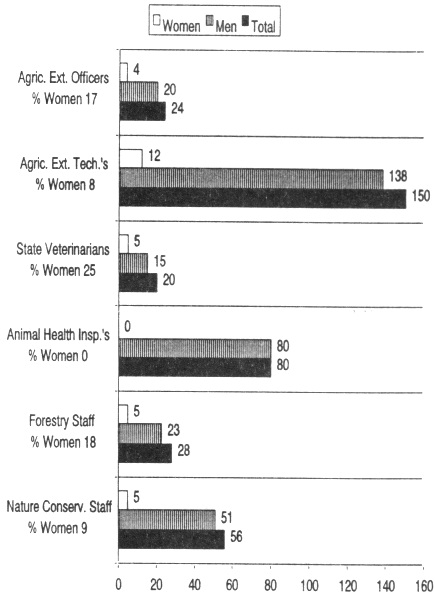
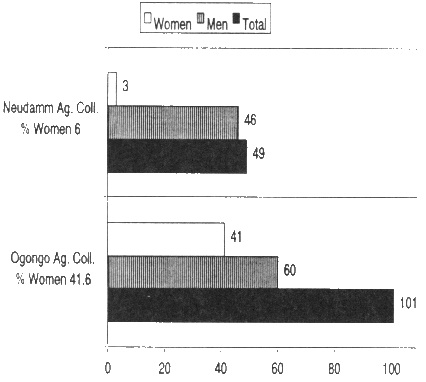
Extension services and agricultural training. Historically, agricultural extension and services have served the interests and needs of commercial farmers. Although steps have been taken to reorient support towards subsistence farmers, few programmes as yet take account of the activities and priorities of women farmers. There are far fewer women extensionists than men, and women comprise a smaller percentage of the enrolment of agricultural colleges.
Agricultural Extension Staff by Position and Gender
Source: Ministry of Agriculture, Water and Rural Development (MAWRD)
Enrolment in Agricultural Colleges
Source: Onongo and Neudamm Agricultural Colleges
