


Selected programmes in support of women in agriculture, forestry and fisheries
Policy Planning and Research
· The Three - Year Women Development Programme 1993-1996 aims to: upgrade the capacity of women to fill policy, planning and higher decision-making positions; develop a gender-sensitivity training programme for development planners and policy-makers at technical levels; and encourage coordination and institutional linkages among the various agencies and organizations in integrating WID into their programmes.
· The Development Research and Studies Centre gives a course in gender development planning.
· In 1990 a workshop on strategies and policies for women in agriculture and rural development was held for all agricultural institutes and women's organization policy-makers and planners.
· In 1993 a workshop on strategies and policies for the advancement of women in development was held for all WID institutions and policy makers to evaluate the achievement of WID Units as well as development policies and programmes targeting women.
Agricultural Extension Staff by Position and Gender, 1989
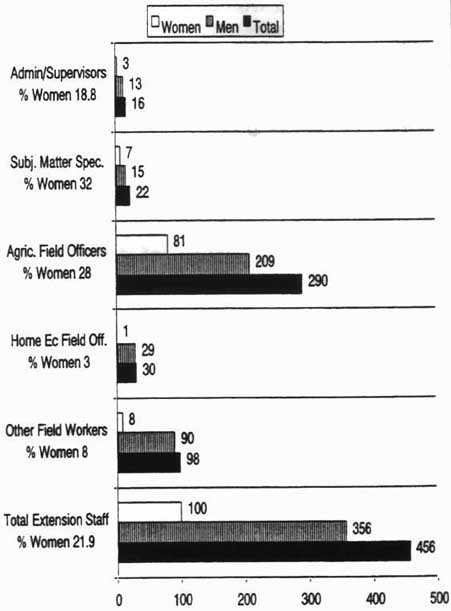
Source: Agricultural Extension and Farm Women in the 1980s, FAO, 1993
Legal and Policy Reform
The Three-Year Women Development Programme (1993-1996) aims to establish legislation to improve women's access to land, irrigation, credit, technology, and extension services and credit.
Access to Agricultural Resources and Services
A growing number of projects funded by national and international donors, both government and NGO, are directed toward women, particularly in the areas of agricultural, livestock and poultry production; rural industries and handicrafts; and social services. The most successful have been in improved food production and training. Income generation projects frequently do not provide income that keeps pace with inflation.
The Three-Year Women Development Programme 1993-1996 aims to: simplify credit procedures and eliminate the collateral requirement to improve women's access to credit, allocate 15% of funds of large agricultural development projects to women beneficiaries; and encourage NGOs and women's groups to fund and implement WID programmes.
