


Access to agricultural resources and services
Land. Lack of access to land is a serious constraint on both men and women. About three-fifths of farmers hold little or no land. Over 62% of farmers have land holdings of less than 2 ha, and together hold only little more than 8% of cultivable land. Moreover, these holdings are characterized by degraded soils, arid and semi-arid locations and intensive cultivation. A large percent of middle farmers are in debt and no longer qualify for credit. As a result, about 30 to 40% of the good agricultural land in the country is idle. The Agrarian Reform programme, begun in 1980, was constrained by civil war and, by 1991, had benefited only 3% of the rural population and 11% of the economically active rural population, of which only 11.7% were women. Women's access to agrarian reform has been hindered by definitions of head of household and agricultural work. The peace agreement references to agrarian reform make no mention of women.
Livestock. Women are generally responsible for the raising and care of poultry and small livestock for the household.
Forestry. The tropical forests have been reduced to about 1% of their original coverage. Women use forests to obtain food products and fuelwood and men to obtain wood for construction.
Water. About 70% of rural women lack access to direct water supply. Being responsible for obtaining water, women often have to walk great distances (on average 0.5 km, but sometimes as much as 4 km) to a water source. Most rural women use rivers for washing clothes and bathing.
Credit. Women have limited access to credit. When rural women are able to obtain credit, terms of repayment often force them to sell their harvest at low prices, rather than storing it until prices are higher. In the agrarian reform sector, women comprise only 18% of those obtaining credit. While women have little access to formal credit, many women have been able to access credit through informal community banks and savings groups, and donor-supported credit projects and programmes. A field survey indicated that lack of collateral and lack of information were the two major obstacles to women's access to credit.
Extension services and agricultural training. Until recently, few women have been able to benefit from agricultural research, training or services. With the establishment in 1993 of the National Centre for Agriculture, Livestock and Forestry Technology (CENTA), it is expected that this situation will improve as the Centre is targeting small and medium-sized farmers for the transfer of technology to improve productivity. CENTA has adopted a gender policy to ensure that women as well as men will benefit. The percentage of women extensionists remains low and this constitutes an obstacle to contact with women farmers. In 1994, women comprised 16% of farmers reached by the national extension programme, greater than the 10% that had been projected.
Agricultural Extension Staff by Position and Gender, 1994
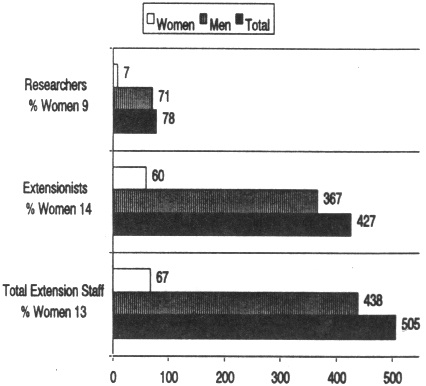
Source: National Sectoral Report on Women, Agriculture and Rural Development, 1995
