


International wheat prices strengthened in February and remained generally firm in March, although substantially below the last season’s peak. Argentine wheat prices rose by around U.S. $ 27 per ton since early February to U.S. $ 175 in late March. Prices for U.S. wheat No.2 were quoted between U.S. $ 172 and U.S. $180 per ton, slightly higher than in February but over U.S. $ 40 per ton less than in the same period last year. Wheat prices have been supported by the relatively small exportable supplies available in the United States during the second half of the season. By late February, old crop wheat waiting to be shipped from the United States was estimated at below 3 million tons, compared to above 7 million tons in the corresponding period last year. Recent logistical difficulties in Canada, which have delayed shipments of about 2 million tons of wheat, have also contributed temporarily to the strength in wheat prices. Also, in the EC, while relatively large restitutions accompanied sales during the first half of the season, the rise in domestic prices, especially in France, led to a fall in restitutions in recent weeks. In the futures markets, prices in recent weeks have gained support mainly from flood concerns in the United States as well as rallies in prices of soybeans. By the fourth week in March, the nearby May Chicago (CBOT) futures rose to U.S.$ 145 per ton, U.S.$ 7 per ton up from the previous month but still almost U.S.$ 39 per ton below the same period last year. Nevertheless, should the current crop prospects materialize, wheat prices could be expected to come under downward pressure, particularly during the harvesting period.
LATEST CEREAL EXPORT PRICES *
| 1997 | 1996 | ||
| March | January | March | |
| (. . . . . . U.S.$/ton . . . . . .) | |||
| United States | |||
| Wheat 1/ | 180 | 180 | 221 |
| Maize | 128 | 119 | 175 |
| Sorghum | 126 | 112 | 170 |
| Argentina 2/ | |||
| Wheat | 175 | 145 | 255 |
| Maize | 121 | 111 | 170 |
| Thailand 2/ | |||
| Rice white 3/ | 335 | 367 | 377 |
| Rice, broken 4/ | 234 | 224 | 265 |
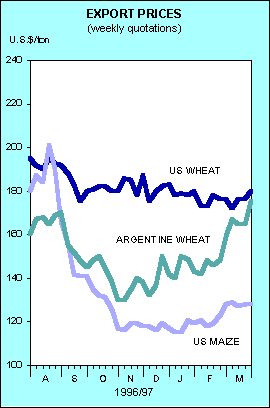 Prices for Argentine and the
United States maize rose slightly in March and by the fourth week they
were quoted at U.S.$121 per ton and U.S.$ 128 per ton, respectively, nearly
U.S.$ 50 per ton below the corresponding period last year. Chicago maize futures
rallied strongly in recent weeks, a development mainly influenced by the strength
in soybean prices as well as heavy fund buying. By the fourth week in March,
May futures in Chicago rose to U.S. $ 120 per ton, a gain of U.S. $ 4 per ton
from February. However, like those for wheat, maize prices could be expected
to weaken between now and the end of the trade season (July 31), especially
in light of the resumption of maize exports from China and a likely decrease
in maize purchases by the Province of Taiwan as a result of the recent outbreak
of the foot-and-mouth disease affecting requirements of the pig sector.
Prices for Argentine and the
United States maize rose slightly in March and by the fourth week they
were quoted at U.S.$121 per ton and U.S.$ 128 per ton, respectively, nearly
U.S.$ 50 per ton below the corresponding period last year. Chicago maize futures
rallied strongly in recent weeks, a development mainly influenced by the strength
in soybean prices as well as heavy fund buying. By the fourth week in March,
May futures in Chicago rose to U.S. $ 120 per ton, a gain of U.S. $ 4 per ton
from February. However, like those for wheat, maize prices could be expected
to weaken between now and the end of the trade season (July 31), especially
in light of the resumption of maize exports from China and a likely decrease
in maize purchases by the Province of Taiwan as a result of the recent outbreak
of the foot-and-mouth disease affecting requirements of the pig sector.
At 132 points, the FAO Export Price Index for Rice (1982-84=100) is only marginally lower than in February, but 8 points below the corresponding level in 1996. Export prices for rice showed little uniformity in direction. The international market largely discounted the Philippines' large procurement of rice in February/March, and there was only a limited price response. Similarly, the sizeable potential demand from Brazil had virtually no impact on the export prices of rice from Asia because of expectations that the bulk of the demand would be met by its MERCOSUR trading partners. The price for Thai 100B continued its downward trend falling by U.S.$ 22 to U.S.$ 335 per ton by the third week of March. In Thailand, fragrant rice prices have maintained their strong upward trend, with March levels at about twice those of Thai 100B, but Thai broken rice prices were relatively stable. The prices of rice of Vietnamese origin also fell as a result of reduced international demand and the slide in the value of the Vietnamese Dong. By contrast, United States' export prices of rice have risen steadily in the past three months, boosted by firmer demand. The strengthening of US export prices for long grain No. 2, 4 percent rice and the concurrent weakening of the prices for Thai 100B, have resulted in a significant widening of the price differential between rice of both origins. In the medium grain rice market, prices have generally fallen because of increased supplies from California and relatively limited export activity.