


The estimate of world cassava output in 1996 has been revised downward by 5 million tons since the last report in November 1996 and is currently put at 163.9 million tons of fresh roots, or one percent below 1995. Production in Africa, the leading production zone, is currently estimated to have reached 85 million tons, or nearly 1 percent above the previous season, primarily as a result of favourable climatic conditions which favoured plantings and yields. Larger crops were harvested in Angola, Burundi, Côte d'Ivoire, Guinea, Ghana, Mozambique and Rwanda. In Côte d'Ivoire and Mozambique output was between 5 and 12 percent above 1995. In Nigeria (the world's largest producer) cassava output was estimated at 31 million tons, the same level as in 1995. By contrast, poor crops were reported for Kenya and Niger following dry conditions and also for Liberia, whose output was affected by the civil war. Production was also down in Uganda and Zaire following civil strife that disrupted farming activities and also as a result of reduced plantings and yields aggravated by major infestations of cassava "mealybug" and outbreaks of " mosaic-virus disease" . Little change in the crop size occurred in other countries of the region.
WORLD CASSAVA PRODUCTION 1/
| 1994 | 1995 |
1996
prelim. |
|
| (. . . . . . million tons . . . . . .) | |||
| WORLD | 163.1 | 165.3 | 163.9 |
| Africa | 82.7 | 84.4 | 85.0 |
| Ghana | 6.0 | 6.9 | 7.0 |
| Madagascar | 2.4 | 2.4 | 2.4 |
| Mozambique | 3.4 | 4.2 | 4.7 |
| Nigeria | 31.0 | 31.4 | 31.4 |
| Tanzania | 7.2 | 6.0 | 6.0 |
| Uganda | 3.4 | 3.0 | 2.4 |
| Zaire | 18.0 | 18.9 | 18.8 |
| Asia | 49.3 | 48.5 | 47.2 |
| China | 3.5 | 3.5 | 3.5 |
| India | 5.8 | 6.0 | 4.8 |
| Indonesia | 15.7 | 15.4 | 15.8 |
| Philippines | 1.8 | 2.0 | 1.9 |
| Thailand | 19.1 | 18.2 | 17.7 |
| Viet Nam | 2.4 | 2.5 | 2.5 |
| Latin America and Caribbean | 30.9 | 32.2 | 31.4 |
| Brazil | 24.5 | 25.3 | 24.6 |
| Colombia | 1.6 | 1.8 | 1.8 |
| Paraguay | 2.5 | 2.7 | 2.6 |
Overall, cassava production in Latin America and the Caribbean declined, in particular in the Dominican Republic, Paraguay and Brazil. In Brazil, the world's second largest cassava producer and processor, output in 1996 reached 24.6 million tons, or 3 percent below the record of 25.3 million tons achieved in 1995, mainly as a result of reduced plantings and yields in major growing areas. By contrast, in Colombia a small rise in output was the result of various measures implemented by the Government to expand cultivation by providing better access to credit and technical assistance to farmers. In fact, the Government's four-year plan for the improvement and strengthening of the cassava agro-industry on the Atlantic Coast has the objective of developing processing industries for chips, pellets and flour to meet the growing domestic and foreign food and feed demand for cassava and cassava products.
In Asia, total output in 1996 is estimated at 47.2 million tons, or 3 percent below 1995, mainly reflecting reductions in India, the Philippines and Thailand. In India, output declined by 20 percent to 4.8 million tons, as plantings were damaged or destroyed by a tropical cyclone which hit some of the main producing areas at the end of 1996. Among other major producers in the region, output in Thailand is estimated to have fallen to 17.7 million tons, 3 percent below 1995, due to heavy monsoon rains throughout the country which affected cassava roots and yields, lower use of inputs and the planting of cassava on more marginal lands. By contrast, in Indonesia output in 1996 rose by 3 percent over 1995 to 15.8 million tons, mainly reflecting favourable weather conditions.
In Africa, where cassava is mainly grown for food, consumption in 1996 was stimulated partly by the rise in the domestic prices of cereals, reflecting high import prices and the disruption of grain marketing systems due to civil strife in some countries. In countries such as Benin, Cameroon, the Central African Republic, and Côte d'Ivoire, consumers have reacted in recent years to a loss of purchasing power, following the devaluation of CFA currency, by increasing consumption of roots and tubers, including cassava. As a result, in those countries, the demand for cassava is estimated to have risen well above available supplies, thus pushing up prices. In Nigeria, despite the removal of the export ban on cassava and cassava by-products in place since 1988 and of all taxes on cassava exports, per caput consumption continued its upward trend as new varieties are preferred over traditional ones in a number of food preparations.
In most countries of Latin America and the Caribbean, usage of fresh and processed cassava is estimated to have increased in 1996 in Brazil and in countries of the Caribbean basin. Although cassava flour remains the main cassava product in Brazil, new markets for a naturally fermented starch, known as "polvilho azedo" with bread-making properties, is increasingly used in pre-mixes for the food industry and in urban fast-food outlets. Also, greater use of processed cassava into unleavened "casaba" bread is made in countries of the Caribbean basin. Greater use of cassava for animal feed is reported in Brazil, Bolivia and Paraguay.
In most Asian countries, in particular, China, India, Indonesia, the Republic of Korea and Japan, domestic supplies were further supplemented by imports of tapioca starch in 1996. This was used to meet the demand of food products for urban consumers, including noodles, snack foods, chips and cakes. Also in Thailand, where cassava is mostly processed into pellets and chips for animal feed, the volume of these products has decreased in favour of cassava flour and starch for the domestic industry and for exports in line with the government policy to become less dependent on exports to the EC, which is largely a pellet and chip market. In fact, out of the 17.7 million tons of cassava roots produced in Thailand in 1996, about 10 million were converted into tapioca pellets and 7.7 million tons were processed into starches, flours and products both for domestic use and exports.
In the developed countries, particularly in the EC, cassava utilization for animal feed increased during most of 1996 because of its price competitiveness vis-a vis other feed ingredients.
World trade in dry cassava products in 1996 is estimated to have reversed its downward trend established over the last few years to reach 6.0 million tons ( 15 million tons in fresh root equivalent), 9 percent above 1995. This increase mainly reflects larger shipments to both the EC and non-EC countries as chips and pellets for feed. Trade in cassava starch and flour for food and industrial uses, accounting for an estimated 16 percent of world trade, was 2 percent higher than in the previous year.
WORLD TRADE IN CASSAVA 1/
| 1994 | 1995 |
1996
prelim. |
|
| (. . . . . . million tons . . . . . .) | |||
| World Exports | 7.0 | 5.5 | 6.0 |
| Thailand | 5.8 | 4.2 | 4.6 |
| Indonesia | 0.7 | 0.5 | 0.6 |
| China 2/ | 0.4 | 0.4 | 0.4 |
| Others | 0.1 | 0.4 | 0.4 |
| World Imports | 7.0 | 5.5 | 6.0 |
| EC 3/ | 5.4 | 3.4 | 3.6 |
| China 2/ | 0.6 | 0.6 | 0.4 |
| Japan | 0.4 | 0.3 | 0.3 |
| Korea. Rep. of | 0.2 | 0.2 | 0.6 |
| Others | 0.4 | 1.0 | 1.1 |
The rise in world imports in 1996 reflects the expanding demand by both the EC and non-EC countries. Imports by the Community in 1996 are estimated at 3.6 million tons, 6 percent above the level reached in 1995. Likewise, total purchases in 1996 by non-EC countries are estimated at 2.4 million tons, or 9 percent above 1995. Major increases in imports, especially in the form of chips and pellets, took place in the Republic of Korea, Malaysia, the Philippines and Turkey. Purchases of cassava flour, particularly native and modified starches, dextrin and other products rose in 1996 mainly as a result of strong demand from Japan, China, Indonesia, the United States and other Asian markets. However, imports of Japan of cassava starch were limited to the annual quota of 200 000 tons as set by the Ministry of Agriculture to protect domestic sweet potato and potato industries.
Thailand and Indonesia continued to be the main suppliers to the world market, covering about 80 percent and 10 percent of global exports, respectively. Total shipments of cassava products from Thailand in 1996 are estimated at 4.6 million tons or 10 percent above 1995, with total export of chips and pellets amounting to 3.7 million tons. Out of 3.1 million tons of chips and pellets exported to the Community, 2.6 million tons went to the Netherlands largely for transshipment and the remainder to Ireland, Portugal and Spain. Almost 600 000 tons were exported to non-EC countries, including Japan, Korea Republic, Malaysia, Switzerland and Turkey.
Foreign sales by Indonesia in 1996 are estimated to be slightly higher than in 1995. However, as a result of favourable prices offered on the domestic market, the quota allocation mechanism 1/ and attractive export returns from starches and flours, Indonesia shipped only 40 percent of its annual quota of 866 000 tons to the EC. China and the Republic of Korea were the other destinations for cassava exports from Indonesia. China and Vietnam, being exporters and importers at the same time, were likewise unable to fulfil their quotas to the EC market due to increased domestic requirements. Aggregated shipments by minor exporters in Africa, Latin America and the Caribbean and Asia reached 300 000 tons, of which 146 000 tons were reserved for the EC.
_______________
1/ Under the "bonus quota mechanism", Indonesian exporters were eligible to ship up to 2.6 tons to the EC for each ton exported to non-EC countries in 1996.
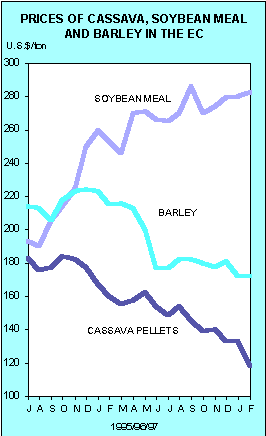
PRICES OF CASSAVA, SOYBEAN MEAL AND BARLEY IN THE EC
|
Cassava pellets
1/ |
Soybean meal
2/ |
Cassava soybean
meal mixture 3/ | Barley 4/ | |
| ( . . . . . . . . . . . . . . . . . . . U.S.$/ ton . . . . . . . . . . . . . . . . . . . .) | ||||
| 1990 | 167 | 208 | 175 | 225 |
| 1991 | 178 | 197 | 186 | 222 |
| 1992 | 183 | 204 | 187 | 235 |
| 1993 | 137 | 208 | 151 | 197 |
| 1994 | 144 | 192 | 154 | 182 |
| 1995 | 177 | 197 | 181 | 209 |
| 1996 | 152 | 268 | 175 | 194 |
| 1997 5/ | 126 | 281 | 157 | 172 |
In 1996, the EC import price for cassava pellets, the major cassava product traded internationally, continued to trend downward averaging U.S.$ 152 per ton, or 14 percent below 1995. This decline reflects low domestic prices in Thailand due to poor quality root crops and the combined effect in the EC market of reduced prices for barley, the primary substitute, and higher prices of soybean meal, the complementary ingredient of cassava in feed rations. In fact, in 1996, quotations for barley were U.S.$ 194 or 7 percent lower than then the average in 1995 while those for soybean pellets from Argentina ( c.i.f. Rotterdam ) were U.S.$ 268 per ton, or 36 percent above the average of U.S.$ 197 in 1995. Despite the increase in soymeal prices, however, cassava/ soybean mixtures in the Community continued to remain attractively priced in relation to quotations for barley (see table below).
 Preliminary indications
for global cassava production in 1997 are for a possible recovery in major Asian
countries. Expectations of higher export returns from value-added sales of starch,
flour and other products suggest that traditional plant material in the main
exporting countries will be replaced by new, higher-yielding varieties with
a high quality starch content suitable for processing to meet the rising demand
for tapioca products domestically and abroad. In Africa, output could increase
in some countries due to producers' responses to higher domestic cassava prices
in some countries, to a recovery in plantings following drought and to the on-going
diffusion of high-yielding and pest-resistant varieties. An increase might also
occur in Latin America and the Caribbean as technical assistance and higher
producer prices are expected to induce farmers to increase plantings.
Preliminary indications
for global cassava production in 1997 are for a possible recovery in major Asian
countries. Expectations of higher export returns from value-added sales of starch,
flour and other products suggest that traditional plant material in the main
exporting countries will be replaced by new, higher-yielding varieties with
a high quality starch content suitable for processing to meet the rising demand
for tapioca products domestically and abroad. In Africa, output could increase
in some countries due to producers' responses to higher domestic cassava prices
in some countries, to a recovery in plantings following drought and to the on-going
diffusion of high-yielding and pest-resistant varieties. An increase might also
occur in Latin America and the Caribbean as technical assistance and higher
producer prices are expected to induce farmers to increase plantings.
The size of world cassava trade in 1997 will depend on various factors, including price developments for grains and soybeans in the EC and the availability of supplies in major exporting countries. Given the good crop expectations in those countries, the volume of cassava trade is anticipated to be higher than in 1996. It could also be positively affected by the policy developments announced by the Government of Thailand in November 1996 which include: a) revisions in its export policy with respect to the allocation of the EC quota implying the abolition of the stock-check system 1/. This measure is expected to reduce the costs for holding stocks and to encourage exporters of tapioca chips, pellets and starches to compete freely on the market; b) the restoration of the "bonus quota" to non-EC countries at the ratio of 1:2 2/ and c) a new market intervention plan, under which the Thailand's Foreign Trade Department requires industries to buy fresh cassava at a minimum price of 1.01 baht/kg (U.S.$ 39.12 ton) 3/ to support farm prices. This measure is expected to increase the price of fresh cassava roots, which in 1996 dropped to 0.75 bath/kg (U.S.$ 29.05/ton), and to encourage producers to increase plantings. Also, trade in starch and products could benefit from the new agreement between Thailand and the EC with respect to the opening of an additional annual quota of cassava starch beyond what was negotiated in earlier years.
Prices for cassava pellets in 1997 in the EC are anticipated to remain under pressure in line with the downward adjustments of grain prices and continuously high soymeal prices in the EC. Indications for the first quarter of 1997 point to a further reduction in pellet prices to levels well below those prevailing in the last two years.
________________
1/ In 1996, Thailand’s cassava export’ s quota to the EC was allocated under the three track mechanism under which 3.0 million tons were allocated to licensed exporters on the basis of stock holding, 1.5 million tons on the basis of exporters past performance, and 0.75 million tons on reserve.
2/ This system would enable exporters to get two tons of the EC quota for each ton of cassava pellets exported to non-EC countries.
3/ At the average exchange rate of 25.82 bath per U.S.$ as of February 1997.