

In recent years, the frequency and severity of devastating droughts, floods and storms have increased dramatically. So too have the destruction and human suffering caused by civil strife and the collapse into chaos of countries shattered by what have come to be called "complex emergencies". The world witnessed 16 major disasters in the 1960s, 29 in the 1970s and 70 in the 1980s - and the upward trend continues.
Experts do not fully understand or agree as to why the pace of disasters
and emergencies has accelerated. Some scientists and computer models point to climate
change and global warming as the explanation for why storms have become harsher and
rainfall more erratic, while others cite cycles in climatic conditions rather than any
fundamental change. Social and political factors frequently mentioned include the end of
the cold war, increasing population pressures that force people to live in more marginal
and dangerous places, endemic mismanagement and corruption and many others.
Whatever the cause, the toll in human lives and suffering has been immeasurable. Deaths
over the course of the current decade number in the hundreds of thousands. Some 50 million
people have been uprooted from their homes to live precariously as displaced persons or
refugees within or beyond the borders of their native lands. On a world scale, the
economic damage of disasters is estimated at US$93 000 million for the 1980s and will
almost certainly exceed US$100 000 million for this decade.
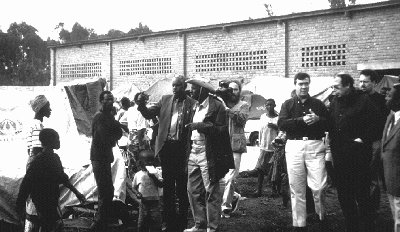
Director-General Jacques Diouf (centre forefront), leading an advance
team of the special mission to Rwanda,
gets information on the refugee situation first hand at a refugee centre in the province
of Gisenyi
Emergencies are placing increasingly heavy claims on all citizens of the
world, as the share of international aid given for humanitarian purposes grows. The United
Nations has seen the share of its budget devoted to emergency relief double within less
than ten years. FAO's spending for emergency operations has also soared. The brief on
FAO's emergency activities that is delivered to my desk each month routinely catalogues
the countries that are affected by disasters and their aftermath, as well as the FAO
relief projects that have been approved or are in the pipeline.
We at FAO are proud of what we are contributing to an increasingly well targeted and
coordinated international emergency preparedness and response system. In facing the
challenges posed by natural and man-made disasters, FAO works closely with other
organizations within the UN family, with national governments and with non-governmental
organizations, each contributing its own special skills and experience. We are keenly
aware of the importance of this partnership and cooperation.
The Rome Declaration on World Food Security, adopted by heads of State and government at
the World Food Summit in November 1996, emphasized the need to move quickly from relief to
rehabilitation and on to building the foundations for sustainable recovery and prevention
of future disaster-related emergencies. The declaration states: "We will endeavour to
prevent and be prepared for natural disasters and man-made emergencies and to meet
transitory and emergency food requirements in ways that encourage recovery,
rehabilitation, development and a capacity to satisfy future needs".
FAO regards humanitarian assistance as an integral part of its mandate to help raise
levels of nutrition and standards of living, particularly in the rural areas of the
developing world. FAO is working to advance this goal by concentrating on the areas where
it can offer particular knowledge, skills and resources. Because it is primarily a
development-oriented agency, the Organization has a particularly vital role to play in
humanitarian assistance operations leading to sustainable recovery. FAO is the only UN
specialized agency with a demonstrated capacity to plan for agricultural rehabilitation.
Our philosophy is that disaster victims are best served by help that gets them back
quickly to their homes and their fields.
Our experience allows us to tailor rehabilitation programmes to the particular conditions
and needs of affected farm families, ensuring that the seeds they sow will sprout and that
the crops they harvest will meet their nutritional and cultural requirements. Thus FAO,
through its Special Relief Operations Service, arranges each year for the delivery of
millions of dollars of emergency aid in the form of agricultural inputs and rehabilitation
and reconstruction services.
But of course prevention is better than cure. FAO's Global Information and Early Warning
System for Food and Agriculture (GIEWS) continuously monitors and analyses weather and
crop conditions to forecast the possible onset of food shortages and emergencies and give
governments and civil society time to prepare. Through its Emergency Prevention System for
Transboundary Animal and Plant Pests and Diseases (EMPRES), FAO monitors animal and plant
pests and diseases that threaten to spill over national frontiers and coordinates
prevention and control measures.
FAO has developed and promoted drought-resistant plant varieties and hurricane-resistant
crops; it assists member countries with flood control systems and water harvesting; it
promotes crop and livestock diversification to avoid excessive dependence on one variety,
species or even farming system.
FAO's Special Programme for Food Security, launched in 1994, specifically aims at reducing
variability and improving agricultural productivity through better control of water,
sustainable intensification and diversification of production, and removal of
socio-economic constraints, which should lead to the prevention of drought- and
flood-related emergencies.
These approaches, taken together, can reduce the risk of a natural disaster becoming a
human tragedy.
The world may never be free from disaster. But we can improve our ability to prepare,
respond and rebuild. This booklet aims to show how a streamlined and more focused FAO is
playing an active role in that process.

Jacques Diouf
Director-General